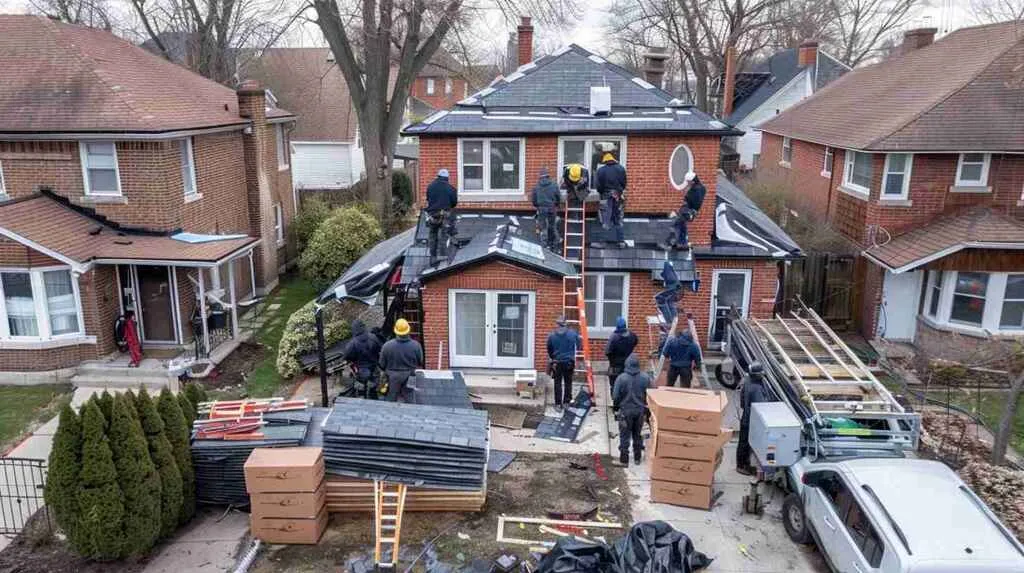
Shingle a Hip Roof Queens NY – The Right Technique Explained | Free Quotes
Sideways is the only way water should ever move on a hip roof-downward along that clean diagonal line from ridge to corner. The single most important move on a Queens hip roof, before you pick up a hammer or talk about permits, is snapping dead-straight reference lines along every single hip, because if you don’t lock in those lines first, you’re basically guessing your way through geometry while standing on a slope.
I’ve been roofing in Queens for 19 years, and I still treat every hip like I’m counting out a clean drum pattern: measure-and-snap, check-and-double-check, one beat at a time. Once that rhythm is set, the shingles practically install themselves.
Snap Your Hip Lines First: The Non-Negotiable Step
On a little brick house off Queens Boulevard last winter, I proved to a skeptical homeowner that one straight chalk line down the hip can fix what six bundles of shingles can’t. The guy had started shingling his own hip roof over a long weekend, eyeballing the hip caps as he went, and by Sunday afternoon the hip line looked like it was trying to dodge a pothole. I climbed up there, tore back two rows of caps, snapped a fresh chalk line from the ridge straight down to the eave on both sides of the hip, and suddenly he saw exactly how far off he’d drifted. That chalk line became the reference for every cap going forward-not his eye, not the previous shingle, just the line. This isn’t about being picky; it’s about locking in a reference that won’t lie to you. In Richmond Hill, in Jackson Heights, in every neighborhood with hills and sightlines, crooked hip caps telegraph across an entire roof. Starting a hip roof without snapping lines is just plain dumb, and I won’t sugarcoat it-it’s not real roofing if you skip this step.
Here’s exactly how to snap those lines: start at the ridge, hook your tape on the hip intersection, and pull it taut all the way to the corner eave. Snap a line on both sides of the hip, about an inch off center so the cap will cover both lines when you nail it down. Check the lines with your tape at the top, middle, and bottom to make sure they’re ruler-straight-no bowing, no wandering. That chalk becomes your rhythm section; every hip cap you install follows that beat, not your mood or the angle of the last shingle you nailed.
✓ Exact Chalk-Line Habits for Straight Hip Caps
- ✓Snap lines on both sides of every hip before opening a single bundle of shingles.
- ✓Hook your tape at the ridge and pull all the way to the eave-no short segments that drift.
- ✓Check the line with your tape at three points (top, middle, bottom) to confirm it’s truly straight.
- ✓Position the chalk about 1 inch off the hip center so the cap will cover both lines when installed.
- ✓Re-snap if wind or a boot heel smudges the line-don’t try to remember where it was.
⚠️ What Happens When You Skip Snapping Hip Lines
Hip caps wander from course to course, creating a visible zigzag instead of a clean diagonal that looks professional from street level in Queens.
Exposed nail heads appear because you’re guessing placement instead of nailing to a consistent reveal along your reference line.
Crooked courses telegraph across the entire roof plane, especially obvious on capes and Tudors where neighbors can see four sides at once.
Lay Out the Roof Like a Drum Pattern: Eaves, Hips, Then Field
Here’s my blunt take: if you don’t plan your shingle courses around the hips first, you’re not ‘installing’ a hip roof-you’re gambling with it. Back in 2017, after a nasty nor’easter, I got a call at 6:30 in the morning from a retired teacher in Bayside with water staining every corner ceiling. Her hip roof had been ‘re-shingled’ three years earlier, but nobody bothered to weave the shingles correctly near the hip and valley intersections. I pulled a strip back and showed her how the nails were too close to the hip and the underlayment just stopped short, like someone got tired and called it good enough. That morning taught me to show customers exactly how water wants to travel on a hip roof-it doesn’t care about your convenience or your shortcuts; it rolls toward the corners and over the hips, following gravity and slope. The order matters: you run your starter along the eaves, plan your first full course from the lowest corner, and then every subsequent course steps up and staggers to meet the hips cleanly, following the manufacturer’s exposure spec. On Queens capes and Tudors, with their short hip runs and intersecting planes, you can’t just wing it-you have to treat the layout like setting up a groove where every beat connects to the next one.
Once you’ve got that rhythm down, the next move is staggering your joints and maintaining consistent exposure as you work up the roof. Think of each shingle course like a snare hit landing on the two and four-it has to lock in with the course below it, offset by half a tab or whatever your shingle pattern calls for, so water can’t shoot straight down a vertical seam. The exposure is your tempo: if the manufacturer says 5 inches, you measure 5 inches from the bottom of one course to the bottom of the next, every single time, using your chalk lines on the hips as your guide to keep the whole roof square. Water doesn’t improvise; it follows the cleanest path downward, which on a hip roof means diagonally toward the corners and then off the eaves. If your courses wander or your hips don’t align, you’re basically creating detours for water, and detours always end in leaks.
Proper Layout Order for a Queens Hip Roof
If you can’t sketch your hip layout on paper in 60 seconds, you’re not ready to nail it into your roof.
Nailing, Caps, and Corners: Where Hip Roofs in Queens Fail First
The funny thing about hip roofs is they’re like a four-way intersection-every bad decision you make on one side shows up in the opposite corner. One night in Ozone Park, late fall, we were working under portable lights to finish a small hip roof before a forecasted windstorm. The homeowner insisted on using a fancy designer shingle but didn’t realize how much trickier they are on tight hips and short runs. Around 8 p.m., a gust of wind peeled up some poorly nailed shingles the previous contractor left on an addition, and I used that accident as a live demo for my crew: wrong nail placement on the hips, no starter strip at the rakes, and the whole system failed at the corners first-exactly where a hip roof is most vulnerable if you don’t respect the details. Nail placement on hip caps is critical; you want each nail to catch both the cap and the underlying field shingle, positioned about an inch from the edge and covered by the next cap’s overlap. At the rakes and eaves where hips meet, you double up your starter and make sure nails aren’t riding the hip itself-they go into solid decking on either side. Wind in Queens, especially those fall nor’easters that come howling off the water, hits corners and hips first, so that’s where your nail pattern has to be tightest. Here’s an insider tip I learned the hard way: slightly bias your hip cap overlaps away from the prevailing wind direction-in most of Queens that means lapping up and toward the south or southeast-so wind can’t catch the edge and peel it back.
Once you’ve locked down the nailing pattern, the next beat is cutting and installing the hip caps to follow your snapped chalk line, not your gut feeling. I treat hip caps like the hi-hat in a drum groove-they’re repetitive, they set the tempo, and if they drift even a little, the whole roof sounds off. Cut your caps to the width specified by the manufacturer (usually around 12 inches for three-tab style), and overlap each one by about 5 inches, nailing through the overlap zone so the next cap hides the nails. Start at the eave and work up toward the ridge, checking every third or fourth cap against your chalk line to make sure you’re still tracking straight. The overlap direction should always shed water downward and away from prevailing wind, which in Queens usually means you’re working upward from the corners and lapping toward the ridge. It’s a rhythm: measure, cut, align to the line, nail, check, repeat. Miss that rhythm and you’ll see it from the street.
When to Call a Roofer in Queens: Corner & Hip Problems
🚨 Urgent – Call Now
- Exposed nails at hips: Wind or settling has lifted caps, leaving nail heads open to weather.
- Caps lifted after windstorm: Even one peeled cap can let water under the whole hip line.
- Water stains at ceiling corners: Clear sign hip or corner flashing has failed and water is traveling into the structure.
⏱️ Can Wait – Monitor
- Minor shingle lift you can monitor: Single tab or edge lifted but no exposed nails or underlayment showing.
- Slight granule loss on hip caps: Normal wear over time; watch for accelerated loss or bald spots.
- Small cosmetic misalignment: Hip cap visibly off-line but still sealed and functional; note for next re-roof.
DIY or Call a Pro? Reading Your Own Roof in Queens, NY
If you dropped a marble on your roof right now, where would it roll? That’s exactly how you should think about every nail, every overlap, and every cut on a hip roof. Evaluating your own roof for a DIY attempt comes down to three things: slope, height, and existing condition. If your hip roof is steeper than 6/12 pitch, you’re already in territory where footing gets sketchy and mistakes get expensive-worth calling someone who works on ladders every day. If the roof is higher than two stories, or if you have to navigate around chimneys, skylights, or satellite dishes mounted on the hips, the complexity jumps fast. Existing condition matters too: if you’re tearing off two or more layers, dealing with rotted decking at the hips, or if the corners already show water damage, you’re not just shingling-you’re troubleshooting and repairing structure, and that’s a different game.
My personal threshold for when a hip roof project is beyond DIY is simple: if you can’t confidently explain to me how you’ll snap your hip lines, plan your shingle courses to meet those hips, and install caps that follow a straight reference line-all while staying safe on a slope-then you’re not ready to do it yourself. Hip roofs demand rhythm and flow; every course has to connect cleanly to the next, water has to travel predictably from ridge to eave along those diagonal hips, and the whole system has to lock together like a solid groove. Miss one beat and the whole roof sounds off.
Should You Shingle Your Own Hip Roof or Call Shingle Masters in Queens?
What to Check Before You Call for a Hip Roof Quote in Queens
Before you pick up the phone, spend ten minutes gathering the information that helps me give you a clean, accurate quote instead of a rough guess: estimate your roof size if you can (length times width of your house is close enough), count the number of visible hip lines from the street, check your attic or a corner ceiling for evidence of more than one shingle layer, and note any recent leaks or stains near the corners. That’s all I need to start the conversation right.
✓ Quick Homeowner Checklist Before Calling Shingle Masters in Queens, NY
- ☑Note any interior corner stains, water marks, or discoloration on ceilings where hip lines meet walls.
- ☑Count visible hip lines from the street-each hip you can see is one I need to plan for.
- ☑Take a few photos from the street and backyard showing all roof planes and any visible damage or wear.
- ☑Check if there’s more than one shingle layer-look in the attic or at the edge of a rake; this affects tear-off cost.
- ☑Jot down recent storm or leak history-knowing when and where water came in helps me diagnose the hip issue faster.
Why Queens Homeowners Trust Carlos and Shingle Masters for Hip Roofs
✓19+ years roofing experience with a specialty in the geometry and layout challenges of hip and cross-hip roofs.
✓Licensed & insured in NYC, following all local codes and manufacturer installation standards for warranties.
✓Deep familiarity with Queens neighborhoods-Astoria, Bayside, Jackson Heights, Ozone Park, Richmond Hill-and the roof styles common to each area.
✓Free written quotes with clear scope, breaking down exactly what hip work, cap installation, and flashing your roof needs.
✓Rhythm-based approach to explaining work so you understand not just what we’re doing, but why each step matters to your roof’s performance.
Hip Roof & Shingle Questions from Queens Homeowners
How long does it take to re-shingle a typical Queens hip roof?
Most single-family Queens hip roofs-around 1,200 to 1,800 square feet-take two to three days for a full tear-off and re-shingle, including proper hip cap install and flashing. Complex roofs with dormers, multiple hips, or steep pitches can stretch to four or five days, but I’ll tell you the timeline up front in your quote.
Can you work around existing satellite dishes and vents on the hips?
Absolutely-I remove and reset satellite mounts, plumbing vents, and any roof penetrations as part of the job, sealing them properly when they go back. If a mount or vent is in the way of a clean hip line, I’ll talk with you about the best placement before I nail anything down.
Do you help pick shingle brands and colors that look right on Queens capes and Tudors?
Yes-I’ve worked on hundreds of Queens homes and I know which shingle profiles and colors complement the brick, siding, and trim common to capes, Tudors, and colonials in neighborhoods from Astoria to Richmond Hill. I’ll show you samples and explain which brands hold up best on our hip roofs and weather patterns.
Hip roofs demand rhythm and flow-every shingle course locking into the next, water traveling cleanly down those diagonal lines, and hip caps nailed straight to a reference you can trust. If your Queens roof needs that kind of precision, or if you just want to talk through your layout before you commit to anything, reach out to Shingle Masters for a free, no-pressure quote. Call Carlos or request an online estimate, and let’s make sure your hip roof plays the right tune for years to come.