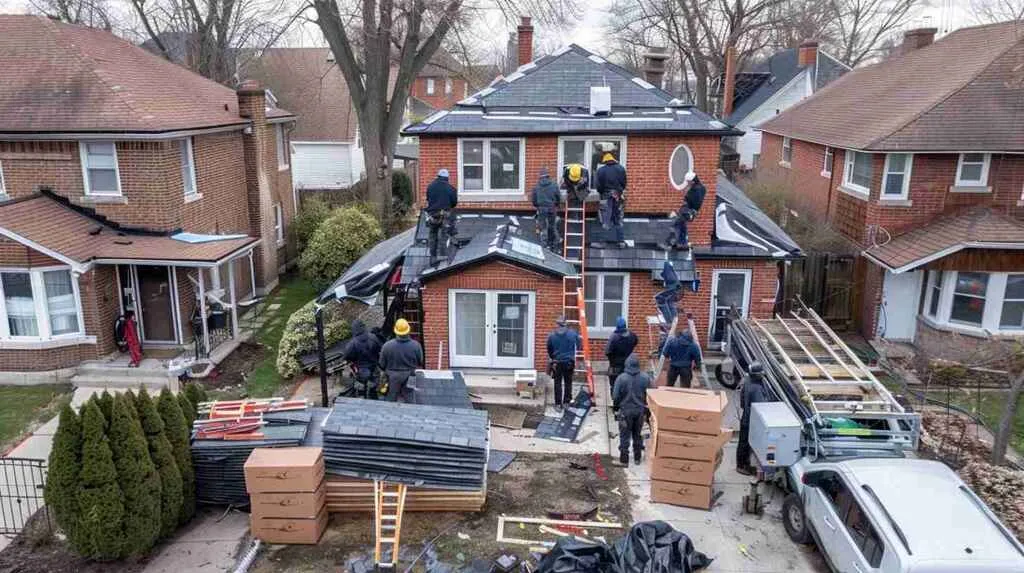
Step Flashing on Shingle Roof Queens NY – Install It Leak-Free | Call Today
Traffic on Queens Boulevard doesn’t work if merge lanes overlap the wrong way, and water on your shingle roof doesn’t forgive bad step flashing either. Each piece of step flashing sits with its flat leg on top of the shingle below it, and its vertical leg running 3-4 inches up the wall-then the next shingle course covers that flat leg completely, handing water down the roof like a perfect lane change. That’s the whole pattern: shingle, metal, shingle, metal, all the way up the wall.
I’ve seen this done wrong more times than I can count, and honestly, it’s the number one leak starter on Queens roofs-I’d rather walk away from a job than install it sloppy. One cold February morning in Astoria, I chipped frozen mastic off a sidewall where another roofer had smeared black goo over step flashing that was sitting on top of the shingles instead of under them. Every piece was too short, water had been running behind that “fix” for two winters, and the homeowner thought the leak was cured because it looked sealed from the ground. Step flashing is traffic control for water, not decoration you can hide with caulk.
How Each Shingle Should Overlap Step Flashing on a Queens Roof
Exact Shingle and Step Flashing Weaving Sequence (Sidewall Installation)
That weaving pattern is your merge lane for water. Every overlap is a lane change, and if one piece is missing or backwards, you’ve created a bottleneck that dumps water straight into your wall cavity. In Queens rowhouses, especially in Maspeth and Jackson Heights where the walls are tight and unforgiving, that sequencing matters even more-there’s no wiggle room for sloppy work.
Blunt truth: step flashing is a hidden gutter, not decoration. Each piece is bent into an “L” so the flat leg catches water running down the shingles and directs it onto the shingle below, while the vertical leg keeps splash and wind-driven rain from sneaking behind your siding. Skip one piece, or reverse the overlap, and you’re asking for a leak that won’t show up until it’s already rotted your sheathing and framing.
On a Typical Two-Story in Queens, Here’s the Leak-Proof Order
On a typical two-story in Queens with a sidewall, I start by stripping old shingles and inspecting the deck, then I roll ice & water shield along the eaves and up any walls or valleys, followed by synthetic underlayment on the field. Starter course goes on, then I set the first step flashing piece tight into the wall corner before I even think about the first full shingle course. After that it’s shingle, step flashing, shingle, step flashing-one piece per course, each lapping the one below it. Once the roof is shingled, the siding crew (or me, if I’m handling it) tucks housewrap and siding over those vertical legs so water never sees an edge it can sneak behind. One humid August in Flushing, we were halfway through a re-roof when a thunderstorm rolled in right as we’d stripped shingles off a long dormer wall. I had the guys drop everything and focus only on getting new underlayment and step flashing in along that wall before the rain hit, even though the rest of the roof was bare deck. The customer watched from the window, confused why I cared so much about “those little metal pieces,” until the sky opened up and every part of the house stayed dry-except the one spot where we hadn’t reached the wall yet, which dripped right into their closet. That two-square-foot wet patch was the perfect live demo of why flashing order matters more than rushing shingles.
| Layer/Step | Correct Queens Install (Carlos) | Common Wrong Way |
|---|---|---|
| Roof Deck | Clean, dry plywood or OSB; any soft spots replaced before underlayment goes down. | Left wet or spongy; covered with felt and forgotten. |
| Underlayment at Wall | Ice & water shield running 6 inches up the wall and onto the roof; synthetic felt above that, lapped correctly. | Felt stapled flat with no overlap, or completely missing up the wall. |
| Step Flashing Pieces | Individual 5×7-inch or 4×6-inch pieces, one per shingle course, each lapping the one below by 2+ inches. | One long continuous L-metal strip caulked to the siding, or oversized pieces that don’t overlap. |
| Shingle Overlap | Each shingle course covers the flat leg of the step flashing below it; metal is hidden under shingles, never on top. | Flashing sitting on top of shingles, or shingles ending short of the wall with a gap. |
| Wall Finish | Housewrap or tar paper over the vertical flashing legs, then siding lapped to shed water down onto the roof. | Siding butted tight to shingles with no flashing, or flashing exposed and caulked. |
| Caulk/Sealant | None, or only tiny beads at siding seams-never relied on to stop water at the roof-to-wall junction. | Heavy bead of black mastic or silicone smeared over everything, hiding wrong or missing flashing. |
Now follow that drop of water from the upper wall down the roof. It hits the siding, runs down to the first step flashing piece, slides onto the flat metal leg, crosses onto the shingle below that piece, then travels down the next shingle to the next piece of step flashing-over and over until it reaches the gutter. Each component hands the water off safely. Skip one “handoff” and water finds the gap, soaks the underlayment, and eventually leaks through into your ceiling or wall cavity. In Queens weather-freeze-thaw cycles all winter, sudden summer storms that dump an inch in 20 minutes-that handoff sequence is the only thing between you and a four-figure repair.
Here’s the Part Most DIY Videos Get Totally Backwards
Here’s the part most DIY videos either skip or get totally backwards: they show continuous L-metal caulked to the siding as if that’s step flashing. It’s not. That’s apron flashing or kick-out flashing, and it belongs at the bottom of a wall run, not replacing individual step pieces all the way up. A couple years ago in Elmhurst, I inspected a 3-year-old roof that was already leaking into a newly remodeled kitchen. The owner proudly told me he’d learned how to install shingles online, but the video skipped step flashing entirely and showed continuous L-metal caulked to the siding. I pulled a single piece and watched water run straight down the wall sheathing behind it, leaving a dark trail all the way to the soffit. That hidden water path changed the whole conversation from “Can you patch this?” to “Okay, Carlos, redo the whole wall properly.” Pro tip: gently lift one or two shingles by a wall with a flat bar and feel for separate step pieces instead of one long metal strip-if you feel one continuous piece, it’s almost always wrong for a shingle roof and you’re looking at a leak waiting to happen.
| Myth | Fact |
|---|---|
| “Caulk or mastic will seal the gap between siding and shingles just fine.” | Caulk dries, cracks, and peels in 2-3 Queens winters. Step flashing is metal-it doesn’t shrink or fail when the temperature swings 60 degrees in a week. |
| “You can use one long piece of L-metal instead of individual step pieces-it’s faster.” | Long continuous metal doesn’t overlap or weave with shingles, so water tracks behind it the first time wind pushes rain upward or sideways. Individual pieces lap like roof shingles-that’s the whole point. |
| “Step flashing only matters on tall chimneys and dormers, not regular sidewalls.” | Any vertical surface meeting a shingle roof needs step flashing-sidewalls, party walls, bay window bumps, shed dormers. In Queens rowhouses, sidewalls are the #1 leak spot I get called for. |
| “If the roof isn’t leaking yet, the step flashing is fine.” | Wrong flashing can hide for 5-10 years while water slowly rots sheathing and framing inside the wall. By the time you see a ceiling stain, you’re looking at mold, insulation replacement, and drywall work-not just a roof repair. |
Think of Step Flashing Like Traffic on the Van Wyck
Think of each step flashing piece like a car merging onto the Van Wyck Expressway-every overlap is a properly marked merge lane, and water flows smoothly as long as the lanes are there and lined up right. Remove one piece or reverse the overlap, and you’ve created a bottleneck and crash-except instead of honking horns, you get a leak into your bedroom wall.
Dangers of Relying on Caulk Instead of Proper Step Flashing in Queens Weather
If I Were on Your Driveway Right Now: Do You Need a Repair or a Re-Flash?
If I were standing on your driveway right now, I’d ask you one thing first: Is your leak at a wall, chimney, or dormer where shingles meet something vertical? If the answer’s yes, that almost always points to flashing, not just shingles. A spot-repair-where I pull a few courses, add missing step pieces, and re-shingle that section-is enough if the leak is small, recent, and the rest of the flashing along that wall looks right. But if I lift a shingle and see continuous metal, heavy caulk, or no metal at all, or if water’s been coming in for more than one season, you’re looking at a full wall re-flash, which means pulling siding, installing new step flashing one piece at a time, and reassembling everything in the right order.
Queens-specific factors matter here: older aluminum siding in Woodside comes off and goes back on differently than vinyl in Flushing, and brick party walls in Astoria require counterflashing that ties into the mortar joints. Each material changes how I open up and reassemble the wall. A 10-minute look from a pro like me at Shingle Masters can tell you exactly what you need and save you from tearing out finished interiors later when that “small leak” turns into a moldy wall cavity behind your bedroom closet.
Should You Call for a Step Flashing Repair or Full Wall Re-Flash?
Can you see individual metal step pieces when you lift a shingle by the wall?
Is the leak in the middle of the roof field, away from any walls or penetrations?
Typical Queens Step Flashing Service Scenarios & Price Ranges
| Scenario | What’s Included | Typical Price Range (Queens, NY) |
|---|---|---|
| Small Step Flashing Repair at One Sidewall Corner | Remove 3-5 shingle courses, install 4-6 new step flashing pieces, re-shingle, match existing roof color. | $450-$850 |
| Re-Flash One Side of a Dormer with New Step Flashing | Strip shingles along dormer wall (8-12 feet), install full run of individual step pieces, re-shingle, seal siding joints. | $1,200-$2,100 |
| Full Re-Flash of a Long Two-Story Sidewall (Siding Removal/Reinstall) | Remove siding 18-24 feet up, strip shingles, install new ice & water shield, full step flashing run (20-30 pieces), re-shingle, reinstall siding. | $3,200-$5,800 |
| Chimney Step Flashing & Counterflashing Replacement on Shingle Roof | Strip shingles around chimney perimeter, install new step flashing on all four sides, cut and install counterflashing into mortar, re-shingle, seal joints. | $1,800-$3,400 |
Prices reflect Queens, NY labor and material costs as of 2025. Final cost depends on roof pitch, siding type, access, and extent of hidden damage discovered during tear-off.
▸ How can I tell from the ground if my step flashing is wrong?
▸ Do you have to remove my siding to fix bad step flashing?
▸ Can you just seal my leak with caulk for now?
▸ How long should proper step flashing last on a Queens shingle roof?
▸ How fast can Shingle Masters respond if water is actively leaking by my wall or chimney?
If your leak is anywhere a roof meets a wall, chimney, or dormer in Queens, NY, the smart move is to let Shingle Masters and me handle the step flashing-because every piece has to be individually woven, lapped, and sequenced right, or you’re just moving the problem around instead of fixing it. Call us now for a leak check and a straight-up quote before the next storm rolls through and turns that drip into a drywall disaster.