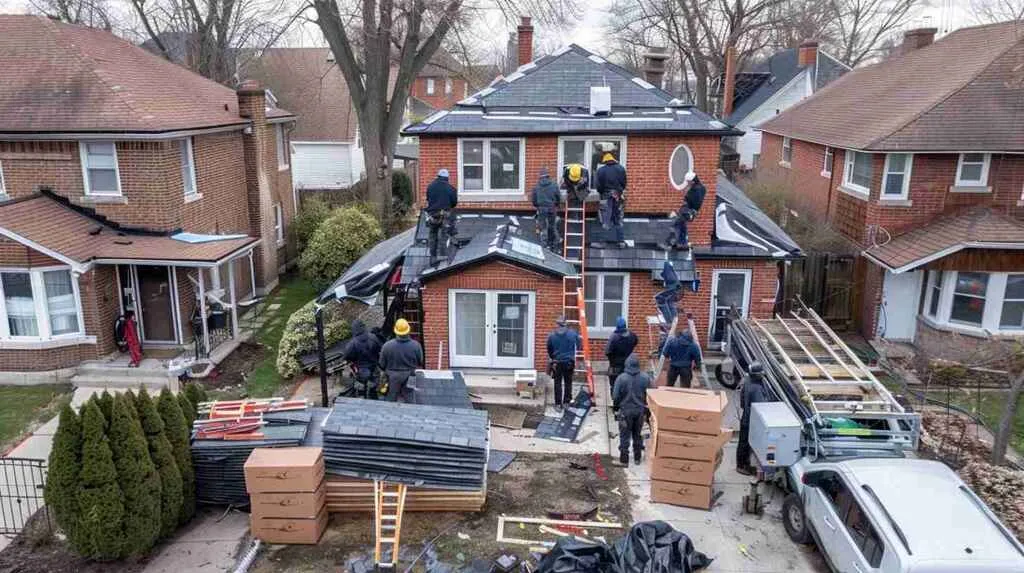
Shingle Roof Overlay Queens NY – When It Works and When It Doesn’t
Underneath those old shingles in Queens, you’ve either got a solid deck or a time bomb. On a cold November morning in Bayside, I showed a homeowner the only test that mattered: I stomped once, hard, near his ridge and watched his face when the deck flexed. That bounce-just a couple inches-told us everything we needed to know about whether an overlay was even worth discussing. Here’s my blunt opinion: if you can feel a bounce in your roof, you have no business talking about overlays.
The 60-Second Flex Test: Is Your Queens Roof Even Overlay-Ready?
One August afternoon in Ridgewood, about 4:30 p.m., I was on a row house roof that felt like a frying pan-my phone literally shut off from the heat. The owner wanted a shingle overlay to “keep costs down.” I peeled back one corner near the chimney and the old shingles crumbled to dust, the decking looked like a wet coffee filter, and I found a screwdriver someone had roofed over in the 90s. That moment taught me what I already knew but needed proof of: if the roof feels like a sponge under your boots, talking about overlays is just lying politely. Think of your roof deck like an old car frame-if it’s already rusted through, spray-painting it and calling it fixed doesn’t make it safe to drive. Same logic applies when you’re standing on shingles in Queens, NY, deciding whether to overlay or tear off.
The 60-second test is simple. No flex, no spongy feel, no crunching or popping when you walk the center and eaves. No obvious dips or waves when you stand across the street and look up the roofline. If any of those show up, forget overlays. Queens weather makes this even more critical-summer heat on tight row houses in Flushing and Jackson Heights bakes shingles from below if there’s no airflow, and winter snow piles up along eaves on those Bayside colonials, creating ice dams that overlay roofs can’t breathe through. A weak deck under all that weight and moisture doesn’t get better; it gets worse, quietly, until your living room ceiling starts to sag.
Should You Even Consider a Shingle Roof Overlay in Queens, NY?
Start: Safely on the roof (or hire a pro to do this).
Q1: When you step firmly near the ridge and a few feet above the eaves, do you feel any bounce or give?
- Yes → Stop. Decking is suspect. No overlay. Plan for tear-off and deck repair.
- No → Go to Q2.
Q2: From the street, do you see dips, waves, or humps in the shingle lines?
- Yes → Roof deck likely uneven. No overlay.
- No → Go to Q3.
Q3: How many existing shingle layers are there?
- More than one → Queens code and weight say no overlay. You’re done.
- Exactly one → Go to Q4.
Q4: Do any shingles crumble, curl severely, or feel mushy when you lift a corner?
- Yes → Old roof is too far gone. No overlay.
- No → You might be a candidate for a carefully installed overlay. Get a pro inspection in person.
⚠️ Queens-Specific Risks If You Ignore the Flex Test and Overlay Anyway
- Trapped moisture in old shingles turns your decking into “wet cardboard” within a couple of seasons, especially on tight row houses with poor ventilation.
- Extra weight from a second shingle layer on already-flexing sheathing can crack plaster ceilings and widen existing leaks during summer heat waves.
- Home insurers and buyers’ inspectors in Queens often flag questionable overlays; you can end up paying for a full tear-off later anyway, plus emergency repair costs.
When a Shingle Overlay in Queens Works-and When It Quietly Eats Your Deck
In 2018, during that weird early spring snow in March, I did a two-layer tear-off in Flushing for a retired music teacher. She insisted the second layer had “worked fine for 25 years”-and she was right, mostly. But when we finally cleared everything, there was a narrow strip of rot exactly where the second layer trapped ice along the eave. Standing there in the slush, I realized overlays don’t always fail dramatically; sometimes they just shave quiet years off the life of the wood and nobody notices until ceilings start to stain. That’s the thing about overlays in Queens neighborhoods like Flushing, Bayside, and Jackson Heights-the typical housing stock (row houses, semis, small colonials) doesn’t always have great attic ventilation to begin with, so adding a second shingle layer on top of already-compromised airflow is like keeping food in a warm fridge: looks fine today, ugly tomorrow.
The simple rules: an overlay can work on a one-layer, flat, well-nailed roof with solid plywood, no visible sag, and decent ventilation. It’s a bad idea on roofs with a history of ice dams, chronic leaks at valleys or chimneys, or poor attic airflow. And honestly, if you’ve already got curled, brittle shingles and soft spots near the gutters, you’re not saving money-you’re just delaying the real fix and making it more expensive when you can’t delay anymore.
| Overlay (Second Layer) | Full Tear-Off and New Roof |
|---|---|
| Pros: Faster install (1-2 days), lower labor cost, less dumpster/permit hassle, can work if deck is truly solid and flat. | Pros: Full deck inspection, fix rot/soft spots before covering them, better ventilation setup, longer warranty from manufacturers, cleaner resale documentation. |
| Cons: Hides deck problems, adds weight to structure, traps moisture if old shingles aren’t dry, shortens effective lifespan in Queens freeze-thaw cycles, can void some warranties. | Cons: Higher upfront cost, more time on-site (3-5 days), dumpster/permit required, messier process with more noise and debris. |
| Best For: Roofs under 15 years old, one existing layer, no visible sag, no history of leaks, homeowner plans to sell within 5-10 years. | Best For: Roofs over 20 years old, multiple layers already, any deck flex or rot, homeowner wants maximum lifespan and resale value. |
| Risk in Queens: Medium to high if ventilation is poor or eaves see chronic ice. | Risk in Queens: Low-you’re starting clean. |
| Typical Queens Cost: $4,500-$7,500 for 1,200-1,500 sq ft. | Typical Queens Cost: $7,000-$12,000 for same size, depending on deck repair needs. |
| Existing Roof Condition | If You Overlay | If You Tear Off | Risk Level in Queens |
|---|---|---|---|
| 12-year-old architectural shingles, solid deck, no leaks | ~12-15 more years | ~20-25 years | Low |
| 18-year-old 3-tab, some curl, minor deck sag | ~5-8 years, possible hidden rot | ~18-22 years | Medium |
| 22-year-old roof, brittle shingles, history of ice dams | ~3-5 years, high chance of accelerated deck failure | ~20-25 years | High |
| Two existing layers, any age | Not allowed by code | ~20-25 years | Prohibited |
How to Install a Shingle Roof Overlay the Right Way (If Your Roof Passes the Test)
I still remember the first overlay I refused, standing on a wood ladder that shook every time a bus rolled by on Queens Boulevard. The homeowner was frustrated-he’d already gotten two “yes” estimates from other contractors. But when I walked his roof, I could feel the deck dip under my weight near the chimney, and the old shingles were so brittle they snapped like crackers when I tried to lift a corner. Saying no to that job felt uncomfortable, but overlaying that roof would’ve been like spray-painting rust on a car and handing him the keys. Sometimes the right call is the one that doesn’t put money in your pocket.
Step-by-Step Overlay Process I Use on Solid Queens Roofs
When the deck does pass the flex test-no bounce, no rot, one layer, flat surface-the overlay process still demands precision. Skipping any of these steps is like putting new soles on shoes with ripped uppers: looks okay at first glance, fails fast under pressure. Here’s the actual sequence I follow on Queens roofs that qualify, walking through each phase in the order it happens, not the order it sounds good in a sales pitch.
7 Steps to Install a Shingle Roof Overlay Correctly in Queens, NY
Walk every section of the roof. Check for bounce, soft spots, visible sag, and loose or popped nails in the existing shingles. If anything feels off, stop and assess the deck from below (attic crawl) before committing to an overlay.
Nail down any curled, lifted, or loose tabs so the new layer sits flat. Trim torn edges and replace missing shingles in valleys or along rakes to create a smooth, stable base.
Proper drip edge at eaves and rakes prevents water from wicking back under the new shingles. This is non-negotiable in Queens, where freeze-thaw cycles and summer storms hit edges hard.
Even on an overlay, install ice shield at least 3 feet up from the eave edge, fully line all valleys, and wrap around chimneys and skylights. This protects the one area overlays tend to fail first.
Use a full starter course, not leftover scraps. Position it so the adhesive strip bonds properly and the tabs overhang the drip edge by about ½ inch to shed water cleanly.
Offset the new shingle pattern by at least 6 inches from the old seams to avoid creating a weak line. Nail through both layers into solid deck-typically 4 nails per shingle, 6 in high-wind zones near the coast.
Walk the finished roof one more time, checking that ridge caps are properly sealed, all flashing is secure and caulked where needed, and no nail heads are exposed. Clean up debris daily so nothing damages the new shingles overnight.
Skipping deck repair to save money now almost always costs more later.
Critical Spots You Can’t Ignore: Eaves, Valleys, and Chimneys
I once got called to a semi-attached in Jackson Heights at 8 p.m. after a thunderstorm-the family had pots and an old rice cooker catching leaks in the living room. Another contractor had done a cheap overlay two years earlier: new shingles over a wavy, patched-up deck with no new underlayment. When I walked that roof with my headlamp, every step felt like a drum. That night is why, whenever someone asks me how to install a shingle roof overlay, I start with: “First, make sure you’re not just hiding a crime scene.” The trouble areas-chimneys, skylights, valleys, and eaves-are where overlays fail first in Queens, not because the shingles are bad, but because the old flashing and underlayment underneath are shot. Here’s my practical insider tip: always run ice-and-water shield up from the eaves at least three feet and around every chimney and skylight, even on an overlay. Don’t trust the old flashing-replace step flashing along chimneys and add new counter-flashing if the old metal is loose or corroded. In Queens, our freeze-thaw cycles mean water that gets under one shingle layer will definitely get under two, and by the time you notice, the deck’s already soaked.
Overlay Must-Haves vs Automatic Deal-Breakers
✅ Overlay Must-Haves
- ✓ Exactly one existing shingle layer
- ✓ Solid deck with no flex, bounce, or sag
- ✓ Flat, even surface from ridge to eave
- ✓ Existing shingles dry, firmly attached, no major curl or brittleness
❌ Automatic Deal-Breakers
- ✗ Two or more existing layers (code violation)
- ✗ Any deck bounce, soft spots, or rot
- ✗ Visible waves, dips, or sag from the street
- ✗ Chronic leak history at valleys, chimneys, or eaves
What an Overlay Will Really Cost You in Queens (Now vs Later)
When a customer in Queens asks me, “Can’t we just put new shingles over this?”, I always answer with another question: “If your car’s frame was rusted, would you just repaint it?” The truth is, an overlay might save you anywhere from $2,500 to $5,000 up front compared to a full tear-off on a typical 1,200-1,500 square foot Queens roof-less labor, smaller dumpster, faster timeline. But the real question isn’t what you save today; it’s how much life you’ll actually get out of it and what it costs when you eventually have to tear off both layers. Think of it like keeping food in a warm fridge: looks fine today, ugly tomorrow. If the deck underneath has even minor issues you didn’t catch, that overlay just bought you a few years before you’re back on the phone, except now the job costs more because there’s twice as much material to haul away.
Typical Queens Roofing Scenarios: Overlay vs Tear-Off Cost Ranges
| Queens Roof Scenario | Overlay Approx. Cost | Full Tear-Off Approx. Cost | Victor’s Recommendation |
|---|---|---|---|
| Small row house (900-1,100 sq ft), 12-year-old shingles, solid deck | $3,800-$5,200 | $6,000-$8,500 | Overlay could work if no leaks or sag |
| Typical colonial (1,300-1,500 sq ft), 18-year-old roof, minor curling | $5,000-$7,000 | $8,000-$11,500 | Tear-off safer at this age |
| Semi-detached (1,400-1,600 sq ft), 22 years old, some deck flex | $5,500-$7,500 | $9,000-$13,000 (includes deck repair) | Tear-off required; overlay = future failure |
| Two-family home (1,800-2,200 sq ft), history of ice dams | $6,500-$9,000 | $11,000-$16,000 | Tear-off only; fix ventilation at same time |
| Already has two layers (any size or age) | Not allowed | $10,000-$18,000 (double tear-off + disposal) | Tear-off mandatory by code |
All costs are rough estimates based on Queens, NY labor and material rates as of 2025. Actual prices vary by roof complexity, accessibility, and specific repairs needed.
| Myth | Fact |
|---|---|
| “Overlays last just as long as tear-offs.” | Overlays typically shave 3-7 years off effective lifespan in Queens because trapped moisture and poor ventilation accelerate aging from below. |
| “If the old shingles look okay from the ground, an overlay is fine.” | What you see from the street doesn’t show deck flex, trapped moisture, or rot. The flex test and attic inspection are the only reliable checks. |
| “Overlays are always cheaper in the long run.” | If the overlay fails early or hides deck damage, you’ll pay for a full tear-off later plus emergency repairs-often more than doing it right the first time. |
| “You can overlay as many times as you want.” | Queens building code (and most NYC boroughs) allows a maximum of two shingle layers total. After that, tear-off is legally required. |
| “Manufacturers warranty overlays the same as new roofs.” | Most shingle warranties are voided or significantly reduced on overlay installations. Always check the fine print before committing. |
Before You Call a Roofer in Queens: Quick Checks and Straight Answers
Truth be told, most failed overlays I see in Queens don’t look like disasters from the street; they look perfectly fine-right up until you get close. Before you call Shingle Masters or any other roofer, do a few simple checks that won’t replace a pro inspection but will make the conversation faster and more honest. You don’t need to climb onto your roof or poke around in dangerous spots; just look, listen, and pay attention to what the house is already telling you.
Before You Ask for a Shingle Overlay Estimate in Queens, NY
- Stand across the street and look at your roofline. Do you see dips, waves, or humps? Flat means maybe; wavy means no.
- Check your attic on a sunny day. Look for light coming through cracks, water stains on rafters, or soft, dark spots on the underside of the roof deck.
- Count the shingle layers from the edge or a vent. If you can see two distinct layers already, overlay is off the table-code says tear-off only.
- Look for curled, cracked, or missing shingles. If more than 15-20% of visible shingles are damaged, overlay won’t fix the underlying problem.
- Check your gutters for granule buildup. Heavy granule loss means the old shingles are near the end of their life and not a stable base for new ones.
- Note any history of leaks, ice dams, or ceiling stains. If water’s been getting in, the deck may be compromised even if it looks fine from outside.
- Ask yourself: am I planning to sell within 5-10 years? If yes, a tear-off and full warranty may add more resale value than a cheaper overlay with questions attached.
Queens Shingle Overlay Questions I Hear All the Time
Can I legally do an overlay in Queens if I already have two shingle layers?
No. NYC and Queens building codes limit residential roofs to a maximum of two shingle layers total. If you already have two layers, you’re required to tear off down to the deck before installing new shingles. Attempting a third layer is a code violation and will be flagged during any permit inspection or resale appraisal.
Will my shingle warranty still be valid if I do an overlay instead of a tear-off?
Most manufacturers either void the warranty or significantly reduce coverage on overlay installations. Some brands offer a limited warranty on overlays, but it’s typically shorter and excludes certain types of damage. Always read the fine print and get written confirmation from the manufacturer before proceeding with an overlay if warranty protection matters to you.
Does an overlay hurt my home’s resale value in Queens?
It can. Buyers’ inspectors and appraisers in Queens often note overlay roofs in their reports, and savvy buyers may ask for a price reduction or request documentation showing the deck was inspected before the overlay. A properly done overlay on a solid deck with good records is less of a concern, but a questionable overlay can become a negotiation point that costs you more than the savings you got up front.
How long does a shingle overlay installation take, and how noisy is it?
A typical overlay on a Queens single-family home takes 1-2 days, sometimes 3 if there’s complex flashing work around chimneys or skylights. It’s quieter than a full tear-off because there’s no ripping and tearing, but you’ll still hear nail guns, walking on the roof, and equipment being moved around. Most of the noise happens during daylight hours, and we clean up debris at the end of each day.
Can I do an overlay on a low-slope or flat roof in Queens?
Generally, no. Overlays are designed for pitched roofs (typically 4:12 slope or steeper) where water sheds quickly. Low-slope and flat roofs in Queens usually require different materials-rubber membrane (EPDM), TPO, or modified bitumen-and those systems don’t benefit from overlaying old shingles. If you have a flat or low-slope section, talk to a roofer about membrane options, not shingle overlays.
Why Call Shingle Masters for a Roof Overlay Check in Queens, NY
- ✓ Fully licensed and insured for all NYC roofing work
- ✓ 19+ years of experience on Queens residential roofs
- ✓ Response within 24 hours for inspection requests
- ✓ Honest yes-or-no overlay calls-we’d rather talk you out of a bad job than take easy money
- ✓ Familiar with Queens housing styles-row houses, semis, colonials, small multifamily buildings
If your roof passes the simple tests-solid deck, no bounce, one existing layer, no history of chronic leaks-an overlay might be a reasonable option that saves you time and money. But if there’s any doubt, any soft spots, any dips you can see from the street, a full tear-off is safer and cheaper in the long run. Call Shingle Masters for a straight yes-or-no answer on overlays in Queens, NY, with no sales pitch-just an honest inspection and a clear plan based on what your roof actually needs, not what’s easiest to sell.