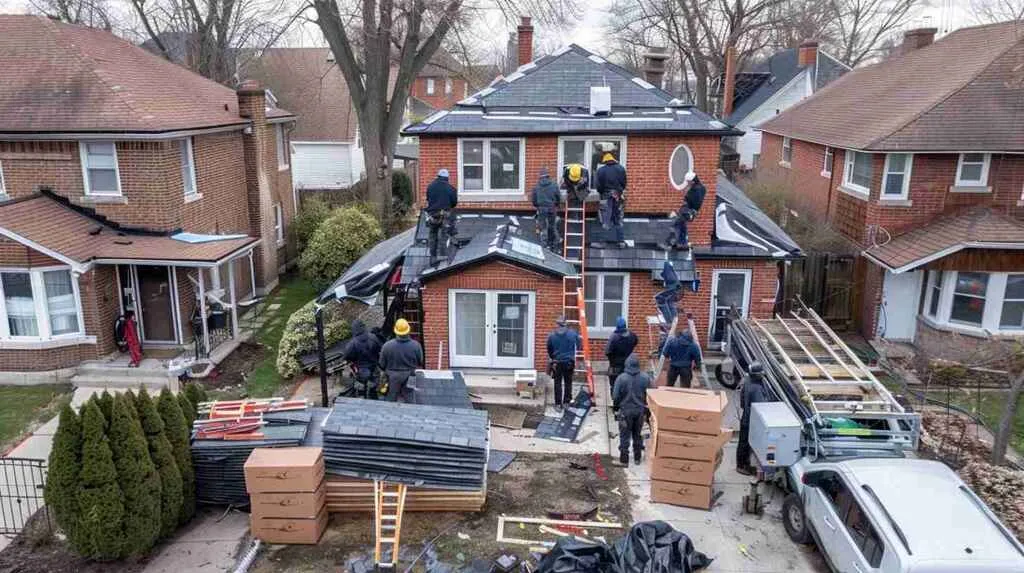
How to Install a Shingle Roof Queens NYC – Full Process Explained
Blueprint for a leak-free shingle roof starts with a question most people skip: can your existing Queens structure even carry a new shingle system? Before I open a bundle of shingles or roll out underlayment, I spend the first hour checking if the deck and framing can safely support what we’re about to install-because in 19 years working across Jackson Heights, Bayside, Flushing, and Far Rockaway, I’ve seen too many “simple re-roofs” turn into surprise re-frames once we lift off the old material and find rot, sag, or four mystery layers nobody remembers installing.
Check If Your Queens Roof Can Actually Take New Shingles
Here’s my unfiltered opinion: verifying that your existing deck and structure can handle a new shingle roof is the single most skipped step, and it’s the one that costs people the most heartache later. I start by looking at how many layers are already up there-code allows two, but I’ve torn off roofs with three and four, each one nailed through progressively weaker wood-and then I walk the surface, checking for soft spots, visible sag between rafters, and any bounce that tells me the sheathing has lost its grip. I also trace a single raindrop’s path across the deck in my mind, asking where it would go if it snuck past a shingle or through a seam, because if I can’t map a safe exit route for water at every joint and edge, I know the whole plan is already leaking on paper before we install anything real.
One August evening around 7:30, just as the sun was dropping behind the buildings in Jackson Heights, I was tearing off an old shingle roof and found four layers stacked like lasagna, with the bottom layer nailed straight into 1×6 planks full of gaps. The homeowner swore the last crew “did everything to code.” I ended up walking him shingle by shingle through what had gone wrong, using a flashlight and a level, so he could see how water had been sneaking into his bedroom ceiling for years without showing a big stain. That job taught me to never trust “it looks fine from the attic”-you have to get up there with a pry bar, pull a corner, and see what’s really underneath.
If you’re tackling this in Queens, you or your contractor need to count the existing layers, check the deck type-older homes in Flushing and Bayside often have 1×6 or 1×8 plank sheathing instead of plywood, which means gaps and flex-and look for any brown water stains, soft spots, or sagging areas that signal rot or broken rafters. If you find more than two layers, serious sag, or any section where a boot or knee sinks into the surface, you’re looking at a full tear-off and likely some re-sheeting with plywood before you even think about underlayment or shingles. Skip this step and you’re just nailing a pretty roof onto a rotten skeleton.
Pre-Installation Structural & Deck Check
Warning: Over-Layered or Weak Roof
Adding new shingles over more than two existing layers in Queens is illegal under most building codes and dangerous for your home’s structure. The combined weight-especially when snow, ice, or heavy rain load the roof during winter storms-can overload rafters never designed to carry that much mass, leading to sag, cracked ceilings, and even catastrophic collapse in older houses with undersized framing.
If you see soft spots, visible sagging, or any section where the surface feels spongy under your weight, stop immediately. Those are red flags that the existing deck or framing has failed, and installing a new shingle roof without addressing the underlying structure is just putting expensive lipstick on a rotting foundation-within months, you’ll have leaks, interior damage, and a repair bill triple what a proper tear-off and re-sheet would have cost in the first place.
Dial In Deck Repairs, Edges, and Ice Protection So Water Has a Safe Route
I still remember a roof in Flushing where the homeowner insisted “the wood looked fine from the attic,” but once we pulled the shingles, my boot went right through a rotten plank. That’s the reality in Queens neighborhoods like Flushing, Bayside, and even parts of Astoria, where homes built in the 1950s through 1970s used 1×6 or 1×8 plank decking with gaps between boards-those gaps let water and ice travel sideways invisibly for years, rotting the wood from the inside out while the attic looks perfectly dry from below. The lesson: tear-off and deck inspection go hand in hand, and any plank that’s soft, discolored, or crumbles when you press a screwdriver into it gets replaced with new plywood before we even talk about underlayment. At the edges-eaves, rakes, valleys-this is where water hits first and hardest during a storm, so I insist on proper drip edge installed over the underlayment at the rakes and under the ice and water shield at the eaves, creating a continuous metal path that guides every raindrop into the gutter instead of behind the fascia board.
When a customer in Queens asks me, “Can we skip the ice and water shield to save money?” I answer with a question: “Do you like surprises during a Nor’easter?” Ice and water shield-a self-adhering rubberized membrane-goes along all eaves (minimum 3 feet up from the edge, more if your roof pitch is shallow), in every valley where two roof planes meet, around every penetration like chimneys and skylights, and along any low-slope section where snow and ice can dam up and force melt backward under shingles. In Queens, where winter storms regularly dump heavy wet snow followed by freeze-thaw cycles, that shield is the difference between a dry bedroom and a ceiling stain shaped like the 7 train route. I think of it as the last-ditch escape route for that single raindrop I’m always tracking-if it sneaks past a shingle or a nail hole, the shield catches it and channels it down and out instead of into your insulation.
Are you really willing to bet your bedroom ceiling on what the attic “looked like” before you tore anything off?
| Roof Area | Minimum Protection | Best Practice in Queens, NY | What Happens If You Skip It |
|---|---|---|---|
| Eaves | Ice and water shield 3 feet up from edge; drip edge installed under shield at eave | Ice and water shield 4-6 feet up (more on low-slope roofs); metal drip edge with proper overlap to prevent wind-driven rain from wicking behind fascia | Ice dams form in winter, melt backs up under shingles, leaks into soffit and walls, rots fascia boards and eave framing over time |
| Rakes (gable edges) | Drip edge installed over underlayment at rake; shingles overhang edge by ¾ inch | Drip edge over underlayment with overlapping joints sealed; shingles flush to edge to resist wind uplift common in exposed Queens neighborhoods | Wind catches unsecured shingle edges, lifts and tears them during storms; water runs behind rake trim and into gable-end walls, causing interior damage |
| Valleys | Ice and water shield 18 inches each side of valley centerline; shingles woven or cut with proper overlap | Ice and water shield full valley length plus 24 inches each side; metal valley liner optional but recommended on steep or high-flow valleys; cut shingles never woven in Queens’ heavy rain | Valleys concentrate water flow like a highway; any gap or improper overlap lets water shoot sideways under shingles and straight into the deck, causing rapid rot and interior leaks |
| Low-slope sections (under 4:12) | Ice and water shield full coverage on any section with slope less than 4:12; two layers of underlayment minimum | Full ice and water shield coverage, overlapped and sealed; consider upgrading to low-slope shingles rated for 2:12 to 4:12 pitches to handle Queens’ standing water and ice | Water and ice pool on low slopes instead of running off; without continuous waterproof membrane, melt and rain will find nail holes and seams, causing guaranteed leaks within the first year |
✅ Non-Negotiable Prep Tasks Before Underlayment
-
✓
Replace all rotten or soft planks – Any deck board that feels spongy, shows dark water stains, or crumbles when you press a screwdriver into it must be cut out and replaced with new ½-inch or ⅝-inch plywood sheathing before you roll out a single foot of underlayment. -
✓
Re-nail or screw down loose sheathing – Walk the entire deck and drive 8d ring-shank nails or 2-inch screws into any plywood or plank that’s lifted, warped, or bouncing between rafters, ensuring a solid, flat substrate that won’t telegraph through new shingles or cause nail pops later. -
✓
Install proper drip edge at all eaves and rakes – Metal drip edge goes under the ice and water shield at the eaves and over the underlayment at the rakes, with overlapping joints and sealed corners, creating a continuous water-shedding path that protects fascia boards and prevents wind-driven rain from wicking backward. -
✓
Clean gutters and verify proper slope – Remove all old shingle debris, leaves, and granules from gutters and downspouts; check that gutters slope at least ¼ inch per 10 feet toward downspouts so water doesn’t pool and back up under the new shingles during heavy Queens rainstorms. -
✓
Verify all penetrations are sound – Inspect chimneys, vent pipes, skylights, and roof-mounted HVAC units to confirm they’re structurally solid and properly flashed at the base; any cracked masonry, rusted pipes, or loose mounts need repair or replacement before new shingles go down, or you’ll be chasing leaks forever.
Ventilation and Underlayment: Preventing the Slow-Motion Roof Failure
Here’s my unfiltered opinion: if you’re installing shingles in Queens without checking ventilation first, you’re just preheating a slow-motion roof failure. Think of your attic like the 7 train at rush hour-air needs to flow in at the soffit (intake) and out at the ridge or high vents (exhaust) in a smooth, continuous path, or it all backs up and creates heat, moisture, and chaos. In summer, a poorly ventilated attic in Queens can hit 150°F, cooking your shingles from beneath and cutting their lifespan in half; in winter, warm air trapped inside condenses on cold deck sheathing and drips back down, rotting the wood and growing mold you’ll never see until it’s too late. For semi-attached homes and houses with party walls-common across Astoria, Sunnyside, and parts of Jackson Heights-you can’t always add soffit vents on the shared side, so I balance intake on the open eaves with additional high exhaust vents or a ridge vent along the full peak, ensuring that even with one side blocked, air still completes the circuit from low to high and keeps moisture and heat moving out instead of pooling inside.
Underlayment is the backup route for any raindrop that sneaks past a shingle, nail hole, or wind-damaged seam-it’s not the primary waterproofing layer, but it’s the last line of defense before water hits bare wood. In Queens’ humid summers and punishing Nor’easters, I use synthetic underlayment (not old-school felt) because it won’t tear in wind, wrinkle in heat, or absorb moisture like paper, and I tape every seam and overlap with the manufacturer’s recommended tape to create a continuous water-shedding plane. Proper overlaps-6 inches horizontal, 4 inches vertical at side laps-and careful detailing around valleys, chimneys, and vents mean that if a shingle ever fails, the underlayment catches the water and routes it down the slope to the drip edge and into the gutter. Without a clear exit path for vapor rising from inside and water sneaking in from outside, even the most expensive shingles will fail early, because the failure isn’t at the surface-it’s in the hidden layers where moisture and heat quietly destroy everything.
| Myth | Fact |
|---|---|
| “More attic vents always means better ventilation.” | Balance matters more than quantity. You need equal intake (soffit) and exhaust (ridge or roof) area-if you add high vents without enough low intake, you create turbulence and short-circuit the airflow, actually reducing ventilation effectiveness and sometimes pulling conditioned air from the house into the attic. |
| “Felt underlayment is just as good as synthetic and way cheaper.” | Felt tears, wrinkles, and absorbs moisture. In Queens’ humid summers and windy installs, felt rips easily, absorbs dew and rain during multi-day jobs, and degrades faster under shingles; synthetic costs more upfront but stays flat, sheds water immediately, and lasts the life of the roof, making it a better long-term investment. |
| “Ice and water shield goes everywhere-the more the better.” | Only where code and physics require it. Ice and water shield is meant for critical areas-eaves, valleys, penetrations, low slopes-where water and ice can back up or pool; covering the entire roof with it can actually trap moisture rising from below because it’s vapor-impermeable, potentially causing deck rot if ventilation isn’t perfect. |
| “You can mix different vent types on one roof without problems.” | Mixing vents causes short-circuiting. If you have both ridge vents and powered attic fans, or turbine vents near a ridge vent, the higher vent pulls air from the lower one instead of from the soffit intake, creating dead zones with no airflow and defeating the whole purpose of the ventilation system-stick with one exhaust type for best results. |
Lay Shingles Like Traffic on the LIE: Starters, Courses, Valleys, and Ridges
Think of your shingle courses like cars merging onto the LIE; if you don’t stagger and overlap them correctly, you’re creating a traffic jam for water, and water always wins. The actual installation starts with a starter course-special starter shingles or full shingles cut and reversed-along the entire eave, overhanging the drip edge by about ¾ inch to ensure water drips free instead of wicking backward. From there, the first full course goes on with proper exposure (usually 5 or 5⅝ inches depending on the shingle type), and every subsequent course staggers by 6 inches horizontally so vertical seams between shingles never line up-if they do, you’ve created a highway for water to shoot straight through two layers and into the deck. Nail placement is non-negotiable: four to six nails per shingle (check the manufacturer’s spec), driven through the nailing strip about ¾ inch below the adhesive strip, flush to the surface but not overdriven, because a nail that breaks the shingle surface or misses the strip entirely won’t hold in wind. On a windy November morning in Bayside, we were halfway through installing new architectural shingles when I noticed the crew from the house across the street nailing high and skipping underlayment on a low-slope section. By lunchtime, one of their shingles had flown across and landed on our roof. The homeowner watching me from the sidewalk asked if “that kind of thing really matters,” so I stopped what I was doing and showed her, with my own bundle of shingles, how a slightly wrong nail line can turn a 25-year roof into a 7-year headache-because the nails miss the adhesive strip, wind gets under the tab, and within a year the whole roof is flapping and leaking.
I’ll never forget a sticky June afternoon in Far Rockaway when a DIY-minded landlord called me in after they started a shingle roof themselves. They’d done tear-off fine, but by the time I got there, the starter course was upside down, the drip edge was under the felt in some places and over it in others, and they’d run the shingles straight up a valley without cutting a proper pattern. We spent an hour on the porch with iced coffees and a garbage bag full of mis-nailed shingles, and I used their mistakes as a step-by-step lesson on how the system is supposed to be built from the eaves up. In valleys, you never weave shingles-you cut them at an angle and overlap toward the flow so water can’t shoot sideways under a seam. At hips and ridges, you use ridge cap shingles, starting from the end opposite prevailing winds and overlapping each cap so wind can’t lift the edge. Every cut, every overlap, every nail line is chosen based on where water will travel during a storm-if I can’t trace that single raindrop’s path smoothly from ridge to gutter without it sneaking under a shingle or through a seam, I know the installation is wrong and I fix it before moving on.
Step-by-Step Shingle Installation for a Queens Roof
| Approach | Pros | Cons |
|---|---|---|
| DIY Shingle Installation |
• Save labor cost (typically 50-60% of total project) • Work at your own pace on weekends • Learn hands-on skills and understand your roof system • Satisfaction of completing a major home project yourself |
• Steep learning curve-mistakes are expensive and dangerous • High risk of injury from falls, tools, or heat exhaustion • No warranty on labor; manufacturer warranties often require pro install • Takes 3-5x longer than experienced crew • Easy to miss critical details (ventilation, flashing, valley cuts) that cause leaks within first year • Difficult to match quality and wind resistance of pro installation |
| Hiring Shingle Masters (or another Queens pro) |
• Job done in 1-3 days instead of weeks • Proper structural inspection, deck repair, and code compliance • Experienced crew handles all safety, permits, and disposal • Labor warranty (typically 5-10 years) covers installation defects • Correct ventilation, flashing, and valley details ensure long shingle life • Licensed, insured pros reduce your liability if someone gets hurt |
• Higher upfront cost due to labor • Must coordinate schedule and be home for site access • Need to vet contractors carefully to avoid fly-by-night crews • Less control over daily progress and material choices |
Queens-Specific Timing, Maintenance, and When to Call Shingle Masters
The blunt truth is, shingle installation is 70% preparation and 30% nailing-it’s the part you don’t see from the sidewalk that decides if it leaks. In Queens, the best time to install a shingle roof is late spring through early fall-April through October-when temperatures stay above 40°F consistently (shingles seal better in warmth) and you’re less likely to hit a week of rain that stalls the job and leaves your house exposed. Avoid mid-summer’s extreme heat if you can, because shingles over 90°F get soft and are easy to damage during install, and never install in winter when cold makes shingles brittle and the self-sealing adhesive won’t activate until spring. Once your new roof is on, maintenance is mostly about keeping water’s travel route clear: clean gutters twice a year (spring and fall), visually inspect from the ground after every big storm-looking for lifted shingles, missing granules, or anything that seems off-and trim back tree branches that hang over the roof and drop leaves, acorns, or scrape shingles in wind. If you spot a problem, calling a local pro like Shingle Masters before the next rainstorm is always cheaper than waiting until you have a ceiling stain shaped like a map of Queens.
Ongoing Care Schedule for Your Queens Shingle Roof
Clean all gutters and downspouts, removing leaves, shingle granules, and debris; check that water flows freely and gutters aren’t pulling away from fascia; inspect visible flashing around chimneys and vents for rust or gaps.
Walk around your house and visually inspect the roof from the ground, looking for lifted, missing, or damaged shingles; check yard and gutters for loose granules (a little is normal, a lot means shingles are failing); note any new stains on ceilings or walls inside.
Trim back tree branches within 6 feet of the roof to prevent scraping and leaf buildup; from inside the attic, check for daylight coming through the deck, new water stains, or damp insulation; verify soffit and ridge vents are clear and not blocked by insulation or bird nests.
Have a pro like Shingle Masters inspect from the roof itself, checking nail lines, adhesive seal quality, and any early signs of wear or failure not visible from the ground; they’ll also verify that flashing, valleys, and penetration boots are still tight and not cracked or lifted.
If you spot a problem-lifted shingle, new leak, or storm damage-call immediately before the next rain; small repairs caught early (re-nail one shingle, replace a flashing boot) are cheap, but ignored issues turn into full section replacements or interior water damage within months.
Common Queens Homeowner Questions About Shingle Roof Installation
Do I need a permit to install a new shingle roof in Queens?
How long does a typical shingle roof installation take in Queens?
Will the noise and debris bother my neighbors or damage my landscaping?
Do I need to be home during the roof installation?
What should I do to prepare my house before the crew arrives?
If you want a shingle roof in Queens installed with this same step-by-step attention to where water travels, call Shingle Masters to have our team inspect your structure, plan every detail from deck to ridge, and install the system correctly the first time-because in 19 years, I’ve learned that the difference between a roof that lasts 25 years and one that starts leaking in seven is what happens before the first shingle gets nailed.