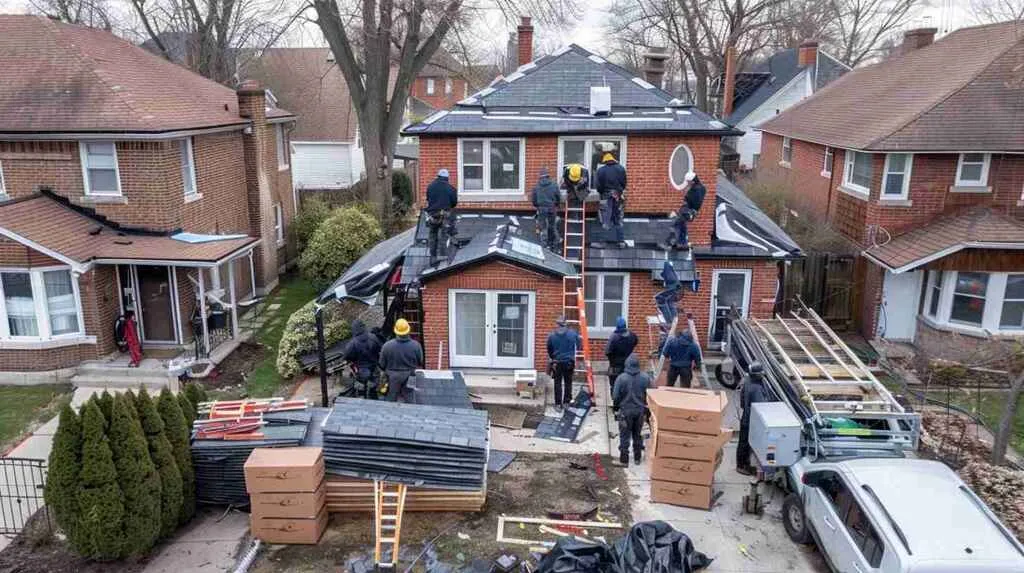
Install Ridge Vent on Shingle Roof Queens NY – No Leaks Method | Call Today
Blueprint: Most shingle ridge vent manufacturers call for a 1½-inch-wide slot centered on your ridge-that’s ¾ inch cut back on each side of the ridge board-and the biggest reason new ridge vents leak in Queens is somebody ignored that number or ran the slot too far toward a chimney or gable end. On my notepad, the first thing I draw is a simple side view of your roof with a big arrow showing hot air trying to escape. When that arrow hits the ridge, you need exactly enough opening-not too wide, not cut into the wrong places-so the vent can cover it cleanly without leaving gaps where wind-driven rain sneaks under.
Exactly How Wide to Cut the Ridge Slot (So It Doesn’t Leak)
I’m gonna give you my direct opinion here: cutting the slot wider than the manufacturer’s spec or running it too close to a chimney, hip, or gable end is the number one way homeowners-and even some rushed crews-create “mystery” leaks that don’t show up until two winters later. Think of the layout and that first cut like the intro and first verse of a song: you don’t rush it, you set the tempo, and every later piece (the vent itself, the nails, the cap shingles) has to land on that rhythm. If your intro’s off-beat, the whole song falls apart.
One August afternoon in Elmhurst, it was so humid my tape measure was sweating. I was installing a ridge vent over a finished attic where the homeowner’s son slept, and every winter his comic books curled from condensation. Halfway through, I realized another contractor had nailed the sheathing tight over the ridge years ago-no actual gap under the old “vent.” I had to carefully cut that slot from the outside, ⅛ inch at a time, with the sun cooking my neck, making sure I didn’t drop sawdust down onto the kid’s LED galaxy ceiling inside. Insider tip: set your circular saw depth just past the shingle and sheathing thickness-usually around 1¼ inches total-then finish the last bit of cut near chimneys and gable ends with a hand saw to keep control and avoid pushing debris into finished spaces below.
Precise Ridge Slot Layout & Cutting-The “Intro” & “Verse” Steps
Common Ridge Slot Cutting Mistakes That Cause Leaks in Queens Weather
- Cutting the slot wider than the manufacturer’s spec-leaves exposed sheathing edges that wick water under the vent when wind drives rain sideways, especially during nor’easters off Jamaica Bay.
- Running the slot all the way to the gable end or rake edge-creates an open path for wind-blown rain and snow to dump straight into the attic; always stop 6-12″ short and cap the end properly.
- Crossing into a hip or valley, or cutting right up to a chimney-these are transitional zones with their own flashing; breaching them means water has two leak paths instead of one, and the repair is expensive.
- Cutting through hidden nails or truss plates-you compromise structural connections and create vibration points where fasteners work loose over freeze-thaw cycles, letting water seep past the vent flanges every spring.
Laying the Ridge Vent Like a Clean Chorus (No Nail Leaks, No Gaps)
Let me be blunt: most “leaky ridge vents” in Queens are not actually leaking at the vent-they’re leaking at the nails and cuts around it. Here in Queens, we get wind-driven rain from multiple directions depending on whether a storm’s coming up the Atlantic coast or looping around from the west, and snow drifts pile on ridges and then melt unevenly. That punishes sloppy nail placement and unsealed end-caps way harder than in milder climates. Think of this as the chorus of your install song: everything repeats cleanly along the ridge-same nail pattern, same overlap, same sitting height-so the whole section plays in tune and doesn’t let water sneak through off-beat mistakes.
In January about five years ago, right off Cross Bay Boulevard, I got a 7:00 a.m. call from a panicked landlord who thought her new ridge vent was leaking. It had snowed overnight, and water was spotting the top corners of two bedrooms. When I climbed up, the vent was fine-the problem was they’d stuffed the entire ridge area with fiberglass insulation from inside, choking off airflow. The warm, wet air had nowhere to go, so it frosted under the sheathing and melted in streaks. I spent the afternoon cutting back insulation between each rafter bay while my coffee froze in the cup holder. The lesson: a properly sitting ridge vent needs clear air path, correct nail depth, and a flashing system that directs any condensation or minor melt back outside-not pooling on drywall. When you over-drive nails or skip the drip edges at the vent ends, you turn condensation into what looks like a roof leak, and nobody can tell the difference until you’re up there with a flashlight in February.
✅ Nailing & Shingle Details That Prevent Ridge Vent Leaks
-
✅
Use the right nail length: 1¾″ minimum for ⅜″ sheathing, 2″ for ¾″ sheathing, so the nail bites at least 1″ into solid wood (ridge board or rafter tail). -
✅
Hit framing, not air: Before you nail, tap the ridge board with your hammer and listen-you’ll hear the difference between solid wood and the hollow space between rafters. -
✅
Proper overlap direction: Each vent section or cap shingle should lap over the piece below it by at least 2″, just like roof shingles shed water downward-never reverse it. -
✅
Seal the ends properly: Use manufacturer end-caps or a strip of ice-and-water shield folded into the last 6-12″ of slot, then cap over it; an open vent end is an open invitation for leaks. -
✅
Respect manufacturer spacing: Most vents specify nail spacing (typically 10″-12″ apart along each flange); tighter than that and you risk splitting the vent plastic, looser and it lifts in wind.
Balancing Attic Airflow in Queens: Intake, Exhaust, and Tempo
Matching Ridge Vent to Soffit Intake
Here’s the quiet truth nobody mentions in the brochures: if your ridge vent isn’t matched to your intake, you’ve basically installed an expensive plastic hat. Most shingle ridge vents provide around 18 square inches of net free area (NFA) per linear foot-that’s the actual open space for air to move after you account for mesh and baffles. Building code generally calls for 1 square foot of attic ventilation per 150 square feet of attic floor (or 1:300 if you have a balanced system), split 50/50 between low intake (soffit or eave vents) and high exhaust (ridge). In Queens, where a lot of older homes in Jackson Heights and Forest Hills have finished attics or bonus rooms tucked under the roof, you absolutely need balanced soffit vents to pull cool air in low while the ridge vent lets hot, moist air escape high. Think of it like keeping a song in tempo: if the intake is sluggish (blocked soffits, no vents at all), the ridge vent can’t exhaust properly, and the whole attic “arrangement” drags and goes flat. Insider tip: don’t mix multiple high vents-ridge plus box vents or turbine vents-on a short ridge; they fight each other, and you end up with dead air pockets and weird pressure zones that actually pull moisture into the attic instead of out.
Avoiding Choked Ridges and Sweaty Attics
One late fall evening in Astoria, I took on a “cheap quick fix” job I should’ve turned down. The homeowner insisted his brother-in-law had pre-cut the ridge slot, so I just needed to “throw on the vent before dark.” Halfway through fastening, my hat light caught something: they’d run the slot 3 inches past the end of where the vent would cover, right toward a chimney. I had to improvise a watertight patch with scrap sheathing and ice-and-water under the shingles in the dark, then come back the next morning to redo the whole ridge properly. That was the last time I ever trusted a brother-in-law’s cutting without measuring it myself. The bigger lesson: always stop your slot and your vent at least 6-12 inches back from chimneys, sidewalls, and gable ends (check your vent’s manual for exact distances), and never let the slot cross into a hip or valley transition. Those zones have their own flashing and drainage planes, and breaching them with a ridge slot turns one potential leak into three. When you terminate the vent correctly and balance it with soffit intake, your attic stays dry, your shingles last longer, and you don’t get that “sweaty attic” smell every humid August in Queens.
Do You Have Enough Intake for a New Ridge Vent?
Start here: Do you have continuous or regularly spaced soffit vents?
YES → Does the total soffit vent area equal or exceed the ridge vent NFA you’re planning to install?
✅ YES → OK for full-length ridge vent. Proceed with install and ensure soffit vents aren’t blocked by insulation inside.
⚠️ NO → Add more intake first. Install additional soffit vents or consider SmartVent-style products at the drip edge before cutting your ridge slot.
NO → Do you have any low intake vents at all (even old gable or eave vents)?
⚠️ SOME → Calculate total intake area. If it’s less than half your planned ridge vent NFA, upgrade intake before installing ridge vent.
🚫 NONE → Do not install ridge vent yet. Schedule an attic inspection in Queens, NY with Shingle Masters to design a balanced intake/exhaust system-a ridge vent alone will do more harm than good.
Not sure how to measure your soffit vents or calculate NFA? Call us-we’ll walk your roof and give you exact numbers, no charge for the consultation.
When You Should Call a Queens Ridge Vent Specialist (Instead of DIY)
When I walk a roof for the first time, the question in my head is always the same: “Where is this roof trying to breathe, and where is someone choking it?” Cutting one inch wrong at the ridge can cost you more than the entire vent and the shingles combined once you factor in drywall repair, insulation replacement, and mold remediation.
Think of your roof like a drum: if you cut the wrong hole in the shell, it doesn’t matter how nice the hardware is-the sound, or in this case the airflow, will be wrong. In Queens, specific roof situations demand a pro: homes with multiple dormers where ridge lines change direction every few feet, short ridges where you’re balancing exhaust with limited intake, steep slopes (8:12 or higher) where one slip means a trip to the hospital, and older homes in Jackson Heights or Forest Hills with original framing that might have hidden trusses, collar ties, or skylight curbs near the ridge. This is the “bridge” and “outro” of your install song-the final inspection, a hose test if you want peace of mind, and checking the attic in both cold and hot seasons to confirm you’ve got balanced airflow and no condensation. When the ridge vent is installed correctly, you forget it’s even there: no leaks, no musty smells, just a roof that breathes the way it’s supposed to.
When to Call Shingle Masters for Your Ridge Vent
🚨 Urgent: Call Shingle Masters Now
- Active water stains on ceiling or walls after storms
- Visible daylight through the ridge from inside attic
- Ridge slot cut past where the vent covers, or into a hip/valley
- Mold smell or visible mold in finished attic spaces
- Vent sections lifting, loose, or missing after high winds
- You’re planning to sell and inspector flagged ventilation issues
⏳ Can Wait a Bit (But Schedule an Inspection)
- Attic feels stuffy in summer but no visible moisture
- Planning a re-roof in the next 6-12 months
- Old metal or plastic box vents you want to replace with ridge
- Insulation is blocking soffit vents but no damage yet
- Energy bills seem high and HVAC tech mentioned poor attic ventilation
- You just want a professional second opinion before DIY
Why Queens Homeowners Call Shingle Masters for Ridge Vents
-
✓
NYC license and full insurance-we pull permits when required and carry the coverage to protect your property. -
✓
19+ years shingle roofing experience in Queens, with hundreds of ridge vent installs across Astoria, Forest Hills, Jackson Heights, and Elmhurst. -
✓
Neighborhood familiarity-we know Queens weather patterns, building codes, and the quirks of older homes and multi-family properties. -
✓
Fast response-we typically schedule inspections within 2-3 business days and can handle emergency leak repairs same-week. -
✓
No-leak ridge vent method-manufacturer-compliant slot cuts, balanced intake checks, proper fastening, and sealed ends every time.
Frequently Asked Questions-Ridge Vents in Queens, NY
Will a ridge vent leak during heavy snow or nor’easters?
No, not if it’s installed correctly. Quality ridge vents have internal baffles designed to block wind-driven snow and rain while allowing air to pass. The key is proper overlap at seams, sealed end-caps, and stopping the slot 6-12″ short of chimneys and gable ends so you’re not creating open pathways. In Queens, we see plenty of nor’easters and lake-effect snow bands-ridge vents that leak during those events are almost always missing end seals or have nails in the wrong places.
Can I add a ridge vent to my existing shingle roof without replacing all the shingles?
Yes, absolutely. It’s called a “retrofit” ridge vent install. We remove the cap shingles along your ridge, cut the proper slot in the sheathing, install the ridge vent, and then re-cap with new ridge shingles that match your existing roof color. As long as your current shingles are in decent shape (not curling, cracked, or near end-of-life), a retrofit works great and solves attic ventilation issues without a full re-roof. Most retrofits in Queens take one day.
Will I hear wind noise through the ridge vent at night?
You shouldn’t hear anything if the vent is fastened securely and the baffle/filter design is solid. Cheap or poorly installed ridge vents can whistle or rattle in high wind because they’re either not nailed into framing, the mesh is loose, or the vent sections aren’t overlapped correctly. We use high-quality ridge vents with dense foam or molded plastic baffles that eliminate noise-most homeowners in Queens never even know the vent is there once the install is done.
Does a ridge vent really lower my cooling and heating bills?
Yes, when it’s balanced with proper intake vents. In summer, a functioning ridge vent pulls superheated air out of your attic (which can hit 140°F+ on a Queens July afternoon), reducing the heat load on your ceiling insulation and HVAC system. In winter, it exhausts moist air before it condenses and soaks insulation, keeping your R-value effective. Homeowners typically see a 10-15% reduction in cooling costs and fewer ice dams in winter once we fix their attic ventilation-but only if intake and exhaust are balanced.
What if I already have box vents or turbine vents-should I remove them before installing a ridge vent?
Yes, in most cases. Mixing multiple high exhaust vents on the same roof plane causes air to short-circuit between the high vents instead of pulling through the attic-you end up with worse ventilation and sometimes increased condensation. When we install a ridge vent in Queens, we typically cap or remove old box vents and turbines, patch those holes with matching shingles, and let the ridge vent do all the high exhaust work. If your roof has separate sections (like a main house and a garage), you can keep different vent types on different planes-just not on the same ridge.
A ridge vent installed like a well-arranged song-intro (layout), verse (cut), chorus (vent), bridge (flashing), outro (inspection)-won’t leak and will keep a Queens attic dry through nor’easters, summer humidity, and everything in between. If you’re ready to stop worrying about mystery stains and sweaty attic spaces, call Shingle Masters in Queens, NY today. We’ll inspect your ridge, check your intake, and install or correct your ridge vent using the no-leaks method-so the only thing you’ll hear from your roof is silence, exactly the way it should be.