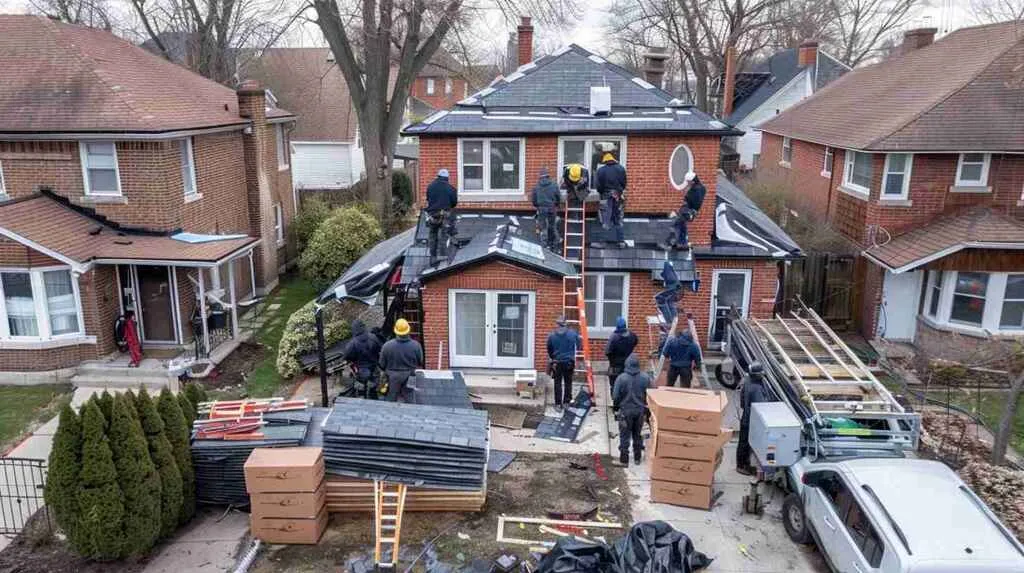
Install a Pipe Boot on Shingle Roof Queens NY – No Leak Method | Call Today
Blueprints show pipe penetrations as clean circles, but the first thing you learn after a few years on Queens roofs is that the boot doesn’t just get set on top-it gets woven into the shingle pattern like another course, or it will eventually leak. I’ve spent 19 years tracking down the “simple” pipe leaks that turned out to be bad layering, and here’s what that actually looks like in real life: every shingle around the boot has to direct water like a subway map, guiding the flow around the pipe and down the roof instead of under the flange.
How a Pipe Boot Really Works on a Shingle Roof in Queens
On a typical Queens cape with a 3-tab shingle roof, the first thing I do is find the course line just below the pipe-no guessing, no eyeballing. That line is the main “water platform” for everything happening around that penetration. Water wants to travel downfield along the shingle courses like commuters moving from station to station, and if you leave an opening at the wrong place, it rushes right through. The boot’s job isn’t to plug the hole-it’s to become part of the water transit system, with its flanges tucked into the shingle overlap so every drop keeps moving in the right direction. Blunt truth: a boot just set on top with caulk is a future leak, and treating it like non-negotiable water management instead of cosmetic patching is the only way it holds up through Queens weather.
I still see the same mistakes all over Jackson Heights, Bayside, and Astoria: homeowners or rushed contractors reach for caulk before a flat bar, nails driven high where they’ll be exposed, and old neoprene boots left underneath the new one because “it adds extra protection.” One February morning in Jackson Heights, I pulled a boot that looked fine from the street and found they’d stacked the new one right over the old brittle rubber. Every freeze-thaw cycle opened a tiny gap because the two layers couldn’t flex together, and the homeowner had ceiling stains in three rooms. I had to re-lay three courses while my fingers went numb at 19 degrees, because the real fix wasn’t caulk-it was respecting the shingle pattern and seating a proper boot step by step. Cold weather in Queens makes shingles brittle, so you’re fighting both the bad install and the climate; that double layer trap is exactly how a “simple” fix turns into a full interior repair.
Big picture: you’re controlling the water route. Think of your roof like a subway map where each shingle course is a platform and the boot is a controlled transfer station. If the bottom flange sits on top of the lower course, the side flanges tuck under the side shingles, and the top flange slides under the upper course, water never finds an entrance-it just keeps riding the “train line” down to the gutter. The next sections will show you whether this is something you can tackle yourself in Queens or when to call a pro, and then we’ll walk through the exact step pattern so you see how each move ties back into that water path.
| Myth | Fact |
|---|---|
| You just set the pipe boot on top of the shingles and screw it down. | The boot has to be woven into the shingle courses so water flows over the top flange, not under it. |
| A thick bead of roofing caulk around the pipe will stop any leak. | Caulk is a backup, not the main seal; correct shingle layering and flashing do the real work. |
| If the boot looks fine from the ground, it’s not your problem. | Cracked rubber or bad cuts are almost invisible from the sidewalk-you need a close inspection. |
| It’s okay to leave the old boot underneath the new one for “extra protection.” | Stacked or buried boots trap water and crack with freeze-thaw; the old boot needs to come out and the course reset. |
DIY or Call a Pro? Read This Before You Touch That Pipe Boot
When I meet a homeowner asking how to install a pipe boot on a shingle roof, my first question is, “Are you trying to stop a leak or just following YouTube?” That distinction matters because motivation shapes outcome. One summer at about 9 p.m., I got an emergency call from a family in South Ozone Park-water dripping from the kitchen light fixture right after a new roof had just been installed. Under a work light, I found a nice-looking boot that the roofer had nailed high and never woven under the upper shingle course. With the storm circling back, I had to gently unseal hot asphalt shingles without tearing granules and show the homeowner why tucking that boot correctly would do more than any glob of tar. Queens weather swings hard-summer heat softens shingles, winter makes them brittle, and spring storms come sideways with wind-so if your install doesn’t account for freeze-thaw and UV, you’re just setting up the next leak. Local knowledge: newly installed roofs in Queens often look perfect but hide shortcuts around penetrations because boots are the last detail before the crew moves to the next job.
Here’s my honest take: if you’re comfortable on a ladder, your roof is one story with a walkable pitch (say, a typical Bayside cape or Woodside ranch), and you’re methodical about prying shingles without ripping granules, you can probably handle a straightforward boot replacement. But if your house is a two-story colonial in Jamaica Estates, a row house in Astoria with tight side access, or you’re looking at a steep pitch where one slip means a trip to the ER, call a pro-it’s not worth the risk or the bigger leak you might create by nailing in the wrong spot. Queens housing stock runs from single-story ranches to attached two-families with shared walls, and roof height plus access changes everything; if you need an extension ladder and you’re not 100% confident, that’s your sign to pick up the phone instead of the flat bar.
Should You DIY Your Pipe Boot in Queens?
Start here: Is your roof one story and safely walkable from a sturdy ladder?
- → YES: Are you comfortable working around hot asphalt shingles and prying them without damage?
- → YES: Is there an active leak right now, or is this preventive?
- → Preventive: Are your shingles less than 12 years old and still flexible?
- ✓ Reasonable to DIY with care – follow the steps exactly and take your time.
- → Active leak: Call Shingle Masters in Queens, NY – leak tracking and proper diagnosis matter more than speed.
- → Preventive: Are your shingles less than 12 years old and still flexible?
- → NO: Call a pro – tearing granules or breaking seals incorrectly creates bigger problems.
- → YES: Is there an active leak right now, or is this preventive?
- → NO (two-story, steep pitch, or tight access): Call Shingle Masters – falls and bad installs both cost more than a professional visit.
⚠️ Safety & Damage Risks When Working Around Pipe Boots
- Falls on steep or icy Queens roofs: Even a moderate pitch becomes dangerous in wet or cold conditions; one slip can mean serious injury.
- Tearing shingles when they’re hot or brittle: Summer heat makes shingles stick and winter cold makes them crack-both increase the chance you’ll damage more than you fix.
- Creating a bigger leak by nailing or cutting in the wrong place: A misplaced nail above the boot or a bad cut around the pipe opens a permanent water path that’s harder to fix than the original problem.
Step-by-Step: No-Leak Pipe Boot Install on a Shingle Roof
On a typical Queens cape with a 3-tab shingle roof, the first thing I do is find the course line just below the pipe-no guessing, no eyeballing. That line is your “main water line,” the platform every shingle above it depends on, and if you don’t respect it, you’re already setting up a leak. I think of it like the express track on the subway: water wants to ride that course straight down, and the boot’s job is to let it transfer smoothly around the pipe without jumping the rails. Insider tip: before you touch a single nail, snap a chalk line or just visually lock in where that lower course sits, because every other move-lifting shingles, positioning the new boot, nailing-has to tie back into that reference line. If you start guessing, you end up with gaps where water sneaks under the flange, and no amount of caulk will save you.
Late one fall afternoon in Astoria, wind gusts hit 30 mph while I was redoing three pipe penetrations on a flat-to-slope transition. I’d warned the owner that the “unicorn” leak-only happens in sideways rain-was almost always bad detailing around pipes or vents. Sure enough, the old lead jack was split on the backside where no one ever looks. I laid my level alongside the pipe and showed him how wind-driven rain used the slope and the gap like a secret tunnel; once he saw it, he finally believed me that replacing boots isn’t cosmetic, it’s structural water control. Queens gets those sideways storms off the Atlantic, and if your boot isn’t sealed on all four sides-especially the uphill/backside where you can’t see from a ladder-water will use any crack like a shortcut. That’s why every overlap matters: the side flanges tuck under side shingles to block horizontal flow, the bottom flange sits on top of the lower course to catch gravity flow, and the top flange slides under the upper course so nothing runs backward.
So that’s your water path controlled-bottom flange on top of the lower course, sides woven in, top tucked under, nails only in the covered zones. Now, before that settles in, look at what happens if we change this one detail: if you nail above the top flange where it’s exposed, every raindrop hits that nail head and funnels straight under the boot. The step-by-step below breaks it into the exact sequence I use on every Queens roof, from finding that course line to the final sealant bead, so you see how each move either blocks or redirects the water route.
Precise Sequence to Install or Replace a Pipe Boot on a Shingle Roof
- Locate the shingle course directly below the pipe and snap or visualize the line-this is your reference point for every other step, the “main platform” that the boot has to tie into.
- Gently break the seal on the shingles above and to the sides using a flat bar, preserving granules-work slowly in hot weather (shingles stick) and carefully in cold (shingles crack).
- Remove roofing nails around the old boot and slide the old boot off, fully removing any buried pieces or stacked old boots-leaving layers creates freeze-thaw gaps.
- Inspect the pipe all the way around and the deck for soft spots or hidden splits, especially on the uphill/backside where wind-driven rain hits and damage hides.
- Dry-fit the new boot so the bottom flange sits on top of the lower shingle course, sides tuck under the side shingles, and the top flange slides under the upper course-this is the water transit map in action.
- Nail only in the manufacturer’s nailing zone where nails will be covered by shingles, never exposed above the top flange-every exposed nail is a future leak point.
- Re-lay and seal shingles over the flanges, matching the original pattern and adding small dabs of sealant under lifted tabs if needed to restore the factory seal.
- Run a minimal bead of sealant where the boot meets the pipe (if specified by the boot type), and double-check that all shingle edges direct water away from the penetration-walk the “water route” one more time to confirm no openings.
Typical Queens Pipe Boot Repair Costs & What Affects Price
$350 to $650 is the range I usually see for a straightforward pipe boot replacement on a Queens roof, but that number moves depending on a few specific things: roof height and access (a single-story ranch in Bayside is faster and safer than a two-story colonial in Jamaica Estates with limited ladder space), boot type (basic rubber is cheaper than high-temp silicone or a lead jack), how many shingle courses need to be reset, and whether it’s an emergency storm call at 9 p.m. or a scheduled repair on a clear Tuesday morning. If you’ve got two or three boots that need replacing at once-common on older homes with multiple vent stacks-the per-boot price drops because we’re already set up on your roof. This is a ballpark; Shingle Masters can give you an exact quote after seeing your roof, because every house in Queens has its own quirks and every leak tells a different story.
| Scenario | Roof Type/Height | What’s Included | Estimated Range (Queens, NY) |
|---|---|---|---|
| Single cracked boot on a walkable one-story roof | Single-story cape or ranch, 4/12-6/12 pitch | Remove old boot, install new boot, reset limited shingles, seal | $250-$450 |
| Boot replacement on a two-story with shingle course repair | Two-story colonial or semi-attached, moderate pitch | Remove boot, replace, re-lay 2-3 shingle courses, sealing, inspection | $350-$650 |
| Two pipe boots replaced on a Queens row house | Attached row house with shared walls, ladder access from front or rear | Access setup, remove and replace both boots, weave into shingles | $550-$900 |
| Emergency storm call for active leak at pipe | Varies; often two-story with limited access in rain | Leak tracking, temporary stabilization, emergency sealing, plan for permanent fix | $300-$700 depending on time and conditions |
| Upgrading to premium/high-temp boots during scheduled repair | Any; usually tied into other small repairs | Remove old boots, install upgraded boots, integrate with shingle pattern | $450-$900 depending on count and boot type |
Before You Call for Pipe Boot Help in Queens
Treating your roof like a water transit map-knowing where the leak shows up inside, how the weather triggers it, and what the pipe area looks like from the ground-helps you talk clearly to your roofer and speeds up the whole visit. Having a quick checklist and a few common questions ready means we can diagnose faster and get you a real fix instead of a band-aid.
What to Check Before Calling Shingle Masters About a Pipe Boot Leak
- Where inside does the leak show? Note the room, ceiling location, and whether it’s directly below a visible pipe or offset to one side.
- How long has it been happening? New leak after a storm, slow stain over months, or only during certain weather?
- Does it only leak during heavy or wind-driven rain? Sideways rain often means backside flashing failure that won’t show up in light drizzle.
- Approximate age of your roof: Knowing if your shingles are 8 years old or 18 helps us understand boot condition and whether broader work is needed.
- How many pipes or vents can you see from the ground? Helps us estimate scope and whether multiple boots might be involved.
- Any past roof or plumbing work near that area? Previous repairs sometimes create new leak points if boots weren’t reset properly.
Common Queens Homeowner Questions About Pipe Boots on Shingle Roofs
How long should a pipe boot last on a shingle roof in Queens?
Basic rubber boots typically last 10-15 years in Queens, but harsh UV exposure and freeze-thaw cycles can shorten that-sometimes boots fail before the shingles do. High-temp silicone or lead boots last longer, especially if your roof gets full southern sun or you’ve got a dark shingle color that heats up. If your roof is approaching 12-15 years old and you’ve never replaced a boot, it’s worth having someone take a close look before the next big storm.
Can you just seal around the pipe instead of replacing the boot?
You can, and it might hold for a few months, but it’s a temporary band-aid that doesn’t fix the real problem-bad shingle layering, cracked rubber, or incorrect flashing. Caulk dries out, cracks in winter, and peels in summer; it’s a backup seal, not the main defense. If the boot is split or the flanges aren’t woven into the shingle courses correctly, no amount of sealant will stop water from finding its way under. Worth doing as an emergency stop-gap while you wait for a proper repair, but not a long-term solution.
Will you need to replace a big section of my roof to fix one bad boot?
Usually not-most of the time we’re only resetting a few shingle courses around the penetration, maybe 3-5 courses depending on how the original install was done. If the deck underneath is soft or the surrounding shingles are badly damaged, the scope can expand, but a typical boot replacement on a sound roof is a localized repair. We lift the shingles, replace the boot, weave it back in, and re-seal; your roof looks the same when we’re done, just without the leak.
Do you work year-round in Queens, even in winter?
Yes, with weather windows-we watch the forecast and schedule around temps and precipitation. Shingles get brittle below freezing, so we take extra care when lifting and sealing, sometimes using a heat gun to soften adhesive tabs. Emergency leak calls don’t wait for spring, and honestly, some of the worst boot failures show up in January and February when freeze-thaw is cycling every day. If you’ve got an active leak in winter, we’ll stabilize it and plan the permanent fix for the next clear, moderate-temp window.
If you’re in Queens, NY and even a little unsure about how to install a pipe boot on a shingle roof without creating a bigger leak, Shingle Masters can come out, map the water routes on your roof, and install or replace the boot the way it should have been done the first time. Call today for an inspection or repair slot-because the longer you wait, the more water finds its way in.