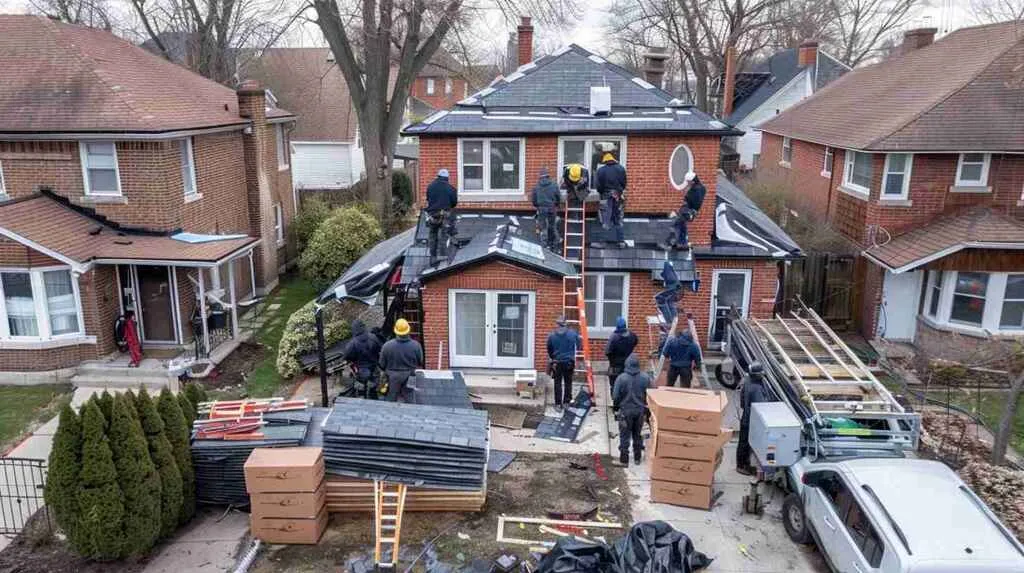
Install Composite Shingle Roof Queens NY – What’s Different | Free Quotes
Blueprint first: on the first thirty minutes of any Queens roof job, I’m not touching shingles-I’m checking the wood deck like a mechanic listens to your engine before popping the hood. What most DIY videos skip is that your composite shingle roof is a system, not a stack of materials, and I’ve learned from 19 years in Corona, Jackson Heights, Bayside, and Rockaway that the system only outputs dry ceilings if the input layer-deck and underlayment-is debugged correctly before a single shingle goes down. If that base “code” is wrong, every layer on top will throw water leaks no matter what brand you bought or how carefully you followed a YouTube nailing tutorial.
Deck Prep and Underlayment: The First Line of Defense
On the first thirty minutes of any Queens roof job, I’m not touching shingles-I’m checking the wood deck like a mechanic listens to your engine before popping the hood. I won’t lay a single composite shingle until I’m happy with what’s underneath, and anyone who does is setting you up for leaks-that’s not opinion, that’s physics and 19 Queens summers watching heat buckle bad decks and winter ice push water through gaps. The deck and underlayment are your roof’s core input layer: if the input is corrupted-soft plywood, wide gaps between boards, old layers still hiding underneath-then every command you give the system after that (shingles, flashing, nails) will output leaks the moment a Nor’easter parks over the East River.
I still remember the first time I saw ice backup on a Jamaica roof that only had felt paper-looked like someone put a frozen river under the shingles. One August afternoon in Jackson Heights, it was 92 degrees and the shingles were so hot I could’ve fried an egg on them-literally, we tried it during lunch. The homeowner had watched some YouTube videos on how to install a composite shingle roof and nailed everything too high, so the self-sealing strips never bonded right. We redid the whole job with proper synthetic underlayment, correct nailing zones, and made sure the ice and water shield was in place at the eaves and valleys. A thunderstorm hit the same night we finished, and he texted me a picture of his dry ceiling at 1:17 a.m.-I still remember the time because I was half-asleep and proud we beat both his “DIY” and the Queens weather in one shot.
Here’s what I mean by “input layer” in practical Queens terms: ice and water shield goes at your eaves, up at least 24 inches past the warm wall line, plus every valley and around every penetration-chimney, skylight, vent pipe, roof-to-wall joint. That rubberized membrane is your last line of defense when ice dams form or wind blows rain sideways off the bay. Then synthetic felt covers the rest of the open deck, overlapped correctly so water can’t sneak between courses. Think of this like debugging a network path: if underlayment has a gap, water has a straight route to your ceiling, and you won’t see the “error message” until insulation is soaked and drywall is sagging months later.
Queens-Ready Deck Prep and Underlayment Sequence
Remove all old shingles, nails, and flashing down to plywood or plank deck; verify there are no hidden second layers that will trap moisture and rot out the new system.
Probe for soft spots, delamination, or wide gaps in the deck; replace any compromised plywood panels and tighten all loose sheathing to rafters so you’re building on a solid foundation.
Fasten metal drip edge along all eaves first so future ice and wind-driven rain can’t wick back into the fascia and deck-this edge detail stops rot before it starts.
Run ice and water shield from eaves up at least 24 inches past the warm wall line, plus valleys and around chimneys and vents, to block ice backup and wind-blown rain that regular felt can’t handle.
Roll and fasten synthetic underlayment over the remaining open deck, overlapping courses per manufacturer specs and keeping it flat to avoid telegraphing bumps through shingles.
⚠️ WARNING: Skipping or Skimping on Underlayment in Queens
If a roofer wants to install composite shingles directly over questionable wood or bare spots with minimal felt, you’re building leaks into the system from day one.
- In Queens, ice dams, wind-driven rain off the East River, and sudden summer downpours will exploit every underlayment gap you leave open.
- You may not see the leak “error message” for months, but insulation and framing can be soaking the whole time, rotting out your investment silently.
- Always confirm: full tear-off to solid deck, ice and water at eaves/valleys/penetrations, and synthetic underlayment with correct overlaps-no shortcuts.
Nailing, Courses, and Queens Wind Loads
Let me be blunt: if your composite shingles aren’t nailed in the right zone, I don’t care what brand you bought, they’ll fail the first time a Nor’easter parks over Rockaway. There was a job in Bayside where we started at 6:45 a.m. on a chilly November morning because the couple had a newborn and didn’t want hammering going past nap time. Their old three-tab shingles were layered under a cheap composite install that someone slapped over failing plywood-no starter course, no drip edge, nothing. I walked them through every layer we were fixing, like a step-by-step diagram, and the dad kept saying, “I wish my IT department explained things this clearly.” To this day he sends me photos every time there’s a Nor’easter just to gloat that his roof doesn’t move an inch. The fix wasn’t magic-it was proper nailing in the manufacturer’s reinforced zone, correct number of nails per shingle, and nail heads flush so the self-seal strips could bond under Queens heat without lifting in Queens wind.
Here’s the debugging analogy: nails and course alignment are your routing table for water and wind loads. Wrong nailing is like leaving network ports wide open-wind will catch those lifted tabs and rip them off, water will sneak under loose edges, and your whole system crashes during the next storm. My personal standard is I won’t sign off on a job unless I can zoom in on nail lines and show you they’re dead-on in the nailing strip, and I’ve walked away from helper crews who wanted to “eyeball it” because that’s not how you write reliable code on a 25-year roof.
✅ Manufacturer-Spec Nailing
- Nails driven exactly in the shingle’s reinforced nailing strip
- Nail heads flush with shingle, not overdriven or crooked
- Correct number of nails per shingle (typically 4-6 depending on wind rating)
- Ensures shingles self-seal properly and share wind load across the roof plane
❌ “Eyeballed” DIY Nailing
- Nails scattered high or low, often above the reinforced zone
- Overdriven nails that cut through mat or sit at an angle
- Inconsistent nail count per shingle and missed edges
- Leads to lifted tabs, blow-offs, and leaks along courses during Nor’easters
Edges, Valleys, and Penetrations: Where Queens Roofs Actually Leak
The ugly truth about composite shingles in Queens is that most leaks start at the edges and penetrations, not in the middle of the field where everyone loves to take pictures. The worst near-disaster I’ve seen was on a semi-attached in Ozone Park during an icy March rain. The previous installer had skipped underlayment around the chimney and roof-to-wall transitions to “save time,” and there was a literal waterfall behind the bedroom wall when I first visited. While we were redoing it, a gust of wind ripped a bundle of composite shingles out of a helper’s hands, and I had to catch it with my forearm so it wouldn’t slide into the neighbor’s new skylight-left a bruise for a week, but we got that roof watertight before the temperature dropped and froze everything solid. That job taught me that every missed detail at an edge or penetration is a “data leak” point in the system-eaves let ice backup sneak under, valleys channel double the water volume, chimneys create four separate flashing transitions, and roof-to-wall joints on row houses are basically asking for trouble if you rely on caulk instead of layered metal.
I explain my step-by-step approach to flashing and edge work as if I’m debugging a network path: each layer-drip edge, starter course, shingles, step flashing, counterflashing-is another security rule that has to be installed in the right order or water will find the gap you left. Insider tip here: when you’re getting quotes, always ask to see close-up photos of edge and flashing work, not just pretty field shots of the main roof plane, because that’s where pros either shine or cheat and you won’t know which until the next big storm tests every seam.
High-Risk Leak Zones on a Queens Composite Shingle Roof
Eaves and rakes where shingles meet gutters and fascia-ice and wind-driven rain both attack here first
Valleys where two roof planes intersect and channel heavy runoff during Queens thunderstorms
Chimneys and skylights with metal flashing and sealant transitions that age faster than the shingles
Roof-to-wall joints, especially on semi-attached and row houses where two different structures meet
Pipe boots and vent penetrations that can crack in freeze-thaw cycles and let water straight into your attic
How I Sequence Edge and Flashing Details to Stop Leaks
1. Eaves and Rakes
Drip edge first at eaves, then ice and water over the metal, then starter strip and first course of shingles locked so water can’t backtrack into the fascia or soffit-each layer blocks the next failure mode.
2. Valleys
Install full-width ice and water first, then either open metal valley or closed-cut shingle valley depending on house style and water volume, always lapped with the main underlayment so there’s no straight path for runoff.
3. Chimneys
Wrap base with ice and water, then step flashing each shingle course, then counterflashing cut into masonry so water sheds in layers instead of relying on caulk that’ll crack in three winters.
4. Roof-to-Wall Joints
Run underlayment up the wall, install step flashing with each shingle, then integrate with siding or wall flashing so water can’t sneak behind the intersection where two different materials meet.
DIY vs. Pro in Queens: Who Should Actually Install Your Composite Shingles?
Here’s the question I always ask homeowners who want to “help” with the install: do you want to carry bundles or make decisions that keep your ceiling dry for 25 years? Most DIY issues aren’t brute force-you can learn to swing a hammer in an afternoon-they’re mis-ordered “commands” in the system: underlayment before shingles, flashing before valleys, proper nailing zones before self-seal, and those errors only show up when a storm hits and your ceiling starts dripping months after you thought the job was done.
Should You DIY or Call a Pro for Your Composite Shingle Roof in Queens?
Start: Are you comfortable working safely on a sloped roof for multiple days?
→ No? Hire a pro like Shingle Masters; safety and speed matter on Queens roofs, and one fall costs more than any labor savings.
→ Yes? Next question: Do you fully understand underlayment, flashing, and manufacturer nailing specs?
→ No? Consider at least hiring a pro for deck, underlayment, and flashing, even if you help with labor-those are the “input” steps that determine if your roof leaks.
→ Yes? Final question: Are you prepared for surprise repairs like rotten plywood or hidden second layers?
→ No? Get a professional inspection and fixed-price quote before you start tearing off so you’re not stuck halfway through with exposed decking and a storm forecast.
→ Yes? You might handle the work, but compare tool, material, and time costs against a pro install with warranty in Queens wind and weather-sometimes the math doesn’t add up the way you think it will.
What to Check Before You Call and Common Queens Questions
Think of each layer of your roofing system like security on your Wi‑Fi network-if you leave one part open, water’s going to find the easiest way in, every single time. Your job as a Queens homeowner isn’t to become a roofer overnight, it’s to verify that each “security rule” is actually in place when someone quotes your job: solid deck with no soft spots, ice and water shield at eaves and valleys and penetrations, synthetic underlayment covering the rest, proper drip edge and starter course at the perimeter, correct nailing in the reinforced zones, and step flashing at every chimney and wall joint. If any of those inputs are skipped or cheaped out, the system will output leaks no matter how expensive your shingles were.
Here’s what I need to know before I can give you an honest quote: rough square footage of your roof (you can estimate by multiplying your home’s footprint by 1.3 for a normal pitch), how many layers are currently on there, whether you’ve had any leaks or visible damage, and what neighborhood you’re in-Astoria row houses have different roof-to-wall issues than Bayside ranches, Jamaica two-stories handle wind differently than Rockaway beach cottages, and Ozone Park semi-attached homes often hide second layers under the current shingles. I’ll walk your roof with a tablet, take close-up photos of deck, edges, and penetrations, and show you exactly what needs to be fixed and what can stay so there’s no surprises when we tear off and find something unexpected.
Quick Checks Before Calling Shingle Masters About Composite Shingles
Look for any existing leaks or stains on top-floor ceilings and note their locations so I can trace the water path back to the deck.
Check how many visible layers of shingles are on the roof edge or at the attic hatch-more than one layer means full tear-off is mandatory.
Take 2-3 photos from the sidewalk or backyard showing the whole roof, plus close-ups of gutters and any chimneys or vents.
Note whether your home is semi-attached, row-style, or fully detached-roof-to-wall flashing is different for each and affects the quote.
Make a list of any past roof repairs, including when and what areas were worked on, so I know what’s been patched vs what’s original.
Common Queens Composite Shingle Questions
How long does a composite shingle install usually take in Queens?
Most single-family Queens homes take 1-2 full days for a complete tear-off and install, assuming normal plywood repairs and decent weather. Semi-attached or complex roofs with multiple layers or rotten decking can push that to 3 days, and if we hit a surprise second layer or need to sister rafters, I’ll let you know before we go past the estimate.
Can you install composite shingles in winter here?
Yes, but I adjust technique for cold temps-extra care with shingle brittleness, checking self-seal activation with my hand, and using more hand-sealing near edges so wind gusts off the bay don’t catch cold shingles before they bond. I won’t install below 35°F because the adhesive just won’t work and you’re asking for blow-offs.
Do I need ice & water shield if I never see ice dams?
In Queens, ice and water isn’t just for dams-it also protects against wind-driven rain and those freeze-thaw cycles that push water under shingles at eaves and valleys. I’ve seen plenty of Jamaica and Bayside homes with no ice buildup still get leaks from sideways rain during Nor’easters because someone skipped the underlayment at the edges.
Will new composite shingles work with my existing gutters?
Usually yes, as long as drip edge and shingle overhang are set correctly. I check pitch and gutter condition so runoff doesn’t overshoot during heavy summer storms-Queens gets those 2-inch-per-hour downpours that’ll flood any gutter if the roof’s not shedding water into the trough properly.
Why Queens Homeowners Call Shingle Masters for Composite Shingles
19+ years installing and repairing shingle roofs across Queens neighborhoods
Licensed and insured in New York City with full workers’ comp coverage
Same-week on-site inspections available for most Queens ZIP codes
Detailed photo documentation of deck, underlayment, edges, and flashing on every job
In Queens, a composite shingle roof only works if every “line of code” is written correctly-deck solid and dry, underlayment layered to block ice and wind-driven rain, edges detailed so water can’t sneak back into fascia or walls, and nails placed exactly in the reinforced zones so self-seal and wind load both do their jobs for 25 years. If you want to see how that’s actually done on your roof, call Shingle Masters and I’ll walk it with you, show you close-up photos of what needs fixing, and give you a clear, no-fluff quote that breaks down deck, underlayment, flashing, and shingles so you know exactly what you’re paying for and why each step matters.