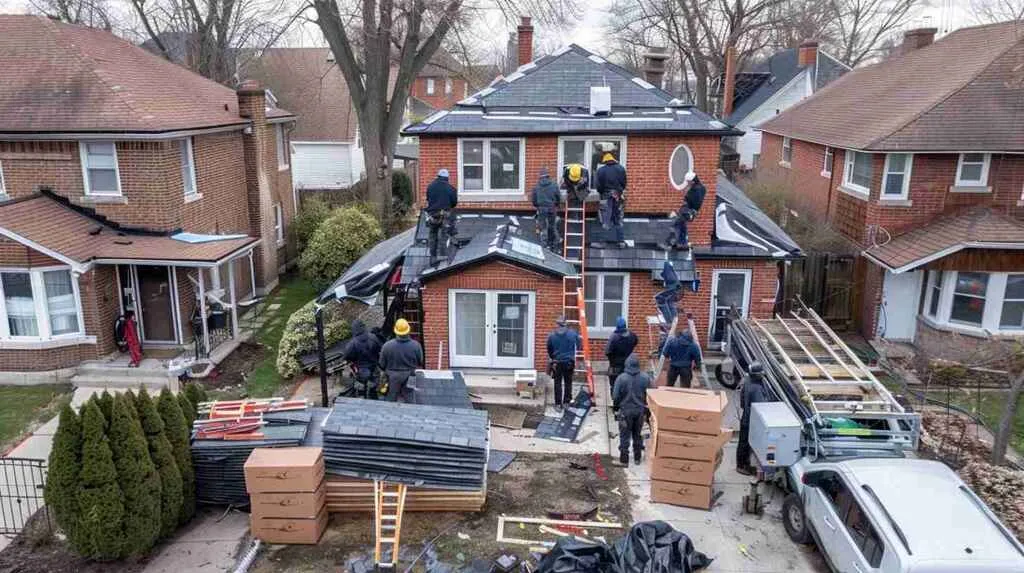
How to Install a Shingle Roof Queens NY – Start to Finish | Free Estimates
Momentum starts before you ever lift a bundle of shingles. Here’s the first question I’d ask you if we were standing in your driveway in Queens right now: what’s under your shingles? Most homeowners want to jump straight into discussing colors and brands, but if I showed you what I see when I peel back that top layer on a typical Woodside or Astoria roof-rotten boards, failed underlayment, missing drip edge-you’d understand why we’re not talking about shingles yet.
Start at the Deck and Drip Edge, Not the Shingles
Picture a layered sandwich-if one slice of bread is moldy, the fillings don’t matter; your roof works the same way. Think of your roof deck as the backstage rigging and supports of a live show. The shingles are what the neighbors see-the “set”-but if that hidden structure underneath is weak or waterlogged, the whole performance falls apart the first time a Queens nor’easter rolls through. I learned that the hard way on more roofs than I care to count, and I’ll save you the tuition by walking you through what I check before I even think about installing a single shingle.
Walk your attic first, looking up at the underside of the decking with a flashlight. You’re hunting for dark water stains, sagging between rafters, and daylight peeking through nail holes. Then you get on the roof itself and test every square foot-literally step on it and feel for soft spots or bouncing. Queens houses, especially the older row homes in Jackson Heights or Woodhaven, have been patched and re-roofed for decades, so you might find boards from three different eras nailed together like a quilt. One July afternoon in Jackson Heights, 98 degrees and no shade, I started a “simple” shingle replacement that turned into a full deck repair when my boot went right through a rotten board by the chimney. The homeowner was at work, so I video-called her from the roof, sweat pouring down my face, and used my tape measure as a pointer to show every bad spot before we touched a thing. That job taught me never to skip a slow, methodical walk on every square foot of a Queens roof, no matter how straightforward the customer says it will be. My opinion? Anyone who starts talking shingle brands before checking the deck and drip edge is putting the cart before the horse and setting you up for leaks.
Once you’ve confirmed your deck is solid-or you’ve replaced the bad sections-the next critical move is installing drip edge along every eave and rake. Drip edge is a thin metal strip that does two jobs: it protects the edge of your deck from water and it guides water cleanly into the gutters instead of running back under the shingles. In Queens, where we get wind-driven rain and freeze-thaw cycles that can force water uphill, skipping drip edge or reusing bent, corroded old metal is asking for edge rot. Install the eave drip edge first, then your underlayment, then the rake drip edge on top of the underlayment-that layering sequence matters. This is backstage work nobody sees from the street, but it’s the foundation for everything that goes on top.
✓ What to Inspect on Your Existing Roof Deck Before Installing Shingles
| Inspection Item | What You’re Looking For |
|---|---|
| Attic Water Stains | Dark marks on the underside of decking, especially around chimneys, valleys, and penetrations |
| Soft or Bouncing Boards | Walk the entire deck; if it flexes or your boot presses through the surface, that section needs replacing |
| Daylight Through Gaps | Any visible light from the attic means holes from old nails, knots, or gaps between boards |
| Previous Patch Jobs | Mixed board types, uneven nailing, or sections that look newer-signs of quick fixes that may hide deeper damage |
| Edge Condition | Check eaves and rakes for rot where water historically runs off; if the edge is crumbly, it will fail under new shingles |
⚠️ Warning: Covering rotten decking or omitting drip edge is the #1 reason new shingle roofs in Queens fail early, even if you use premium architectural shingles. No matter how good your shingles are, they can’t compensate for a bad foundation. If your deck is compromised or your edges aren’t protected, you’re building on borrowed time-usually until the next big rainstorm or winter freeze.
Tear-Off, Underlayment, and Ice Protection in Queens, NY
Stop thinking about shingle colors and focus on the wood under your feet.
Let me be blunt: if you don’t strip the old shingles properly, you’re building your new roof on a lie. A lot of Queens roofs, especially on older row houses in Sunnyside or Elmhurst, have multiple shingle layers and patched-in boards from decades of quick fixes, making careful tear-off essential. Some contractors will suggest an overlay-laying new shingles over the old ones to save time and dump fees-but that’s almost always a bad idea. The extra weight stresses your framing, you can’t inspect the deck, and any hidden leaks stay hidden until they rot through. Plus, New York building code generally limits you to two layers maximum, and if you’re already at two, an overlay is illegal. One rainy March evening in Flushing, I got a call from a panicked landlord whose new “budget roof” had started leaking in three places after only eight months. When I climbed up, I found shingles high-nailed, no starter strip along the eaves, and flashing basically drawn on with caulk. I tarped it by flashlight, then came back clear skies the next day and rebuilt the whole system-from drip edge to ridge vent-explaining every layer to him so he’d know exactly what corners not to let anyone cut again.
Once the old shingles and felt are stripped down to bare wood and your deck is solid, you install underlayment-the waterproof membrane that’s your real defense against leaks. Synthetic underlayment is tougher and safer to walk on than old-school tar paper, and it won’t wrinkle or tear as easily if the job gets delayed by weather. Along the eaves, you run a strip of ice and water shield-a self-adhesive rubberized membrane-at least three feet up from the edge, sometimes more if your roof is low-slope or you’ve had ice dam problems. In Queens, where winter temps swing above and below freezing, that ice-and-water barrier stops meltwater from backing up under the shingles when your gutters freeze. You also run it in every valley and around chimneys, skylights, and vent pipes. This is where a careful crew slows down to get the backstage layers right, taping seams and pressing out bubbles, because this membrane is what keeps water out when shingles blow off or get damaged.
Proper Tear-Off and Underlayment Sequence for a Queens Shingle Roof
-
1
Protect landscaping and gutters: Cover shrubs with tarps, place plywood over AC units, and hang tarps inside gutters to catch debris during tear-off. -
2
Strip all old shingles and felt: Use a tear-off fork or shovel to remove every layer down to bare decking; bag and haul debris to a dumpster same-day to keep the site clean. -
3
Inspect and repair the deck: Walk every board, replace any rotten or cracked sections with new plywood or OSB, and pull or pound down any protruding nails. -
4
Install drip edge along eaves: Nail metal drip edge to the eave edges before any underlayment goes down, overlapping corners by at least two inches. -
5
Roll out ice & water shield: Apply self-adhesive membrane at least three feet up from eaves, in valleys, and around all penetrations; press out wrinkles and tape seams. -
6
Cover the rest with synthetic underlayment: Roll underlayment from eave to ridge, overlapping rows by six inches and nailing through the printed lines; install rake drip edge on top.
Common Queens Shingle Roof Tear-Off Myths
| Myth | Fact |
|---|---|
| “You can just roof over the old shingles to save money and time.” | Overlays hide deck problems, add dangerous weight to older Queens framing, void most manufacturer warranties, and are often illegal if you already have two layers. |
| “Ice and water shield is optional-it’s just an upsell.” | In Queens winters, ice dams force meltwater under shingles; without ice-and-water membrane at eaves and valleys, that water leaks straight into your house. |
| “Felt paper underlayment is good enough-it’s been used for 100 years.” | Felt tears easily, wrinkles in heat, and degrades faster than synthetic; modern synthetics are stronger, safer to walk on, and last longer exposed to weather delays. |
| “A quick tear-off in one morning means the crew is efficient.” | Rushing the tear-off often means missed deck damage, bent flashing, and a messy job site; methodical tear-off with same-day inspection and repair is how you avoid callbacks. |
Laying Shingles, Nailing Patterns, and Flashing the Right Way
Two tools set the tone for the whole day: your tear-off fork and your chalk line. The fork got you down to clean wood; now the chalk line keeps your shingle courses straight and your roof looking professional instead of wavy. Start by snapping a horizontal line along the eave for your starter course-a row of shingles installed upside-down or a specific starter strip product that seals the bottom edge and gives the first full course something to lock onto. Skipping the starter strip is a rookie mistake that leads to blown-off shingles and edge leaks. Then you snap vertical lines every few feet to keep your shingle columns aligned as you work up the roof. Each full shingle overlaps the one below, and you stagger the joints so water can’t run straight down a seam. The nailing pattern is critical: four to six nails per shingle, placed in the manufacturer’s marked nailing zone-not too high, not too low. High-nailing means the nail misses the shingle below and that tab will blow off in wind; low-nailing puts the nail where water runs and creates a leak path. One rainy March evening in Flushing, I saw the consequences firsthand when a “budget roof” failed after eight months-shingles high-nailed, no starter strip along the eaves, and flashing basically drawn on with caulk. Don’t be that landlord.
Flashing is where most DIY jobs and bad contractors fall apart. Step flashing goes along walls and chimneys-individual L-shaped pieces that layer with each shingle course so water always hits metal and gets directed down and out. You don’t just run one long piece and caulk the top; that’s a temporary Band-Aid. Around here in Queens, especially on row houses with shared walls and tight spaces, you need meticulous step flashing at every sidewall, and you need to lift the siding or existing counterflashing to tuck the new flashing behind instead of just caulking the face-that’s an insider tip that separates a five-year fix from a 25-year fix. Vent pipes get rubber or metal boots that slide over the pipe and seal to the shingles; chimneys get a combination of step flashing, counter flashing, and sometimes a cricket (a small peaked structure) on the uphill side to divert water. If you’re doing this yourself and you get to a chimney or a dormer wall and you’re not 100% confident in your flashing game, that’s the moment to call someone like Shingle Masters who’s done a thousand cut-up Queens roofs.
Correct vs Incorrect Nailing for Architectural Shingles in Queens Wind Conditions
| Nailing Method | Description | Result After a Queens Nor’easter |
|---|---|---|
| Correct Zone Nailing | Four to six nails per shingle placed in the marked nailing strip, which penetrates both the current shingle and the top of the one below it. | ✓ Shingles stay put; wind can’t lift tabs because the nail secures two layers together. |
| High-Nailing | Nails placed above the nailing strip, often too close to the top edge of the shingle, missing the shingle below. | ✗ Tabs blow off in 40+ mph winds; exposed nail heads rust and leak within a year. |
| Low-Nailing | Nails driven below the nailing strip, often visible on the finished roof and in the water path. | ✗ Every nail becomes a leak point; water runs over the nail and into the deck below. |
| Under-Nailed (3 nails or fewer) | Skimping on nail count to save time or materials, especially common on budget jobs. | ✗ Shingles flap and curl prematurely; entire sections can lift off in sustained wind gusts. |
DIY vs Hiring a Pro in Queens: When to Call Shingle Masters
Here’s the honest truth: some roofs you can tackle yourself, and some roofs will hurt you or bankrupt you if you try. If you’ve got a small, low-slope shed or garage roof, you’re comfortable working at height with proper fall protection, and the job is just a straightforward tear-off and reshingle with no valleys or chimneys, DIY can make sense. But the second you’re looking at a steep pitch, multiple roof planes, dormers, chimneys, or shared walls on a Queens row house, you’re in professional territory. Think of it like a live show: a simple one-act play in a black box theater, you can handle the set yourself. A full Broadway production with moving sets, lighting cues, and trapdoors? You need a seasoned crew. A few years back, on a windy November morning in Astoria, I was halfway through installing new architectural shingles when a sudden gust flipped an unsecured bundle clean off the roof and onto an empty parking spot. The homeowner, an engineer, came out with a notebook full of questions about underlayment and nailing patterns, clearly worried. I sat on the ridge with him for 20 minutes, walking through my whole install process nail by nail, and by the end he was the one reminding me to keep the bundles double-tied. That’s the level of detail and safety awareness a roof demands.
When you hire a professional roofer in Queens-someone like Shingle Masters-you should expect a full process, not just guys showing up with shingles. First, they inspect your attic and the existing roof from top and bottom, taking photos of any damage or rot. They give you a written estimate that breaks down tear-off, deck repairs, underlayment, flashing, shingles, and cleanup, so there are no surprise charges when they find something. During the job, a good crew protects your property, works safely with harnesses and staging, and keeps you updated-ideally with progress photos each day. At the end, they walk the roof and the ground with a magnet roller to pick up every nail, and they show you the completed flashing and ridge work before they pack up. That’s the standard I held myself to when I walked that Astoria engineer through every layer, and it’s what you deserve when you’re paying someone to protect your biggest investment.
Should You DIY Your Shingle Roof or Call Shingle Masters in Queens?
Is your roof pitch steeper than 6/12 (steep enough that you feel unsafe walking it)?
YES → Call Shingle Masters (fall risk too high for DIY)
NO → Continue ↓
Does your roof have valleys, chimneys, dormers, or multiple roof planes?
YES → Call Shingle Masters (flashing complexity requires experience)
NO → Continue ↓
Do you have proper fall protection gear (harness, anchor points, staging)?
NO → Call Shingle Masters (don’t risk your life to save money)
YES → Continue ↓
Are you confident inspecting and repairing rotten deck boards?
NO → Call Shingle Masters (hidden damage is common in Queens)
YES → You might be ready for a small DIY repair or garage roof
Bottom line: Most Queens residential roofs are complex enough that professional installation pays for itself in longevity and peace of mind.
✓
Why Queens Homeowners Hire Shingle Masters for Shingle Roofs
- Licensed & Insured in New York: Full liability and workers’ comp coverage protects you from any job-site accidents or property damage.
- 19+ Years Shingle Experience in Queens: We’ve worked on every house type from Bayside colonials to Woodside row homes, so we know the local roof challenges.
- Full Attic and Deck Inspection Before Quoting: We check from below and above to find hidden damage before we quote, so you get an honest price with no surprise add-ons.
- Detailed Photo Updates During Install: You’ll see progress photos of the deck, underlayment, and flashing-proof that the backstage work is done right.
- Cleanup Guaranteed: Magnetic sweep of your property, bagged debris hauled same-day, and your landscaping left as we found it (or better).
Costs, Timing, and Common Questions for Queens Shingle Roofs
A typical shingle roof replacement in Queens-say, a 1,500-square-foot ranch or row house with one layer to remove and no major structural repairs-runs somewhere between $8,000 and $15,000, and the job usually takes two to four days depending on weather and complexity. That range accounts for full tear-off, new underlayment and ice shield, architectural shingles, proper flashing, and cleanup. If your roof has two layers, rotten decking, or elaborate chimneys and dormers, expect the higher end or beyond. The exact number depends on what we find when we inspect your attic and deck, which is why Shingle Masters gives free estimates that include a full attic check and photos-so there are no surprise add-ons once the crew is on your roof.
Queens Shingle Roof Install FAQs
Do I need a permit to replace my shingle roof in Queens?
In New York City, a full roof replacement (tear-off and reshingle) typically requires a permit from the NYC Department of Buildings, especially if you’re replacing more than 25% of the roof or doing structural work. A reputable contractor like Shingle Masters will pull the permit for you as part of the job and handle the inspections. Skipping the permit can lead to fines and problems when you sell your house. Always confirm your contractor is handling permits before work starts.
How long does a shingle roof installation take in Queens?
Most residential shingle roofs in Queens take two to four days from tear-off to final cleanup, assuming good weather. A small, simple roof might be done in a day and a half; a large, complex roof with multiple chimneys and valleys can take five days or more. Weather delays are common-rain or high winds will push the schedule back, but a professional crew will tarp and secure the roof every night so your house stays dry.
Can you work around tenants or do I need to vacate during the roof install?
You don’t need to leave your house during a roof replacement. The work happens entirely on the outside and roof, though you’ll hear a lot of noise-tearing off shingles, hammering, and the occasional thud of debris hitting the dumpster. If you work from home or have young kids napping, plan for that noise. We recommend moving cars out of the driveway, covering any outdoor furniture, and keeping pets inside. Tenants can stay in place; just warn them about the noise and occasional vibrations.
How noisy is a shingle roof tear-off and install?
It’s loud. Tear-off involves scraping and prying old shingles off with metal tools, and every piece that slides down makes a bang when it hits the dumpster or tarp. Nailing new shingles means pneumatic nail guns firing thousands of times over a couple days. If you’re home, expect the noise level of construction-think jackhammer adjacent but not quite as sustained. Most crews start around 8 AM and wrap by 5 PM. If noise is a concern, plan to be out during the day or use noise-canceling headphones.
What happens if it rains in the middle of my roof replacement?
A good crew tarps the roof at the end of every day and watches the weather forecast closely. If rain is coming, we’ll either finish a critical section (like getting the underlayment down) before it hits, or we’ll tarp the exposed areas and pause work. Light drizzle might not stop the job, but steady rain or thunderstorms will. Your house won’t leak if the crew is prepared-underlayment is waterproof, and tarps are secured tightly. Weather delays are frustrating but common in Queens; a pro will communicate the plan and keep you updated.
A shingle roof in Queens is only as good as its hidden layers-the deck, the drip edge, the underlayment, and the flashing-and following each step in the right order, without shortcuts, is what keeps leaks away for 20 or 30 years instead of 5. Whether you’re tackling a small garage yourself or hiring a crew for your main house, understand that every layer has a purpose and every nail matters. Shingle Masters handles the whole sequence-from attic check to final cleanup-with free, photo-documented estimates so you see exactly what you’re paying for and why. Call Shingle Masters today for a Queens, NY shingle roof inspection and written quote before the next big storm rolls through, and let’s make sure your roof is built to last, one careful layer at a time.