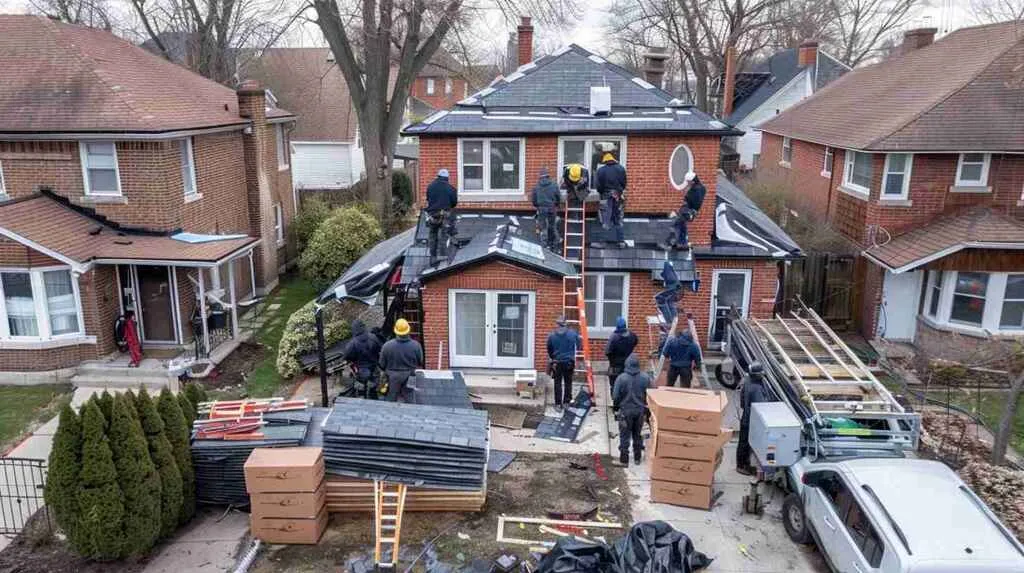
Hip Roof Shingle Installation Queens NYC – Four Sides, Done Right
Clockwork – that’s how a well-planned hip roof in Queens behaves when all four sloping sides work together as one system, not as four separate guessing games. The truth is, those four faces don’t cost you extra effort if they’re sequenced correctly, and they can actually cut your long-term leak repair bills in half once you understand how water really moves across those angled planes. I’m going to walk you through exactly how I lay out, cut, and cap a hip roof so it reads clean from every sidewalk angle and stays dry backstage, where it matters.
Why Hip Roofs in Queens Don’t Have to Mean Extra Headaches
One July afternoon around 3:30 p.m., we were on a hip roof in Jamaica Estates, and a surprise thunderstorm rolled in while we were mid-way through shingling the windward hip. The previous contractor had left the hip caps barely overlapped, so water was practically invited inside during heavy rain. I remember yelling over the thunder to my crew to prioritize sealing the hip ridges first, not the main slopes, because once that sideways rain hit, those lines were the highway straight into the living room. The homeowner watched from the window as we tarped only the leeward side and methodically finished the hip caps – she later told me the old leak spot stayed bone dry for the first time in years. Here’s my blunt take: too many roofers treat the hip and ridge caps as an afterthought, like decorative trim instead of the load-bearing structural spine they actually are, and I refuse to sugarcoat how bad that is for your house. I think about a hip roof like a stage set – you’re building four angled faces that have to read clean from the sidewalk front row and from the Google Maps balcony view, which means the hip lines and shingle stagger have to look intentional from every camera angle.
A typical Queens hip roof – the kind you see on semi-detached brick houses off Northern Boulevard, two-story colonials in Jamaica Estates, or chopped-up multi-families in Elmhurst – collects and sheds water differently than a simple gable. Where a gable funnels rain straight down two faces, a hip roof has four slopes meeting at hips and ridges, and those seams become express lanes for water when sideways rain blows in off the East River or Long Island Sound. If your roofer doesn’t plan the hip caps and shingle overlap to channel water away from those intersections, you’re setting yourself up for leaks at the exact spots that are hardest to repair later.
When I plan a hip roof installation, I’m obsessed with symmetry – not just because it looks better from the street, but because a coordinated four-face system means water moves predictably, shingles wear evenly, and you won’t be calling me back in three years to patch mystery stains. The four sides aren’t a problem if they’re treated as one continuous puzzle, and honestly, a well-executed hip roof usually gives me fewer callback visits than gable roofs where homeowners skip valleys and flashing work.
| Aspect | Hip Roof in Queens | Gable Roof in Queens | What I Do Differently on a Hip |
|---|---|---|---|
| Water Movement | Four slopes meet at hips/ridges; sideways rain follows these seams directly into framing if caps aren’t overlapped tight | Two slopes; water runs straight down to gutters; fewer intersection points | I seal hip caps before field shingles, using double the underlayment at every hip seam and treating windward hips as priority one |
| Planning Approach | Must snap chalk lines from peak down each hip to control shingle stagger and alignment on all four faces | Simpler layout; usually two rake edges and one ridge line to manage | I measure diagonally from each corner to the peak to confirm symmetry, then lay out shingles so cuts mirror across opposite hips |
| Long-Term Leak Risk | Higher risk at hip intersections if decking is old or if previous overlay hid rot; fewer exposed gable ends means less wind-driven rain enters attic | Gable ends can let wind-driven rain into attic vents; fewer internal seams but more exposure to lateral weather | I always tear off to inspect decking at every hip junction – overlays on hip roofs are a time bomb because they hide triangular rot pockets |
| Aesthetic & Curb Appeal | Four visible faces from most angles; crooked shingle lines or mismatched caps show up immediately from sidewalk and neighbor windows | Two main faces; easier to hide small alignment mistakes on less-visible rake sides | I plan hip cap color and shingle stagger for how the roof reads from the front curb, side alley, and Google satellite view – it has to look intentional from every “seat” |
Quick Facts: Hip Roof Shingle Installation in Queens, NY
- Typical Project Duration: 2-4 days for most Queens single-family hip roofs, depending on weather, decking repairs, and number of hips/valleys
- Replacement Age Threshold: Most asphalt shingle hip roofs in Queens hit critical condition around 18-22 years, earlier if hip caps were installed incorrectly the first time
- Priority Areas on a Hip Roof: Hip ridges and the peak ridge itself – these seams shed more water per square foot than the field shingles and are the first to fail if nailing or overlap is rushed
- Botched Hip Cap Callbacks: I get called to fix poorly installed hip caps about once every three weeks, usually because the previous crew skipped underlayment or used roofing cement instead of proper overlap
How I Lay Out Hip Roof Shingles So the Four Sides Work Like Clockwork
Picture me on a March morning, blue chalk line in one hand, coffee in the other, running that line from the peak down each hip to control how every single shingle sits. On a freezing January morning at 7:00 a.m. in Astoria, I had a landlord who insisted we “just lay shingles over the old ones” on his small hip roof to save a buck. When I pulled back the existing hip ridge, the decking had rotted in a perfect triangle where three planes met – like a black, soft crater right where all the water converged. I made him walk up halfway on the ladder and shine a flashlight into that hole so he could see his tenant’s bedroom light through the deck. That was the day he stopped arguing about “overlay vs. full tear-off” on a hip roof, because he realized the corners and hip lines were literally disappearing under his feet. In dense Queens neighborhoods – Astoria, Sunnyside, Woodside – you see a lot of 1940s-60s housing stock where the original hip framing is settling, and those triangular intersections are exactly where moisture gets trapped and decking goes soft first.
Once the deck is solid and I’ve snapped my chalk lines, I’m thinking in 3D: how does each shingle course on the north face line up with the shingle on the east face when they meet at that hip seam? I nail the field shingles working up toward the hip, not down, so every course supports the one above it and water can’t back-track under a seam. Here’s an insider tip most roofers won’t mention: on a hip roof, you never trust the old hip line or the existing framing angle to be true – you trust your chalk and your level, because even a quarter-inch drift over twelve feet makes your hip caps look crooked from the sidewalk, and that’s the kind of thing neighbors notice and bring up at the next block party.
My Step-by-Step Process for Hip Roof Shingle Installation in Queens
- Inspection & Tear-Off: I pull off all existing shingles and underlayment, then inspect every inch of decking at hip intersections, valleys, and ridge – any soft spots get replaced with new plywood before I roll out a single square of felt.
- Chalk Line Layout: From the very peak, I snap a chalk line down each of the four hips to establish a visual guide – this controls shingle alignment and ensures cap shingles will sit straight, even if the framing underneath is slightly crooked.
- Underlayment & Ice-and-Water Shield: Double-layer ice-and-water shield goes along every hip seam and the entire ridge, because those are the highways for leaks; standard felt covers the field, overlapped uphill by at least four inches.
- Field Shingle Installation: Starting at the eaves and working up toward each hip, I stagger shingles so no two seams align vertically, nailing in the high-wind zone recommended by the manufacturer – on windward hips facing the East River, I add an extra nail per shingle tab.
- Hip & Ridge Cap Installation: I cut and bend hip cap shingles to follow my chalk line, overlapping each cap by at least five inches and nailing on both sides of the fold so wind can’t peel them back – this step happens before I consider the main roof “done.”
- Final Inspection & Cleanup: I walk the perimeter at ground level to check sightlines from every angle, then sweep gutters, magnet-sweep the driveway, and take photos of completed hip caps to add to my project binder.
Warning: The Risk of Overlaying Shingles on a Queens Hip Roof
Laying new shingles over old ones on a hip roof is like putting a fresh coat of paint over a water-damaged wall – it looks fine for six months, then everything underneath keeps rotting. Hip intersections are where moisture gets trapped first, and an overlay hides those triangular pockets of rot until the new shingles start sagging or you see water stains inside. Most shingle manufacturers void their warranty if you overlay on a hip roof, and I’ve personally pulled back “like-new” overlays to find decking so soft I could push my thumb through it. If a landlord or flipper is pushing you to overlay to save a thousand bucks, you’re trading short-term savings for a guaranteed callback – and probably a bigger bill – within three years.
Making Crooked Framing Look Straight From Every Angle
If you’ve ever folded an origami box, you already understand why hip roof shingle installation in Queens can either be art or chaos. I’ll never forget an evening job in Richmond Hill where we were rushing to finish hip shingle installation before Ramadan iftar for the family inside – they’d invited us to eat with them if we got done in time. The original builder had misaligned the hip framing, so every shingle line wanted to run crooked toward the backyard. I spent an hour up there, kneeling on the ridge at sunset, snapping chalk lines from the very peak down each hip to “fake” visual straightness so the cap shingles would look even from the street. When we climbed down just as the call to prayer played softly from a neighbor’s window, their dad pointed up and said, “Now that looks like somebody planned it,” and that meant more to me than the check. Here’s an insider tip I don’t usually share: on a hip roof, I plan for how the shingles and cap lines read from the street, not just from the ridge – I’ll actually walk to the sidewalk three or four times during the job to check sightlines, because what looks perfect from on top can look wavy or crooked from the front curb if you didn’t account for perspective.
I think about a hip roof from three “camera seats” – the sidewalk front row, where your neighbors and every delivery driver see it; the Google Maps balcony view, where that satellite photo will live forever; and the backstage interior, where water actually does its damage. The hip cap alignment and shingle stagger have to work for all three audiences, especially on those tight Queens lots where your neighbor’s third-floor bathroom window is staring directly at your hips. A rushed job focuses only on keeping water out (backstage), but a camera-aware layout makes sure your roof looks intentional and professional from every angle, which matters when you’re trying to sell or refinance.
What Hip Roof Shingle Installation Really Costs in Queens
$9,500 is about where a lot of Queens hip roof replacements land for a typical 1,600-square-foot single-family house with moderate pitch and standard architectural shingles, but that number moves up or down depending on how many hips and valleys you’re working with, what we find when we peel off the old shingles, and whether you want basic three-tab or a premium laminated line. Spending the extra money on proper hip and ridge cap work – double underlayment, quality cap shingles, careful nailing – usually saves you three or four leak repair service calls over the next ten years, which pencils out to real savings even if the up-front number feels higher than a gable roof quote.
Before You Call About Your Queens Hip Roof
When I sit at your dining table and sketch your roof, the first thing I ask is, “Where have you seen stains or bubbling paint inside?” – not “What does the roof look like from outside?” I care way more about where water is ending up in your house than what the shingles theoretically should be doing, because a roof is only as good as the drywall and insulation it’s protecting. Here’s my unfiltered opinion: if your roofer doesn’t ask about interior symptoms or won’t climb into your attic to trace a stain, they’re guessing about the source and you’re rolling the dice on whether the repair actually fixes anything.
The weird truth about Queens hip roofs is that the prettiest ones are usually hiding the ugliest shortcuts underneath. I see it all the time in Forest Hills, Bayside, and Jamaica – immaculate curb appeal, fresh paint, manicured hedges, and then I pull up one hip cap and find three layers of mismatched shingles, zero underlayment, and decking that’s been wet for years. Being honest with me about past leaks, band-aid patches, and how many roofers have “fixed” the same spot helps me design a hip shingle layout that finally closes the loop on those recurring issues, instead of just cosmetically covering them up for another two years.
Before You Call Shingle Masters: Hip Roof Checklist
- Interior Signs of Leaks: Note any ceiling stains, bubbling paint, musty smells, or water marks in the attic – these tell me exactly which hip or valley is failing
- Photos to Take: Shoot your roof from all four sides of the house at ground level, plus any visible damage to shingles or hip caps from a second-story window
- Access Considerations: Check if your driveway can fit a dumpster, whether side gates are wide enough for material staging, and if overhead wires will interfere with ladder placement
- Previous Repair Records: Dig up any old invoices or notes about past roof work – knowing what’s been patched (or overlaid) saves me time and saves you diagnostic fees
- Age of Current Roof: If you know roughly when the shingles were installed, that helps me estimate how much decking damage to expect at the hips
- Attic Inspection (If Possible): If you can safely get into your attic with a flashlight, look for daylight coming through the roof deck or wet/dark stains on the underside of the plywood near the peak
- HOA or Landmark Rules: Some Queens co-ops and historic districts have shingle color or style restrictions – let me know up front so I can plan around them
Common Questions About Hip Roof Shingle Installation in Queens
?
Do hip roofs cost more than gable roofs to shingle in Queens?
?
How long does a hip roof shingle installation take in Queens?
?
Can you install hip roof shingles in winter in Queens?
?
How does ventilation work on a hip roof compared to a gable?
?
What kind of warranty do you offer on hip and ridge work?
Why Queens Homeowners Trust Shingle Masters for Hip Roofs
Fully Licensed & Insured in NYC: All permits, liability coverage, and workers’ comp in place for every job
19+ Years Shingle Experience: Lena has shingled hundreds of Queens hip roofs, from Jamaica to Bayside
Same- or Next-Day Leak Response: Existing customers get priority scheduling for emergency hip cap repairs
Photo & Sketch Documentation: Every hip project gets a hand-drawn layout sketch and before/after photos for your records
Transparent Pricing: Written estimates with line-item breakdowns for decking, underlayment, shingles, and labor – no surprise charges
A hip roof in Queens is a three-dimensional puzzle that demands intentional planning, not guesswork or speed. When those four sloping faces are treated as a single coordinated system – with hips and ridges prioritized, chalk lines snapped from every peak, and shingle courses staggered to read clean from the sidewalk and the satellite view – you end up with a roof that performs backstage and looks right from every audience seat. If you’re ready to have your hip roof sketched, planned, and shingled so it actually works like clockwork, call Shingle Masters and let’s walk through your project together, starting with where the water’s been ending up and working backward to the four slopes that should have been stopping it all along.