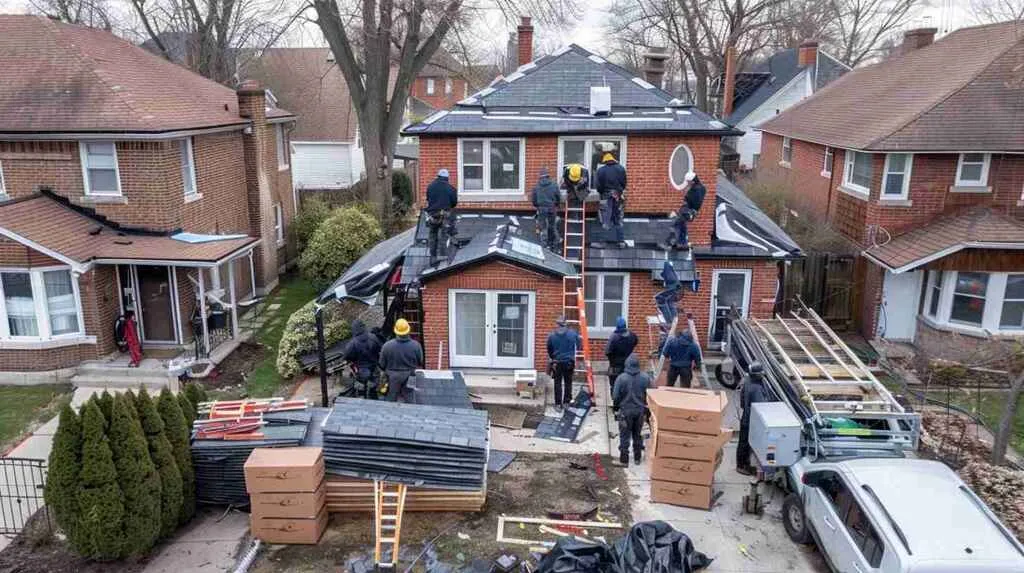
When Does a Shingle Roof Need Replacing Queens NY – Signs to Know
Picture this: you’re standing in your living room in Corona, staring at a fresh coffee-colored stain spreading across the ceiling, and your first thought is “the roof must need replacing.” Here’s the truth I learned after 19 years on Queens roofs-if you’re waiting to see water on your ceiling before thinking about a new shingle roof, you’re already several years late in Queens’ climate. When I walk a customer’s property, the first question I ask them is, “If I poured a bucket of water on this section, where do you think it would go?” Because that’s exactly how I read every roof: by following where the water wants to go and spotting the patterns that tell me a shingle system has quietly timed out, years before that first drip hits drywall.
Early Warning Signs Your Queens Shingle Roof Is Done (Before It Leaks)
When I walk a customer’s property, the first question I ask them is, “If I poured a bucket of water on this section, where do you think it would go?” I’m not being cute-I literally mean it. Water on a roof doesn’t think or plan; it just follows the path of least resistance, and on a Queens shingle roof that’s working right, that path is down the slopes, into the gutters, and away from your house. But when shingles start to fail, they create new paths-little highways that send water sideways under tabs, through cracks, into valleys where it shouldn’t pool. My opinion, after nearly two decades fixing roofs from Jackson Heights to Bayside: waiting for an indoor leak in Queens is like waiting for your car to break down on the BQE before you check the oil. The shingles are telling you the truth years earlier if you know what to look for.
One August afternoon in Woodside, about 4:30 p.m. when the sun was beating on the west-facing slope, I was on a two-story colonial where the owner swore the roof was “fine because it wasn’t leaking.” I knelt down, pressed on a shingle, and it literally crumbled into my glove like old toast. I showed him the granules piled in the gutter-looked like a strip of gray beach sand-then thumped the decking and heard that hollow sound that tells me the wood is starting to rot. That job taught me that by the time a Queens roof leaks inside, the outside has been screaming for years. What looked like a simple shingle problem from the sidewalk turned into a full tear-off and deck repair because water had been quietly working its way through bald spots and cracked tabs for at least three seasons, maybe more.
So what do those early screams look like? Heavy granules in your gutters after every rain-not just a sprinkle, but enough to feel gritty when you scoop them out. Shingles that crack or feel brittle when you press them with your thumb, especially on south- and west-facing slopes that bake all summer in neighborhoods like Richmond Hill and Jamaica. Soft or bouncy spots when you walk the roof, which means the decking underneath is already compromised. Sun-beaten patches where shingles look almost polished, with no texture left-that’s the asphalt core exposed, and once you see that along a valley or near a chimney, you’re not patching, you’re planning a replacement. All of these signs map directly to where water wants to go: down slopes, into valleys, around penetrations. When those paths start to fail, the water just finds a new one-usually straight through your roof.
✓ Early “Roof Is Done” Clues You Can Spot From the Sidewalk or a Ladder in Queens
- ✅ Granules piling up in gutters and downspouts after every storm-means shingles are losing their protective layer and water will hit bare asphalt, accelerating cracks and leaks along the entire slope.
- ✅ Shingles curling or cupping at the edges, especially on the sunny sides-tells you thermal cycling has broken the adhesive bond, and water will now run sideways under those lifted edges straight to the underlayment.
- ✅ Bald, smooth-looking patches where shingles have lost all their granules-water on bare asphalt accelerates decay, and these spots almost always appear first in valleys and around chimneys where flow is heaviest.
- ✅ Random cracked or missing tabs scattered across multiple roof planes-not storm damage in one area, but widespread brittleness that says the shingles have aged out and won’t hold nails or seal properly anymore.
- ✅ Soft, spongy, or bouncy feeling when you walk certain sections-indicates the decking below has absorbed water through failed shingles and is rotting, which means replacement, not a surface patch.
- ✅ Daylight visible through the roof boards when you’re in the attic-means gaps have opened between shingles or decking, and water is already running paths you can’t see from above until the next hard rain lights them up on your ceiling.
| Myth | Fact (Queens Reality) |
|---|---|
| “No leaks inside means my roof is fine” | By the time water shows up on your ceiling in Queens, shingles have usually been failing for 2-4 years, and you’re often looking at deck repair, not just shingle replacement. The shingles tell the story first. |
| “I can just keep patching the same spot every year” | Recurring leaks in the same valley, chimney, or wall mean the shingles and underlayment in that water path are done. Patching over it just hides the problem while freeze-thaw cycles and summer sun keep making it worse underneath. |
| “Granules in the gutter are normal forever” | You’ll see a little granule loss in the first year or two of a new roof, but if you’re scooping handfuls of gritty sediment every spring and fall on a roof that’s 15+ years old, those shingles have lost their UV protection and are aging fast, especially on sun-blasted south and west slopes common in Queens. |
| “If shingles are still lying flat, they’re okay” | Flat doesn’t mean functional. I’ve pulled up perfectly flat-looking shingles in Flushing and Bayside that were so brittle they snapped in half, with zero granules left and underlayment underneath turning to dust. Queens wind and thermal stress break down the asphalt core long before the shingles visibly curl. |
How to Know If Your Shingles Are Beyond Repair
I’ll never forget a windy November morning in Bayside when I got called by a landlord who was furious because “the last roofer must’ve screwed up” after shingles blew off in a nor’easter. When I climbed up, I saw three different layers of shingles-one over another over another-like a roofing lasagna from the 80s, 90s, and early 2000s. The top layer was curling and brittle, nails were barely biting into the multiple layers beneath, and the whole thing moved under my feet. That’s when I started telling every customer: when you see one loose shingle on a triple-layer sandwich, you’re not doing a patch-you’re doing a replacement. It’s not just about the visible damage; it’s about the fact that NYC code caps you at two layers, and trying to nail new shingles into that kind of mess is like trying to hang a picture on a crumbling plaster wall. A lot of older two- and three-family homes in Corona, Elmhurst, and Bayside ended up with these multi-layer situations because for decades, the cheap option was “just cover it up.” Now those roofs are hitting 20-30 years total, and there’s no repair that makes sense-you strip it all, inspect the deck, and start fresh.
So when is replacement the only smart move? More than two layers already puts you in mandatory tear-off territory by city code, and honestly, even two layers make me nervous if the bottom one is rotted or the deck is soft. Large areas of curling, cracking, or blistering across multiple slopes-not just one small section hit by a branch-signal that the entire batch of shingles has aged out and lost flexibility. Shingles that won’t stay sealed or keep lifting after you press them down mean the adhesive strips have failed, which happens in Queens around the 18-22 year mark depending on how much sun and ventilation the attic gets. Widespread looseness after a nor’easter, where tabs are flapping on three or four different roof planes, tells me the nails aren’t holding anymore because the shingles have become too brittle. And any roof where you can feel movement, sponginess, or soft spots under your feet? That’s not a shingle issue-that’s a deck issue, and you’re looking at a full tear-off to fix it right.
| Roof Condition in Queens | What It Usually Means | Recommended Action |
|---|---|---|
| 5-8 missing or damaged shingles in one area after a storm | Isolated wind or impact damage; rest of roof still sound | Repair/patch – replace damaged section and inspect underlayment |
| Shingles curling or cracking on multiple slopes, roof 15+ years old | Widespread age-related failure; asphalt has become brittle | Full replacement – patching won’t stop the pattern from spreading |
| Two or three layers visible when you lift a shingle edge | Violates NYC code (max 2 layers) and adds dangerous weight; nails won’t hold | Mandatory tear-off and replacement – no patching allowed by code |
| Heavy granule loss in gutters, bald spots near valleys/chimneys | Shingles losing UV protection in high-water-flow areas; underlayment exposed to sun and rain | Full replacement – once granules are gone, decay accelerates fast |
| Soft, bouncy, or sagging sections when you walk the roof | Decking has absorbed water and is rotting; structural issue beneath shingles | Full replacement + deck repair – surface fixes won’t address hidden rot |
A roof that looks “tired” from the sidewalk is almost always already letting water into the system somewhere.
Reading Leak Patterns: What Your Ceiling Stain Is Really Telling You
There was a job in Flushing on a quiet Sunday morning after a storm where the homeowner kept asking for “just a quick fix around the chimney” because of a little ceiling stain. I got onto the roof and saw the shingles around the chimney were basically polished smooth-no granules left-like someone had sanded them with a machine. I followed the pattern down-slope and found a long valley where water had been rushing for years, slowly eating the shingles away. We pulled a few pieces up and the underlayment literally tore like wet tissue. That experience is why I always tell people: those “mysterious” indoor stains almost always have a very clear story written on the shingles if you know how to read them. The stain isn’t the problem-it’s the last chapter of a story that started years earlier when water found a weak shingle, a worn valley, or a poorly sealed penetration and started quietly carving a path. Here’s an insider tip I share with every homeowner in Queens: after any storm, go outside and visually check the shingles directly below your chimney and in the valleys where two roof planes meet. If you see smooth, bare, or patched shingles in those spots, you’re looking at the true source of current or future ceiling stains, not some mysterious phantom leak.
Follow the Water: Simple At-Home Test to Trace a Ceiling Stain Back to Roof Trouble Spots
⚠️ Why Repeatedly Caulking Around Chimneys and Vents in Queens Can Quietly Destroy Your Roof
Surface caulk and tar patches crack and shrink during Queens’ freeze-thaw cycles, actually trapping water behind them instead of keeping it out. They hide the real problem-failing shingles and deteriorating flashing-so homeowners keep slapping on another layer every spring while the underlayment and decking underneath rot away. Any chimney, vent, or valley stain that has come back more than once after a “patch” is a major red flag that the shingles and flashing in that water path are done, and it’s time to stop hiding the problem and replace the roof before you’re also replacing ceiling drywall and roof framing.
Queens Weather vs. Shingle Roof Lifespan: What’s Normal Wear Here?
Here’s the part nobody likes to hear, but Queens weather doesn’t care about our feelings: the “30-year shingle” on the package is tested in a lab, not on a south-facing slope in Richmond Hill that bakes at 160°F all July and August, then freezes and thaws 40 times between December and March. In real Queens conditions-hot summer sun that cooks the asphalt, winter freeze-thaw that cracks it, coastal winds coming off the Rockaways and up through Bayside and Whitestone that lift tabs and drive rain sideways-you’re looking at a practical lifespan closer to 18-25 years depending on a bunch of factors most people never think about. West-facing slopes in Jamaica, Woodhaven, and Ozone Park get pounded by afternoon sun year-round and age faster. Roofs with poor attic ventilation trap heat underneath and literally cook the shingles from below, cutting years off their life. And if your house is near open water or parkland where wind has a clear run-think Breezy Point, Rockaway, parts of Bayside near the bay-you’re dealing with higher wind loads and salt exposure that accelerate granule loss and shingle brittleness.
So what does normal aging look like versus accelerated failure? Normal is minor, even color fade after 10-12 years, especially on the sunny side. A few granules washing into the gutters in year one or two, then tapering off. Maybe one or two tabs lifting slightly after a big nor’easter on an otherwise healthy 15-year-old roof-you patch those and move on. Accelerated failure is widespread bald spots where whole sections of shingles have no granules left, especially in valleys, along edges, and around chimneys. Random broken or missing tabs scattered across three or four different roof planes, not clustered in one storm-damaged area. Shingles that lift all along a ridge or hip even though there was no recent wind event, which means the adhesive has given up and thermal movement is doing the damage now. When you start seeing these patterns on a roof that’s 18+ years old in Queens, you’re not looking at a few bad shingles-you’re looking at a roof that’s telling you it’s done.
Typical Queens Shingle Roof Timeline and What to Watch For Each Stage
Years 0-10: New Roof, Basic Storm Checks
After any major storm or high wind, do a quick visual from the ground and check gutters for excessive granule loss (a little is normal in year one). Focus on valleys and chimneys-these are where water flows hardest and problems show up first, even on young roofs with installation issues.
Years 10-15: Start Annual Attic and Shingle Checks
Inspect your attic once a year for any daylight coming through the boards or dark stains on the underside of the decking. From outside, look for early curling on sun-exposed slopes (south and west in Queens) and check that shingles are still lying flat and sealed. This is when poor ventilation starts to show its effects.
Years 15-20: Plan for Replacement, Especially If Ventilation Is Poor or Slope Faces South/West
Get a professional inspection and start budgeting. Check for widespread granule loss, brittleness (shingles that crack when you press them), and any recurring small leaks around chimneys or valleys. If your attic gets super-hot in summer or you’ve had multiple patches, you’re likely in the replacement window.
Years 20+: Assume You’re on Borrowed Time and Budget for Full Replacement
Even if you don’t see leaks yet, a 20+ year shingle roof in Queens is living on borrowed time. Pay close attention to valleys, eaves, and anywhere two roof planes meet-these high-stress areas fail first. Any new damage or leak at this age is almost always a sign to replace, not patch, because the whole system is near the end.
Quick Decision Guide: Does Your Shingle Roof Need Replacing in Queens, NY?
Look, I get it-nobody wants to drop fifteen or twenty thousand dollars on a new roof if they can avoid it, and I respect homeowners in Queens who do their homework and ask tough questions before they commit. But here’s what I’ve learned after nearly two decades following water paths across roofs from Astoria to the Rockaways: layering patches and ignoring clear patterns in Queens almost always costs you more in the long run, because by the time you admit the roof is done, you’re often fixing rotted decking, moldy insulation, and water-damaged ceilings on top of the shingle replacement itself. The smartest thing you can do is get a real inspection-and I mean one where someone actually walks every slope and goes into your attic with a flashlight, not a drone flyover or a guy with binoculars from the driveway. That’s the only way to know for sure whether you’re patching storm damage on a fundamentally sound roof or putting Band-Aids on a system that’s quietly failing from the shingles down to the wood.
Should You Replace Your Queens Shingle Roof or Keep Patching?
Start here: Is your roof 18+ years old, or older than you know for certain?
→ YES: Do you see curling, cracked, or bare shingles on more than one side of the house (not just isolated storm damage)?
→ YES: Strong candidate for full replacement – call Shingle Masters for an inspection
→ NO: Have you had 2 or more leaks or patches in the last 2 years, especially in valleys or around chimneys?
→ YES: Likely replacement – recurring leaks signal system failure
→ NO: Get a professional roof and attic inspection within 30 days
→ NO (roof is under 18 years): Is the damage limited to one small storm-hit area (e.g., 5-8 shingles on one slope)?
→ YES: May be a good candidate for targeted repair and monitoring
→ NO (damage is scattered or widespread): Schedule full inspection to determine if it’s pattern failure or multiple isolated issues