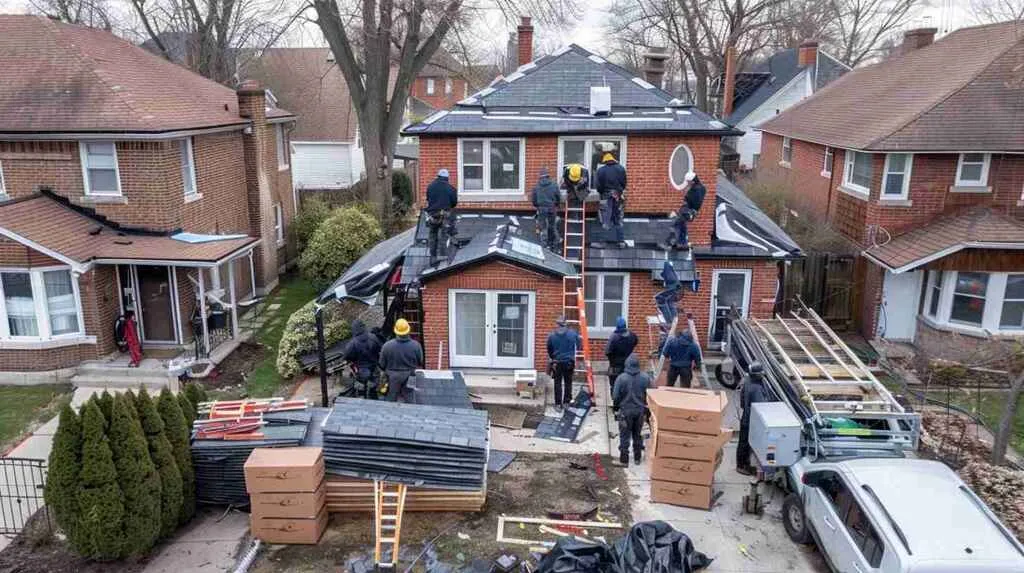
Work on a Steep Shingle Roof Queens NY – Safety Protocols Used | Call Today
Harnessed to a ridge anchor before my boot even touches the first shingle-that’s how I start every steep roof job in Queens, and honestly, if you skip that first clip-in, nothing else I say matters because you won’t be around to finish the job. Over 19 years on roofs, I’ve broken down steep-slope safety and work into what I call Level 1 (basic survival), Level 2 (efficient work without dying), Level 3 (protecting everyone around you), and the Boss Fight (Queens-specific chaos like wind tunnels between buildings and narrow side yards), and that’s exactly how I’m going to walk you through how to work on a steep shingle roof safely.
Level 1: Clip-In Safety Basics on Steep Shingle Roofs in Queens
On a 10/12 pitch in Queens, the first thing I think about is not shingles-it’s my anchor point. Here’s my honest take: if you’re asking how to work on a steep shingle roof, you should be asking how to not fall off it first, and I’ll turn down any job where Level 1 safety isn’t possible, even if it costs me money. Safety isn’t a step I add after setting up the ladder-it’s the step that decides whether I even take the job.
One January morning, just after sunrise, I was on a crazy steep Tudor in Forest Hills with frost still on the north slope. The homeowner was in a rush because they had a home inspection at 11 a.m. and wanted me to “just get it done.” I stopped, walked back down, and made them wait an extra hour so I could rig a proper ridge anchor and let the frost burn off. That decision probably saved my life-I watched a loose shingle slide past me like a hockey puck fifteen minutes later while I was clipped in. That’s what Level 1 is: the non-negotiables that keep you from sliding down a roof like freight on rails.
Before I take a single step onto any steep shingle roof in Queens, six things have to be in place: a solid ridge anchor that’s tested to hold my weight plus impact load, a properly rated harness that fits correctly (not your buddy’s old construction belt), a shock-absorbing lanyard clipped and locked before I step up, a ladder angled at 4:1 and tied off at the top, slip-resistant footwear with clean soles, and weather conditions that allow safe work-no frost, no heavy rain, no gusty wind. If any one of those is missing, the work doesn’t start, period.
✓
Level 1: Non-Negotiable Safety Setup Before Stepping on a Steep Roof
Ridge anchor tested and secured – must support 5,000 lbs and be inspected before every use
Full-body harness fitted correctly – leg straps snug, D-ring between shoulder blades, no twists in webbing
Shock-absorbing lanyard clipped in – before your first step onto the roof, not after you’re already up there
Ladder angled 4:1 and tied off – ladder feet on solid ground, top secured to prevent shifting
Slip-resistant footwear with clean soles – no grease, no wet grass, no mud transferred onto shingles
Weather conditions safe for work – no frost, no rain, no wind gusts over 25 mph, clear forecast for next 3 hours
What Happens If You Skip the First Clip-In
I’ve watched too many near-misses and actual falls in Queens over 19 years, and the most common failures all start the same way: someone climbs onto a steep shingle roof thinking they’ll “just clip in once they get up there” or “only be up for a minute.” Here’s what actually happens in those split seconds:
Ladder slips while you’re transitioning – your weight shifts, the ladder feet slide on pavement or grass, and you’re suddenly holding onto thin air with nothing stopping your slide down 30 feet of shingles.
Surprise frost or dew you didn’t notice from the ground – the north slope gets no sun until 10 a.m. in winter, and that thin layer of ice turns every shingle into a toboggan run.
Loose or brittle shingles act like roller skates – you step on a curled tab or a granule-bare spot, it gives way under your boot, and gravity takes over before you can react.
Overconfidence on a “familiar” roof – I’ve seen guys who’ve been on the same house three times fall on the fourth because they skipped one safety step, thinking muscle memory would save them. It doesn’t. These failures cause broken bones, shattered ankles, cracked ribs, traumatic brain injuries, and worse-all in the time it takes to say “I should’ve clipped in first.”
Level 2: How I Actually Work on a Steep Shingle Roof (Step by Step)
In late July two summers ago, around 3 p.m., I was re-shingling a 12/12 pitch in Astoria when a summer storm rolled in faster than the forecast claimed. I’d already set up roof jacks and planks, but the wind hit sideways so hard it tried to peel my harness lanyard off the anchor. I called the crew down immediately and we spent twenty minutes just safely bagging tools and locking down tarps while the homeowner watched from the window, clearly annoyed we stopped. The next day she told me her cousin’s roofer broke an ankle in a similar storm because he “just wanted to finish one more row.” That’s Level 2 in action-moving from basic survival to efficient, smart work that respects the fact that speed never beats stability on a steep roof. I set roof jacks every four feet, run planks across them to create stable platforms, and stage all my tools within arm’s reach so I’m not constantly bending, reaching, or shifting my weight in ways that could throw me off balance.
Here’s the thing about Queens: the weather changes fast, the streets are narrow so wind funnels between buildings unpredictably, and a 10/12 pitch in Forest Hills behaves totally differently than the same pitch in Astoria because of how the surrounding houses block or channel gusts. I’ve learned to sequence my work around those patterns-starting on the leeward side in the morning, keeping an eye on the sky every twenty minutes, and never pushing a work window just because the forecast says “partly cloudy.” That’s Level 2: you’re not just clipped in anymore, you’re thinking three steps ahead about how the job flows, where you’ll be when the wind picks up, and whether you can finish a section safely before conditions change.
Level 3: Protecting People Below and Your Property Around the Roof
I’ll never forget a Saturday evening in Bayside, working for an older couple who insisted on staying in the yard to “keep an eye on things.” The husband kept trying to stand right below the eave while we were stripping an old, steep roof. At one point, a pry bar slipped and clanged down onto the debris net instead of his shoulder-because I had insisted on setting that net even though it added an extra hour to the setup. I climbed down, showed him the dent in the netting, and he just went quiet and moved his lawn chair back ten feet without another word. That’s Level 3: you’re not just thinking about your own safety anymore, you’re protecting everyone and everything under the eaves-neighbors, kids, pets, cars, siding, AC units, landscaping. A steep roof in Queens isn’t just dangerous for the guy on it; it’s dangerous for anyone within 15 feet of the drip edge when you’re tearing off shingles, prying up flashing, or dropping bundles.
Queens lots are tight-most houses have maybe six feet between the driveway and the neighbor’s fence, cars parked right under the eaves, kids’ play equipment in the side yard, and central air condensers sitting directly below where old shingles are coming off. I’ve learned to walk the perimeter before we even bring tools out of the truck, asking homeowners to move cars, warning neighbors we’ll be working above their yard between certain hours, taping off walkways with bright caution tape, and setting plywood shields over anything fragile. Here’s an insider tip: before your roofer starts stripping a steep slope, ask them exactly how they’re protecting the areas below-if the answer is vague or they seem annoyed by the question, that’s a red flag. I’ve had homeowners thank me for moving their garbage cans, covering their hydrangeas, and putting a tarp over their deck furniture, because the previous roofer left dents in their siding and cracked a basement window with falling debris.
✓
Level 3: Protection Steps Victor Uses on Queens Steep Roofs
Debris netting along the eaves – catches falling shingles, nails, and tools before they hit people, cars, or landscaping below
Plywood shields over AC units and fragile features – prevents dents, scratches, and expensive damage to condensers and siding
Caution tape around walkways and side yards – keeps homeowners, neighbors, and delivery drivers out of the fall zone
Tool tethers and bucket lanyards – every hammer, pry bar, and utility knife clipped to prevent them from sliding or dropping off the roof
Direct communication with neighbors before starting – knock on doors, explain the timeline, and ask them to keep kids and pets inside during tear-off
Boss Fight: Queens-Specific Steep Roof Hazards and How We Beat Them
Think of a steep roof like a black diamond ski slope-nobody starts there without training, the right gear, and a plan for how to stop. In Queens, you’re not just dealing with the pitch; you’re dealing with sudden wind tunnels created when gusts squeeze between row houses, older framing on pre-war Tudors and colonials that might have weakened sheathing or unexpected rafter spacing, narrow alleys where you can’t stage a dumpster or even park your truck close to the house, and busy sidewalks where you’re legally liable if a shingle flies off and hits someone. This is the Boss Fight-the part where local experience separates a crew that knows what they’re doing from one that’s just winging it and hoping nothing goes wrong.
One slip on a Queens steep roof is not a scare-it’s an ambulance. That’s why Boss Fights are never played on “easy mode.”
✓
Why Queens Homeowners Trust Shingle Masters on Steep Roofs
Licensed and insured in New York State – full liability coverage specifically for steep-slope roofing work, so you’re never on the hook if something goes wrong.
19+ years of personal steep-roof experience – Victor has worked on hundreds of steep shingle roofs across Queens, from Tudors in Forest Hills to colonials in Bayside to row houses in Astoria.
Same-day or next-day response for most Queens addresses – we know the neighborhoods, the traffic patterns, and how to get to your house fast when you need an urgent inspection or repair.
Neighborhoods we serve regularly – Forest Hills, Astoria, Bayside, Jackson Heights, Flushing, Rego Park, Kew Gardens, Fresh Meadows, Whitestone, and everywhere in between.
Level 1-Boss Fight safety protocols on every job – we don’t skip steps to save time, and we won’t start work if conditions aren’t safe. Your roof, your family, and our crew all matter.
Should You Try It Yourself or Call a Steep-Roof Pro in Queens?
Blunt truth: gravity does not care how experienced you are or how many roofs you’ve done. If you’re a homeowner thinking about climbing onto a steep shingle roof in Queens to save a few hundred dollars, ask yourself if you own a tested ridge anchor, a full-body harness that fits correctly, a shock-absorbing lanyard, roof jacks, planks, tool tethers, and debris netting-and whether you know how to use all of that gear correctly under pressure when the wind picks up or a shingle gives way under your boot. Most people don’t, and that’s not a criticism; it’s just reality. For the vast majority of Queens homeowners, calling a pro like Shingle Masters means the difference between a job done safely in a day and a trip to the ER that costs ten times more than the roof ever would have.
Here’s the thing: even if you have the gear and the knowledge, steep roofs in Queens come with Boss Fight-level hazards-wind funnels, tight lots, old framing, and liability for anything that falls onto a sidewalk or neighbor’s property. The peace of mind you get from hiring someone who’s climbed those pitches hundreds of times, who carries the right insurance, and who won’t cut corners when the forecast changes is worth every dollar. Don’t risk a fall, a lawsuit, or a half-finished job because you thought you could wing it.
Steep Shingle Roof Safety and Service Questions in Queens
Do you ever work on steep roofs when they’re wet or icy?
No, absolutely not. Wet shingles are slippery enough on a flat roof; on a steep pitch, they’re a guaranteed slide. Ice or frost is even worse-it turns every step into a gamble. I’ve turned down jobs and rescheduled work dozens of times when conditions aren’t safe, even when homeowners are frustrated by the delay. Your roof will still be there when it’s dry and safe to work on.
Have you ever worked on a steep roof without being harnessed?
Not in the last 19 years, and not on any roof steeper than a 6/12 pitch. Early in my career, I watched a guy slide off a steep colonial in Astoria and break both legs because he thought he could “just be careful.” That was the last time I ever climbed without clipping in first. If a roofer tells you harnesses are optional on steep slopes, find someone else.
How long does a steep roof replacement usually take in Queens?
For a typical single-family house with a steep pitch, plan on 1-2 full days if the weather cooperates and we don’t find unexpected damage when we strip the old shingles. Setup and safety rigging take longer on steep roofs than on flat ones, and we work more deliberately because the consequences of rushing are serious. If it’s a complex roof with multiple dormers, valleys, or chimneys, add another day.
What should I do before your crew arrives to work on my steep roof?
Move cars out of the driveway and away from the eaves, bring in any outdoor furniture or grills that are under the roof line, let your neighbors know we’ll be working (especially if we’ll be near their property), and keep kids and pets inside during the work window. If you have an alarm system tied to vibration sensors, let us know so we can coordinate. We’ll handle the rest-tarps, debris nets, and perimeter tape.
Are small repairs on steep roofs any safer than full replacements?
Not really-the pitch is the same, the fall risk is the same, and the safety setup is the same. A “quick” repair on a steep roof still requires a harness, anchor, and safe access. The only difference is time spent on the roof, which reduces exposure but doesn’t eliminate risk. I use the exact same Level 1 safety protocols whether I’m replacing two shingles or re-doing the whole roof.
Working on a steep shingle roof in Queens is a Level 1-Boss Fight situation, not a beginner level-one missed clip-in, one ignored weather change, or one skipped protection step can turn a routine job into a catastrophe. If you’ve got a steep pitch and you’re not sure how to handle it safely, call Shingle Masters and let Victor’s crew handle the harnesses, anchors, roof jacks, and hard parts so you can stay safely on the ground where you belong. We’ll get it done right, on time, and without anyone ending up in the back of an ambulance.