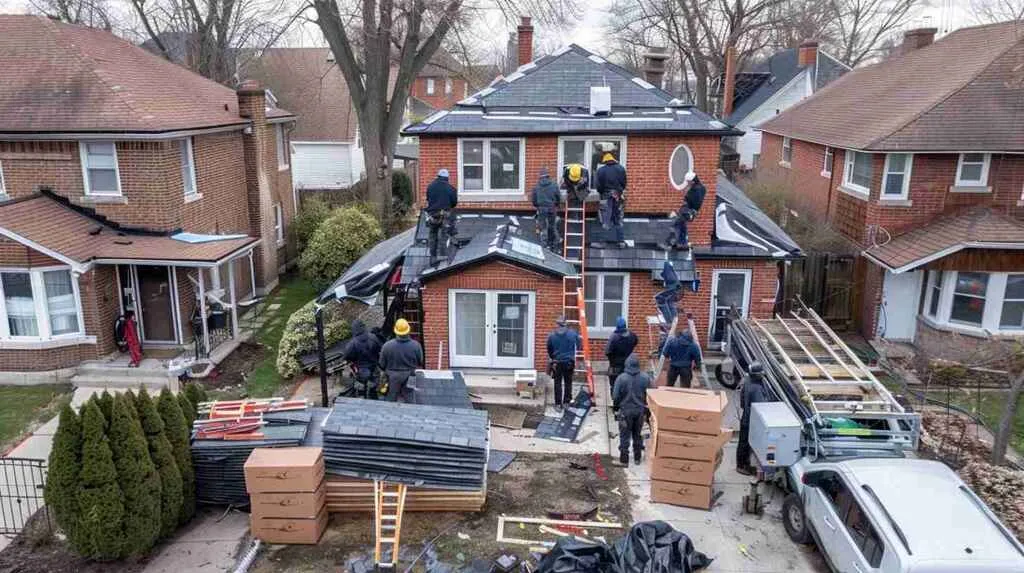
How to Roof a Garage with Shingles Queens NY – Full Process | Free Quotes
Blueprint for a garage roof in Queens starts the moment you climb up and check what you’re actually standing on, not when you crack open a bundle of shingles. Skip that deck inspection and everything else you do is just wrapping new material around a weak link that’ll fail the second we get a heavy Queens rainstorm or a few freeze-thaw cycles. I’ve seen it happen too many times.
The whole roof is a connected system-from the bare wood sheathing up through every layer of underlayment and flashing to the final cap-and if you treat it like random pieces you’re stacking instead of a circuit that has to work together, you’re setting yourself up for leaks, sags, and expensive do-overs.
Step 1: Inspect and Prep the Garage Roof Deck in Queens Conditions
First thing I do when I step onto a garage roof in Queens is walk heel-to-toe across every square foot, feeling for soft spots and listening for creaks that tell me the plywood or boards underneath are compromised. One August afternoon, it was 96 degrees and I was on a detached garage in Woodhaven with a torch in my hand, peeling back old rolled roofing to see how bad it really was-homeowner thought we just needed “a few shingles on top,” but once I opened it up, I found three layers of roofing, no underlayment, and a 2×6 so rotten my pry bar went through it like cake. That taught me I will never quote a garage re-roof in Queens without inspecting the sheathing first, because it’s like bidding on a wiring job without opening the panel. You don’t know what you’re dealing with until you expose it. Think of that deck like a load-bearing circuit board: every rotten spot is a weak node that’ll overload the rest of the system if you don’t replace it now.
Check every rafter end at the eaves, probe suspect spots with a flat bar or screwdriver, and mark any soft or spongy areas with chalk. Pull up at least one test strip of old roofing at the lowest edge to see actual wood condition, not just surface appearance. If you find delaminated plywood or boards with visible rot or insect damage, those sections come out and get replaced with new sheathing-no shortcuts, no “we’ll just screw a metal plate over it.” Re-nail loose boards every 6 inches along the edges and every 12 inches in the field, then confirm your roof slope is at least 2:12 for shingles, ideally 4:12 or steeper so water doesn’t sit and find microscopic entry points.
Walk the entire roof surface heel-to-toe, marking any soft or spongy spots with chalk.
Pull a test strip of old roofing down to bare wood at the lowest edge to see actual sheathing condition.
Probe suspect rafters and 2x framing with a flat bar or screwdriver to check for rot or insect damage.
Replace any rotten or delaminated plywood/boards and re-nail loose sheathing every 6 inches on edges, 12 inches in the field.
Confirm slope is appropriate for shingles (minimum 2:12 with special underlayment, ideally 4:12+) before committing to the system.
⚠️ WARNING: Covering rotten decking with new shingles
Never let anyone in Queens talk you into “just shingling over what you’ve got” on a garage. That’s like taping a new wire onto a burnt terminal: it might look fine this week, but the weak link is still there and will fail right where you can’t see it.
Step 2: Edge Metal, Underlayment, and Leak Path Control
From a purely technical standpoint, the biggest mistake I see DIYers make is starting to nail shingles before they’ve properly sequenced drip edge, ice-and-water shield, and synthetic underlayment at the eaves and rakes. I’ll never forget a windy November morning in Bayside, doing a small garage roof for an older couple that was hosting Thanksgiving for their whole family-we were halfway through laying architectural shingles when a gust ripped a loose tarp off the neighbor’s yard, flew right onto the roof, and almost took our stacked bundles with it. Since then, I never stage more than two bundles open at a time on a garage roof and I always anchor my tarps like I’m expecting a microburst, but that day also reminded me why correct edge-metal and underlayment sequencing matters in Queens wind-driven rain. Every layer you install is blocking a potential short circuit for water, and if you nail them in the wrong order or skip a step, water will find that opening and run straight into the garage where you don’t want it-near electrical panels, along wall plates, into stored belongings.
Think of water like current looking for the path of least resistance. Ice-and-water shield at the eave acts like an insulator that stops back-feeding; drip edge channels water off and away; synthetic underlayment laps each course so even if wind lifts a shingle, water hits the next layer and keeps moving down. When those layers are installed out of sequence or with gaps, you’ve created a weak link in the circuit. I also learned the hard way to never leave synthetic underlayment exposed for weeks-UV light cooks it and weakens your whole system before you even finish the shingles.
| Location | Layer Order From Deck Up | Why It Matters |
|---|---|---|
| Eave (bottom edge) | Ice & water shield, metal drip edge on top of shield, synthetic felt/underlayment, starter strip, shingles | Stops wind-driven rain from back-feeding under shingles at the lowest, most vulnerable edge. |
| Eave (bottom edge) – low-slope 2:12-4:12 | Full-width ice & water shield at least 24″ inside warm wall, metal drip edge on top, synthetic underlayment lapped properly, starter strip, shingles | Adds redundancy where slow drainage makes garages in Queens vulnerable to ice dams and ponding. |
| Rake (gable side) | Synthetic felt/underlayment, metal drip edge on top of felt, starter shingles, field shingles | Prevents sideways rain from curling under the gable edge, a common leak spot in coastal wind events. |
| Garage-to-house sidewall | Ice & water shield up wall and onto deck, step flashing with each shingle course, siding or counterflashing over step flashing | Eliminates a classic “short circuit” where water can run down the wall and behind the shingles into the garage. |
Queens DIY Underlayment Dos and Don’ts
Run underlayment flat and wrinkle-free; wrinkles telegraph through shingles and collect water.
Lap each course of synthetic underlayment at least 4-6 inches, more on low slopes.
Don’t leave underlayment exposed for weeks; UV cooks it and weakens your whole system.
Don’t skip ice & water at eaves just because it’s “only a garage”-Queens freeze-thaw cycles don’t care.
Step 3: Starters, Shingle Layout, and Nailing Pattern
I still remember a Saturday in early spring in Ridgewood where a DIYer called me in basically as “roofing rescue”-he’d started shingling his own garage, nailed through the starter course backwards, skipped the drip edge on one side, and then it rained overnight and water was running behind the fascia. I spent the day carefully undoing his work, explaining each mistake as we went, and by sunset he was handing me nails and cutting shingles like an apprentice. That job really shaped the way I teach homeowners the right sequence for how to roof a garage with shingles so they don’t get trapped in expensive do-overs. The starter strip has an adhesive strip that must face up and out toward the roof edge, acting like a one-way gate for water-install it backwards and it’s like wiring a diode in reverse, water flows where it shouldn’t. Every shingle manufacturer prints arrows on the back showing which end goes down; ignore those and your whole first course is a fail point that compromises everything above it.
Once the starter is correct, your first field course overhangs the drip edge by about 1/4 to 3/8 inch so water drips clear instead of wrapping back to soak the fascia. Nail placement is just as critical as starter direction: each architectural shingle needs 4 to 6 nails placed in the manufacturer’s nail zone, which is usually marked with a line or sits about 5-3/4 to 6-1/4 inches up from the bottom edge. Nails above that zone miss the double layer and won’t catch the shingle below; nails below that zone are exposed and create leak points. I tell people it’s like putting screws anywhere on a breaker-no guarantee it does its job unless you hit the correct contact point. Never cut shingles on top of installed courses because you’ll slice the layer underneath, and always stagger your vertical joints at least 6 inches so you don’t create a continuous weak line for water to follow.
Laying Starter and Field Shingles on a Typical Detached Garage in Queens
Snap a horizontal chalk line one full shingle height up from the eave for a perfectly straight first course.
Install factory starter strip or cut tabs off 3-tab shingles, with adhesive strip at the edge facing up and out toward the roof edge.
Begin your first shingle course at the eave, overhanging 1/4-3/8 inch past the drip edge to shed water cleanly.
Stagger vertical joints according to manufacturer instructions (typically at least 6 inches) to avoid weak lines.
Nail each shingle with 4-6 nails in the manufacturer’s nail zone, never above it, so they catch the double layer of shingle.
Work up the roof, checking every 2-3 courses against a vertical chalk line to keep the “circuit” of joints from drifting.
| Myth | Fact |
|---|---|
| “It’s just a garage, the starter strip direction doesn’t matter.” | Starters act like a one-way gate for water; backwards is like wiring a diode in reverse-water flows where it shouldn’t. |
| “More nails anywhere in the shingle means it’s stronger.” | Nails must sit in the correct zone; random nailing is like putting screws anywhere on a breaker-no guarantee it does its job. |
| “I can line up vertical seams to save cutting time.” | Aligned seams create a continuous weak line; that’s a perfect crack for water to follow and short circuit straight to the deck. |
| “One more shingle layer over the old roof is fine to ‘save money.'” | Extra layers trap heat and hide rot; in Queens’ humidity that’s a slow-cooking failure waiting to show up in a storm. |
| “Short overhang looks cleaner, so I’ll flush it to the drip edge.” | You need a slight overhang so water drips clear; tight to the edge lets water wrap back and soak the fascia board. |
Step 4: Venting, Flashing Details, and When to Call Shingle Masters
If you were standing up there with me, I’d point at the edge where your garage roof meets the house wall or sidewall and ask you to trace the water path with your finger-because that’s where most garage leaks actually start, not in the middle of a shingle field. Think of your garage roof like the cover on a high-voltage panel: if one screw is missing in the wrong spot, you’ve got a problem waiting to happen. Proper step flashing at sidewalls, a ridge vent or gable vents for air movement, and carefully detailed valley or hip transitions are the “screws” that hold the system together under stress. Miss one and the weak link will show up the next time Queens gets hit with wind-driven rain or a late-season nor’easter.
Dialing in Ventilation and Flashing
Garage attics often get skipped for ventilation because people think “it’s not living space,” but trapped heat and moisture still rot your sheathing from the inside out over time. If you’ve got a detached garage with an attic cavity, you want soffit intake vents at the eaves and a ridge vent or gable vents at the peak so air moves through. On attached garages that share a common wall with the house, step flashing is non-negotiable-each piece of L-shaped metal must weave with each shingle course and tuck up under the siding or brick, then get covered by the next shingle above it. I’ve torn into sidewalls where the previous roofer just smeared a bead of caulk and called it flashing; that’s a short circuit waiting to flood your garage and house framing.
DIY vs Pro for Queens Garage Roofs
Here’s the blunt truth most flyers stuck in your mailbox won’t tell you: a simple rectangular detached garage with one layer of old shingles and solid decking is a reasonable DIY project if you’re comfortable on ladders, you can follow an exact sequence, and the weather forecast in Queens is dry and calm for at least 48 hours. But the second you see spongy decking, more than one existing roof layer, a garage that ties into your house wall, or water stains already showing on the ceiling near your electrical panel, you’re looking at multiple weak links in the system and it’s time to call someone who does this every day. I’ve seen too many homeowners start a garage re-roof on Saturday, hit rot or bad flashing by Sunday, and spend the next month fighting leaks because they couldn’t finish before the rain came.
When a Queens Garage Roof Shingle Job Is DIY vs When It’s Pro Time
Call Shingle Masters ASAP
- ⚠ Deck feels spongy or visibly sags between rafters.
- ⚠ Garage roof ties into the house roof or a sidewall with old or unknown flashing.
- ⚠ You see previous patches, tar blobs, or more than one existing roof layer.
- ⚠ Water stains are already on the garage ceiling, walls, or near the electrical panel.
Might Be Safe for Careful DIY
- ✓ Simple rectangular detached garage with one existing shingle layer.
- ✓ Solid-feeling deck, no visible sag, and no signs of past leaks inside.
- ✓ You’re comfortable on ladders and roofs and can follow an exact sequence.
- ✓ Weather forecast in Queens is dry and calm for at least 48 hours.
Costs, Timing, and Quick Answers for Queens Garage Shingle Roofs
$3,000 on a small Ridgewood garage taught me that every line item on an estimate-from deck replacement to ice-and-water shield to ridge cap-connects like components in a circuit, and if the quote only mentions “shingles and labor” without breaking down underlayment, flashing, and ventilation, you’re dealing with someone who doesn’t see the whole system. A proper garage re-roof estimate should reflect actual deck condition, how many layers need to come off, access constraints, and whether you’re tying into a house wall, not just a square-footage guess pulled from Google satellite view.
Queens Garage Shingle Roof: Common Questions
Do I need a permit to reshingle my detached garage in Queens?
In many Queens neighborhoods, simple like-for-like re-roofing on a small detached garage may not require a full structural permit, but rules change and depend on scope. Shingle Masters checks local DOB rules and lets you know upfront if permits or inspections apply to your specific address.
How long will a properly installed shingle roof last on a Queens garage?
With solid decking, correct underlayment, and architectural shingles, a Queens garage roof can typically go 20-25 years, assuming normal weather and no tree abuse. The weak links are almost always flashing and edges, which is why Luis is obsessive about those details.
Can you match the shingles on my house roof?
Often yes, or we can get close, especially with popular architectural shingle lines used around Queens. When we visit your garage, we bring color charts and look at your house roof in real light, not just off a photo.
How messy is a garage re-roof, and do you clean up nails?
Garage re-roofs create a surprising amount of debris. Shingle Masters tarps around the garage, magnet sweeps the ground for nails, and hauls away all old material so you’re not finding nails months later in your driveway.
A Queens garage roof is a connected system where one weak detail-backwards starter, skipped ice-and-water shield, nails in the wrong zone-can short-circuit the whole setup and leave you fighting leaks and rot for years. If your garage has solid bones and you’re confident following an exact sequence in good weather, you can tackle it yourself. But if you find spongy decking, multiple layers, or tricky tie-ins to your house, you’re looking at a job that needs someone who does this every day and knows how to close every potential leak path before the next storm rolls through Queens.
Call Shingle Masters for a free on-site garage roof inspection and a written quote tailored to your Queens neighborhood-Luis will walk your roof, check your sheathing, and break down every layer and flashing detail so you know exactly what you’re paying for and why it matters.