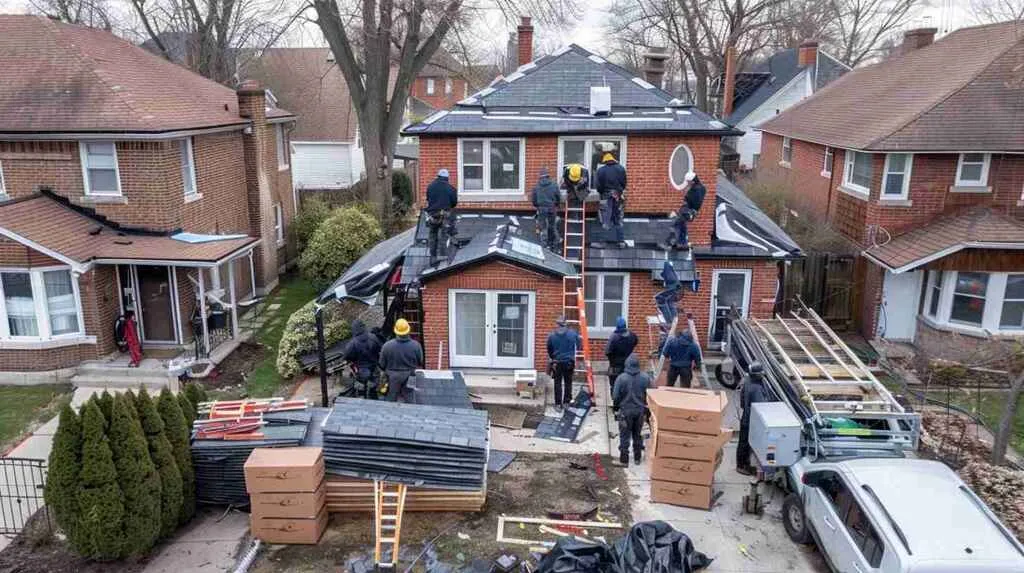
How to Measure a Shingle Roof Queens NY – Accurate Estimating | Free Quotes
Blueprint this: Most Queens homeowners underestimate their shingle roof size by 20-30%, and one August afternoon in Corona when it was 96 degrees, I climbed onto a low-slope roof where the owner swore he only had “about 15 squares” because that’s what the last guy told him – I measured every hip, rake, and overhang myself and came out to 22 squares, which would’ve been a change-order disaster if he’d trusted that cheap quote. On a typical Queens cape with a simple gable roof, the first thing I do is hand you the tape and say: we’re going to measure one eave span together, write it down, and that single number will stop you from guessing.
Stop Guessing: Get Your Real Roof Size in Three Core Measurements
On a typical Queens cape with a simple gable roof, the first thing I do is walk to one outside wall corner and measure straight across the eave line to the opposite outside wall corner – that’s your first core number, the length of one main roof plane, and I don’t care about the overhang yet because we’re getting the basic rectangle down first. Think about measuring a suit – you wouldn’t wrap the tape around the outside of the coat and call it your waist size, right? Same here: we’re measuring the body of the roof, not the accessories, and once you’ve got that eave length written on the back of an envelope or in your phone, you’re already ahead of half the homeowners who call me with wild guesses. One August afternoon in Corona, it was 96 degrees and I was on a low-slope shingle roof where the owner swore he only had “about 15 squares” because that’s what the last guy told him – I measured it myself, hips and rakes and overhangs and all of it, and it came out to 22 squares, and when I showed him the math on the hood of his car he realized he’d almost signed a “cheap” quote that would have run out of shingles halfway through and turned into a change-order nightmare. That day locked in my rule: no guessing roof size, ever.
Here’s my “do one number” rule: once you have that eave length, the next step is measuring the ridge-to-eave distance on the slope – either by going up on a safe ladder and running a tape from the peak down to the gutter line, or if you’re not comfortable climbing, measuring the ceiling width inside the attic from one eave wall to the center ridge beam and doubling it to get the full span. Write which method you used so you can tell your roofer exactly what you measured. The third core number is pitch, and you get it by setting a 2-foot level flat on a shingle, marking the 12-inch point on the level, holding it perfectly horizontal, then measuring the vertical rise from that 12-inch mark straight down to the shingle surface – that rise over 12 is your pitch, and you write it like “6/12” or “8/12,” simple as that.
Three Core Measurements to Stop Underestimating Your Shingle Roof in Queens
- Measure Eave Length on One Side of the Main Roof: Walk to an outside wall corner and stretch your tape to the opposite outside corner along the eave line – ignore the overhang for now, you’re just getting the clean body measurement, like checking your waist without the belt.
- Measure Ridge-to-Eave Distance on the Slope: Either go up and run a tape from the peak down to the gutter, or measure the ceiling width inside from eave wall to center ridge and double it – write down which plane you used so your roofer knows exactly what number you captured, like marking which seam you measured on a jacket pattern.
- Determine Pitch Using a 2-Foot Level and Tape: Set the level flat on a shingle, mark 12 inches on the level, hold it dead horizontal, and measure the vertical rise at that 12-inch mark – that rise over 12 is your pitch (e.g., 6/12 or 8/12), and it’s the adjustment factor that turns flat area into real roof surface area, just like adding extra fabric for a dart or pleat.
⚠️ Common Measurement Mistakes That Shrink Your Roof on Paper
- Measuring along the ground instead of at the eave line, which completely misses the slope
- Ignoring overhangs that add 5-10% area once you count rakes and eaves
- Forgetting attached porches or entry roofs that sit below the main plane
- Using online square footage of the house instead of true roof surface area – your living space isn’t your roof space
Turn Your Numbers Into Squares: Simple Roof Math You Can Check
Here’s my blunt opinion: if your roofer won’t show you their math, they’re guessing – and I’ll never forget a late fall evening in Bayside, climbing a roof right before sunset for a seller who needed numbers for an open house that weekend, and the house had two small additions with different pitch and funky little valleys someone built in the 80s. The seller handed me an old sketch from a contractor and said, “Can we just use this?” and the sketch was off by almost 30% because they measured from the ground, so I stayed until it was almost dark and finished a full plan-view measurement and emailed a real estimate by 8 p.m. – that roof sold the house because the buyer could see every square foot accounted for. Converting your basic measurements into roof area and then into roofing squares (100-square-foot units) is straightforward: you take your eave length times your ridge-to-eave distance to get the plan area of one slope, multiply by two if it’s a simple gable, then multiply by your pitch adjustment factor (1.12 for 6/12 pitch, 1.20 for 8/12, 1.41 for 12/12, and so on) to account for the sloped surface, and finally divide by 100 to get squares and round up. In Queens neighborhoods like Bayside, Woodhaven, and Rego Park, where additions and complex valleys are everywhere, people get burned by bad sketches all the time – don’t be one of them.
Compare the process to tailoring a suit pattern laid flat: each roof plane is a panel, each must be measured separately, then you add a small allowance (waste factor) for cuts, hips, and valleys so you don’t run short when pieces don’t fit together perfectly. Once you’ve got your square count, the next number that actually matters is how much material that really means – shingles come in bundles (typically three bundles per square), and every dormer, every valley, every ridge cap adds to the order, which is why your final number should always include a 10-15% waste allowance for a complex roof and at least 5% even on a dead-simple rectangle.
| Roof Type | Plan Area (sq ft) | Pitch Adjustment Factor | Adjusted Roof Area (sq ft) | Squares (Rounded) |
|---|---|---|---|---|
| Simple cape gable, Elmhurst | 1,000 | 1.12 (6/12 pitch) | 1,120 | 12 squares |
| Two-story colonial, Bayside | 1,400 | 1.20 (8/12 pitch) | 1,680 | 17 squares |
| Cape with rear dormer, Woodhaven | 1,100 | 1.15 (mixed 5/12 and 7/12) | 1,265 | 13 squares |
| Semi-attached with porch roof, Jackson Heights | 900 | 1.12 (6/12 pitch) | 1,008 | 10 squares |
Remote vs. On-Roof Measuring in Queens: When Each One Works
I blend on-roof, ground-based, and aerial measuring depending on safety and weather, and I still remember one winter morning in Flushing when light snow was coming down and a landlord begged me to “just do it from Google” because he didn’t want anyone climbing in the weather – I pulled aerials, did a remote measurement, and something felt wrong because the back dormer looked different from street photos, so I drove over, stayed on the ground, and used a laser measurer and a long tape from the sidewalk and side yard, and sure enough they’d extended the dormer five years before and the satellite image was still the old version, which would’ve left us short almost 5 squares on materials. Remote tools are helpful for a ballpark when access is limited or you’re budgeting months ahead, but in neighborhoods like Flushing and Corona where dormers and extensions change fast, you can’t rely on an aerial alone. Here’s my insider tip: in Queens, always cross-check remote measurements with a quick walk-around and side-yard tape for dormers and rear additions – if you see something on the house that doesn’t match the satellite, flag it immediately and either climb or get a ground measurement before you trust the square count. It’s safe to rely on a remote estimate when the roof is a simple rectangle with no visible bump-outs and you’re just comparing ballpark pricing, but insist on a physical check the moment you spot valleys, dormers, or an active leak, because that’s where the math breaks down and change orders start piling up.
Remote / Aerial Measurement
- Good for initial ballpark when access is limited or weather is bad
- Faster for simple rectangular roofs with no visible additions
- Can miss newer dormers, small additions, and rear bump-outs if satellite imagery is outdated
On-Roof or Ground Measurement
- Captures real overhangs, dormers, porches, and every roof plane accurately
- Lets you spot bad plywood, soft spots, and hidden damage while measuring
- Best for final material order and written proposal – no surprises on install day
Urgent – In-Person Now
- Active leak near ceilings or walls – can’t wait
- Upcoming listing or appraisal within 30 days
- Roof has multiple dormers, valleys, or additions
- You’ve already gotten wildly different square counts from different contractors
Can Wait – Remote First
- Simple gable roof with no visible additions
- You’re budgeting 3-6 months ahead
- No signs of leaks, just aging shingles
- You mainly want to compare ballpark pricing before scheduling visits
Queens-Specific Measuring Tricks: Dormers, Porches, and Overhang “Hems”
The truth is, your roof is more like a jigsaw puzzle than a rectangle, and every bump-out changes the numbers – in Queens housing stock (capes with rear dormers, colonials with side 1-story additions, semi-attached with shared party walls), these little pieces easily add 2-5 squares if you’re not counting them, and I still remember the first time I misjudged a dormer in Woodhaven because I trusted a drawing instead of my tape and ended up short two bundles mid-install. I talk about these extras like a tailor talks about “hems” for overhangs and “seams” for valleys: every one must be measured, cut, and accounted for or the final fit looks terrible and you run out of fabric halfway through. When I walk into a house and a homeowner asks, “Can’t you just look and tell?” this is what I do instead: I measure each bump-out’s length and width at the eave, multiply them to get area, add that to the main rectangle, and keep a running total on the back of my clipboard so nothing gets missed and nothing gets guessed.
Give yourself an insider tip on quickly capturing these extras with a tape and simple sketch: measure each dormer face, each porch roof, each side extension at the eave line, write the dimensions on a rough drawing of your house from above (it doesn’t have to be pretty, just labeled), multiply length times width for each section, then add them all together before applying your pitch factor. Once you’ve got every “panel” measured, you can confidently challenge any quote that doesn’t match your totals – if a contractor comes back with a number that’s way lower, ask them to show you their sketch and their math, because they’re probably missing a dormer or a porch or counting on you not knowing the difference.
Queens Roof Areas People Forget to Measure
- ✅ Front stoop or porch roofs over entry doors – often 40-60 square feet
- ✅ Rear kitchen or sunroom bump-outs that extend beyond the main footprint
- ✅ Side sheds or one-story extensions tucked under the main roof line
- ✅ Small doghouse dormers facing the street (easy to miss from the ground)
- ✅ Overhanging eaves that run deeper than 8-10 inches at the rake and eave
Numbers to Have Ready Before You Call a Queens Roofer for a Shingle Quote
- ☐ Total length of the main eave on each side (measured at the eave line, corner to corner)
- ☐ Ridge-to-eave slope distance or interior ceiling width from eave to center ridge
- ☐ Your best estimate of roof pitch (e.g., 6/12, 8/12) using a level and tape
- ☐ A count of dormers, valleys, and separate roof sections (porches, bump-outs)
- ☐ Approximate age of current shingles and any visible damage (curling, missing granules, leaks)
- ☐ Photos from front, back, and each side of the house taken at ground level in good light
From Measurement to Estimate: What a Precise Queens Quote Should Show
When I walk into a house and a homeowner asks, “Can’t you just look and tell?” this is what I do instead: I sit at the kitchen table, spread out my measurements, and spell out total squares, waste factor, and key line items – shingles, underlayment, ice shield at eaves and valleys, ridge cap, drip edge, ventilation if needed – so the homeowner can see exactly what they’re paying for, line by line, and that’s the opposite of a sloppy one-line quote that just says “roof replacement $8,500” with no breakdown and no way to check if the number makes sense. A proper Queens shingle roof estimate should look like a tailor’s invoice: every panel measured, every seam accounted for, every adjustment noted, and a final number that you can verify against your own tape-and-paper math. I make every customer “do one number” with me – I hand them the tape, have them measure one span, and we check it together so they actually feel what accurate roof measuring is, not just hear me talk about it, and that single shared number builds trust faster than any sales pitch ever could.
Once you’ve done that measurement work yourself, call Shingle Masters for a free, math-backed quote, and I’ll walk you through the numbers like a tailor marking up a pattern so you can see every square foot and every line item before you sign anything.
Why Queens Homeowners Trust Shingle Masters with Measuring and Estimates
Licensed and Insured
Fully licensed and insured in New York for all residential roofing work
19+ Years Experience
Hands-on measuring and installs across every Queens neighborhood
Transparent Breakdown
Every quote shows squares, waste, and materials line by line – no guessing
Free On-Site Measurement
Free measurement and photo report for most single-family homes in Queens
Common Questions About Measuring a Shingle Roof in Queens, NY
Can I measure my shingle roof myself if I’m not comfortable climbing?
Absolutely – you can measure from the ground using a long tape at the eave corners, measure your interior ceiling span from eave to ridge and double it, take photos of every roof plane from the yard, and sketch a rough overhead view with dimensions labeled, and I can finish the pitch and overhang math from those numbers and photos when I arrive for the final check.
How accurate does my measurement need to be before I call for a quote?
Within a square or two is fine for initial pricing – your main job is to capture the basic shape, count the dormers and porches, and note the pitch, and the roofer will refine it on site with precise tools, but having those rough numbers stops wildly wrong ballpark quotes from wasting everyone’s time.
Do Queens building codes affect how much roofing material I need?
Yes – New York building code requires ice and water shield at eaves (typically the first 3-6 feet up from the gutter depending on pitch) and in valleys, plus synthetic underlayment on the rest of the deck, and those extra layers show up in your square count and material list, so always ask your roofer to call out code-required items separately on the estimate.
What if two roofers give me different square numbers?
Ask each one to show you their sketch and their calculations, step by step – one might be including overhangs and porches while the other isn’t, or one might be rounding pitch factor differently – and favor the contractor who can explain every line of math and will physically verify the count before ordering materials, because that’s who won’t run out of shingles halfway through your job.
Ready to get a precise, math-backed estimate for your Queens shingle roof? Call Shingle Masters today or request your free quote online, and I’ll walk you through at least one measurement together so you can see exactly how your roof size and shingle estimate were calculated – no guessing, no surprises, just the real numbers.