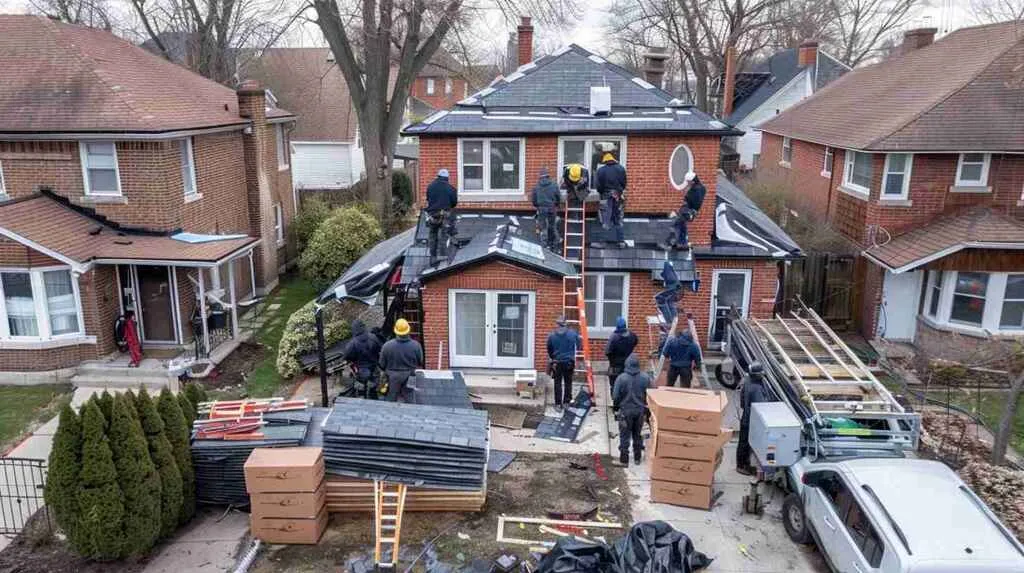
How to Shingle a Roof Queens NY – Clear Guide from Roofers | Free Estimates
Blueprint for stopping leaks starts at the eave. When I’m standing on a two-story in Woodside with my chalk reel in hand, the very first line I snap runs perfectly parallel to that bottom edge, about half an inch down from where the fascia meets the roof deck. That line tells me exactly where the starter course goes, and if I’m off by even three-quarters of an inch, every shingle above it is just decorating the path water will take straight into your ceiling. This guide walks you through the critical steps – from bare deck inspection through final cap shingles – so you’ll know when to keep going and when to call Shingle Masters for a layout that actually keeps water flowing where it belongs.
Snap the First Line and Set Your Starter Course in Queens, NY
On the edge of a two-story in Woodside, I always start the same way: I snap a dead-straight chalk line along the eave before anything else touches that roof. That starter course is the first fitting in your sideways plumbing system, and water is already trying to figure out how to run up under it the moment the first raindrop hits. If you reverse the tabs, skip the strip entirely, or let that line wander because you eyeballed it, you’ve just built a ramp for wind-driven rain to follow straight under the first shingle row and into the sheathing. The starter course argument with water is simple: overlap the edge, seal the tabs down, and give runoff nowhere to climb back up.
Here’s how it works in Queens, where wind off Flushing Bay or the East River loves to test that bottom edge. Measure up from the drip edge about three-eighths of an inch for overhang, snap your chalk line the full length of the eave, then lay starter shingles with the adhesive strip positioned so the first full course above it seals down tight. If your eave runs forty feet, don’t try to eyeball it – that chalk line is your friend. I’ve seen too many Woodside and Jackson Heights jobs where someone skipped this step to “save time,” and by the second Nor’easter the fascia board is soaked through and the soffit is dripping.
Snapping the First Chalk Line and Installing Starter Shingles
- Measure overhang: Mark three-eighths inch down from the top of the drip edge at both ends of the eave, so water drips clear of the fascia.
- Snap the chalk line: Pull a bright-colored chalk line taut between your marks and snap it to create a perfectly straight reference across the entire eave length.
- Position starter shingles: Lay starter strips along that line with the adhesive strip facing up the roof, flush with the chalk line, tabs hanging over the edge.
- Fasten securely: Drive four roofing nails per starter shingle, placed about one inch above the eave edge and spaced evenly, so wind can’t peel them back.
- Check alignment before moving up: Walk the eave and verify every starter piece is straight and sealed; fixing this now takes two minutes, fixing it after three courses takes two hours.
⚠️ Warning: Skipping or Misaligning Starter Strips
If you skip the starter course or install it upside-down with the tabs facing up, you’ve just created a gap where wind-driven rain can push straight under the first row of shingles. Every storm will test that edge, and within a season you’ll have water stains on your soffit, soaked fascia boards, and rot spreading into the roof deck. The starter strip is not optional – it’s the seal that keeps water from reversing course at the most vulnerable line on your entire roof.
Check the Roof Deck and Underlayment Before a Single Shingle Goes Down
Here’s my honest opinion, and you might not like it: if you’re scared of removing rotten wood, you’re not ready to install a single shingle. One February morning in Elmhurst, about 7:30 a.m. with my coffee freezing faster than I could drink it, I got called to a “mystery leak” over a third-floor bedroom. Another roofer had just put new shingles on two months before, and when I peeled back the first few courses I saw they’d skipped the starter strip entirely along the eave – but worse, the sheathing underneath was soft as cardboard from years of slow water intrusion. In Queens’ older housing stock, especially around Woodside and Jackson Heights, you must probe the deck with a screwdriver or pry bar before you commit to a new roof. Any spongy spots, any sagging between rafters, any black streaks from mold means you pull that section, sister in new framing if needed, and replace the plywood or OSB. Laying beautiful new shingles over rotten deck is like wallpapering over a hole.
Underlayment is the hidden layer that redirects water when shingles lose the argument for a minute, and in Queens’ humid, stormy summers – plus the occasional Nor’easter that backs up gutters and tests every seam – you want the right membrane in the right spots. Standard felt works fine on the main field if your budget is tight, but synthetic underlayment grips better on steep pitches and won’t tear in wind. Ice and water shield is non-negotiable at eaves, in valleys, around chimneys, and anywhere two roof planes meet, because that’s where water piles up and looks for a crack. I’ve traced leaks in Jamaica and Astoria that started because someone used plain felt in a valley and the first backed-up leaf pile sent water sideways under the shingles. Underlayment is your insurance policy – spend the extra forty bucks per roll and sleep through the next thunderstorm.
Deck and Underlayment Must-Haves Before Shingling
✅ Probe the entire deck for soft spots
Push a screwdriver or pry bar into sheathing every few feet; any give means water damage and that section needs replacement before shingles go on.
✅ Replace any plywood with delamination or black mold
Delaminated or moldy sheathing won’t hold nails and will continue rotting under new shingles; cut it out, frame as needed, and install new rated plywood.
✅ Install ice & water shield at eaves, valleys, and chimneys
Self-adhering membrane seals around every nail and stops water from wicking sideways under shingles in high-risk zones where runoff concentrates.
✅ Cover the main field with synthetic or #30 felt
Continuous underlayment across the field gives you a second barrier if wind lifts a shingle or a fastener backs out over time.
❌ Never shingle over curled, wavy, or missing deck panels
Shingles follow the shape of the deck; if the deck is wavy or has gaps, your new roof will look lumpy and nails will pull through weak spots within a year.
❌ Don’t skip drip edge along eaves and rakes
Metal drip edge directs water off the roof and protects fascia and rake boards from rot; install it before underlayment at eaves, after underlayment at rakes.
| Underlayment Type | Typical Use Area | Key Advantage | Main Limitation |
|---|---|---|---|
| Asphalt Felt (#15 or #30) | Main roof field on standard-pitch roofs, cost-sensitive projects | Inexpensive, proven track record, available everywhere | Tears in wind, wrinkles when wet, limited UV resistance if left exposed |
| Synthetic Underlayment | Steep slopes, high-wind areas, projects where the deck stays exposed for days | Stronger tear resistance, stays flat, better UV protection, lighter to carry | Costs 30-50% more than felt, can be slippery when wet |
| Ice & Water Shield | Eaves (first 3 feet minimum), valleys, chimneys, skylights, low-slope transitions | Self-sealing around nails, waterproof even if shingles lift, blocks ice dam infiltration | Expensive for whole-roof use, difficult to reposition once stuck down, extreme heat can soften adhesive |
Lay Out Shingle Courses So Water Can’t Find a Ladder or Zipper
There was this Sunday evening in Flushing, light drizzle, when I traced a leak for a very nervous couple expecting their first baby. The leak was right over the nursery, and their roof “looked fine” from the street – clean shingles, no obvious damage. As I walked the surface I found they’d run the shingle joints in a ladder pattern, meaning vertical seams matched up every other course in a straight line from ridge to eave. That straight line was basically a zipper for water; every time rain hit at the wrong angle, it flowed sideways along one seam, found the matching seam in the course below, and kept running down like it was following a subway tile grout line. I had to re-lay a whole section just to stagger the joints properly, and after that I started carrying a laminated drawing in my clipboard to show people exactly how those vertical lines should never, ever look.
Think of each shingle like a subway tile on your bathroom wall; if your lines wander and your overlaps are thin, the water always finds the bad tile first. Proper stagger means offsetting each course by six inches (for three-tab) or by following the manufacturer’s pattern (for architectural shingles), so no two joints line up vertically within three courses of each other. Nail placement matters just as much – fasteners go in the nailing strip about one inch below the adhesive line and at least one inch in from the edge of each tab, never down in the water channels where they create a puncture for runoff to exploit. In Queens, where wind-driven rain crosses ridge lines and tests every dormer and valley, consistent layout is your way of out-thinking water at every joint. The shingle is trying to keep water moving downslope in overlapping channels; your job is to never give water a straight path sideways or upward.
Do not let your shingle joints line up in straight vertical lines, ever.
Staggering Shingle Joints and Nailing Correctly
- Measure your offset: For three-tab shingles, offset each course by 6 inches (half a tab); for architectural shingles, follow the manufacturer’s stagger pattern printed on the wrapper – usually 4 to 6 inches.
- Mark your starting point: On every course, measure and mark where the first shingle edge should land so you maintain consistent offset across the entire roof; use a pencil line on the underlayment if needed.
- Nail in the manufacturer’s zone: Drive four to six nails per shingle (check instructions) in the nailing strip – typically one inch below the adhesive line and one inch in from each edge – never down in the cutouts or water channels.
- Check alignment every three courses: Step back and visually confirm your joints are staggered and no vertical lines are forming; catching a pattern mistake on course four is easy, catching it on course twelve means tearing off and starting over.
| Myth | Fact |
|---|---|
| “You can eyeball the stagger pattern and it’ll look fine from the ground.” | Eyeballing creates accidental ladder joints where vertical seams line up and funnel water straight down; measure every course offset or you’ll find the leak in six months. |
| “More nails per shingle is always better – it makes the roof stronger.” | Over-nailing punches extra holes in the waterproof layer and can crack shingles in cold weather; follow the manufacturer’s nail count and placement exactly. |
| “Nails anywhere in the top half of the shingle will hold it down fine.” | Nails must go through the nailing zone so the course above covers and seals the fastener; nails too high get exposed, nails too low miss the double-layer overlap and pull out in wind. |
| “If you run out of a color mid-roof, just finish with a close-match bundle – no one will notice.” | Shingle color varies by manufacturing lot, and sunlight will make mismatched bundles obvious within weeks; order 10% extra from the same lot or plan seams at natural break lines like hips. |
Handle Valleys, Chimneys, and Dead-Flat Spots the Right Way
A summer ago in Astoria, blazing hot afternoon, top of a two-family brick house, I watched a DIY owner install shingles straight over a dead-flat spot behind a dormer – no slope, no extra underlayment, no cricket, nothing. He proudly told me he’d followed a “how shingle a roof” video step by step, and to be fair his courses looked neat and his nails were straight. Three storms later he called me back with soaked drywall, because that flat section had zero gravity helping water move, so every raindrop just sat there and worked its way under the shingles through the nail holes. Valleys, chimneys, skylights, and any spot where two roof planes meet or where slope drops below 4:12 are where water piles up and changes direction – shingle quality doesn’t matter if the flashing and underlayment can’t handle the extra flow. These are the high-stakes fittings in your sideways plumbing system, and you don’t guess on plumbing.
Here’s how to treat the critical spots so water has a clear, metal-lined path instead of hunting for a crack. In an open valley, you lay a 24-inch-wide strip of ice and water shield down the center, then install pre-bent metal valley flashing on top, then cut and weave shingles so they overlap the metal by at least six inches on each side – never let shingle edges land in the center trough where water volume is highest. Around a chimney, you install step flashing on each side (one piece per shingle course, lapped under the shingle above and over the shingle below) and counterflashing embedded in the chimney mortar joints to cover the step flashing edges. For a dead-flat or very low-slope transition, check the shingle manufacturer’s minimum slope spec – most require at least 2:12, and many want 4:12. If your section is flatter than that, you need a cricket (a small peaked diverter) to push water around the obstacle, or you switch to a low-slope membrane like modified bitumen or EPDM instead of forcing shingles to do a job they’re not made for. Water always wins the argument on a flat roof; don’t fight physics.
⚠️ Warning: Using Standard Shingles on Dead-Flat or Very Low-Slope Sections
Slope thresholds where shingles alone are a leak risk:
- Below 2:12 pitch: Standard asphalt shingles are not rated for this slope at all; water sits instead of flowing, and you need a fully adhered low-slope membrane or metal roofing.
- 2:12 to 4:12 pitch: Shingles may be allowed by code but require double underlayment or ice & water shield across the entire deck, plus careful sealing of every nail; even then, pooling during heavy rain is common.
- Flat sections behind dormers or between roof planes: If there’s zero slope for more than a few feet, you must build a cricket or saddle to divert water, or switch materials entirely – shingles will fail here every time.
- Valleys or troughs that collect leaves: Even on steep roofs, a valley clogged with debris turns into a dam; open metal valleys with ice & water shield underneath are the only reliable solution in Queens’ tree-heavy neighborhoods.
Typical DIY Approach
- Valley: Cut shingles to fit and run a bead of roof caulk down the center – no metal, no ice shield.
- Chimney: Caulk the gap between shingles and brick, maybe tuck one piece of bent aluminum under the top course and call it flashing.
- Sidewall: Run shingles right up to the siding and seal the joint with a thick caulk bead, hoping it holds for a few years.
Pro Roofer Approach
- Valley: Install ice & water shield the full length, then pre-bent metal valley flashing, then weave or cut shingles so they overlap metal edges by six inches minimum – water flows on metal, not through caulk.
- Chimney: Step flashing on sides (one L-shaped piece per course, lapped like shingles), counterflashing embedded in mortar joints and sealed, plus a cricket on the upslope side if the chimney is wider than 30 inches.
- Sidewall: Step flashing behind siding and over shingles, plus a kick-out flashing at the bottom to direct water away from the wall and into the gutter – no exposed caulk joints that will crack in two winters.
Decide: Keep Going DIY or Call a Queens Roofing Pro
Your whole roof is a sideways plumbing system, and every shingle, every flashing piece, every nail is a fitting that either keeps water moving downslope or gives it a chance to pool and find a seam. If you’re confident on a ladder, comfortable with heights, experienced with layout and flashing around chimneys and valleys, and you’ve got the time to do it right across every square foot, then by all means keep going – just don’t skip the starter course, the underlayment, or the stagger pattern. But if any of those details feel shaky, or if your roof has multiple dormers, skylights, or complex hips and valleys, or if you’re not sure about the deck condition under the old shingles, the cost of getting the argument with water wrong in a Queens rainstorm is a lot higher than the cost of a professional estimate. Shingle Masters has been running these jobs across Queens for nearly two decades, and we’d rather walk your roof, point out the tricky spots, and give you a fair price than get a call six months later asking why your ceiling is dripping.
Should You Keep Your Shingle Project DIY or Bring In Shingle Masters?
Start here ↓
Are you comfortable working on a two-story roof for multiple days?
YES → Next question
Have you installed step flashing around a chimney or skylight before?
NO → Call Shingle Masters
Height and safety come first; we carry full insurance and have done this thousands of times.
YES → Next question
Can you afford to redo sections if your stagger pattern or flashing leaks?
NO → Call Shingle Masters
Flashing is where most DIY jobs fail; we’ll get it right the first time with a warranty.
YES → You may be ready for DIY
Just follow every step in this guide and don’t skip the prep work – good luck!
NO → Call Shingle Masters
Budget matters, but re-roofing twice costs more than hiring a pro once; we’ll give you a transparent estimate.
Why Queens Homeowners Call Shingle Masters for Shingle Roofing
✓ Licensed & Insured in NY
Full general liability and workers’ comp coverage, so you’re protected if anything happens on your property during the job.
✓ 19+ Years Shingle Experience
We’ve shingled thousands of Queens roofs – from Woodside Tudors to Astoria two-families – and we know every tricky detail your house can throw at us.
✓ Free On-Roof Estimates
We’ll come out, walk your roof, measure every plane and detail, and give you a written estimate with no pressure and no hidden fees – usually within 48 hours of your call.
✓ Workmanship Warranty
Every shingle job includes our labor warranty covering installation defects, plus we’ll help you register manufacturer material warranties for double peace of mind.
Common Queens Questions About How to Shingle a Roof and When to Hire a Pro
Do I need a permit to shingle my roof in Queens, NY?
Yes, most re-roofing projects in NYC require a permit from the Department of Buildings, especially if you’re doing a full tear-off or adding structural elements like a cricket. A licensed roofing contractor like Shingle Masters pulls the permit as part of the job; if you’re DIY, you’ll need to file an ALT1 application and schedule inspections yourself. Skipping the permit can complicate insurance claims and future home sales.
What’s the best time of year to shingle a roof in Queens?
Late spring through early fall (May to October) gives you the best weather window – shingles seal properly in warm temps, and you’re less likely to fight rain delays. We’ve done winter jobs when necessary, but cold weather slows adhesive activation and makes shingles brittle, so you need extra care with handling and sealing. Avoid starting a roof project the week before a forecasted Nor’easter.
How loud and disruptive is a shingle roof replacement?
Tear-off day is the loudest – you’ll hear scraping, hammering, and debris hitting the dumpster from about 7:30 a.m. to late afternoon. Once the old shingles are off and the deck is prepped, installation is quieter (mostly nail guns) and goes faster, usually one to three days depending on roof size and complexity. We’ll give you a timeline up front so you can plan around it, and we always clean up daily so your yard isn’t a construction zone overnight.
What does a typical shingle roof cost in Queens, and what affects the price?
For a standard single-family home (1,200-1,800 square feet of roof), expect roughly $6,000 to $12,000 depending on shingle quality, roof complexity, and how much deck repair we find once the old shingles are off. Steep pitches, multiple valleys, chimneys, and skylights all add labor time. We’ll break down every line item in your estimate so you know exactly what you’re paying for – no surprises when we’re halfway done.
How far across Queens does Shingle Masters travel for roofing jobs?
We cover all of Queens – from Astoria and Long Island City in the west to Bayside and Douglaston in the east, and everywhere in between: Woodside, Jackson Heights, Elmhurst, Flushing, Forest Hills, Jamaica, you name it. If you’re in Queens and you need a shingle roof done right, we’ll come out for a free estimate and treat your house like it’s in our own neighborhood, because it is.
Every shingle on your Queens roof is a fitting in that sideways plumbing system, and water is always testing every seam, every nail hole, every valley to see if you gave it a path to somewhere it shouldn’t go. If any detail in this guide – from snapping that first starter line to building a cricket behind the chimney – feels over your head or risky, call Shingle Masters for a free on-roof estimate. We’ll walk every plane, check the deck, measure the valleys, and give you a layout and price that keeps water flowing exactly where it belongs: off your roof, into your gutters, and away from your foundation.