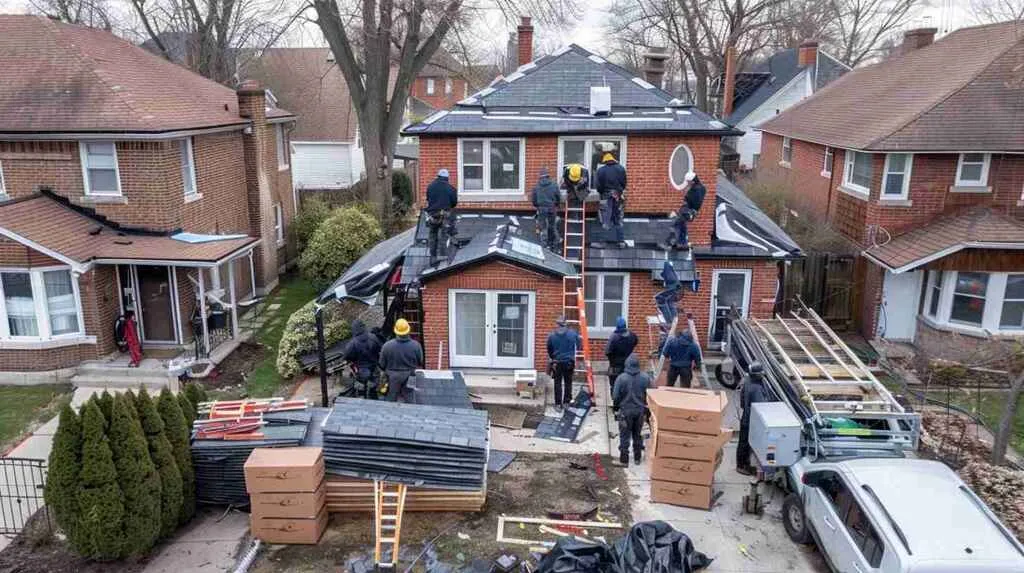
Why Are Roof Shingles So Small Queens NY – The Design Reason | Free Quotes
Fractal-that’s the word I use when someone asks why their Queens roof is covered in thousands of tiny rectangles instead of a few big sheets. Small shingles create a repeating pattern that forces wind and water to zig-zag instead of blasting straight through, the same way circuit boards use hundreds of tiny components so one failure doesn’t kill the whole device. On Queens roofs, shingle size isn’t tradition or aesthetics-it’s deliberate engineering designed to manage storms, freeze-thaw cycles, and installer mistakes. This article will decode that design choice and show you exactly what it means for your home.
Why Roof Shingles Are So Small in Places Like Queens, NY
On a typical Queens block, if you step back across the street and really look, you’ll see every roof is made of thousands of tiny choices, not just tiny shingles. Shingle size is a structural design decision, not just habit or looks. Think about it like product design: you could make a keyboard out of one big flexible sheet, but instead we use 104 individual keys so typing force is spread and individual failures are cheap to fix. Roofing works the same way-small shingles are modular components that break your roof’s job (shed water, resist wind, handle temperature swings) into manageable, replaceable pieces instead of one fragile monolith.
And honestly, if speed were the only thing that mattered, I’d be the first to throw up big sheets. But after 17 years installing roofs across Jackson Heights, Flushing, and Astoria, I’ve seen what Queens wind does to oversized pieces, and I’ve watched small shingles handle crosswinds and torrential rain that would’ve peeled a big sheet like an orange. Small shingles exist to control wind, water, and human error the way circuit boards use many tiny resistors instead of one giant block-so failure, when it comes, stays small and contained. Queens roofs face gusts off the East River, summer heat that buckles decking, winter ice that cracks seams, and mixed building types that create weird wind tunnels. The small shingle isn’t a compromise; it’s the tool that manages all that chaos at once.
| Myth | Fact |
|---|---|
| Bigger shingles would be faster and just as good. | Larger shingles catch more wind and are harder to keep flat across imperfect wood decks, especially with Queens gusts. |
| Small shingles are only about making the roof look patterned. | The repeating pattern is a side effect; the main reason is to stagger seams so water never has a straight path. |
| Using fewer, larger pieces means fewer leak points. | More seams, properly staggered and layered, actually mean leaks are forced to take a long, zig-zag path and usually never get through. |
| Shingle size is just an old tradition that never got updated. | Standard sizes are tuned to factory nailing zones, bundle weight, and crew handling-modern engineering, not habit. |
| Small shingles are only necessary on steep roofs, not low-slope ones. | On low-slope roofs in Queens, small modules and tight overlaps are even more critical because water drains more slowly. |
How Small Shingles Control Wind and Water on a Queens Roof
From a design point of view, small shingles are about controlling chaos-wind, water, heat, and human mistakes. Picture a July thunderstorm rolling in from the west: rain hits your roof at an angle, wind drives it upward under shingle edges, and gravity pulls it down. On a roof with small shingles laid in a proper staggered pattern, that water hits the top edge of one shingle, rolls down, hits the back of the shingle below it (which overlaps from a different column), bends sideways, and drains off-never finding a vertical seam to follow inside. One July afternoon around 3 p.m., we were re-shingling a low-slope roof in Jackson Heights when a surprise storm rolled in, and the homeowner kept asking why we couldn’t just use “big sheets” like on a shed. I pulled a half-installed shingle, soaked on one edge from wind-driven rain, and showed her the staggered seams and how the small size kept water from finding a straight path. Watching the wind peel at that one loosened piece while the others stayed locked in place was the moment she finally understood why shingle size and pattern matter more than the color.
Queens neighborhoods-Jackson Heights, Flushing, Astoria-are exposed differently depending on proximity to the East River and how buildings channel crosswinds down narrow streets. Those gusts create uplift pressure on shingle edges, and freeze-thaw cycles in winter expand and contract every nail hole. Small shingles spread that stress the way many keys on a keyboard spread your typing force: no single point takes all the load, and when one piece fails, it’s a $12 fix instead of ripping up a six-foot panel. The modular design means wind lifts one corner, not an entire section, and ice expansion cracks one seam, not a fault line across your whole roof.
Next time you walk past a Queens house after a storm, look up and imagine the water trying-and failing-to find one straight path through all those tiny pieces.
Water and Wind Path Across a Small-Shingle Roof in Queens, NY
⚠️ Warning: Even with small shingles, if a crew ignores the stagger pattern on a Queens roof, water and meltwater can create a straight leak path, especially on low-slope sections and over porches. Always check that vertical seams are offset by at least six inches from row to row-if they line up, you’ve got a future leak no matter how good the shingles are.
Small Shingles vs. Big Sheets: What Really Happens Over Time
I still remember a roof in Woodside where one oversized shingle experiment turned into three different leak paths in a single winter. The homeowner had hired someone who promised “efficiency,” and they’d laid shingles that were nearly double the standard width. By February, every long seam had become a crack, and water was running inside like a rain gutter. That same season, in the winter of 2018, around 7 a.m. on a bitterly cold Saturday, I inspected a roof in Astoria where a handyman had installed oversized “economy” shingles to save money for an older couple. When I climbed up, I could trace every leak right along the misaligned, longer seams where the big shingles had buckled under freeze-thaw cycles, almost like cracked tiles on a bathroom wall. Standing up there, nose frozen, I realized how dangerous it is when people treat shingles like wallpaper instead of as a carefully sized system. Then there was the landlord in Elmhurst-an engineer back in his country-who wanted data on “why the modules are so small.” One early spring evening, just before sunset, I laid out three different shingle sizes on his roof deck, snapped chalk lines, and had him try to “design” a layout that avoided vertical joints lining up. After ten minutes of frustration, he laughed and admitted the standard small size and the factory nailing zones were basically idiot-proof engineering for real-world crews and crazy Queens wind. Here’s my insider tip: ask your roofer, “Show me your shingle layout pattern on paper before you start,” and if the contractor can’t quickly sketch a staggered pattern, that’s a red flag.
What This Means for Your Queens, NY Roof Project
When a homeowner in Queens asks me, “Why are roof shingles so small, can’t we just go bigger and faster?” I usually answer with a question: “Do you want your roof to act like a raincoat or like a tarp?” A raincoat is made of overlapping pieces, sealed seams, and modular zones-just like small shingles-so if one part fails, the rest still works and you stay dry. A tarp is one big sheet, and the second it tears or the wind grabs an edge, the whole thing fails at once. Your roof is up there in Queens weather 24/7, facing storms, ice, summer heat, and the occasional roofer who’s having a bad day. Small shingles are the raincoat.
Design questions to ask your roofer
Before you sign a contract, you’ll want to think like a product designer and ask specific questions about how your roof will be assembled, not just what brand of shingle they’re using. Modules, redundancy, and error tolerance matter as much as the warranty. Here are the questions that separate a thoughtful crew from one that’s just moving fast:
-
✅
What shingle size and reveal pattern are you planning, and why? A good roofer can explain in 30 seconds why they’re using a specific layout for your roof slope and wind exposure. -
✅
Can you sketch the seam stagger pattern on paper before you start? If they can’t draw it, they probably won’t follow it on the roof. -
✅
What’s the wind rating on these shingles, and does it match Queens exposure? Not all small shingles are created equal-some are rated for 110 mph, others for 130 mph gusts. -
✅
What underlayment are you using, and how does it interact with shingle size? Small shingles work best over synthetic underlayment that can handle nail penetration without tearing. -
✅
How many nails per shingle, and are you hand-nailing or using a gun? Factory nailing zones are designed for four to six nails per piece; cutting corners here kills the whole modular system.
When small shingles might not be the right answer
Not gonna lie-there are a few situations where small asphalt shingles aren’t the best tool. If you’ve got a nearly flat roof (less than 2:12 pitch) or a modern design with long, unbroken planes, you might be better off with a full membrane system like TPO or modified bitumen. But here’s the thing: even those systems use seam design and modular rolls similar in concept to shingle sizing-they’re still breaking your roof into manageable, sealed zones instead of trying to cover the whole thing with one giant sheet. The principle stays the same.
Quick Reference: Shingle Size, Roof Life, and Local Service in Queens
Think about your smartphone: it’s built from lots of tiny components, not one giant chip-and your roof works the same way. Small shingles are modular, replaceable pieces designed to fail gracefully in small areas instead of catastrophically across a whole slope. If one shingle cracks, you swap it out; if a big sheet cracks, you’re peeling back half the roof. The quick-reference visuals below are your cheat sheet for deciding what matters on your Queens roof and when to call someone who thinks like a designer, not just an installer.
| Shingle Setup | Typical Behavior in Queens Weather | Recommended Inspection Interval |
|---|---|---|
| Standard small architectural shingles, correct pattern | Handles wind gusts and storms well; minor granule loss over time. | Every 2-3 years, plus after major storms. |
| Standard small 3-tab shingles, correct pattern | More prone to wind lift near edges; OK on simple, sheltered roofs. | Every 1-2 years, especially after Nor’easters. |
| Oversized “economy” shingles, misaligned seams | Frequent seam leaks along long joints; visible buckling after winters. | Annually, and after any ice or heavy rain events. |
| Large sheet roofing on a typical Queens pitched house | Prone to noise, movement, and edge lifting; tricky around penetrations. | Annually, plus after summer heat waves and winter storms. |
Why Call Shingle Masters in Queens, NY
- → 17 years of design-focused roofing across Jackson Heights, Flushing, Astoria, and the surrounding Queens area
- → Victor Han’s background in industrial design means every shingle layout is sketched and explained before installation
- → Known locally as “the pattern guy” for obsessive attention to seam stagger, wind rating, and long-term performance
- → Free roof inspections and quotes that explain the “why” behind shingle size, not just the “what”
Why can’t I just use bigger shingles and finish faster?
You can install bigger pieces faster, but you’re trading speed for long-term durability. Larger shingles catch more wind, have longer seams that are harder to seal, and don’t handle deck movement or temperature swings as gracefully. On a Queens roof exposed to storms and freeze-thaw, those trade-offs usually show up as leaks within 3-5 years.
Do small shingles last longer than big ones?
It’s not just about the shingle size-it’s about how the size interacts with layout, nailing, and wind exposure. Standard small shingles, installed with proper stagger and nailing, tend to age more evenly and allow for easier spot repairs. A big sheet might last just as long in perfect conditions, but Queens doesn’t offer perfect conditions, so the modular approach wins in real-world use.
Can I mix shingle sizes on different parts of my roof?
Technically yes, but it’s almost never a good idea. Mixing sizes creates different expansion rates, different wind resistance, and confusing seam lines that are hard to flash properly. If you’ve got a reason-like a low-slope porch section that needs different material-talk to your roofer about a clean transition, not a patchwork.
Is it safe to DIY shingle repairs if I understand the pattern?
If you’re comfortable on a ladder, understand the stagger pattern, and have the right nails and sealant, replacing one or two damaged shingles is doable. But if you’re not sure about the layout or you’ve got more than a few pieces to replace, call a pro-one misaligned shingle can create a leak path that costs more to fix than the original repair.
Small shingles aren’t a shortcut or a compromise-they’re a design tool built for real-world roofs in places like Queens, where wind, water, heat, and human hands are all variables you have to manage at once. If you’re ready to talk about your roof the way we’d talk about designing a phone-component by component, failure mode by failure mode-reach out to Shingle Masters for a free quote. Victor will walk you through the shingle pattern and size the same way he’d explain a circuit board layout: with a Sharpie, a piece of cardboard, and a plan that actually makes sense for your home.