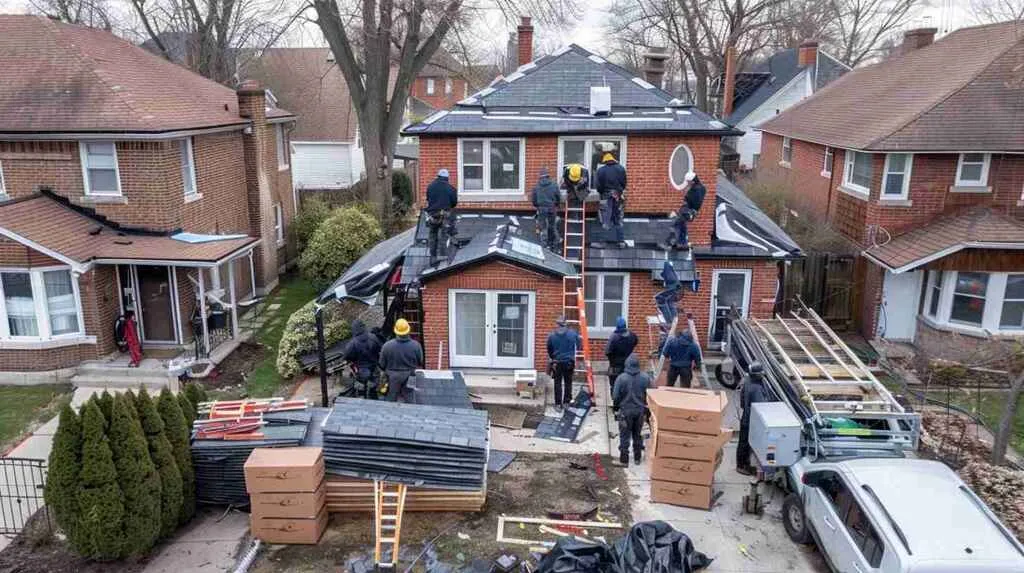
Why Are Roof Shingles Important Queens NY – The Real Answer | Free Quotes
Truth: in Queens, that $6,000-$15,000 you’ll spend on a shingle roof isn’t buying you “pretty gray rectangles” to admire from the curb. You’re buying control over water, wind, and UV-the stuff that can trash your framing, soak your insulation, and turn your attic into a sauna. I’m Luis Ortega, and I’ve spent 19 years roofing across every corner of Queens, treating every shingle as part of a larger system built to outthink the next Nor’easter.
What Roof Shingles Really Do on a Queens, NY Home
Most people think shingles are just the visible layer-the part you photograph for an insurance claim or paint around when you’re picking house colors. But shingles are really a fish-scale barrier that sheds wind-driven rain, blocks UV from cooking your decking, and creates a mechanical lock against uplift when gusts wrap around your block. If you live in a neighborhood with tight house spacing-Astoria, Jackson Heights, Corona-you’ve got wind tunnels that test every nail and seal strip harder than any brochure rating anticipated.
One January morning around 7:15 a.m., I was on a Bayside colonial with frozen shingles and a homeowner swearing his “good-looking roof” couldn’t be the problem. I showed him how the wind had lifted just the second row of shingles, and you could see the nail pattern printed in the ice underneath where water had snuck in. That job taught me that shingles matter less for how they look from the curb and more for how they lock down where you can’t see. Here’s what I tell every customer at their kitchen table: shingles are important in the hidden layers-edges, nail lines, underlayment-because that’s where water and wind make their next move. I’d rather “overbuild” a roof for Queens gusts than hand you a pretty roof that peels apart in five years.
Quick Facts: Key Shingle Facts for Queens, NY Homeowners
| Typical shingle roof cost in Queens | $6,000-$15,000 for most single- and two-family homes |
| Average architectural shingle lifespan here | 18-25 years with proper installation and ventilation |
| Main threats to shingles in Queens | Nor’easter winds, wind tunnels between houses, UV, and freeze-thaw cycles |
| What shingles actually control | Water shedding, wind uplift, heat/UV exposure, and roof deck protection |
Myth vs. Fact: Why Shingles Matter Beyond Appearance
| Common Myth | Real Answer for Queens Roofs |
|---|---|
| “If the shingles look good from the street, the roof is fine.” | Wind damage and failed seal strips often start in the second or third row where you can’t see from the sidewalk. |
| “Any shingle rated for 30 years will last that long here.” | Queens wind patterns, sun exposure, and attic heat commonly shorten that to 18-25 years if the system isn’t done right. |
| “One missing shingle isn’t a big deal.” | A single gap lets water under surrounding shingles, following the nails into your decking and insulation. |
| “All asphalt shingles protect the same.” | Heavier architectural shingles with proper starter and ridge components resist Queens gusts far better than cheap three-tabs. |
Follow the Water: How a Shingle Roof System Prevents Leaks
On a typical two-family in Jackson Heights, the first thing I look at isn’t the color of the shingles-it’s how they’re layered at the edges. Now follow the water with me: rain hits the ridge first, runs down each overlapping course like fish scales, sneaks into valleys and sidewall joints where underlayment and step flashing catch it, and finally exits at the eaves where starter shingles and drip edge kick it into the gutters. In neighborhoods like Jackson Heights and Flushing, tight house spacing creates wind tunnels that blow rain sideways, testing every seal and overlap harder than a lab wind tunnel ever could.
A summer storm in 2018 hit Middle Village hard, and I got a call at 9 p.m. from a retired school principal with water coming through her ceiling fan. When I got there, lightning still popping in the distance, I found that her old three-tab shingles had been installed perfectly-but 20 years earlier, with no starter strip and no proper ridge caps. The shingles themselves had done all they could; the missing components turned that roof into a funnel. That night I really started explaining to customers that a “shingle roof” is actually a system-starter, field shingles, ridge caps, underlayment-and if you skip one part, the whole thing can fail during a Queens storm.
Now Follow the Water With Me, Step by Step:
- Step 1: Wind-driven rain hits the ridge and upper courses first, trying to blow under the top shingles.
- Step 2: Water runs down the face of each shingle, overlapping like fish scales, and is directed away from exposed nail heads.
- Step 3: At valleys and sidewall joints, underlayment and step flashing catch any water that sneaks under the shingle surface.
- Step 4: Along the eaves, starter shingles and drip edge kick water into the gutters instead of letting it curl back toward the fascia.
- Step 5: At the ridge, properly formed ridge caps let hot, moist attic air out while shedding rain off both sides of the roof.
| Component | What It Does for Water | What It Does for Wind in Queens | What Happens If It’s Missing |
|---|---|---|---|
| Starter shingles at eaves | Seal the first row so water can’t sneak under from the bottom edge | Give the wind fewer loose edges to grab | Water curls under first course; shingles tear in gusts off the East River |
| Underlayment (ice & water + felt/synthetic) | Backup barrier if water gets under shingles | Adds a bit of stiffness and secondary protection | Minor leak becomes a ceiling stain after one Nor’easter |
| Field shingles | Main fish-scale surface that sheds the bulk of rain | Lock together with seal strips to resist uplift | Decking exposed, fast aging and rot |
| Ridge caps | Protect the top joint where both sides meet | Designed to flex and stay put in gusts | Ridge becomes a straight-line leak during sideways rain |
More Shingles, More Problems: Heat, Layers, and Roof Life
I’ll never forget a Saturday in early fall, mild weather, when a young couple in Astoria tried to save money by having a friend “lay new shingles over the old ones.” By the time I saw it, the roof had three layers, the top ones were curling, and the heat in the attic was brutal. We pulled up a section and you could smell the cooked asphalt. It was the perfect example of how more shingles don’t mean more protection-they mean trapped heat, stressed framing, and a warranty that means nothing. Here’s an insider tip most roofers won’t say out loud: in Queens, you almost always want a single, properly ventilated shingle layer instead of multiple overlays. The extra weight stresses your framing, the trapped heat ages your shingles faster, and most manufacturer warranties vanish the moment you add that second layer. Don’t let a cheap quote trick you into a roof that’ll fail early.
Is It Time to Worry About Your Shingles in Queens?
$450 is about what a small repair might cost now, versus thousands after a major leak. Be honest: what have you noticed on your roof-missing shingles, granules piling up in your gutters, new ceiling stains?
When I sit at a customer’s kitchen table, I always start with the same question: “Do you want this roof to survive one big storm, or twenty years of storms?” That choice shows up in the warning signs you’re seeing right now. If shingles are flipping after a recent wind event, if brown stains appeared suddenly in your bedroom ceiling, or if you’re finding shingle pieces in the yard after a Nor’easter, the water and wind have already made their move-you’re just catching up. Shingles are your frontline against the next Queens gust that wraps around your neighbor’s house and slams into your eaves. Don’t wait until the leak becomes a mold problem or a decking replacement.
Should You Call a Queens Shingle Roofer Now or Can It Wait?
⚠️ Urgent Situations
- You see missing or flipped shingles after a recent storm.
- Brown ceiling stains appeared or got bigger in the last week.
- Shingle pieces or a lot of granules show up suddenly in your gutters.
- You can see daylight or feel dampness in the attic after rain.
✓ Can-Wait Situations
- Shingles are slightly discolored but lying flat and sealed.
- Granules in gutters are light and haven’t increased over several cleanings.
- You’re near the 15-20 year mark with no active leaks and just want an inspection.
- You’re planning a larger renovation and want to time the roof with other work.
Quick Check: Repair vs. Full Shingle Replacement in Queens
Do you need a shingle repair or a full new roof?
Start: Are your shingles under 15 years old?
→ Yes → Go to Next question
→ No → Likely plan for full replacement soon.
Next: Is damage limited to one area (like under a tree or windward corner)?
→ Yes → Targeted repair may be enough.
→ No → Inspect entire roof for widespread wear; replacement is more likely.
Important: If attic shows multiple wet spots or sagging deck anywhere → Skip repairs, evaluate full system replacement.
Queens-Focused Shingle Answers and What to Do Next
Here’s the blunt truth most brochures skip: a shingle is just a controlled way to force water to behave. In Queens, the details-starter strips along the eaves, properly formed ridge caps at the peak, a single well-ventilated layer instead of multiple cheap overlays-are what buy you decades of calm during storms instead of panic calls and ceiling buckets. If you want your shingles to survive not just the next gust off the East River but the next twenty years of freeze-thaw cycles, wind tunnels between tight houses, and sideways rain, you need someone who’ll sit at your kitchen table and walk you through every line of the estimate. That’s what Shingle Masters does.
Common Queens Shingle Questions
How often should shingles be inspected in Queens, NY?
At least once a year, plus after any major wind event or Nor’easter. In neighborhoods with tighter houses and more wind tunnels-like Astoria, Jackson Heights, and Corona-an annual professional look from the ground and at the roof edge can catch lifted shingles before they leak.
Are architectural shingles worth it in Queens compared to three-tab?
Yes. Architectural shingles are heavier and have better wind ratings, which matters when gusts wrap around corner lots or taller two-families. They also seal more reliably and hide minor deck imperfections better than three-tab shingles.
Can I just replace a few damaged shingles myself?
You can, but it’s easy to break surrounding shingles or miss that wind has lifted a larger area than you can see. A quick pro visit can confirm whether it’s truly isolated or if the wind and water have already started traveling farther under the surface.
How long does a shingle replacement usually take in Queens?
Most single-family or small two-family shingle replacements take 1-2 days with a full crew, including tear-off, minor decking repairs, installation, and cleanup. Complex roofs, tight driveways, or shared walls with neighbors can add a day.
Will a new shingle roof really lower my bills?
It can help. A proper single-layer shingle system with good attic ventilation reduces trapped heat in summer and moisture in winter, which can ease the load on your AC and reduce the risk of mold or insulation damage.
Why Queens Homeowners Call Shingle Masters
- 19+ years installing and diagnosing shingle roofs across Queens neighborhoods.
- Licensed and insured in New York City for residential roofing.
- Fast response for storm damage calls, usually within 24 hours when weather allows.
- Detailed, line-by-line written estimates explaining every shingle and component.
If you want your shingles to survive not just the next storm but the next twenty years of Queens weather, call Shingle Masters for a free, line-by-line shingle roof quote and on-site inspection tailored to your block and house style. We’ll come to your kitchen table, sketch out exactly what your roof needs, and show you how every component works together to keep water and wind exactly where they belong-outside.