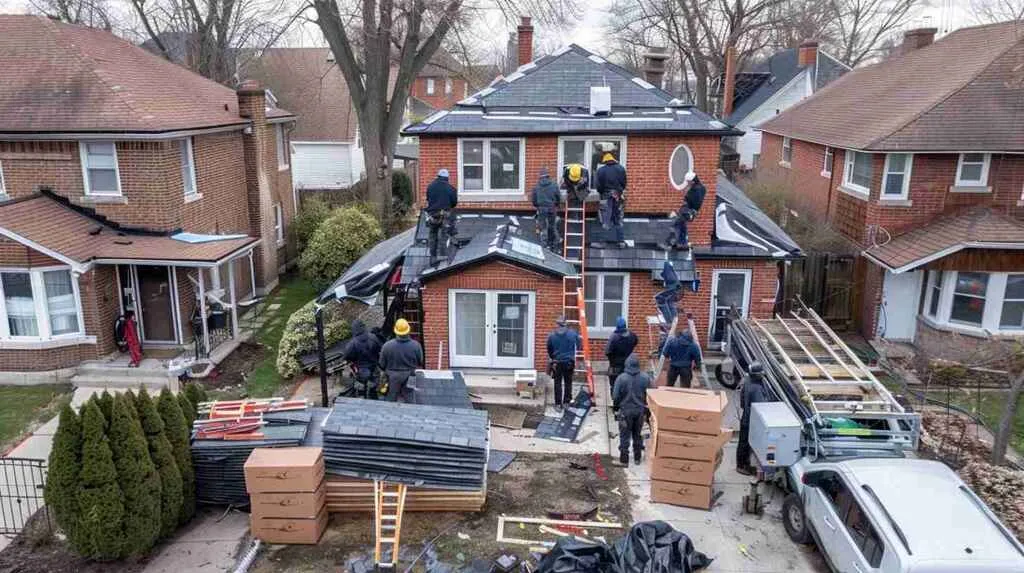
Roof Shingle Fell Off Queens NY – What to Do Right Now | Free Estimates
Quartz, tar, and gravity – those are the three things that keep your roof from leaking, and when one shingle falls off your Queens roof, gravity just won the first round. The single smartest move you can make in the next ten minutes is to stay off the roof completely and focus on what you can safely do from the ground, because climbing a steep Astoria two-family with a rickety extension ladder won’t end well, and honestly, you’re not going to see the real problem from up there anyway.
What To Do The Minute You See a Shingle on the Ground in Queens
On a typical Queens block, I can tell from the sidewalk what happened – wind caught the edge, the seal strip let go, and that shingle tumbled down with a couple of nails still sticking out of it. From your safe spot on the ground, you want to look for the bare patch on the roof (often darker than the surrounding shingles, sometimes black underlayment showing through), scattered granules in the gutter or on the driveway, and then mentally follow the path the water would take from that gap. Water’s like a stubborn houseguest with its own plans – it doesn’t just drip straight down where the shingle’s missing; it’ll travel under the surrounding shingles, slide along the underlayment, and show up on your ceiling six feet away from where you think the problem is.
Here’s what the physics says, whether we like it or not: a missing shingle creates a point where wind can lift the edges of the shingles around it, and water uses capillary action to sneak under those lifted edges, especially on Queens roofs with valleys, dormers, or where two roof planes meet. I’ve seen this play out on rowhouses in Woodside and Jackson Heights where the transition between the main roof and a flat-deck extension becomes a highway for water once a single shingle goes missing near that seam.
Let me be blunt for a second: your to-do list for the next hour is simple, safe, and doesn’t involve a ladder. Block off the area where the shingle fell so nobody parks under a spot that might drop more debris, take clear photos of the shingle on the ground (nails, tears, and all) and of the roof area where it came from, walk through your top floor and attic looking for fresh water stains or damp spots directly under and downhill from the missing shingle, check the weather forecast for rain in the next 24-48 hours, and call a licensed Queens roofer for a same-day or next-day assessment rather than trying to patch it yourself with hardware-store roof cement and hope.
✅ Immediate Ground-Level Actions If a Roof Shingle Falls Off in Queens
- ✅ Stay off the roof completely – steep pitches, wet shingles, and consumer ladders are a dangerous combination.
- ✅ Move people, pets, and cars away from where shingles or loose nails may fall.
- ✅ Take clear photos of the shingle on the ground and the bare patch on the roof (zoom in if you can).
- ✅ Note the weather – wind speed when it happened, current forecast, and the exact time you discovered the missing shingle.
- ✅ Do a quick walk-through of top-floor rooms and attic for fresh stains, damp drywall, or drips.
- ✅ Call a licensed Queens roofer for a same-day or next-day assessment before the next storm tests that gap.
⚠️ DIY Dangers When a Shingle Comes Loose
Do not climb on a steep Queens rowhouse roof with a consumer-grade extension ladder – falls from roof edges send people to the ER every storm season. Do not try to nail a torn shingle back into old nail holes; the seal strip is blown, the nail holes are enlarged, and you’ll just drive water sideways under the surface. And do not smear hardware-store roof cement over the gap as a patch without understanding how water will travel under the surrounding shingles – you’re basically building a dam that redirects the leak somewhere worse.
How Bad Is One Missing Shingle, Really?
Here’s what the physics says, whether we like it or not: wind doesn’t just blow shingles off – it lifts them from the bottom edge, and once one’s gone, the wind can get under the edges of the shingles around it, creating more lift and more gaps. Water uses capillary action to creep under those lifted edges, then gravity pulls it down along the underlayment until it finds a nail hole, seam, or crack in the wood deck. On Queens roofs – especially two-family homes in Astoria with multiple roof planes, or rowhouses in Woodside and Jackson Heights where valleys and party-wall transitions create natural water highways – a “small” gap from one missing shingle can funnel a surprising amount of water into places you’d never expect.
I still remember a homeowner in Woodside who called me in late spring after finding one shingle in his backyard. He almost canceled the appointment because “it’s not leaking now, so it’s fine,” but that missing shingle was right over a seam where the main roof met a small dormer extension. When I opened it up, water had already traveled about four feet sideways under the felt, soaking into the wood sheathing in a dark line that pointed straight at his second-floor bathroom. Six months later he called back, sheepish, to admit there was mold on the underside of the roof deck exactly where I’d warned him it would show if he delayed the repair. We ended up replacing a six-shingle section plus sheathing and felt instead of the quick two-shingle patch we could’ve done in May.
| Location of Missing Shingle | Typical Queens Example | Leak Risk Level | What the Water Wants to Do There |
|---|---|---|---|
| Middle of a flat roof section | Center slope on a one-family in Flushing | Low | Water drips straight down through underlayment, usually stays contained if you repair quickly. |
| Near a valley or transition | Where main roof meets dormer in Astoria two-family | High | Water funnels into the valley, travels under felt, spreads along seams – can show up feet away. |
| Along the eave edge | Bottom row on a semi-attached home in Jamaica | Medium | Water can run back under the starter strip if wind-driven, but often drips off into gutter. |
| Over a roof penetration | Near chimney flashing or vent pipe on Woodside rowhouse | High | Water wants to follow the edge of the flashing down into the attic or wall cavity – hard to trace. |
| Myth | Fact |
|---|---|
| “If it’s not leaking today, it’s fine.” | Water often travels sideways under the underlayment for weeks before showing up as a ceiling stain – by then, wood rot may have started. |
| “It’s just cosmetic – one shingle won’t hurt.” | Wind uplift and capillary action don’t care about cosmetics; a single gap near a valley or transition can funnel gallons of water under your roof during a storm. |
| “I can just glue it back myself with roof cement.” | Roof cement smeared over a torn shingle with blown seal strips and enlarged nail holes just redirects water under adjacent shingles – you’re creating a new leak path, not fixing the old one. |
| “Insurance won’t care about one missing shingle.” | Most adjusters care a lot about prompt repairs and documented damage; delaying lets them argue the leak was from “lack of maintenance” rather than a storm event. |
Step-by-Step: What a Proper Shingle Repair Looks Like in Queens
From Quick Tarp to Last Nail
If you were standing next to me on the ladder, I’d point out that a real repair isn’t just slapping a new shingle over the gap – it’s about inspecting the surrounding shingles for lifting, checking the seal strips (those tar lines that glue each shingle to the one below), looking at the underlayment for tears or wet spots, and making sure the nails didn’t rip through the wood deck when the wind pulled the old shingle off. One November afternoon in Astoria, I had a homeowner who wanted me to “just nail it back up” after a 35 mph gust tore a shingle loose. I had to explain that reusing a wind-torn shingle is like reusing a ripped Band-Aid – the seal strip’s blown, the nail holes are enlarged, and physics doesn’t care that it’s almost Thanksgiving. We set a temporary patch that day and came back to do the full repair with new shingles, proper nailing, and sealed edges.
I still remember a homeowner in Jamaica who found a shingle in her driveway one winter evening with tire tracks on it. She thought the delivery truck had knocked it off the roof, but when I climbed up with my headlamp around 8 p.m., I found a patch of brittle shingles where ice had formed underneath from poor attic ventilation. That “one broken shingle” was basically an early warning that aging, heat, and moisture were ganging up on her roof. We opened up more than the obvious bare spot, found water stains on the sheathing three shingles over, and ended up replacing a six-shingle section plus addressing the ventilation issue. If we’d just patched the single visible gap, she’d have been calling me back in March with a ceiling leak.
Professional Shingle Repair Process Shingle Masters Follows in Queens
Step 1: Phone Intake
Basic questions about where the shingle fell, when you noticed it, and any interior signs like stains or drips.
Step 2: On-Site Roof Inspection
We focus on where the water wants to go from that gap – valleys, seams, and transitions get extra attention.
Step 3: Temporary Weatherproofing
If rain or heavy wind is forecast within 24-48 hours, we tarp or seal the area immediately.
Step 4: Removal & Inspection
Damaged shingles come off carefully so we can inspect the underlayment and wood deck for hidden water damage.
Step 5: Installation of New Shingles
Proper nailing pattern (four nails per shingle, not three), sealed edges, and matched color and style.
Step 6: Surrounding Area Check
We check nearby shingles for lifting or brittleness – same wind or age that caused the first failure often affects others.
Step 7: Walk-Through & Documentation
Photos of the completed repair, simple explanation of what to watch for in the next storm, and written summary for your records.
💰 Typical Queens Shingle Repair Scenarios & Price Ranges
Ranges reflect typical labor, materials, and access difficulty; exact quotes depend on inspection findings.
When to Call Right Now vs When It Can Wait a Week
Before you spend a dollar on this, ask yourself one question: If it rains hard tonight, do I know exactly where that water will go from this gap? If the answer is no – if you can’t confidently trace the path from the missing shingle to a safe exit off your roof – treat the situation as urgent and don’t wait on repairs.
Can you trace where the water wants to go from that bare spot, or are you guessing?
🚨 Call Today (Emergency)
- Bare black underlayment visible from the ground
- Missing shingle near a valley or where two roof sections meet
- Active interior drip or fresh ceiling stain appeared after the shingle fell
- Forecast shows heavy rain or wind within 24-48 hours
- Multiple shingles found on ground after a storm
📅 Can Usually Wait a Few Days
- Older but still layered shingles visible under the missing one
- No interior signs after a hard rain tested the area
- Shingle loss at the very edge, away from transitions or penetrations
- Scheduled roof inspection or replacement already upcoming in next 2-4 weeks
📋 Information to Gather Before Calling Shingle Masters
- Address and neighborhood (Astoria, Flushing, Jamaica, Woodside, etc.)
- When you first noticed the missing shingle
- Photos of the shingle on the ground and the roof area
- Any recent interior leaks or stains
- Roof age if you know it
- Type of building (attached rowhouse, semi-detached, stand-alone)
- Your availability for a quick on-site visit in the next 24-48 hours
Queens Roof Care After the Emergency: Keep the Next Shingle From Falling
On a typical Queens block, I can tell from the sidewalk which roofs are headed for trouble – curled edges at the eaves, shingles with bald spots where the granules have worn off, mis-nailed patches where someone’s uncle tried a DIY fix, or dark streaks that signal poor attic ventilation turning the shingles brittle from below. A winter job that sticks with me was a Saturday evening in Flushing when a young couple called because they’d found a shingle in their driveway with tire tracks on it. They assumed the delivery truck had knocked it down, but when I climbed up with my headlamp around 8 p.m., I found a patch of brittle shingles where ice had formed underneath from poor ventilation. That one broken shingle was basically an early warning that aging, heat, and moisture were ganging up on their roof. We staged the repairs over two seasons – addressed the ventilation first, then planned a phased shingle replacement – instead of waiting for a mid-winter emergency when ice dams and leaks would’ve forced a rushed, expensive fix.
Here’s an insider tip I give every homeowner after we finish a shingle repair: schedule a quick visual scan from the sidewalk or backyard after every major wind event or hailstorm, and check your gutters and driveway for stray shingles or scattered granules – they’re your roof’s way of telling you it’s getting tired. Another tip: if you’re comfortable with heights, peek into your attic on a sunny day and look for pinpricks of light coming through the roof deck, or damp insulation near the eaves. And keep asking yourself that simple question: “Where does the water want to go next?” It’s the same mental model I use on every job, and it’ll keep you ahead of leaks, rot, and expensive surprises.
🗓️ Ongoing Roof Checkups for Shingle Roofs in Queens
| Interval | What to Check | Why It Matters for Leaks |
|---|---|---|
| After Every Major Storm | Quick visual scan from sidewalk or yard for lifted, missing, or displaced shingles | Catches wind damage before the next rain tests the bare spots and sends water under the felt |
| Spring & Fall (Twice Yearly) | Lifted shingles, clogged gutters full of granules, attic moisture or mold signs | Clears debris that blocks drainage, spots seal-strip failures before they spread, reveals hidden leaks early |
| Every 2-3 Years (After Age 10) | Full professional roof inspection covering shingles, flashing, underlayment condition, ventilation | Aging roofs fail in clusters; a pro can predict where water will find a path before it actually does |
| Pre-Winter (November) | Ventilation adequacy, brittle or curled shingles, any past patch areas for seal integrity | Ice dams form where warm attic air melts snow; poor ventilation + old shingles = leaks when melt refreezes at eaves |
✅ Why Queens Homeowners Call Shingle Masters When a Shingle Falls Off
- ✓ Licensed and insured in New York State – full liability and workers’ comp coverage
- ✓ 19+ years hands-on roofing experience in Queens neighborhoods from Astoria to Jamaica
- ✓ Same-day response when possible for missing-shingle calls, within 24 hours for most situations
- ✓ Free written estimates with photos so you understand exactly what you’re paying for
- ✓ Experience tracing water paths – we can predict where a leak will show up weeks before it actually does
Common Questions About a Single Missing Shingle in Queens, NY
Is one missing shingle really enough to cause a leak?
Absolutely – especially if that shingle is near a valley, dormer, or where two roof planes meet. Water doesn’t just drip straight down; it travels sideways under the underlayment, following gravity and capillary action until it finds a nail hole or seam. I’ve traced ceiling stains back to missing shingles six feet uphill from where the homeowner was looking.
Can I just nail the old shingle back on myself?
Not safely or effectively. Once a shingle’s been torn off by wind, the seal strip (the tar line that glues it to the shingle below) is broken, the nail holes are enlarged, and the edges are often cracked. Nailing it back up just creates new leak paths where water will run under the damaged edges. Plus, steep Queens roofs and consumer ladders are a dangerous combination – falls send people to the ER every storm season.
Will my homeowners insurance cover a shingle blow-off in Queens?
Most policies cover sudden wind damage, but adjusters want to see prompt repairs and clear documentation. If you delay and water damage spreads, they may argue it’s “lack of maintenance” rather than a covered storm event. Take photos of the missing shingle and the roof area, note the date and weather conditions, and get a licensed roofer’s assessment quickly – that paper trail matters when you file a claim.
How fast can Shingle Masters come out if a shingle fell off today?
We prioritize missing-shingle calls and typically offer same-day visits when our schedule allows, or within 24 hours for most situations. If heavy rain or wind is forecast in the next day or two, we’ll do our best to get a temporary tarp or seal in place immediately, then schedule the full repair as soon as conditions are safe for quality work.
Do I need a full roof replacement if a few shingles came off during a storm?
Not necessarily. If the rest of your roof is in decent shape – shingles still flexible, seal strips intact, no widespread curling or granule loss – a targeted repair of the damaged section is usually fine. But if the shingles that blew off were already brittle, or if we find similar damage across multiple areas during the inspection, that’s a sign the whole roof is nearing the end of its lifespan, and a replacement might make more financial sense than patching it every storm season.
Now, follow the path the water would take from that missing shingle – up under the edges, along the felt, down to a seam or nail hole, and eventually into your attic or ceiling. Shingle Masters has spent 19 years tracing those exact paths on Queens roofs, from Astoria two-families to Woodside rowhouses to Jamaica single-family homes, and we can predict where a leak will show up before the next storm tests your roof. Call us now for a free, same-day or next-day estimate, and let’s stop that water before it finds its way inside.