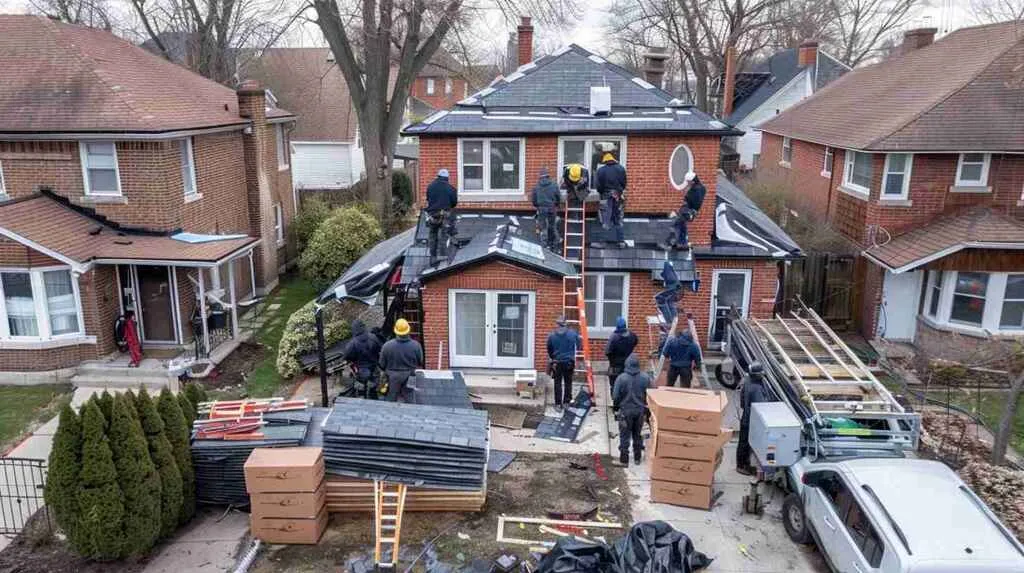
What Do Roofers Put Under Shingles Queens NY – Layers Explained
Hidden behind every row of asphalt shingles on your Queens home is a system most people never think about-and honestly, the shingles are just the third or fourth line of defense, not the first. The real waterproofing heroes are the layers you can’t see from the sidewalk: ice and water shield, underlayment, proper flashing, and a solid deck underneath. I’ve spent two decades climbing onto roofs across Jackson Heights, Bayside, Corona, and Woodside, and I’ve learned one thing for sure: what you don’t see is what saves you when Queens weather hits.
Shingles shed sun and the bulk of rainwater, but they’re not the magic shield. Your underlayment and ice barrier are doing the heavy lifting, especially in this climate where we get freeze-thaw cycles, wind-driven rain, and the occasional surprise nor’easter. In this guide, I’m going to peel back every layer-literally and figuratively-so you understand exactly what roofers should be putting under your shingles, and which shortcuts will come back to haunt you.
Hidden Roof Layers: The Real Leak Stoppers Under Your Shingles
Here’s what trips people up: they see fresh shingles and assume the roof is waterproof. But I’ve been called to brand-new-looking roofs in Queens that leak like sieves because someone skipped or botched the layers underneath. The deck is your foundation, ice and water shield is your emergency backup when things go sideways, underlayment is your raincoat, and shingles are the jacket you wear over the raincoat. Each one matters, and each one does a different job in our Queens climate.
One August afternoon, about 3 p.m., I was on a two-family in Woodside, sun bouncing off the shingles so hard my tape measure was too hot to hold. The owner kept saying, “But my shingles are only eight years old, why is it leaking?” I pulled up a strip and showed her the felt underneath-torn, wrinkled, and never lapped right at the eave. The shingles looked fine, but the underlayment had been acting like a sponge for years. That was the day I started telling every customer, “What you don’t see is what saves you.” It’s like biting into a Cubano from Roosevelt Avenue that looks perfect but has stale ham inside-the outside doesn’t tell the whole story.
So here’s the sandwich breakdown, bottom to top: solid roof deck (your bread), ice and water shield at the vulnerable spots (your mustard and pickles that keep everything from sliding apart), synthetic underlayment or quality felt over the whole deck (your main filling-roast pork, ham, cheese), and finally the shingles and ridge caps (the toasted crust). Every decision I make on a Queens roof comes down to treating each layer with respect, because I’ve seen what happens when roofers treat shingles like they’re the only ingredient that matters.
Common Misunderstandings: What Really Keeps Water Out
| Myth | Fact |
|---|---|
| Shingles are what make the roof waterproof. | The underlayment and ice & water shield handle most of the waterproofing; shingles shed sun and bulk water. |
| As long as the shingles look good, the roof won’t leak. | You can have fresh shingles over wrinkled or torn felt and still get leaks inside your house. |
| All that stuff under the shingles is optional “extra.” | In Queens’ wind-driven rain, skipping underlayment or ice barrier is the fastest way to a mystery leak. |
| Underlayment type doesn’t matter much. | Cheap tar paper vs. quality synthetic can be the difference between a dry deck and a soggy, rotted one. |
| If the roofer nailed a lot of shingles, the roof is secure. | Fastening pattern and overlaps on the hidden layers matter just as much as shingle nail counts. |
Roof Layer by Layer: From Deck to Shingle in Queens, NY
The “bread”: roof deck and ventilation
Think of your roof deck as the tortilla in a burrito-everything sits on top of it, and if the tortilla falls apart, the whole thing’s a mess. In Queens, most homes I work on have half-inch or five-eighths-inch plywood sheathing, though older row houses in Jackson Heights or two-families in Woodside might still have 1×6 or 1×8 plank boards running horizontal. If the deck’s soft, spongy, or has gaps, nothing you nail over it will hold right. Before any underlayment or shingle goes down, I check every square foot, replace rotted sections, and make sure the deck is solid and properly ventilated underneath so moisture doesn’t bake the whole sandwich from the inside out.
The “filling”: ice & water shield and underlayment
This is where the real waterproofing lives. Ice and water shield is a peel-and-stick rubberized membrane that seals around every nail and stops water dead even when it’s trying to run uphill under your shingles-critical in Queens where ice dams form at gutters after snowmelt. I run it at every eave, in valleys, and around chimneys, skylights, and vent pipes. Then over the rest of the deck goes your underlayment: synthetic roofing felt is my preference for durability and tear resistance, though #15 or #30 asphalt felt still works if it’s installed tight and lapped correctly. This layer is your raincoat-if shingles lift in wind or a branch punches through, the underlayment keeps the deck dry until you can fix it.
The “crust”: shingles and ridge caps
Now we get to the part everyone sees. Asphalt architectural shingles rated for New York wind give you the finished look, shed UV and rain, and protect the layers below from direct abuse. Starter strips at the eaves and rakes seal the first row against wind lift, and ridge caps finish the peak. Shingles matter, don’t get me wrong, but they’re doing maybe 40% of the waterproofing work-the rest is happening invisibly underneath.
Here’s my non-negotiable line in Queens, NY: every roof I touch gets ice and water shield at the eaves and in valleys, no exceptions. If it’s a low-slope section over a kitchen extension or a high-wind corner on a Bayside cape, I’m using synthetic underlayment, not cheap felt. And I’m checking or replacing flashing at every wall, chimney, and transition because I’ve seen too many “perfect” shingle jobs leak at the seams where the metal was reused or bent wrong. Contractors who skip these steps are gambling with your ceiling, not theirs.
Queens Weather vs. Your Underlayment and Ice & Water Shield
One January morning after a snowstorm, I got an emergency call from a retired teacher in Bayside: water dripping through her recessed lights. I climbed up in 20-degree weather, wind cutting through my gloves, and found no ice and water shield at the eaves-just brittle old tar paper under decent-looking shingles. The meltwater had backed up under the shingles and walked right in. We ended up redoing the first 6 feet of the roof with proper ice barrier, and she made me promise I’d explain this “invisible shield” to every homeowner who thought shingles were the whole story. The shingles are just the jacket-your real waterproofing is hiding underneath. In Queens, where you get freeze-thaw cycles, sideways rain driven by wind funnels between buildings, and ice that forms and melts three times in a week, I run ice and water shield a minimum of three feet up from every eave, and six feet if the pitch is shallow or the exposure is bad-ask any roofer to put that exact number in writing before they start.
⚠️ Warning: Skipping Ice & Water Shield in Queens
If your roofer in Queens tells you ice & water shield is “optional,” be careful.
- Snow that melts and refreezes at the gutters can push water back up under shingles.
- Without a peel-and-stick barrier, that water finds every nail hole and tiny seam in your deck.
- Even brand-new shingles can leak after the first freeze-thaw cycle if there’s no ice barrier.
- Always ask exactly how many feet of ice & water shield they’re installing from the eave and in valleys-get it in writing.
How I Build a Queens Roof So the Hidden Layers Actually Work
I’ll never forget a job in Corona at 7 p.m., working under floodlights because rain was coming overnight. The previous crew had skipped the synthetic underlayment on a low-slope section to “save time,” just nailed shingles right to the deck. The first wind-driven rainstorm turned that whole area into a drip field over the kitchen. We had to strip everything, dry the deck with leaf blowers, then roll out underlayment by headlamp. Since then, whenever someone asks why we bother with all those layers, I tell them I’ve seen what happens when you treat shingles like they’re magic. Low-slope sections over kitchen extensions are everywhere in Queens-those little flat or near-flat additions on the back of row houses and two-families-and they’re leak magnets if you don’t respect the layers.
So here’s my process, same on every Queens home whether it’s a cape in Bayside or an attached row house in Woodside. First, strip old shingles and underlayment down to bare deck, replace any soft or rotted plywood or planks so we’re nailing into something solid. Then I install ice and water shield at all eaves-usually three to six feet up depending on pitch-in every valley, and around every chimney, skylight, and vent pipe. Next, I roll out synthetic underlayment over the rest of the deck, keeping it flat and tight with proper overlaps and cap nails so wind can’t get under it during the job. Before a single shingle goes down, I fit and fasten new metal flashing at sidewalls, chimneys, and roof-to-wall transitions. Then starter strips at eaves and rakes, shingles laid in the manufacturer’s pattern with correct nailing, and finish with ridge caps and a seal around all penetrations. On low-slope or high-wind corners, I insist on synthetic underlayment-it holds up better during installation, sheds water faster, and doesn’t wrinkle or tear like cheap felt. That’s a non-negotiable for me in neighborhoods where wind funnels between buildings or you’ve got a shallow pitch.
Step-by-Step: Luis’s Exact Sequence Under the Shingles
- Strip old shingles and underlayment down to bare deck; replace any soft or rotted plywood or planks.
- Install ice & water shield at all eaves (usually 3-6 feet up), in valleys, and around chimneys, skylights, and vent pipes.
- Roll out synthetic underlayment over the rest of the deck, keeping it flat and tight with proper overlaps and cap nails.
- Fit and fasten new metal flashing at sidewalls, chimneys, and roof-to-wall transitions before shingles go down.
- Install starter strips at eaves and rakes, then lay shingles in the manufacturer’s pattern with correct nailing.
- Finish with ridge caps and seal around all penetrations, then do a hose or visual test at known leak-prone areas.
✅ Must-Have Hidden Details Under Your Shingles in Queens
- ✅Ice & water shield at least 3 feet up from all eaves
- ✅Extra ice & water in valleys and around chimneys
- ✅Synthetic underlayment on any low-slope or wind-exposed sections
- ✅Properly lapped underlayment (top piece always overlapping bottom)
- ✅New or inspected flashing at all walls and roof transitions
Quick Checks and Questions Before You Hire a Roofer in Queens
Before you hand over a deposit, take a quick walk around your house like you’re talking to a neighbor who knows roofs. Look at the eaves from the sidewalk-do the shingles lie flat at the gutter line, or are edges curled or lifted? That’s a clue something’s wrong underneath. If you’ve got attic access, go up there after a heavy rain or during a thaw and check for fresh dark spots, drips, or damp insulation near the eaves. On Queens two-families, attached row houses, and small condos, these edge zones are where bad underlayment or missing ice barrier show up first. When roofers come to quote, ask every one of them: how many feet of ice and water shield will you install from the gutter line, are you using synthetic underlayment or basic felt and why for my roof pitch, will you replace or re-use existing flashing at walls and chimneys, and what brand and wind rating are the shingles rated for in Queens conditions.
If a roofer can’t name and explain these layers in plain language-deck, ice and water shield, underlayment, flashing, shingles-you’re better off moving on. The crew that skips explaining the hidden stuff is the same crew that’ll skip installing it right. At Shingle Masters, we don’t start nailing shingles until we’ve shown you exactly what’s going underneath and walked you through why each layer matters for your specific Queens home.
Before You Call: Quick Self-Check for Queens Homeowners
- ✅Look at the eaves from the sidewalk: do shingles lie flat at the gutter, or are edges curled or lifted?
- ✅Check your attic after heavy rain or a thaw: any fresh dark spots, drips, or damp insulation near the eaves?
- ✅Ask every roofer: how many feet of ice & water shield will you install from the gutter line?
- ✅Ask: are you using synthetic underlayment or basic felt, and why for my roof pitch?
- ✅Ask: will you replace or re-use existing flashing at walls and chimneys?
- ✅Ask for the brand and wind rating of the shingles they’re proposing for Queens conditions.
If a roofer in Queens can’t clearly explain what they’re putting under the shingles-layer by layer, with reasons-they shouldn’t be on your roof. Give Shingle Masters a call and we’ll walk you through the full layer-by-layer plan for your Queens home, show you samples of every material we use, and make sure you understand why each piece matters before we ever start tearing off old shingles.