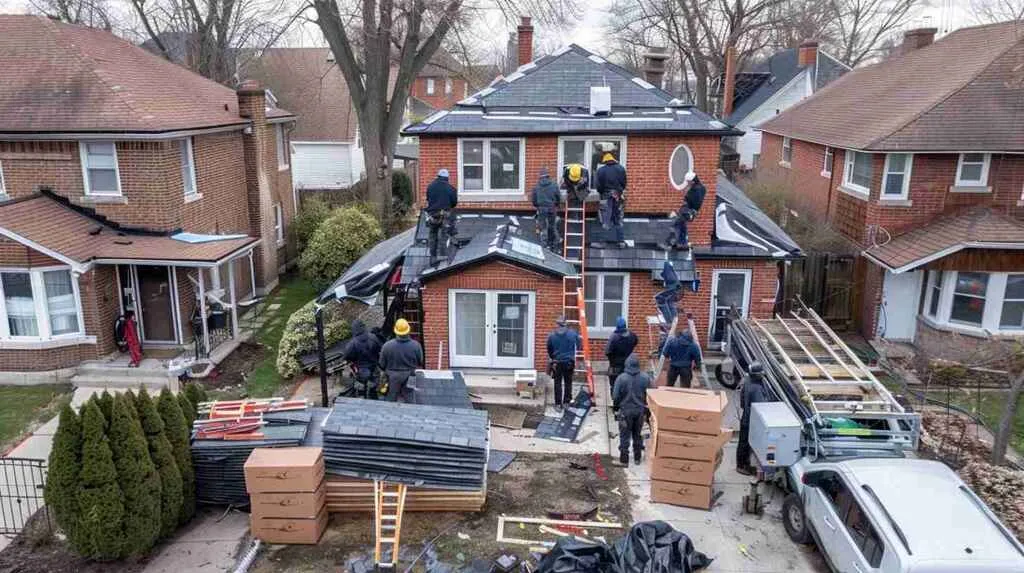
Synthetic Roof Shingles Queens NY – Premium Look, Less Upkeep | Free Quotes
Blueprint this: On a typical 20-by-40 Queens row house, homeowners spend between $8,500 and $14,000 to swap out failing asphalt shingles for synthetic slate or cedar. That number makes people blink until I remind them what they’ve already been spending – $800 here for patching after a storm, another $1,200 three years later when ice ripped off the ridge caps, then $2,500 for an emergency repair when wind tore a whole section loose and water started showing up in the upstairs bedroom. When you add up the patch-work cycle over fifteen or twenty years, synthetic shingles don’t just look better, they stop bleeding you dry.
Synthetic Roof Shingle Costs on a Typical Queens Row House
On a typical 20-by-40 Queens row house, I see the same thing every week – a roof that’s been patched three or four times, and the homeowner is tired of it. Here’s what it actually costs to stop that cycle: full tear-off of the old asphalt, deck inspection and any necessary plywood repairs, ice-and-water shield along the eaves and valleys, synthetic underlayment, premium synthetic shingles (slate-look or cedar-look), new drip edge and flashing, ridge venting, and cleanup. Think of it like casting better actors for a long-running show – you’re editing out all those future leak scenes before they even happen, and the curb appeal from the street looks like you spent twice what you did.
The asphalt patch-job cycle is brutal in Queens weather. You’re dealing with freeze-thaw every winter that cracks sealant, summer heat on black tar that bakes shingles brittle, and nor’easters that peel tabs right off. Most people patch every two to four years, and after a decade the roof deck itself starts rotting because water’s been sneaking in behind those band-aids. Synthetic shingles handle all of it – engineered polymers flex instead of crack, the color runs all the way through so fading doesn’t matter, and they’re rated for 110-mph winds. One August afternoon, we were redoing a little row house in Jackson Heights where the owner wanted real cedar shakes “for the look” until I showed him the mold streaks on his neighbor’s roof. I still remember the heat reflecting off that black tar at 3 p.m., my shirt stuck to my back, while I laid a synthetic cedar sample over his existing shingle and hosed it down from the second-floor bathroom window to prove how it shed water. He signed for the synthetic on the spot, and three years later, during that brutal nor’easter, his was the only house on the block that didn’t lose a single piece of “wood” – even though it was all composite.
$2,000 every few years for patching adds up to $10,000+ over a roof’s life, with nothing to show for it at the end. One synthetic install at $12,000 buys you 30+ years and zero emergency calls.
| Scenario | Roof Description | Includes | Estimated Price Range (Queens, NY) |
|---|---|---|---|
| Typical Row House | 20×40 attached, two layers existing shingle, simple gable | Tear-off, deck check, synthetic slate or cedar, ridge vent, cleanup | $8,500 – $12,000 |
| Small Cape or Bungalow | 25×30 detached, one layer, hips and valleys | Full tear-off, ice shield on all edges, synthetic cedar-look, new flashing | $9,200 – $13,500 |
| Co-op Low-Rise Section | 30×50 flat-to-slope, parapet walls, shared party wall | Tear-off, deck rebuild (partial), synthetic slate, parapet flashing, tapered insulation | $14,000 – $19,000 |
| Tudor or Complex Roof | Multi-gable, dormers, three skylights, steep pitch | Tear-off, skylight reflashing, synthetic designer shingle, copper accents, extended labor | $16,000 – $24,000 |
| Garage or Small Addition | 12×20 single-slope or shed roof, accessible | Tear-off, synthetic shingle to match main house, flashing tie-in | $2,800 – $4,500 |
Why Synthetic Roof Shingles Are Low-Maintenance in Queens Weather
Here’s my unfiltered opinion: if you hate climbing ladders, synthetic can be your best friend. Queens weather is tough – we get freeze-thaw cycles that split organic shingles apart, summer heat that bakes the oils out of asphalt until it crumbles like stale bread, and nor’easters that treat a cheap three-tab roof like tissue paper. Synthetic shingles laugh at all of it because they’re engineered polymers with UV inhibitors baked in and impact modifiers that let them flex instead of crack. I’ve done hundreds of these jobs in Jackson Heights, Astoria, Bayside, Flushing – neighborhoods where the row houses sit tight together so wind funnels between them and every rainstorm hits the west-facing slope like a fire hose. Basic asphalt starts showing granule loss after five years; synthetic still looks sharp after fifteen.
I’ll never forget a December job in Bayside where a real slate roof had started dropping pieces onto the sidewalk – not cute when kids are walking home at 4 p.m. in the dark. The homeowner was terrified of the cost of real slate replacement, so I brought a single synthetic slate shingle, climbed up there with a headlamp and a thermos of coffee, and laid it next to the original in the cold wind. We did half the roof in synthetic slate, half still original for budget reasons, and two winters later you literally couldn’t tell from the street which half was which, but the synthetic side had zero ice damage. The real slate kept shedding chunks every time ice built up in the valleys; the synthetic stayed locked down tight. That’s the difference – it’s not just about looks, it’s about what happens when winter decides to test you.
Synthetic Roof Shingles in Queens
✓ Pros:
- 30-50 year lifespan with minimal maintenance
- Realistic slate or cedar look at half the price of real material
- Holds color in Queens sun; no granule loss like asphalt
- 110+ mph wind rating; resists ice and freeze-thaw damage
✗ Cons:
- Higher upfront cost than standard asphalt ($2-4 more per square foot installed)
- Fewer roofers trained to install premium synthetic properly
- Some older co-op boards unfamiliar with modern synthetics and may require board approval
- Very steep roofs (12/12 pitch+) add labor cost due to safety equipment
Standard Asphalt Shingles in Queens
✓ Pros:
- Lower initial cost ($3,500-$7,000 typical Queens row house)
- Fast availability; every roofer stocks them
- Familiar to co-op boards and inspectors
- Easy repairs if one shingle gets damaged
✗ Cons:
- 15-20 year realistic lifespan in Queens weather; warranty claims are a hassle
- Constant patching cycle – wind, ice, and sun all take chunks out
- Granule loss starts around year 7; looks shabby fast
- Organic versions prone to algae streaks and mold in shaded areas
Quick Facts: Synthetic Shingles for Queens Homes
| Typical Lifespan | 30-50 years depending on product grade and Queens exposure; many carry transferable warranties |
| Maintenance Frequency | Annual gutter cleaning and visual check; no re-sealing or patching typical for first 15+ years |
| Wind Rating | Class 4 impact, 110-130 mph wind rating standard; outperforms asphalt in Queens storms |
| Warranty Expectations | 50-year limited material warranty common; Shingle Masters adds 10-year workmanship guarantee |
How We Install Synthetic Shingles on Queens Row Houses and Co-ops
When I step onto a roof for the first time, the first thing I ask myself is not “What’s broken?” but “What keeps breaking here?” That’s the storyboard approach – I’m looking at drainage patterns, where ice dams form every winter, how the party wall flashing was done (or not done), whether the previous guy just slapped shingles over rotting plywood and called it a day. On a Queens row house or low-rise co-op, you’re often dealing with tight access, shared walls, and old deck materials that weren’t consistent to begin with. My job is to cast the right synthetic roof shingle for the role – sometimes that’s a heavy slate-look profile for a Tudor that needs to match the neighbor’s real slate, sometimes it’s a lighter cedar-shake style for a bungalow, and sometimes it’s a designer composite that blends three colors to hide the fact that half the block is brick and half is siding. Then I plan every flashing detail, every valley tie-in, every parapet cap so water has exactly one place to go: off the roof and into the gutter.
There was a co-op in Flushing where the board demanded “no plastic-looking shingles” after a bad experience with cheap three-tabs in the ’90s. Midway through the job, we hit a surprise: the old roof deck was patched with three different kinds of plywood and even a chunk of an old door – classic. I had to stop the crew, bring the board president up to the bulkhead at 7 a.m. on a foggy Saturday, and show him how the synthetic roof shingle system would bridge the different substrates better than brittle asphalt. We rebuilt the worst sections, tied the rest together properly, and when the first heavy rain came, the superintendent called me just to say, “For the first time in 15 years, the top-floor hallway is dry.” That’s what a professional process gets you – not just new shingles, but an actual solution that holds up because every weak point got fixed before we ever nailed down the first course.
Why Queens Homeowners Trust Shingle Masters
| Years in Business | Since 2005; locally owned and operated in Queens with references on every block |
| Lead Installer Experience | Miguel Alvarez – 19 years hands-on roofing; certified in synthetic slate, cedar, and designer composite systems |
| Licensing & Insurance | NYS licensed, fully insured (general liability + workers’ comp); certificates provided to co-op boards on request |
| Estimate Response Time | On-site within 48 hours for Queens addresses; same-day quote turnaround after inspection |
| Manufacturer Certifications | Certified installers for DaVinci Roofscapes, EcoStar, and Boral synthetic systems; extended warranties available |
Should You Switch to Synthetic Shingles on Your Queens Roof?
Let me be blunt for a second: most roofs in Queens don’t fail because of storms; they fail because of shortcuts. Somebody saved $400 by skipping ice shield. Somebody else used the cheapest shingles Home Depot had that week. Another crew nailed straight through old rotted plywood and figured “it’ll hold.” And it does hold – for three years, maybe five if you’re lucky – and then winter shows up with a nor’easter and you’ve got water dripping into your bedroom at 2 a.m. A well-installed synthetic system avoids all those failure scenes because the material itself won’t rot, crack, or lose tabs, and if you hire someone who actually preps the deck and flashing right, you’re done worrying. Here’s an insider tip I give everyone: don’t chase the absolute lowest bid on synthetic. If one estimate is $5,000 cheaper than the others, that roofer is cutting corners on underlayment, flashing, or deck repairs, and you’ll lose every penny of that “savings” in callbacks and leaks. Pay for the job done right once.
Imagine your roof is the set of a long-running TV show – every season it’s exposed to sun, wind, and snow, and your shingles are the actors who can’t quit. Cheap asphalt is like casting day-players who phone it in and bail after a few episodes; you’re constantly recasting and the show looks messy. Synthetic is the veteran ensemble cast – they show up, they perform in any weather, and twenty years later the final curb-appeal shot from the street still looks expensive even though your budget was Queens-reasonable. Think about your own roof’s “next season.” Do you want to keep patching and praying, or do you want to recast with synthetic and edit out the next decade of maintenance headaches? That’s the question I ask every homeowner, because the answer tells me whether we’re putting a band-aid on it or actually solving the problem for good.
Is Synthetic Right for Your Queens Home? Follow This Path
| Question/Node | Yes Branch | No Branch |
|---|---|---|
| Is your roof actively leaking or missing shingles right now? | → Emergency patch first, then plan full synthetic upgrade within 6 months | → Continue to next question |
| Do you plan to stay in this house 10+ years? | → Continue to next question | → Standard asphalt upgrade is fine; focus budget elsewhere |
| Are you tired of patching and re-patching every 2-4 years? | → Synthetic shingles are your answer – call Shingle Masters for a storyboard walkthrough | → Continue to next question |
| Do you want the high-end look of slate or cedar without real-material cost and weight? | → Synthetic shingles deliver that look at 50-60% less than real slate/cedar installed | → Continue to next question |
| Is your main concern keeping costs low this year, even if it means more repairs later? | → Upgrade to better asphalt (architectural grade) and budget for synthetic in 10-12 years | → Invest in synthetic now – you’ll save on maintenance and sleep better during storms |
Myths vs. Facts: Synthetic Roof Shingles in Queens
| Myth | Fact |
|---|---|
| “Synthetic shingles look fake and plastic from the street.” | Modern synthetics have texture depth, color variation, and shadow lines that fool even architects from ten feet away. I’ve had neighbors ask which quarry the “slate” came from. |
| “They won’t hold up to Queens nor’easters and ice.” | Synthetic shingles are rated 110-130 mph and Class 4 impact. They flex in freeze-thaw instead of cracking like asphalt or real slate, and I’ve never had a callback for storm damage on a properly installed synthetic job. |
| “Synthetic is always more expensive than real slate or cedar.” | Real slate installed in Queens runs $25-$40 per square foot; real cedar shake is $18-$28. Quality synthetic slate or cedar is $9-$14 installed – less than half the cost and a fraction of the maintenance. |
| “Co-ops and attached row houses won’t allow synthetic materials.” | Most modern co-op boards approve synthetic once they see samples and understand the performance benefits. We provide spec sheets, fire ratings, and before/after photos from other Queens buildings to make approvals smooth. |
Common Questions About Synthetic Roof Shingles in Queens, NY
I still think about a rainy Tuesday in Elmhurst when a customer asked me this exact question: “Is synthetic just too new, or too plastic, for my block?” She was worried her neighbors would think she’d cheaped out, when in reality she was about to spend more than any of them ever had on a roof. Most questions boil down to the same four concerns – cost versus what you actually get for that money, whether it’ll look right next to brick or between two row houses that have real slate, if a co-op board is going to give you grief, and what the installation process looks like when you’re living under the roof while we work. Let me answer those head-on.
Frequently Asked Questions: Synthetic Roof Shingles in Queens
How long do synthetic roof shingles last compared to asphalt in Queens weather?
Premium synthetic shingles last 30-50 years in Queens with minimal maintenance, versus 15-20 years realistic lifespan for standard asphalt. The difference is material science – synthetics don’t have organic components that rot or dry out, and UV inhibitors are engineered into the polymer so color stays stable. I’ve seen 15-year-old synthetic roofs in Bayside that still look sharp, while the asphalt roofs next door are curling and losing granules after ten.
Will synthetic shingles actually improve my home’s curb appeal, or do they look obviously fake?
From the sidewalk, a quality synthetic slate or cedar roof is indistinguishable from the real thing unless you’re a roofer with binoculars. The texture depth, color blending, and shadow lines are that good. I’ve had listing agents tell me synthetic roofs photograph better than worn real slate because there are no broken or mismatched pieces. If curb appeal matters – and in Queens resale markets it absolutely does – synthetic gives you the high-end look without the high-end price or the cracked-tile maintenance nightmare.
Are synthetic roof shingles allowed on co-ops and attached row houses in Queens?
Yes, as long as you follow your building’s approval process. Most co-op boards want to see product specs, fire rating (Class A), wind rating, and photos of completed jobs. We provide a full packet with manufacturer data, references from other Queens co-ops, and samples the board can review. Attached row houses need coordination with neighbors on shared party-wall flashing, but synthetic actually makes that easier because it’s lighter and doesn’t stress old framing like real slate would.
How noisy is the installation, and how long does a typical Queens row house job take?
Tear-off day is loud – pneumatic tools, dumpster loading, scraping old nails. Plan for noise from 8 a.m. to about 3 p.m. that first day. After that it’s quieter; synthetic shingles go down with hand nails or a pneumatic nailer no louder than a neighbor hammering a fence. A typical 20×40 row house takes two to three days start to finish: one day tear-off and deck prep, one to two days installing synthetic and flashing. We tarp every night so you’re never exposed if it rains.
What kind of warranty does Shingle Masters offer on synthetic shingle installations?
The shingles themselves carry a 50-year limited material warranty from the manufacturer (transferable if you sell). Shingle Masters adds a 10-year workmanship guarantee covering installation – flashing, fastening, underlayment, and deck repairs we performed. If something we installed fails within that decade, we come back and fix it at no charge. Between the two warranties, you’re covered for the realistic life of the roof.
How much more does synthetic cost than a standard asphalt roof replacement in Queens?
On a typical Queens row house, standard asphalt runs $5,000-$7,500 installed; synthetic slate or cedar runs $8,500-$12,000. You’re paying $3,000-$5,000 more upfront, but you’re eliminating the patch-and-replace cycle that costs $2,000+ every few years with asphalt. Over 20 years, synthetic is cheaper total cost of ownership, and your house looks better the whole time. If budget is tight this year, we can phase the job – do the main roof now, garage or addition later – but don’t go cheap on materials trying to save $1,000; you’ll regret it the first winter.
Before You Call Shingle Masters: Quick Prep Checklist
Having this info ready helps us give you an accurate quote faster and schedule your job without delays:
- Approximate roof size or building footprint – even a rough “my house is about 20 feet wide” helps; we’ll measure exactly on-site
- Number of existing shingle layers if you know – one layer tears off faster and costs less than two or three
- Active leaks and where they show up inside – bedroom ceiling, hallway, attic corner; helps us prioritize deck repairs
- Photos from the sidewalk or an adjacent window – even phone snapshots let us see pitch, condition, and access before we visit
- Any HOA, co-op, or landmark rules you’re aware of – saves time if we need to prepare an approval packet up front
Shingle Masters has been upgrading Queens row houses, co-ops, and small homes to synthetic roof shingles since 2005, and we treat every job like the long-term investment it is – proper prep, quality materials, and a storyboard-clear explanation of what happens at every step. Call (555) ROO-FING or request a free quote online, and we’ll schedule a walkthrough where Miguel sketches your roof’s plan, shows you samples in real daylight next to your house, and gives you a straight answer on whether synthetic makes sense for your situation and budget.