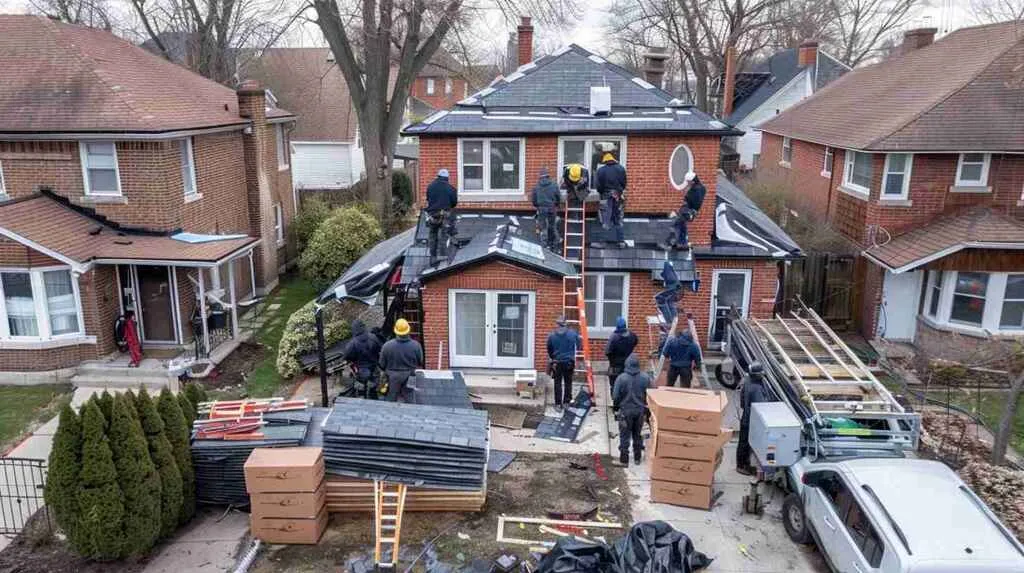
Starting a Shingle Roof Queens NY – The First Course Done Right
Blueprint for every shingle roof I install in Queens: about 90% of the “mystery leaks” that end up in my voice mail start within the first 18 inches from the eave-and they have nothing to do with the wind, the valley, or that chimney everyone blames. They start because somebody skipped, rushed, or simply guessed at the first course: the drip edge, the underlayment lap, the starter strip, and that initial row of shingles. Get those four layers aligned, overlapped, and nailed right, and water drops clean off the edge like it’s supposed to. Get them wrong, and you’ve basically built a wick that pulls rain back into the fascia, the wall, and eventually your bedroom ceiling.
Think of it like the hem on a pair of dress pants. If that bottom inch is crooked or unfinished, the whole garment hangs wrong no matter how expensive the fabric is. Same with shingles. I set my pocket level on the starter course the way a tailor lays a straight edge on fabric before making the first cut, because that reference line controls everything that comes after.
Why the First 18 Inches of Your Shingle Roof Control Every Leak
Water doesn’t teleport. It starts at the top of the roof, runs down the slope, and leaves the building at the eave. If the first 18 inches-drip edge, underlayment, starter, first visible course-aren’t set up to shed that flow cleanly past the fascia, the water will find the nearest gap, nail hole, or crooked seam and crawl backward. I’ve seen it happen on Colonial revivals in Forest Hills and narrow two-families in Astoria: the shingles look fine from the street, but the first course is cut short or the starter is missing entirely, so every rain event is pumping gallons into the wall cavity instead of into the gutter. In my opinion, which I state pretty directly, I’d rather spend an extra morning getting one good edge right than spend the next five years patching ceiling stains that keep coming back.
One August afternoon in Woodhaven, it was 96 degrees and the shingles were practically melting in our hands. The homeowner had a leak right above the bay window, and three different roofers had “repaired” it. I stripped it back to the decking and found the first course five inches short of the drip edge, with no overhang at all, so water was curling under into the fascia. When I showed the owner, she thought I was joking-until I poured a bottle of water on the edge and it disappeared into her wall like a magic trick. That demo with the water bottle made it real: no overhang means no clean drop, just capillary action sucking moisture back toward the wood.
| Myth | Fact from the Roof Edge |
|---|---|
| “Leaks start where I see the stain on the ceiling.” | About 90% of the leaks I fix start within the first 18 inches up from the eave and just travel until they show up inside. |
| “If the shingles look neat from the street, the edge must be fine.” | I’ve seen perfectly straight-looking roofs in Queens with the first course cut short, letting water curl under into the fascia and walls. |
| “Ice and wind are the main problem, not how the starter is done.” | Ice and wind only win when the starter course, drip edge, and underlayment aren’t overlapped like a properly sewn hem. |
| “Any overlap is good enough.” | A sloppy or too-short overhang at the eave acts like a wick, pulling water back under instead of letting it drop cleanly. |
On a Typical Two-Family in Elmhurst, the First Thing I Do Is Set the Edge
On a typical two-family in Elmhurst, the first thing I do is walk the entire eave line from corner to corner, pocket level in hand, checking whether the fascia is straight and the old drip edge is even still there. Queens wind comes hard off the bay and funnels down those narrow side yards, so gutters can’t hide a crooked edge-they just amplify it. Older two-families often have funky fascia lines that were patched over the decades with scrap wood and random furring strips, creating hills and valleys that will telegraph straight through new shingles if I don’t correct them first. Setting the drip edge dead straight is the only way to give the starter strip and first course a clean, level “runway” to start from.
A winter job in Bayside still sticks with me. It was just after a sleet storm, wind whipping off the bay, and we were doing a full tear-off on a Cape with a very fussy retired engineer watching from the driveway. I laid out the starter strip and he starts quizzing me on nail spacing and overhang tolerances like it was an exam. When I measured the 3/8-inch overhang and explained the capillary action that happens if you go tighter-how water can literally climb back under a shingle if the gap is too small-he literally went inside, grabbed his old slide rule, and came back out nodding like we’d just solved a physics problem together. That 3/8 inch might sound trivial, but it’s the difference between clean runoff and a slow leak that shows up three winters later.
Here’s my insider tip: before you sign a contract with any Queens roofer, ask them exactly how much overhang they plan at the eave, where they’ll put the nails in the starter course, and whether they use a separate starter strip or just flip full shingles upside down. If they can’t answer clearly or they wave it off as “standard,” walk away. It’s like asking a tailor how they’ll finish the hem on a suit-if they don’t care about that detail, the rest of the work won’t hang right either. The starter must be offset from the first visible course so the seams don’t line up, and it must be sealed properly to fight Queens wind-driven rain that tries to peel roofs from the bottom up.
Exact Sequence for Setting Up the First Course
- Strip the edge back to solid wood sheathing, removing all rotted furring strips and old flashing.
- Install metal drip edge along the eave, dead straight, checking every few feet with a pocket level.
- Run the underlayment so it laps over the top flange of the drip edge, sealing the plywood-to-metal seam.
- Lay the starter strip with the adhesive edge toward the eave and a consistent 1/4-3/8 inch overhang past the drip edge.
- Nail the starter in a straight line, just above the adhesive and per manufacturer spacing, avoiding overdriven nails.
- Begin the first visible shingle course, offsetting joints from the starter seams and matching the exact overhang of the starter.
| Detail | Target Measurement | Why It Matters in Queens |
|---|---|---|
| Shingle overhang past drip edge | 1/4-3/8 inch | Enough to clear the fascia so water drips free, but not so long that wind can lift the shingle. |
| Nail distance from lower shingle edge | Above adhesive strip, typically 5 5/8-6 inches from butt | Keeps nails out of the water path while still fastening into the double-layer area. |
| Nail spacing along starter course | Every 6-8 inches, no high or low wander | Prevents wind from peeling the roof like a loose cuff in coastal gusts and Nor’easters. |
| Drip edge overlap at joints | At least 2 inches | Stops water from sneaking into gaps where metal pieces meet along long Queens eaves. |
Getting the Starter Course Straight When the Deck Isn’t
There was a Saturday in Corona where a small landlord called me in a panic because his tenant’s bedroom ceiling had collapsed after a heavy spring rain. Up on the roof I found the previous roofer had started the shingle roof on top of a crooked, rotted 1×2 furring strip instead of proper drip edge, so the whole first course was wavy. Water was channeling along the low spots and straight into one corner of the building. We had to rebuild the edge, replace deck boards, and then re-lay the first two courses just to give the rest of the roof a fighting chance. That job taught me you can’t “follow the crooked wood”-you have to create a new, straight reference line, like re-cutting a suit hem so the whole garment hangs right, or every shingle above will telegraph that wave forever.
When I walk from the eave to the rake and then visually up the slope, I’m checking for alignment at every step. If the deck is soft, patched with random scraps, or visibly out of line, any shingles laid on top inherit that flaw. You can’t shim your way out of a rotten edge with scrap plywood-hidden troughs become leak channels. Before a single starter strip goes down, the edge wood has to be cut back to solid, flat material and rebuilt straight, even if it means an extra morning and a few more sheets of CDX.
⚠️ Warning about crooked or rotten eaves:
- If the decking at the edge is soft, patched with random furring strips, or visibly out of line, any shingles laid on top will telegraph that wave forever.
- Water follows the low spots in a wavy first course, concentrating runoff into one corner or wall cavity instead of shedding evenly.
- Simply “shimming” with scrap wood instead of replacing rotten deck boards creates hidden troughs that become leak channels.
- Before a single starter strip goes down, the edge wood has to be cut back to solid, flat material and rebuilt straight.
Roof Started on Crooked, Rotten Edge
- Starter course waves up and down.
- Shingle tabs look uneven along the gutter.
- Water paths bunch into dips and edges.
- High risk of leaks at one corner after heavy Queens rains.
Roof Started on Rebuilt, Straight Edge
- Starter and first course form a clean, level “hem.”
- Tabs line up parallel to the gutter line.
- Runoff sheds evenly across the whole eave.
- Lower chance of localized ceiling collapses and hidden wall damage.
Let Me Be Blunt: If the Starter Course Is Wrong, the Rest Is Decoration
Let me be blunt: if your starter course is wrong, the rest of the roof is just expensive decoration. Fancy architectural shingles with a 50-year warranty mean absolutely nothing if the edge and starter are letting water roll backward into your walls-it’s like spending a thousand dollars on a suit with a crooked hem, and the leak won’t care how much you spent on the shingles.
Quick Signs Your Starter Course in Queens Might Be Wrong
- ❌ Shingles flush with the drip edge or tucked behind the gutter instead of slightly past it.
- ❌ No separate starter strip visible-first row looks like full shingles “right off the bat.”
- ❌ Exposed nails right at the bottom edge of the first visible course.
- ❌ Wavy line where shingles meet the gutter, instead of a clean, straight hem.
Before You Call a Queens Roofer About Your Eave Leak
When I sit at a kitchen table in Queens Village and a homeowner asks, “Why does this edge matter so much?” here’s what I tell them. You don’t need to climb on the roof-actually, please don’t-but you can eyeball some basics from the ground or a second-story window before you pick up the phone. Look along the gutter line: does the shingle edge look straight or wavy? After a steady rain, are you seeing clean drops of water coming off the edge, or streaks running back along the fascia? Take a zoomed-in photo on your phone so when a roofer shows up, you can point to the exact overhang and alignment issues. It’s like checking the seams and hems on a jacket before you buy it-being an informed homeowner means you’ll get honest answers instead of vague promises.
Things to Observe About Your Shingle Roof Edge in Queens, NY
- ✅ Look along the gutter line from the sidewalk or a second-story window-does the shingle edge look straight or wavy?
- ✅ Check after a steady rain: do you see clean drops of water coming off the shingle edge, or streaks running back along the fascia?
- ✅ Note any stains or peeling paint on the exterior wall just below the roof edge.
- ✅ Take a photo zoomed in on the first row of shingles so a roofer can see the overhang and alignment.
- ✅ Write down which side of the house (street, yard, alley) shows the worst staining or drip marks.
Common Questions Queens Homeowners Ask About Starting a Shingle Roof
Can I just nail new shingles over the old first course?
On most Queens roofs I see, the first course problems run all the way down to the drip edge and sometimes the decking. Simply nailing over old shingles doesn’t fix wrong overhangs, bad nail lines, or rotted edges-it just hides them until the next big storm.
Do all roofs need a separate starter strip?
Yes. Whether it’s a cut shingle starter or a factory starter roll, you need that extra sealed layer at the eave to back up the first visible course and cover the joints. Skipping it is like leaving raw fabric at the bottom of a suit pant leg.
Is 1/4 inch really enough overhang past the drip edge?
On the Queens jobs I do, 1/4-3/8 inch is the sweet spot: far enough to drip clear, tight enough to keep the wind from getting under. Anything shorter tends to wick water back toward the fascia over time.
How long does it take to properly rebuild and start a bad edge?
For a typical straight eave on a small Queens house, rebuilding the rotten edge and resetting the starter and first course usually takes a skilled crew a few hours. It’s a small slice of time that prevents years of chasing leaks.
If your leak-or your planned reroof-is anywhere in Queens and you want that first course done like a properly tailored hem, call Shingle Masters. I’ll walk your eave line with my pocket level, show you exactly what needs fixing, and build you a starter course that’ll shed water cleanly for the next two decades. Schedule an inspection, and let’s stop that mystery leak before it becomes a ceiling collapse.