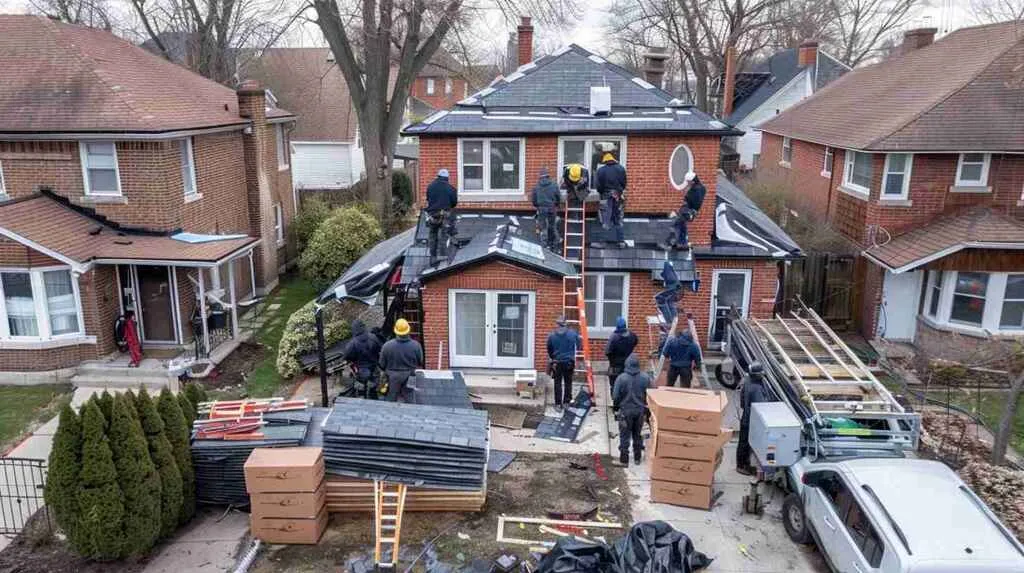
Shingle Top of Roof Queens NY – Ridge, Caps, Vents and What Fails
Honestly, at least 80% of the “mystery leaks” I see in Queens start at the very top of the roof, not around the windows or siding where homeowners always blame the problem. In 19 years on roofs across Jackson Heights, Bayside, and Astoria, I’ve learned that most people never even look up at their ridge line until it’s raining inside, and by then the shingle top of roof has been failing for months. I’m Luis Calderón, and when I’m not sketching roof cross-sections on pizza boxes for confused homeowners, I’m usually standing on a ridge explaining how it’s the busiest intersection on your entire house-air, heat, and water all fighting to use the same narrow strip.
Why the Shingle Top of Roof in Queens Fails So Often
At least eight out of ten roof leak calls I get in Queens start with someone convinced the problem is a window, a door, or the siding-anywhere but the top. But here’s what I see every single time I climb up: the ridge, the caps, or the vent up there are letting water, heat, or both back up like a broken traffic light at rush hour. Think of your shingle top of roof as the one spot where three kinds of traffic meet-air trying to escape your attic, heat trying to move, and water trying to run off-and if that intersection isn’t built right, all three crash into each other and you get leaks, ice dams, and blown-off shingles. Not gonna lie, it drives me a little crazy how many roofers treat the ridge like an afterthought when it’s literally the most stressed piece of the whole system.
One January morning, right after a freezing rain, I was on a two-family in Jackson Heights where the ridge shingles had literally snapped in half like crackers. The owner kept insisting “the leak is from the window,” but I showed him how the water was tracking under a cheap plastic ridge vent that had warped in the cold. We stripped the top 3 feet on each side, rebuilt the ridge with proper caps and a heavier vent, and I still remember the steam coming off the roof as the sun finally hit it while we nailed the last cap in place. Queens weather-especially those freeze-thaw cycles we get all winter, then the July heat-absolutely abuses the shingle top of roof, and if the materials or installation were marginal to begin with, that’s where you’ll see the first failure.
| Myth | Fact |
|---|---|
| Leaks almost always start around windows and siding, not the top of the roof. | On asphalt shingle roofs in Queens, the ridge, caps, and vents are the starting point for a huge chunk of so-called mystery leaks. |
| If shingles look okay from the street, the ridge must be fine. | You can’t judge the ridge from ground level; caps often crack right on the nail line long before field shingles show wear. |
| Ridge vents are optional in Queens because houses are older and “already breathe.” | Without a properly vented ridge, heat and moisture traffic backs up under the roof, shortening shingle life and causing condensation leaks. |
| Cap shingles can be mixed and matched from leftover bundles with no problem. | Mismatched or brittle caps at the shingle top of roof are the first pieces to snap and blow off in Queens wind and freeze-thaw cycles. |
| If the ceiling only drips during wind-driven storms, it must be a wall issue. | Wind-driven rain often gets pushed up and under a bad ridge detail, then rides the sheathing down until it shows up at a ceiling or wall joint. |
Ridge, Caps, and Vents: The Real Failure Points I See in Queens
Let me be blunt about the top of your roof: there are three main failure zones I look at first, and all three get hammered harder in Queens than in most other places. The ridge line itself-the wooden peak where two roof planes meet-has to stay straight, dry, and properly vented. The cap shingles that run over that ridge are flexible pieces that bend 180° and take every bit of wind, rain, and temperature swing, so they crack, curl, and blow off faster than any other shingle on the roof. And the ridge vent-that long strip of perforated material or plastic mesh running under the caps-is supposed to let hot air out while keeping water, bugs, and snow out, but cheap vents warp, split, or get installed wrong and then you’ve got an expressway for water right into your attic. Around here, with bay winds in Bayside, older colonials and two-families off Northern Boulevard, and nor’easters that hit from every direction, the shingle top of roof sees more abuse in five years than a roof in the suburbs might see in ten.
One summer evening around 7 p.m., I got an emergency call from a retired teacher in Bayside whose bathroom ceiling had just collapsed after a thunderstorm. When I got up there with my headlamp, I found someone had ended the ridge vent 4 feet shy of the hip and then “patched” the gap with upside-down shingles. Water was being funneled under the caps every time wind hit from the bay. We did a full tear-off of the ridge that night, and I stood in her kitchen at 10 p.m. explaining, with doodles on a napkin, how air and water were both fighting to use the same bad opening at the top of her roof. Here’s an insider tip I give everyone: always check where the ridge vent begins and ends, not just the middle section. Those transition points-where the vent stops at a hip, a gable end, or a dormer-are where hacks get lazy and improvise with tar, caulk, or random shingle scraps, and that’s where your leak is hiding.
| Failure Area | What Goes Wrong | What You Might Notice from the Ground or Attic |
|---|---|---|
| Ridge Vent Cut and Flashing | Cut too wide or too narrow, vent not seated or flashed correctly, plastic vent warping in cold or heat. | Dark streaks or staining below the ridge in the attic after storms; odd-looking plastic strip along the peak. |
| Ridge Cap Shingles | Brittle, mismatched, or improperly overlapped caps that split at the bend. | Uneven, wavy, or curling caps along the top of the roof; a few pieces missing after wind. |
| Nail Lines at the Ridge | High nails, overdriven nails, or nails too close to the vent slot, opening pathways for water. | Ceiling stains in the middle of rooms, especially following heavy wind-driven rain from one direction. |
| Transitions to Hips and Gables | Ridge vent or caps stopping short and being “patched” with upside-down shingles or caulk blobs. | Leak spots near upper corners of rooms that get worse when storms hit from the bay or river side. |
| Old vs New Roof Tie-Ins at the Ridge | New ridge installed over old framing without correcting height or straightness, leaving gaps and weak points. | Random drips far from walls or chimneys, especially after recent partial re-roof jobs. |
⚠️ Warning: Danger of Partial Ridge “Patch” Jobs
Patching just a few caps or a short section of ridge vent usually fails fast in Queens weather-within one or two freeze-thaw cycles or the next big storm. Even worse, most shingle manufacturers will void your warranty if you mix old and new materials at the ridge or don’t follow their installation specs for ridge ventilation. A proper ridge rebuild costs more up front, but you won’t be calling me back six months later when the same spot is leaking again.
If you only remember one thing, make it this: the shingle top of your roof in Queens is either your best traffic cop or your worst troublemaker.
How I Diagnose and Rebuild the Shingle Top of Your Roof
If I’m standing in your driveway and I look up at your ridge, the first thing I’m checking is whether the line is straight or wavy, because a wavy ridge means the framing underneath has settled or wasn’t done right in the first place. Next, I’m looking at the caps-are they all the same color and style, or is there a Frankenstein mix of leftovers? Then I scan for the ridge vent: does it run the full length, or does it mysteriously stop partway? I’m basically playing traffic cop in my head: where is the hot air supposed to exit, where is the water supposed to run off, and are those two flows interfering with each other? Every roof has a story, and the shingle top of roof is where that story gets written in cracked caps, blown-off pieces, and dark water stains in the attic. Once I’m up on the roof, I’m pulling a few caps to see how the vent is actually seated, checking nail patterns, and running my hand along the ridge to feel for soft spots or flexing that tells me the decking underneath is rotted.
One job that still bugs me was a big brick rowhouse in Astoria where the owner ignored my advice to replace the brittle, mismatched ridge caps during a re-roof. Six months later, after a nor’easter, he called me back angry because shingles were scattered on 31st Street like confetti. I took photos showing how the old caps had split right at the nail line while the brand-new field shingles stayed put. We replaced the entire ridge in 30-mph winds, and I used that job for years to show people why the “shingle top of roof” is the one place you never cheap out. Here’s my insider tip for anyone getting a roof done in Queens: never let a roofer reuse old caps, even if they “look fine.” Caps get brittle after a few years of bending and flexing in our weather, and reusing them is like putting old rubber bands on a fresh package-they’ll snap the first time you need them to hold.
When to Call a Queens Ridge and Cap Specialist vs Watching It
Here’s where most contractors cut corners on the shingle top of roof: they’ll tell you “it’s fine, just wait and see,” when they really mean “I don’t want to deal with ridge work right now.” But there’s a big difference between a true emergency-where waiting even a day means more water damage inside your house-and a situation you can monitor for a week or two while you schedule the right crew. If you’ve got caps blowing off in wind, water actively dripping from the attic ridge after every rain, or you can see daylight through nail holes when you’re in the attic, that’s a call-me-now situation. On the other hand, if you noticed a couple of curling caps during your spring gutter cleaning and there’s no sign of leaks yet, you’ve got time to get it done right instead of scrambling for the first guy who answers the phone. Just don’t confuse “you’ve got time” with “ignore it”-the shingle top of roof doesn’t heal itself, and what’s a $600 cap replacement today turns into a $2,500 decking and cap job six months from now.
✅ Before You Call: Quick Checks You Can Do Safely
- Walk around your house and look up at the ridge line from every side – note if it looks straight, wavy, or if any caps are clearly missing or different colors.
- Check your attic on a sunny day – look for light coming through nail holes or gaps along the peak, and note any dark stains or damp spots on the wood below the ridge.
- Remember the wind direction during your last leak – if ceiling drips only happen when wind hits from a certain side, that’s a clue about where the ridge is failing.
- Take photos of any missing or damaged caps – even blurry phone pics from the driveway help me understand what I’m walking into.
- Note when your roof was last worked on – if you had a partial re-roof or repair in the past few years, mention it; old-new tie-ins are common trouble spots.
- Check for shingle debris in gutters or on the ground – if you’re finding granules or small shingle pieces near the house, they often come from failing caps at the ridge.
Straight Answers About Ridge, Caps, and Vents in Queens
Think of your ridge like the nose on a face-it sticks out, takes the most weather, and when something’s wrong there, everyone notices. Below are the five questions I hear most often when homeowners finally look up and realize the shingle top of roof might be their real problem.
▸ How long should ridge caps and vents last on a Queens roof?
▸ Can I just replace a few damaged ridge caps, or do I need the whole ridge redone?
▸ Will insurance cover ridge and cap damage from a Queens storm?
▸ Do I really need a ridge vent, or can I skip it to save money?
▸ If my ridge is failing, does that mean I need a whole new roof?
Why Call Luis at Shingle Masters for Your Ridge Work in Queens
✓ 19 years of hands-on roofing experience across every Queens neighborhood-Astoria, Jackson Heights, Bayside, Flushing, and beyond
✓ Specialized expertise in ridge, cap, and vent diagnosis-I catch problems other roofers miss or ignore
✓ Fully licensed and insured in New York City, with references from dozens of Queens homeowners
✓ Fast response for emergencies, and I personally inspect every ridge job before, during, and after
✓ I specialize in preserving the original look of older Queens homes while upgrading performance-your roof will look right and work right
No high-pressure sales. No surprise charges. Just straight answers, solid work, and a ridge that won’t leak on you next storm.
The ridge, caps, and vents at the shingle top of roof are the busiest intersection on your entire house-three kinds of traffic all meeting at one narrow strip that has to hold up against Queens weather year after year. Get that intersection rebuilt right, with quality materials and proper installation, and you’ll stop chasing mystery leaks and blown-off shingles for the next 15-20 years. Cheap out or ignore it, and you’ll be back on the phone with a roofer-or worse, a ceiling repair contractor-within a couple of seasons. If you’re in Queens and you’re tired of wondering where that drip is really coming from, give Shingle Masters a call and let me take a look at the top of your roof. I’ll sketch out exactly what’s going on up there, what it’ll take to fix it, and what it’s going to cost-no vague estimates, no “we’ll see when we get up there” nonsense, just a clear plan so you can make the right call for your house.