Shingle a Steep Roof Queens NY – Skill and Equipment Required | Free Quotes
Sideways is exactly where most cheap steep roof jobs in Queens end up-either the shingles blow off in eighteen months or the crew ends up in the hospital because they skipped rigging. Any steep roof re-shingle in Queens that’s priced under $9,000 is either covering a tiny garage, dangerously underbuilt, or straight-up missing the safety and ventilation steps that keep your attic dry and your roofers alive. Like a live show, the parts you don’t see-the rigging, the backing track, the sound mix-are where the real money and safety live, and cutting corners there means the whole performance goes sideways fast.
Real Costs to Shingle a Steep Roof in Queens (And What’s Usually Missing Under $9K)
Sideways doesn’t happen by accident-it happens because somebody decided that safety harnesses, proper underlayment, or ridge ventilation were “optional extras” instead of the backbone of a steep roof. On any pitch steeper than 7/12 in Queens, you’re looking at real labor, real rigging, and real material differences that separate a safe, code-compliant job from a disaster waiting for the next nor’easter. I’m not gonna sugarcoat it: if someone’s quoting you under $9,000 on a steep roof that’s more than a one-car garage, they’re either using bargain-bin 3-tab shingles, skipping ice and water shield where you need it most, or sending guys up there without fall protection. Think of it like a live show-safety is your stage rigging, underlayment is your backing track, shingles are your front-of-house sound, and ventilation is the sound mix. Skip any one of those and the whole performance collapses.
Now, if we follow that beat, let’s talk about what Queens weather does to timelines and costs. One January afternoon around 3 p.m., the sun dropped behind a building in Astoria and the temperature on a slate-steep roof went from damp to icy in ten minutes. I had two guys already clipped in at the ridge, and suddenly the plywood felt like glass under our boots. I shut the whole job down mid-bundle, called the homeowner out to the sidewalk, and showed him with a level and an infrared thermometer why working one more hour would be asking for a stretcher. It pushed us a day behind, but that job ended up being the cleanest steep shingle installation I’ve ever done because we refused to fight physics. Safe scheduling, weather shutdowns, proper drying time between underlayment and shingles-those aren’t delays, they’re why your roof lasts twenty-five years instead of five.
Ballpark Cost Scenarios to Shingle Steep Roofs in Queens, NY
Note: Anything well below these ranges for steep roofs in Queens means corners are being cut on safety, materials, or ventilation. You can’t cheat gravity or the Building Code.
⚠️ Warning: Bids Under $9,000 on Steep Roofs
- No dedicated fall protection – guys working steep pitches without harnesses, rope grabs, or roof jacks
- Minimal or zero ventilation – no ridge vent, no soffit vents, or undersized intake that causes moisture buildup and ice dams
- Cheap 3-tab shingles on high-wind or high-pitch exposures where they’ll curl and blow off in three years
- Skipping ice & water shield in valleys, eaves, and rake edges where Queens freeze-thaw cycles guarantee leaks
Safety Rigging and Gear: How We Keep Steep Roof Work from Going Sideways
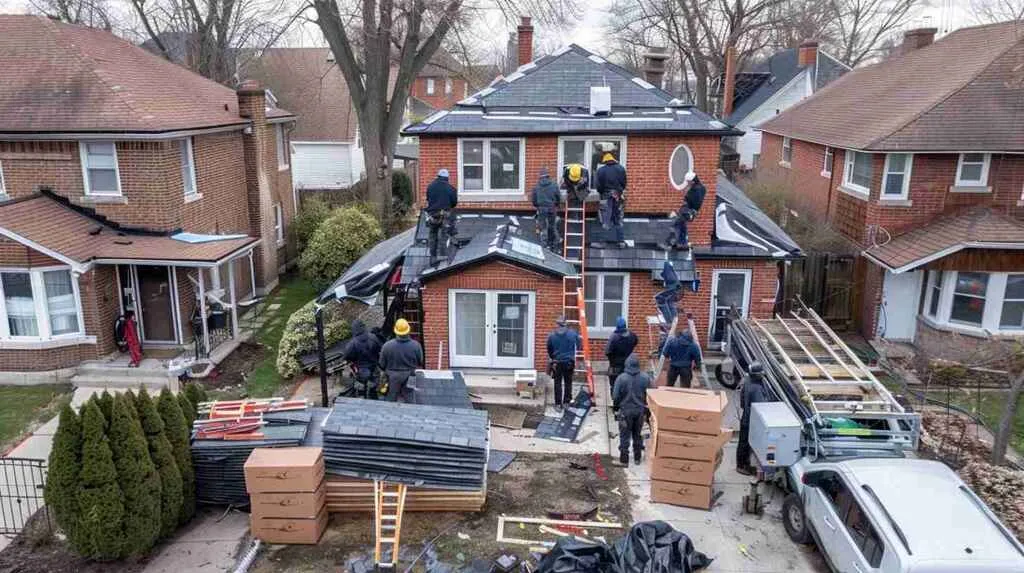
Let me be blunt: if your roofer isn’t talking about harness anchor points, they’re gambling with gravity. On any roof steeper than 8/12 in Queens, proper rigging isn’t a courtesy-it’s the line between a clean job and a funeral. We’re talking roof anchors screwed into solid framing, rope grabs that lock on a fall within inches, roof jacks and walk boards staged every three courses, and every single crew member clipped in before their boots hit the plywood. That setup alone adds half a day of labor and about $800-$1,200 in gear rental and anchor installation to a steep roof job, but it’s also why we’ve done 300+ steep roofs in Jamaica, Forest Hills, and Briarwood without a single serious injury. During a hot August evening in Jamaica, we were re-shingling a 12/12-pitch roof for an older couple who kept insisting they wanted to “watch from the porch.” At 7:30 p.m., the husband leaned too far forward on his cane just as I was explaining why we use two separate rope grabs per man. I stopped mid-sentence, had my foreman demo how our fall line catches a slip on a mock-up ladder, and I watched the guy’s whole attitude change-he went from “Why is this so expensive?” to “I want every guy up there double-tied.” That steep roof ended up being the job where I added a line item on my estimates just for advanced fall protection.
Now, if we follow that beat, let’s talk about what all that rigging actually means for your quote and your safety. Think of roof safety like stage rigging for a live show-you don’t see it from the floor, but without it the whole performance collapses. The harness anchors are your truss mounts, the rope grabs are your safety cables, the walk boards are your catwalks, and the roof jacks are your lighting rigs. Every piece has to be set, checked, and doubled before “showtime”-which in this case is laying shingles on a pitch that’ll launch you twenty feet if you slip. When you see a quote from us that’s $2,000-$3,000 higher than someone else’s, that’s not padding-that’s the rigging, the safety checks, the double-tie systems, and the weather shutdown policy that keeps my crew coming home every night. It’s not an add-on. It’s the baseline.
Essential Steep-Roof Safety and Rigging We Include on Every Queens Job
-
✅
Roof anchor points installed into solid framing before any crew member steps onto the pitch, with load-tested ratings for each position -
✅
Dual rope grab systems per worker on pitches 10/12 and steeper, so there’s always a backup connection -
✅
Roof jacks and walk boards staged every 3-4 shingle courses to create stable work platforms and protect finished shingles -
✅
Pre-job safety briefing with weather check and temperature limits-if it’s icy, wet, or windy above 25 mph, we shut down -
✅
Ground spotter and dedicated safety monitor on every steep job to watch for loose materials, pedestrians, and crew positioning -
✅
Post-job anchor removal and patching so your roof deck is sealed tight and there are no future leak points from rigging holes
Why You Can Trust Shingle Masters on Steep Roofs in Queens
What a Proper Steep Shingle Installation Includes (Backstage to Showtime)
From backing track to front-of-house shingles
On a 10/12 roof in Glendale last fall, I watched a homeowner’s face go from confused to relieved when I explained that the ugly tar-paper underlayment and starter shingles are actually where half the waterproofing happens-they’re the backing track, not the opening band. A proper steep shingle job starts with a complete tear-off so we can inspect every inch of plywood for soft spots, nails popping through, or sections that need replacement. Once the deck is solid, we roll ice and water shield across all eaves, rakes, and valleys-think of that as your studio-grade isolation layer-then cover the field with synthetic underlayment that won’t rip or blow off before the shingles go on. The starter course gets hand-nailed along the eave with the right overhang and exposure, and then we chalk-line the whole roof so every shingle course is laser-straight, even on a pitch where gravity wants to pull everything crooked. I once took over a half-finished steep roof project in Flushing that another contractor abandoned after the first storm hit. It was a Sunday morning, light rain, and I climbed up to find misfired nails sticking out like porcupine quills and starter shingles laid upside down along a 10/12 pitch. The homeowner was panicking about another leak, so I tarped and chalk-lined the whole roof like I was sketching a track layout for a live show, then re-installed the starter, underlayment, and the first five courses before lunch. To this day, I still use photos from that mess to explain why steep roofs in Queens can’t be treated like suburban ranch houses. Here’s an insider tip: before approving a steep-roof job to continue past underlayment, ask your roofer for in-progress photos of the starter course, the ice and water shield layout, and the first five shingle rows. If they won’t show you the backing track, they’re not confident in the showtime performance.
Ventilation: the sound mix of your attic
Think of your ridge vent and soffit intake as the sound engineer of your attic-get the mix wrong and everything else sounds muddy, no matter how good the front-of-house shingles look. On a steep roof in Queens, proper ventilation means cool outside air enters through continuous soffit vents at the eaves, flows up the underside of the roof deck, and exhausts through a full-length ridge vent at the peak. That airflow keeps your attic temps balanced, prevents ice dams in winter when Queens gets those freeze-thaw cycles, and stops moisture from turning your plywood into a spongy mess by July. A steep roof without ventilation is just a heat trap with nice-looking shingles-your AC works overtime, your shingles age twice as fast from underneath, and the first big snow creates an ice dam that backs water under the shingles and into your ceiling. We size the intake and exhaust based on your attic square footage and roof pitch, then physically check the airflow path to make sure insulation or old baffles aren’t blocking it. The sound mix matters as much as the instruments.
A beautiful-looking steep roof without proper ventilation is just an expensive prop.
Our Step-by-Step Process to Re-Shingle a Steep Roof in Queens
-
1
Inspection & photo report – We document current conditions, measure pitch, check deck access, and identify all penetrations, valleys, and flashing before quoting -
2
Safety rigging setup – Roof anchors, harnesses, rope grabs, roof jacks, and walk boards installed before tear-off begins -
3
Tear-off and deck repair – Complete removal of old shingles, underlayment, and nails; plywood replacement or repair where needed; full deck inspection -
4
Ice & water shield + underlayment – Ice and water barrier on all eaves, rakes, valleys, and penetrations; synthetic underlayment across the field -
5
Starter course & first rows – Starter shingles hand-nailed at eaves and rakes; chalk lines for every course; first five rows installed and inspected for alignment -
6
Shingle field & flashings – Field shingles installed per manufacturer spec with proper nail count and placement; step flashing, valley flashing, and pipe boots replaced or sealed -
7
Ridge caps and final cleanup/inspection – Ridge vent installed with proper airflow sizing; ridge cap shingles hand-nailed; anchor points removed and patched; full site cleanup and final walkthrough
Key Components: Proper Steep-Roof Setup vs. What Cheap Jobs Skip
| Component | Proper Steep Roof Setup | What Cheap Jobs Often Do |
|---|---|---|
| Underlayment | Synthetic underlayment rated for steep slopes, fully lapped and fastened; ice & water shield on all eaves, rakes, and valleys | 15# felt paper only, often ripped or loose; ice & water only at eaves if at all |
| Starter Shingles | Dedicated starter strip or cut shingles with sealant strip positioned correctly; hand-nailed every 8-10 inches | Regular shingles flipped upside down or starter skipped entirely; nails spaced randomly |
| Nail Pattern | 6 nails per shingle on steep roofs (4 standard + 2 high-wind); proper depth and placement per manufacturer; hand-nailing on steep sections | 4 nails only, often misfired or over-driven; pneumatic nailer cranked too high, splitting shingles |
| Flashing | New step flashing at all walls and dormers, lapped properly with shingles; valley flashing metal or woven; pipe boots replaced | Old flashing reused and bent; valleys done with shingles only and no metal; pipe boots caulked instead of replaced |
| Ventilation | Full-length ridge vent with baffled design; continuous soffit vents sized for 1:150 or better airflow ratio | Ridge vent skipped or undersized; soffit vents blocked by insulation or non-existent |
DIY vs. Pro on a Steep Roof in Queens: Where Gravity Wins
Here’s the ugly truth about shingling steep roofs in Queens: the pitch doesn’t care what your budget is. You can watch every YouTube video ever made, rent every harness in the five boroughs, and gravity will still beat you the first time you slip on morning dew at a 10/12 angle. Add in NYC Building Code requirements, insurance liability if you fall and hit a neighbor’s car, and the real cost of replacing the shingles you botched the first time, and DIY on a steep roof isn’t savings-it’s expensive procrastination with a side of ER bills.
Before You Call for a Steep Roof Quote in Queens
Are you ready to talk real numbers and real safety for your steep roof, not just the lowest bid? Before you call, grab your address, neighborhood name, and any photos you’ve got from the ground or the attic-even blurry phone pics help me see pitch, valleys, and access. If you’ve had leaks, note where and when. If you’ve got old invoices from past repairs, keep them handy. And if you’re home during the inspection, even better-I’ll walk you through what I see on the roof, what the rigging will look like, and exactly how we’ll handle weather or surprises. Think of it like a pre-production meeting before a live show: the more you share up front, the cleaner the performance.
Quick Checklist Before You Call Shingle Masters for a Steep-Roof Shingle Quote
-
✅
Know your address and neighborhood – Helps us understand access, permit zones, and typical roof styles in your area -
✅
Rough age of your roof – If you know when it was last done or how many layers are up there, that speeds things up -
✅
Any known leaks or problem spots – Where they happen, when they started, and whether they’re active or seasonal -
✅
Photos from the ground and attic if possible – Even phone snapshots of the roofline, valleys, or attic stains help me prep -
✅
Prior repair invoices if you have them – Shows what’s been tried, what failed, and what we’re working with underneath -
✅
Preferred time windows for inspection – Morning, afternoon, weekday, weekend-we’ll work around your schedule -
✅
Whether you plan to be home during the visit – I always prefer walking homeowners through what I see on their roof in person
Common Questions About Shingling Steep Roofs in Queens, NY
What’s a realistic timeline to re-shingle a steep roof in Queens?
+
For most steep roofs in Queens (1,200-2,000 sq ft, 9/12 to 12/12 pitch), count on 4-7 working days from rigging setup to final cleanup. That includes tear-off, deck inspection and repair, underlayment, shingle installation, and ventilation. Weather delays, hidden damage, or complex layouts can add time. We don’t rush steep roofs-safe pacing and proper drying time between steps are non-negotiable.
How do you handle weather delays on steep roof jobs?
+
We shut down immediately if it’s raining, icy, or winds hit 25+ mph-steep roofs are dangerous enough in perfect conditions. Your roof gets tarped tight, and we reschedule as soon as it’s safe. Weather delays are part of every steep roof contract, and we never charge extra for shutdown days. We’d rather wait two days than risk a fall or sloppy work in bad conditions.
Can I stay in my house while you re-shingle a steep roof?
+
Absolutely. Steep roof work is loud-nailing, tearing, material drops-but it’s all outside. You’ll hear us, but you don’t need to leave. We do recommend keeping pets inside and away from windows, and we’ll give you a heads-up before any especially noisy phases like tear-off or deck work. Your attic might get dusty, so cover anything valuable up there if you can.
What kind of warranty do you offer on steep shingle roofs?
+
We offer a 10-year labor warranty on all steep roof installations, covering workmanship, fasteners, flashing, and ventilation. The shingles themselves come with a manufacturer’s warranty (usually 25-50 years depending on the product). If something fails because of how we installed it-misfired nails, improper flashing, ventilation issues-we fix it at no charge. Your warranty is written into your contract, not a handshake.
What makes steep roofs in Queens different from suburban roofs?
+
Queens steep roofs deal with tight access, shared walls, old framing that might not be square, higher wind exposure from open streets and waterfront areas, and stricter permitting in certain zones. You’ve also got older homes in Jamaica, Forest Hills, and Briarwood with unusual pitches, dormers, and original venting that needs updating. Suburban roofs often have yard access and simple gables-Queens roofs demand more planning, better rigging, and crews who know how to work in close quarters.
Ready to get a real quote-not just the lowest number-on your steep roof in Queens? I’ll meet you at your place, walk the roof safely, show you exactly what needs doing, and give you a detailed estimate that includes rigging, materials, ventilation, and a realistic timeline. No pressure, no upselling, just a careful breakdown like a bandleader explaining the setlist before showtime. Call Shingle Masters today or request your free steep-roof quote, and let’s make sure your roof is safe, code-compliant, and built to last twenty-five years-not five.