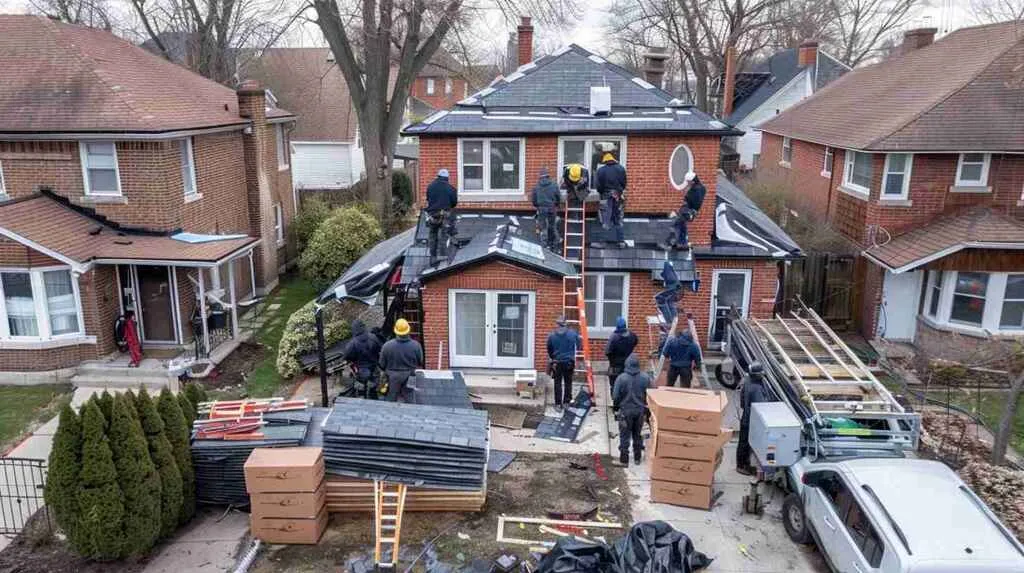
Shingle Roof Renovation Queens NYC – Refresh Without Full Replace
Blueprint talk: In Queens, a typical 1,200-1,500 sq. ft. shingle roof renovation runs about $5,000-$10,000, while a full replacement jumps to $12,000-$20,000-and the difference between smart money and wasted money is knowing exactly when your roof can safely be renovated instead of torn down to the decking. I’m Marco D’Angelo, and after 17 years working on shingle roofs across Jackson Heights, Flushing, Ridgewood, and Astoria, I’ve learned that most homeowners don’t need the sales pitch-they need straight answers about whether they can buy another 8-12 years with a solid renovation or if they’re gambling with a roof that’s already too far gone.
What Shingle Roof Renovation Really Means in Queens (and What It Costs)
I’ll be straight with you: when I say “renovation” for a Queens shingle roof, I’m talking about spending $5,000-$10,000 to carefully upgrade specific worn-out areas-targeted tear-offs near trouble spots, new underlayment where the old stuff’s failed, fresh flashing, ridge cap replacement, and ventilation fixes-all done to buy you 8-10+ years before a full replacement becomes unavoidable. Not every roof qualifies, and that’s the honest truth most contractors skip. If your decking is sagging, you’ve got three layers of shingles already, or there’s widespread rot hiding under curling tabs, then renovation isn’t smart-it’s expensive pretending. But if your structure is sound and the problems are surface-level or localized, renovation becomes the play that saves you $7,000-$12,000 right now and pushes that big tear-off bill down the road to a time when you’ve planned for it.
On a typical 20×60 row house in Queens-the kind you see packed tight from Elmhurst to Middle Village-renovation makes the most sense when the roof is 12-18 years old, showing wear but not total failure. One August afternoon around 3 p.m., with the sun bouncing off every window in Jackson Heights, I stood on a two-family’s roof that looked like it was melting. The owner was convinced they needed a full replacement because their neighbor just did one, but as I checked the decking and underlayment, I realized 80% of the structure was solid-their problem was heat-baked, curling shingles and a couple of bad flashings. I walked them through a staged shingle roof renovation-ventilation upgrade, partial reshingling, ridge cap work-and we saved them about $11,000 compared to a full tear-off. Here’s the thing people miss: renovation isn’t just slapping pretty new shingles over old problems-it’s surgery. You’re opening up the bad spots, fixing the underlayment and decking where it’s compromised, upgrading flashing and ventilation where the original install was weak, and then putting quality shingles over a structure you’ve actually inspected and reinforced.
Queens Shingle Roof Renovation vs Replacement Cost Scenarios
| Home Type / Scenario | Approx. Size (Roof Sq. Ft.) | Renovation Range | Full Replacement Range | Typical Years Gained with Renovation |
|---|---|---|---|---|
| Small Attached Row House (Astoria, Woodside, Sunnyside) |
1,000-1,200 | $4,500-$7,500 | $10,000-$15,000 | 8-10 years |
| Semi-Detached Two-Family (Jackson Heights, Elmhurst, Rego Park) |
1,400-1,600 | $6,000-$9,500 | $13,000-$18,000 | 9-12 years |
| Detached Cape or Split (Flushing, Bayside, Whitestone) |
1,700-2,000 | $7,500-$11,000 | $15,000-$22,000 | 8-11 years |
| Larger Corner Property (Forest Hills, Kew Gardens, Briarwood) |
2,200-2,600 | $9,000-$13,500 | $18,000-$28,000 | 9-12 years |
*Ranges reflect typical Queens labor, permits, and moderate material quality. Add $1,500-$3,000 if full ice-and-water shield or upgraded architectural shingles are chosen. Low-slope or complex rooflines may push renovation closer to replacement cost.
Is Your Roof a Good Renovation Candidate or a Tear-Off Waiting to Happen?
If we were standing on your roof right now, I’d ask you this: How old is it, where do you see active leaks or ceiling stains, does it feel soft or spongy when you walk certain areas, how many shingle layers are already up there, and is your attic hot enough in summer to melt crayons? Those aren’t trick questions-they’re the exact factors that decide whether renovation is a smart 8-10 year bridge or a waste of money that’ll leak in two winters. In Queens, our weather cycles are brutal on shingles: summer heat that bakes asphalt tabs until they curl and crack, winter freeze-thaw that lifts edges and lets water creep under, and Nor’easters that rip off anything loose. Row houses in Astoria and Ridgewood with low-slope sections or shared walls face different stresses than wood-frame detached homes in Flushing with steeper pitches and full sun exposure-so there’s no one-size answer. What I can tell you is this: if your roof is under 20 years old, has only one layer of shingles, shows localized problems (a bad valley, worn ridge caps, flashing rust), and the decking under those trouble spots is still firm, you’re probably a good renovation candidate.
Just before sunrise on a cold November morning, I was on a low-slope shingle roof in Ridgewood that another contractor had “refreshed” six months earlier. The owner called me because the “renovation” was leaking in three spots, and I found they’d just layered new shingles over brittle, cracked ones and reused old rusted step flashing along the sidewall. I spent the next two days carefully peeling back sections, repairing the rotten decking in one corner, installing ice-and-water shield where they’d skipped it, and then doing a proper renovation on the rest. That job is burned into my brain because it showed me that “renovation” without defining exactly which layers you’re opening up, which decking you’re inspecting, and which flashing you’re replacing is just cosmetic theater. You end up with pretty shingles over hidden rot, and in Queens humidity and freeze cycles, that rot spreads fast-especially in neighborhoods like Maspeth, Middle Village, and Glendale where older homes have minimal ventilation and packed-in lot lines that trap moisture.
Renovate or Replace? Quick Queens Roof Check
START → Is your roof under 20 years old?
YES → Does it have only 1-2 shingle layers?
YES → Are leaks localized to 1-2 spots or valleys?
YES → Does the decking feel solid (no spongy areas)?
✅ Good candidate for renovation – expect 8-12 years with proper work
NO → Soft or spongy decking detected?
⚠️ Renovation + targeted tear-off – open up bad sections, replace decking, then renovate
NO → Leaks widespread or chronic for 2+ years?
❌ Full replacement strongly recommended – hidden damage likely extensive
NO → Already 3 layers or roof over 25 years old?
❌ Full replacement strongly recommended – structure likely compromised
NO → Roof 20-30+ years old or visible sagging?
❌ Full replacement strongly recommended – renovation won’t buy meaningful time
⚠️ Risks of Cosmetic-Only “Refresh” Jobs
The biggest danger I see in Queens-especially on low-slope roofs in Ridgewood, Maspeth, and Middle Village-is contractors who treat “renovation” like makeup: they layer new shingles over cracked, brittle ones, skip any decking inspection, reuse rusted flashing because it’s “still there,” and call it done in two days. Here’s what actually happens:
- Hidden rot spreads – moisture trapped under new shingles accelerates decking decay, and by the time you see ceiling stains, damage is widespread
- Mold takes hold – Queens humidity + zero ventilation upgrades = attic mold that spreads into living spaces
- Manufacturer warranties void – most shingle warranties require proper underlayment and single-layer install; stacking over compromised surfaces kills coverage
- You pay twice – cosmetic refresh fails in 2-4 years, then you’re forced into full replacement anyway, but now decking damage is worse and more expensive
Real renovation opens up problem areas, inspects what’s underneath, fixes structural issues, upgrades weak points, and documents the work-so you know exactly what you bought and how long it’ll last.
How a Proper Queens Shingle Roof Renovation Works (Step by Step)
Here’s the part most folks don’t realize until it leaks: a legitimate shingle roof renovation isn’t about making the roof look nice from the street-it’s controlled surgery. You’re doing targeted tear-offs where problems exist (bad valleys, worn-out flashing zones, soft decking spots), upgrading underlayment in those opened sections to modern synthetic or rubberized materials, replacing any compromised wood, installing new flashing that actually ties into the structure correctly, fixing ventilation so your attic doesn’t turn into an oven, and then putting quality shingles over a system you’ve actually seen and repaired. The contractors who just nail new tabs over old problems? They’re counting on you not knowing the difference until it’s raining inside your house. When I bid a renovation, I always tell the homeowner we’re opening up at least one test section near a known trouble spot-usually a valley or chimney flashing-to see what’s really going on under the visible shingles. That’s the insider move: don’t commit to a renovation scope until you’ve looked at the bones.
One rainy March evening in Flushing, I sat at a kitchen table with a retired engineer who had a spreadsheet ready to argue with me about whether a shingle roof renovation made financial sense versus a full replacement. He had wind exposure data from LaGuardia, local hail history, and a 20-year financial projection for energy costs-so I matched him, line by line, showing how selective renovation plus added attic insulation and better ridge ventilation bought him another 9-12 years before replacement was unavoidable. We ended up designing a phased plan that fit his numbers, and he later told me he appreciated that I didn’t treat “renovation” as a sales trick but as an engineering decision. That’s exactly what it is: you’re making calculated repairs that extend service life in a measurable, predictable way. His roof had one layer of 16-year-old shingles, solid decking except near the bathroom vent (where steam had condensed and rotted two sheets of plywood), and original valley flashing that was rusted through. We tore off the bathroom zone down to the rafters, replaced decking, installed ice-and-water shield on that section and along all eaves, upgraded to ridge vents for better airflow, replaced all step and counter flashing with coated steel, and topped it with architectural shingles rated for high wind. Total cost was $8,700; full replacement quote from another contractor was $19,500. He tracked it for three years and confirmed zero leaks, lower AC bills in summer, and a roof he could confidently list when he sold the house in 2022.
Marco’s Queens Shingle Roof Renovation Process
Inspection & Photo Documentation
Walk entire roof, photograph every trouble spot, thermal scan attic if requested, take core samples near known leaks to check decking condition-then sketch what needs opening vs what can stay.
Targeted Tear-Off & Structure Check
Remove shingles in problem zones (valleys, chimneys, vents, soft spots), expose decking, confirm what’s solid and what needs replacement-no guessing, you see the actual wood before we proceed.
Decking & Underlayment Repair
Replace any rotted or soft plywood, install synthetic underlayment or ice-and-water shield in opened sections (especially eaves and valleys), secure to code-this is the foundation that makes renovation last.
Shingle & Ridge Cap Installation
Install new architectural or 3-tab shingles (your choice) over repaired structure, match existing where untouched areas remain, replace all ridge caps with high-profile vented versions for airflow-no shortcuts on fasteners or starter strips.
Flashing & Ventilation Upgrades
Replace step flashing at walls, counter flashing at chimneys, valley metal if needed, add or upgrade ridge vents and soffit intake to balance airflow-these details prevent future leaks and overheating.
Final Walkthrough & Timeline Review
Show you before/after photos, explain what was repaired and why, give written estimate of expected service life (8-12 years typical), schedule a follow-up inspection in 3-5 years, discuss when full replacement will eventually be needed.
What’s Usually Included in a Solid Renovation vs Extra Add-Ons
✅ Typically Included in Base Renovation
- Spot decking repairs – replace rotted or soft plywood in problem zones
- Underlayment upgrades – synthetic or rubberized material in opened sections
- New ridge caps – high-profile vented caps for better airflow
- Flashing replacement – new step, counter, and valley flashing where roof is opened
- Ventilation tweaks – upgrade existing ridge or soffit vents to improve balance
💲 Common Add-Ons (Extra Cost)
- Full ice-and-water shield – cover all eaves and valleys (not just problem spots) – +$800-$1,500
- Upgraded architectural shingles – thicker, longer-warranty products – +$1,200-$2,500
- Skylight replacement or resealing – if existing units are 15+ years old – +$600-$1,800 per skylight
- Full gutter replacement – if old gutters are sagging or leaking – +$1,000-$2,200
- Attic insulation boost – bring R-value up to modern code – +$1,500-$3,000
Thinking in Years, Not Just Dollars: Renovation vs Replacement Trade-Offs
Think about your roof like a subway line-the F train or the 7 line-where regular maintenance and selective repairs keep the system running for decades, but eventually you hit a point where the tracks, signals, and structure need full replacement because patching isn’t safe or cost-effective anymore. Your Queens shingle roof works the same way: renovation is scheduled maintenance that buys you another 8-12 years of safe, reliable service without the disruption and cost of tearing everything down to the rafters. The key is thinking in time blocks-if you’re planning to sell in 5 years, a $7,000 renovation that gets you through closing with zero leaks is smarter than a $16,000 replacement that you won’t recoup. If you’re staying 10-15 years, renovation now plus a planned full replacement in year 10 spreads the financial hit and lets you budget intelligently. Queens-specific realities matter here: if you’re in a co-op, your board might require documented roof work before approving a sale; if you’re attached to neighbors, a full tear-off means coordinating with their schedules and possibly their costs if shared walls or valleys are involved; if you’re on a tight lot line, dumpsters and scaffolding become logistical nightmares that renovation minimizes because you’re not hauling out thousands of pounds of old shingles and decking.
$9,000 wasted if you renovate a roof that’s already sagging, showing widespread rot, has three layers of shingles, or leaking in five places-don’t do it. Full replacement is non-negotiable at that point, and trying to patch your way out is gambling with mold, structural damage, and a bill that doubles when the “renovation” fails in two years.
Shingle Masters at a Glance
-
✓
Average response time in Queens: 24-48 hours for initial inspection and written estimate -
✓
Typical renovation completion: 2-4 days for a standard 20×60 Queens row house (weather permitting) -
✓
Service area neighborhoods: Astoria, Jackson Heights, Elmhurst, Flushing, Ridgewood, Woodside, Forest Hills, Rego Park, Middle Village, Maspeth, Bayside, Whitestone, and throughout Queens -
✓
Average extra roof life achieved: 8-12 years when renovation is performed on structurally sound roofs with targeted repairs and quality materials
Questions Queens Homeowners Ask About Shingle Roof Renovation
These are the exact questions I hear at kitchen tables in Jackson Heights, Elmhurst, and Flushing after I’ve walked the roof and shown the homeowner photos on my phone. The answers aren’t sales pitches-they’re realistic timelines and clear yes-or-no guidance based on what I’ve actually seen work (and fail) on hundreds of Queens roofs over 17 years.
Common Shingle Roof Renovation Questions in Queens, NY
How do I know if renovation will really buy me 8-10 years?
Honest answer: you don’t know for sure until we open up at least one test section and look at the decking, underlayment, and structure underneath. If what we find is mostly solid-firm plywood, no widespread rot, decent ventilation-and the problems are surface-level (worn shingles, bad flashing, localized leaks), then 8-10 years is realistic. If we pull back shingles and see spongy wood, black mold, or three layers of old roofing, renovation becomes a gamble. I always recommend a paid inspection ($200-$400) where we open a small area near your worst leak, photograph what’s underneath, and give you a written assessment before you commit to full renovation. That way you’re making a decision based on facts, not hope.
Can you renovate a roof that already has two layers?
Technically yes, but practically it’s risky and often not worth it. Most building codes max out at two layers, so if you already have two, adding a third is illegal in NYC without a tear-off. Even if we’re replacing worn shingles in a two-layer scenario, the weight load on your decking is high, ventilation is usually terrible (because older layers trap heat), and you’re masking problems rather than fixing them. My recommendation: if you’ve got two layers and you’re seeing leaks or soft spots, bite the bullet and do a full tear-off to one layer, then decide if renovation or full replacement makes sense. Trying to work over two layers is like building a third story on a house with a cracked foundation-it’ll fail, just a question of when.
Will a renovation hurt or help when I sell my house in 3-5 years?
It helps, as long as it’s documented and done correctly. Buyers and their inspectors care about two things: is the roof leaking now, and how many years of life does it have left? A properly executed renovation with photos, receipts, and a clear scope (new underlayment in X areas, replaced Y square feet of decking, upgraded flashing at chimney and valleys) tells the buyer they’re getting 5-8 more years before replacement-and that’s a selling point. What hurts is a sloppy cosmetic job with no documentation, or worse, a roof that looks “new” but starts leaking during the buyer’s inspection. If you’re selling soon, spend the money on renovation that’s verifiable and walk the buyer or inspector through exactly what was done. In Queens, where buyers are detail-focused and inspectors are tough, transparency wins deals.
How long does a renovation take on a typical 20×60 row house?
Two to four days from start to final cleanup, weather permitting. Day one is usually tear-off of problem sections, decking inspection and repair, underlayment install. Day two and three are shingle installation, flashing replacement, ridge cap work. Day four is detail cleanup, final inspection, and walkthrough with you. If we hit unexpected rot or need to coordinate with an attached neighbor, add a day. Compare that to a full replacement, which runs 5-8 days and involves tearing off the entire roof down to the wood, hauling tons of debris, and rebuilding everything-renovation is faster, quieter, and way less disruptive to you and your block. Just keep in mind: if it rains mid-job, we tarp and pause, because working on wet decking causes more problems than it solves.
What happens if you start a renovation and discover hidden rot?
We stop, document it with photos, show you exactly where and how bad it is, and give you a cost to fix it before we continue. That’s the right way. I’ve seen contractors who just keep going, nail over the rot, and hope the homeowner never finds out-don’t hire those guys. In my contracts, I include a line that says “unforeseen structural repairs will be quoted separately and require approval before proceeding,” so there’s no surprise bills and no shortcuts. If we open up a valley and find two sheets of rotted plywood, I’ll photograph it, measure it, give you a same-day price to replace that section (usually $300-$600 depending on access), and you decide whether to proceed or pause. Most homeowners appreciate the honesty, even if it adds cost, because it means they’re getting a renovation that actually works instead of a temporary cover-up. Hidden rot happens on about 30% of Queens renovation jobs I bid, so it’s not rare-it’s just part of doing it right.
✓ What to Note Before Calling Shingle Masters for a Renovation Quote
Having this info ready speeds up the estimate process and helps me give you an accurate ballpark over the phone before I even climb your roof:
- Approximate roof age – even a rough guess (“installed when we bought in 2007”) helps frame expectations
- Number of known shingle layers – if you’ve been in the attic or had prior work, mention whether it’s one layer or two
- Where you’ve seen leaks or ceiling stains – specific rooms, near chimneys, in corners, etc.
- Photos from the street or neighboring windows – if you can safely snap pictures showing curling, missing shingles, or worn areas, text them over
- Attic access availability – I’ll want to check ventilation, insulation, and look for moisture stains from below
- Any past roof paperwork – old contracts, warranties, or repair invoices tell me what’s been done and what’s still original
If you’re in Queens and trying to figure out whether you can safely buy another 8-12 years with a smart shingle roof renovation instead of jumping straight to a $15,000-$20,000 full tear-off, call Shingle Masters and I’ll walk your roof, photograph the real condition, and sketch out a clear plan-not a sales pitch, just honest answers about what’ll work and what won’t. Whether it’s a 1,200 sq. ft. row house in Astoria or a 2,000 sq. ft. detached home in Flushing, I’ll tell you if renovation is the right move or if you’re better off planning for full replacement-and either way, you’ll know exactly what you’re buying and how long it’ll last.