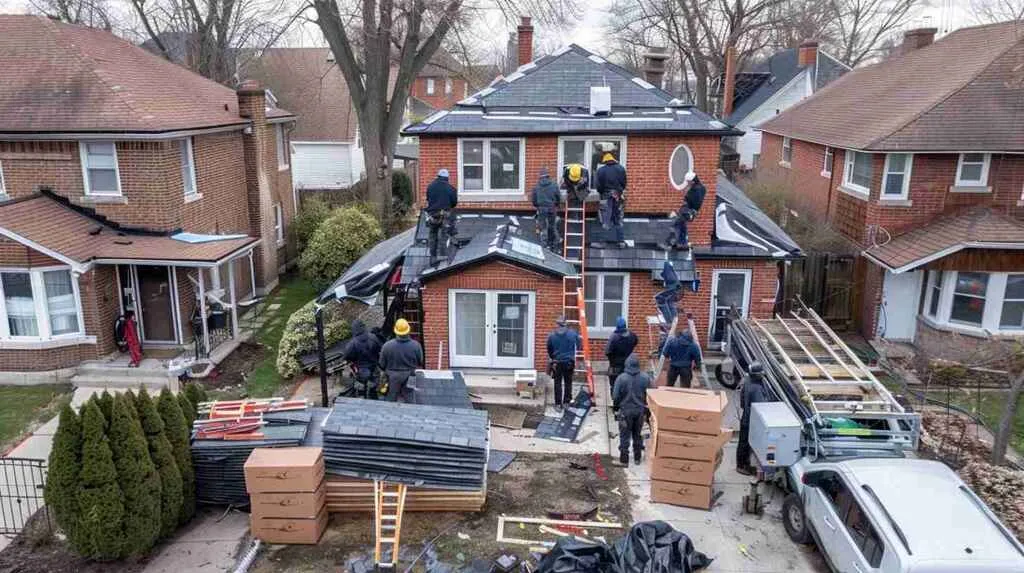
Shingle Roof Layers Queens NY – What’s Under and Why It Matters
Underneath every shingle roof in Queens, hidden from the street and tucked out of sight, is where the most expensive water damage actually begins-not on the surface everybody can see. In 19 years of roofing around here, I’ve watched homeowners pay thousands to fix “mystery leaks” that had nothing to do with the shingles themselves and everything to do with what was never installed, or installed wrong, under them. I’m going to walk you through the exact sandwich of layers under your roof-what each one does, why it matters in our freeze-thaw-and-steam-bath Queens climate, and which skipped layers turn into ceiling stains and mold.
What’s Really Under a Queens Shingle Roof (And Where the Damage Starts)
Here’s my honest opinion: if you only think about the visible shingles, you’re basically judging a book by its dust jacket. On a row house near 37th Avenue last fall, I showed the owner something he’d never seen in 20 years: the actual sandwich of layers under his shingles, which included plywood decking, an ice and water barrier along the eaves, felt underlayment across the field, and ventilation channels feeding the ridge vent. Roofs fail in the hidden layers because each one controls a path-load path, water path, or vapor path-and when you skip or compromise just one, you’re opening a door for moisture, condensation, or structural stress to go exactly where it shouldn’t. Around Queens generally, whether you’re in Flushing, Rego Park, or Corona, these layering mistakes are pretty common in older homes where cost-cutting crews took shortcuts nobody noticed until years later.
One August afternoon in Woodside, 96 degrees and you could see the heat rippling off the asphalt, I got called to a “shingle problem” that wasn’t a shingle problem at all. A landlord swore the shingles were defective because the top floor bedroom kept leaking at the window header; once I peeled up a tiny corner and slid my hand in, I hit raw, unprimed decking-no underlayment at all, like they’d skipped a page in the manual. The roofer before him saved maybe $300 in felt, and the poor tenant had been living with a musty wall for three summers, breathing in spores that could’ve been stopped by a single correct layer. That’s the kind of invisible damage you’re trying to avoid by understanding what goes under the shingles and why each layer has to be there, doing its one specific job in the moisture and load chain.
| Layer (Bottom to Top) | Main Job | If Missing in Queens, NY | Victor’s “Path” Note |
|---|---|---|---|
| Roof Decking (Plywood or Plank) | Structural surface; carries load path from shingles to rafters | Shingles sag, nails back out, drafts, visible daylight from attic | Load goes here first-rotten deck = failed roof |
| Ice & Water Shield | Self-sealing membrane at eaves, valleys, penetrations; blocks capillary water path | Ice dams leak at eaves, stains on ceilings near exterior walls | Stops water that sneaks under shingles in freeze-thaw |
| Felt or Synthetic Underlayment | Secondary water path barrier over entire field; manages windblown rain | Random leaks during hard rain with wind, especially on older homes | Your backup if a shingle fails or blows off |
| Drip Edge / Starter Strip | Guides water off fascia; anchors first row of shingles | Fascia rot, peeling paint, water runs behind gutters | Tiny detail, massive water-path consequences |
| Intake & Exhaust Ventilation | Controls vapor path and temperature; prevents condensation buildup | Sweating deck, rusty nails, bubbling underlayment, mold in attic | Vapor needs to escape-trap it and deck rots from inside |
| Shingles (Top Layer) | Visible weather barrier; sheds most rain and UV | Cosmetic only until underlayment or deck fails underneath | Last line of defense, not the only line |
Decking, Ice Barriers, and Underlayment: Your Hidden Waterproof System
In older neighborhoods like Jackson Heights, Astoria, and parts of Richmond Hill, you’ll find homes with original plank decking-sometimes 1×6 or 1×8 tongue-and-groove boards nailed across the rafters, sometimes with gaps between them wide enough to slip a pencil through. That deck is the structural load path: it carries the weight of the shingles, snow, roofers, satellite dishes, and everything else down to the rafters and eventually to the walls. When those planks rot, warp, or crack, the load path gets compromised, shingles start to ripple and buckle, and nails back out because they’ve got nothing solid to grip. Gaps or rotten sections also mess up the water path, because modern underlayment and ice barrier membranes need a continuous, smooth surface to seal against; lay them over splintered boards with daylight showing through, and you’ve basically put a bandage over a wound that’s still open.
At 6:30 in the morning one January, sun just coming up over Jackson Heights, we were tearing off a “two-layer” roof that turned out to be three layers of shingles over one crumbly layer of cedar shakes. Every time my flat bar hit the deck, dust shot up like chalk from a gym mat, and the homeowner kept asking why the air upstairs felt so cold and drafty; once we opened it up, you could literally see daylight through the gaps in the old plank decking because nobody had ever installed a proper decking overlay or ice and water shield along the eaves. That house had been losing heat through those gaps for decades, and every winter storm that piled snow on the eaves created the perfect setup for ice dams, which would’ve forced water back under the shingles if the owner hadn’t called us when he did. We laid down half-inch plywood over the old planks to create a solid, continuous deck, then rolled ice and water shield along every eave and valley before touching a single shingle.
Ice and water shield is a self-sealing rubberized membrane you install at the eaves (typically 3 to 6 feet up from the edge), in valleys, and around any roof penetration like chimneys, vents, or skylights-basically anywhere water loves to pool or sneak sideways during Queens’ freeze-thaw cycles. When an ice dam forms at your gutter line and meltwater backs up under the shingles, that membrane is what stops it from reaching the deck and dripping into your walls. Above the ice barrier, you lay felt or synthetic underlayment across the rest of the roof field to manage the water path and, to some degree, the vapor path, giving you a second line of defense if a shingle ever cracks, lifts, or blows off in a storm. Here’s an insider pointer I give every customer: never rely on shingles alone around the eaves where ice dams form, because shingles are designed to shed water flowing downhill, not water creeping uphill under them-that’s the membrane’s job, and skipping it is asking for trouble.
Risks of Re-Roofing Over Bad Decking or Without Ice & Water Shield in Queens
- Nails backing out through shingles: Rotten or crumbly deck won’t hold fasteners, so nails pop up and create leak points within a year or two.
- Drafts and cold rooms: Gaps in old plank decking let conditioned air escape and outside air seep in, spiking heating bills all winter.
- Recurring ceiling stains at eaves: Without ice and water shield, every ice dam season turns into a ceiling-stain season, and the damage compounds over time.
- Insurance pushback on repeat leaks: Insurers can deny claims if an adjuster finds the roof was installed without code-required underlayment or over structurally inadequate decking.
What a Proper Queens Tear-Off and Re-Layering Should Include Before Shingles Go On
Full tear-off to decking: Remove all old shingle layers, felt, and flashing down to bare wood so you can see what you’re working with.
Deck inspection and documentation: Walk the entire deck, mark any soft spots, rot, or gaps; take photos if insurance or permits are involved.
Deck repairs or overlay: Replace rotten sections, overlay old plank decks with plywood for a smooth, continuous nailing surface.
Installation of ice & water shield at eaves and valleys: Apply self-sealing membrane at least 3 feet up from all eaves and through every valley.
Underlayment over remaining field: Roll out felt (#30 or synthetic) across the rest of the deck, lapping seams and fastening per code.
Proper fastening and drip edge: Install metal drip edge along eaves and rakes before shingles, fasten everything to manufacturer and code specs.
Ventilation, Insulation, and Vapor: Why Your Roof Needs to Breathe
I’ll never forget a Sunday emergency call in Astoria during that sideways rainstorm in April a few years back. A couple with a new baby had water dripping out of their recessed light in the nursery, and everyone they’d called suggested “maybe it’s the flashing”; standing in the attic with my headlamp, I could hear water dripping on the back of the vapor barrier and then running sideways along a low spot where the insulation was thin. The real issue? The roofing crew had skipped a proper ridge vent and just punched a couple of box vents, so the deck kept sweating and the underlayment was bubbling-layers done out of order, and the moisture had nowhere to go. That wasn’t a roof leak; it was a vapor-path failure that created condensation, which then mimicked a leak perfectly, dripping exactly like rain would. Once we cut in a continuous ridge vent and balanced it with soffit intake vents, the sweating stopped, the deck dried out, and the “leak” never came back.
In Queens’ humid summers and freezing winters, the temperature difference between your conditioned living space and the outside air creates a constant push for warm, moist air to migrate up through your ceiling and hit the cold underside of the roof deck-that’s your vapor path in action. If you’ve got the right balance of intake ventilation at the soffits (pulling cool outside air into the attic) and exhaust ventilation at the ridge (letting hot, moist air escape), plus continuous insulation on the attic floor to keep the heat where it belongs, that vapor path works the way it’s supposed to: moisture exits before it condenses. But if your soffit vents are blocked by insulation, or you’ve got random box vents instead of a ridge vent, or your insulation is patchy and compressed, the vapor path gets distorted, condensation builds up on the deck and nail tips, and you start seeing rusty streaks, bubbling underlayment, and eventually mold. Here’s an insider tip I use on every attic inspection: I look for frosty or rusty nail tips poking through the underside of the deck in winter, and I check whether the insulation is even thickness all the way across-those two clues tell me instantly if the vapor path and ventilation are out of balance, even before I look at the shingles.
How to Tell if Your Shingle Roof Layers Are Failing in Queens
Where exactly are you seeing water, drafts, or stains-and does it happen during hard rain, after snow melts, or just randomly in winter?
When I sit at a kitchen table with a customer, I start with that one question, because the location and timing of the problem usually point to a specific layer failure, not just “bad shingles.” Blunt truth: surface shingle damage-curled tabs, missing granules, a cracked ridge cap-is only one clue, and often not the most important one. Ceiling stains that show up near exterior walls during ice and snow? That’s usually a missing or failed ice and water shield at the eaves. Musty smells in the attic with no visible drips? Condensation from a broken vapor path. Cold spots on the ceiling or drafts near can lights? Gaps in the decking or missing insulation letting air move where it shouldn’t. If you know what to look for and where to look, you can often tell which hidden layer is the problem before you ever climb a ladder or peel up a shingle.
Quick Checks Before You Call Shingle Masters for a Roof-Layer Inspection
- Location of stains relative to exterior walls: Note whether stains are at the perimeter (eaves/valleys) or in the middle of the ceiling; perimeter usually means ice barrier or flashing, middle often means deck or vent issue.
- Whether leaks worsen with wind-driven rain or snow melt: Wind-driven rain points to underlayment or flashing gaps; snow-melt leaks scream ice dam and missing membrane at eaves.
- Attic access availability: Let us know if we can safely get into your attic to inspect the underside of the deck, insulation, and ventilation-it saves time and narrows diagnosis fast.
- Age of current roof: If your roof is over 15 years old or you’re unsure when it was done, mention it; old felt and worn barriers fail differently than newer synthetic materials.
- Whether multiple shingle layers are visible at the eaves: Look at the edge of your roof from the ground-if you see two or three stacked shingle edges, that’s a clue you’re sitting on an old tear-off that might be hiding deck problems.
Queens Roof Layer Repairs: What It Typically Costs
Pricing depends on your home’s square footage and how many layers we have to peel back to fix the real problem, but I’ll give you a rough, honest local range so you’re not flying blind. Catching a bad layer early-say, patching a small section of missing underlayment before the deck rots-is almost always cheaper than waiting until water has soaked into the framing and you’re looking at structural carpentry on top of roofing work.
Common Questions Queens Homeowners Ask About Shingle Roof Layers
Can I just add another shingle layer instead of tearing off?
Most building codes allow two layers max, and honestly that’s already pushing it-every extra layer adds weight to the load path, makes it harder to spot deck problems, traps heat and moisture in weird ways, and shortens the life of the new shingles because they can’t lay flat. If you’ve already got two layers or your deck is questionable, a full tear-off is the only move that lets you fix what’s actually broken instead of just covering it up.
Do I really need ice & water shield if my old roof never had it?
Your old roof probably never had it because code didn’t require it back then, and that’s exactly why you’ve got eave leaks or ice-dam stains now. Ice and water shield controls the water path when meltwater backs up under shingles during freeze-thaw cycles-something regular felt can’t do because it’s not self-sealing. If you’re re-roofing in Queens, where we get freeze-thaw and nor’easters, skipping the ice barrier to save a few hundred bucks is a gamble that’ll cost you thousands the first time an ice dam forms.
How do I know if my decking needs to be replaced?
You won’t know for sure until the shingles come off, but clues include sagging rooflines, soft or spongy spots when you walk the roof, visible water stains in the attic on the underside of the deck, and nails that back out or won’t hold. During a tear-off, we mark every rotten or cracked section, take photos, and give you a clear choice: replace just the bad spots or overlay the whole thing with plywood for a uniform, solid nailing surface that’ll outlast the shingles.
Will fixing ventilation actually stop leaks?
If the “leak” is really condensation dripping off the underside of your deck or vapor barrier, then yes, absolutely-balancing your intake and exhaust vents fixes the vapor path so moisture exits the attic instead of condensing and faking a roof leak. But if water is actively coming in through a hole, missing flashing, or bad underlayment, no amount of ventilation will stop it; you’ve got to fix the water path first, then make sure the vapor path is correct so you don’t create a second problem.
How long should a properly layered shingle roof last in Queens?
With solid decking, correct ice and water shield at eaves and valleys, quality underlayment, balanced ventilation, and architectural-grade shingles installed to spec, you’re looking at 20 to 30 years depending on weather exposure and maintenance. The layers under the shingles are what get you to the high end of that range-skip them and you might get 10 to 15 before hidden rot, condensation damage, or repeated leaks force a premature replacement.
Think of your shingle roof like a layered subway map: each color line-each hidden layer from decking to ice barrier to underlayment to ventilation-has its own job in controlling the load path, water path, or vapor path, and when one is missing or installed wrong, the whole system jams up and you get leaks, drafts, mold, or structural damage that has nothing to do with the shingles themselves. On a Queens roof, those invisible layers are where good roofing actually happens, and understanding what’s under there is the difference between a 15-year bandage and a 30-year solution. If something in your roof’s layering sounds off-if you’ve got mystery leaks, cold spots, attic condensation, or you just know the last crew cut corners-Shingle Masters can peel it back, show you exactly what’s there (or not there), and rebuild it the right way. Call us for a roof-layer inspection or a full tear-off and replacement anywhere in Queens, NY, and we’ll make sure every path is doing its job before the first shingle goes down.