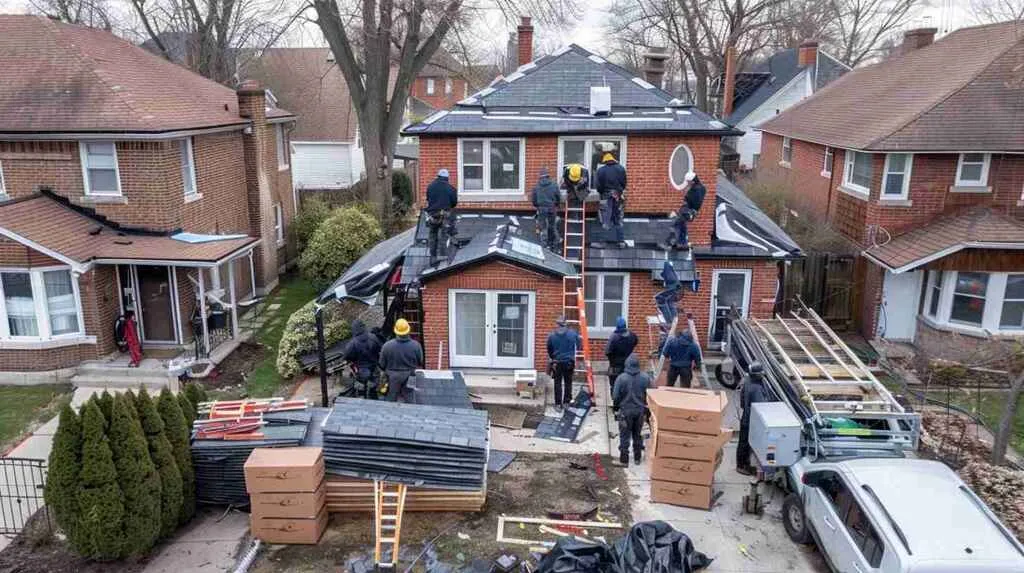
Shingle Roof Design Ideas for Queens NY Homes – Find Your Style
Blueprints show you the bones of a house, but it’s the roof that everyone sees first-and in Queens, most homes waste that first impression by treating their roof like it’s invisible. Three houses down from Queens Boulevard, I saw a dull beige cape that nobody ever looked twice at until the owners put on deep charcoal architectural shingles, and suddenly the whole block felt different because that one roof made every other house look half-asleep.
Street-View Roof Styles That Change How Your Queens Home Feels
Truth is, most “boring” roofs in Queens are just badly dressed houses. Your roof is your house’s outfit-the ridgeline is the collar, the fascia is the jacket trim, and the shingles are the fabric everyone sees when they walk past or pull up for dinner. I’ve watched a plain brick ranch in Forest Hills go from “I guess someone lives there” to “wait, whose house is that?” just by switching from faded gray 3-tabs to a rich weathered-wood architectural shingle with clean white trim. From across the street, that roof didn’t just cover the house; it framed it, gave it shoulders, made the windows and door look intentional instead of random.
One August evening in Astoria, just before a thunderstorm rolled in, I was on a brownstone roof with a couple who kept arguing about shingle color-she wanted bold red, he wanted boring gray. I took a photo of their block, pulled up a quick digital mockup on my tablet, and showed them how a deep charcoal roof would actually make their red brick pop more than a red roof ever could. When the rain started, we were under a tarp talking about how the right shingle design isn’t about what you like in your hand, it’s about what the whole street sees in the rain, shade, and sunset light. That lesson stuck with me: your roof color and pattern have to work in Queens overcast mornings, humid summer glare, and the low winter sun that turns everything either golden or washed-out depending on what you choose.
Plain Roof (3-Tab, Faded Gray)
-
→
Blends into the sky in cloudy Queens weather; house looks shorter and boxier -
→
No shadow lines, so the roof reads as a flat slab from across the street -
→
Shingle color clashes slightly with red or tan brick, making walls look tired -
→
Curb appeal feels “starter home” even if windows and door are updated
Designed Roof (Charcoal Architectural)
-
✓
Deeper charcoal frames the whole house like a clean haircut on a sharp suit -
✓
Layered tabs cast shadows that add dimension in afternoon Queens sun -
✓
Color makes red brick and white trim pop instead of washing them out -
✓
From the corner of the block, the roof pulls the eye in and makes the house look more expensive
Queens Shingle Roof Design – Fast Facts
Picking Shingle Colors and Patterns That Actually Work in Queens Light
Here’s my honest rule: if you can’t picture it from across the street, it’s the wrong shingle. Queens light is tricky-we get overcast mornings that flatten everything, humid summers that make colors look washed-out, and winter haze that turns bright shingles into sad gray blobs. Walk through Astoria and you’ll see red brick with white trim on half the block; in Flushing you get tan stucco and vinyl siding side-by-side; Jackson Heights mixes it all with pre-war brick and newer aluminum facades. The shingle color that looks “perfect” on a sample board in the store can look totally different when it’s covering 1,500 square feet of your roof under Queens July sun or March clouds. I always tell people to check the color at noon, at 5 p.m. when the sun’s low, and on a cloudy day if you can-because that’s when your neighbors actually see your house, not in perfect showroom lighting.
One January morning in Flushing, it was 18 degrees and windy, and I got called to fix a “designer” shingle roof that a handyman had installed. The pattern looked cool from the sidewalk, but he’d mixed different manufacturers and the stagger was totally wrong, so ice dams formed and pushed water right under the nicest part of the roof. I remember standing there, fingers numb, explaining to the homeowner that design is not just the color of the shingles-it’s the way the pattern moves water on a Queens winter day. Mixing shingle brands is like wearing suit pants from one store and a jacket from another: looks okay on the hanger, totally off when you’re actually wearing it in the rain. My insider tip? Always ask for a full-roof visualization or at least big sample boards showing multiple shingles together, and insist on one manufacturer line for the whole roof. That way the tabs line up, the warranty actually works, and the pattern looks intentional instead of patchy when someone parks across the street and glances up.
| Queens Exterior Type | Typical Neighborhood Examples | Recommended Shingle Color Families | Suggested Shingle Style | Street-View Effect |
|---|---|---|---|---|
| Red or Dark Brick | Astoria, parts of Jackson Heights, Forest Hills | Deep charcoal, slate gray, weathered wood brown | Architectural shingles | Dark roof makes brick look richer and creates clean frame |
| Tan or Beige Stucco | Flushing, parts of Bayside, Whitestone | Medium-dark earth tones, warm grays, driftwood | Architectural shingles | Adds definition to soft walls; roof becomes the anchor |
| Vinyl Siding (White/Gray) | Jamaica, South Ozone Park, parts of Richmond Hill | Bold charcoal, black-brown blends, slate blue-gray | Architectural shingles | Strong contrast lifts plain siding; house looks intentional |
| Mixed Brick/Siding Combo | Jackson Heights, Woodside, Elmhurst | Neutral charcoal or warm weathered wood | Architectural shingles | Unifies mismatched materials; ties the look together |
| Painted Wood/Older Siding | Parts of Ridgewood, Maspeth, older Queens blocks | Classic slate tones, soft gray-brown, muted charcoal | 3-tab or low-profile architectural | Keeps vintage charm while refreshing the roofline |
Architectural Shingles – Pros
- Richer shadow lines that show up even on gray Queens days
- Better wind resistance for Nor’easters and coastal storms
- More forgiving patterns that hide small installation imperfections
- Broader color ranges that suit brick, stucco, and vinyl siding
Architectural Shingles – Cons
- Higher upfront cost than 3-tab shingles
- Heavier, so must confirm roof deck is sound on older homes
- Takes a more experienced installer to lay out patterns cleanly
- Can look too busy if the house already has heavy pattern brick
Turning ‘Valheim Roof’ Inspiration into Real Queens-Ready Shingle Designs
When I walk up to your place, the first question in my head is, “What story is this roof trying to tell?” A Saturday last spring in Jamaica, a gamer in his twenties hired me because he said he wanted his “house to look like a Valheim longhouse, but in Queens code.” We literally sat in his living room with his PS5 on, pausing the screen on different roof angles while I translated the Viking look into modern architectural shingles, ridge details, and fascia colors that wouldn’t leak or get him a violation. That job taught me that even when people ask “how to get shingle roof Valheim style,” what they really want is a feeling-warm, tough, and a little dramatic-without sacrificing the real-world performance we need here. You don’t copy the game roof; you translate it. We picked a deep midnight-brown architectural shingle with pronounced tabs that cast shadows like overlapping wood planks, added bold high-profile ridge caps that read as a strong spine from the sidewalk, and wrapped the fascia in wood-tone aluminum that echoed the longhouse timber look without rotting in Queens humidity.
Here’s the thing: you can absolutely chase that Valheim vibe, but you’re dressing your house, not building a movie set. Bring your screenshots, your Pinterest boards, your game pauses-I love that stuff because it gives me a clear target for the feeling you want. But be ready to adjust slopes, overhangs, and materials for local code, snow loads, and the fact that your roof has to survive actual Nor’easters, not digital ones. We’re putting a Viking coat on your house that works in Queens winters, not a costume that falls apart in the first storm.
Should You Chase a Valheim Look or a Classic Queens Style?
If YES: Next question – Is your current roof structure steep enough (visibly from the street) to show off strong roof lines?
→ If YES: Consider a darker architectural shingle (charcoal, midnight, or deep brown), high-profile ridge caps, and stained-wood fascia to echo the longhouse vibe.
→ If NO: Focus on color and ridge detailing instead of slope; use medium-dark shingles with contrasting trim so the roof still feels “strong” from the sidewalk.
If NO (you don’t need dramatic): Lean into classic Queens looks with weathered wood or slate-tone shingles that quietly match the block.
Do you really want your house to feel like a Valheim longhouse, or do you just like the screenshots? Big difference-one’s a design direction, the other’s a wish that won’t survive a Queens winter.
Valheim-Inspired Design Elements That DO Translate to Queens Roofs
-
✓
Dark, moody shingle colors that frame a lighter facade -
✓
Pronounced ridge caps that read like a strong roof “spine” from the street -
✓
Exposed or wood-look fascia/soffit in warm stains or wood-tone aluminum -
✓
Simple, uncluttered roof planes without too many vent protrusions -
✓
Warm exterior lighting under the eaves to give that longhouse glow at night
How We Dress Your Roof Step-by-Step, From Sketch to Shingles
Think of your roof the way you think of your best winter coat: it has to look sharp and keep you alive at the same time. When I start a new Queens roof project, I don’t walk straight to the attic-I walk across the street first. I stand where your neighbors stand, where the delivery driver parks, where someone would snap a photo of your block for the real estate listing. That street view tells me what your roof is doing right now: is it sitting too flat, too bright, clashing with the trim? Then I pull out my notepad and do a quick sketch-think of it like dressing a person. The ridgeline is the collar, the slopes are the shoulders, the fascia and drip edge are the hem and cuffs. I’ll mark two or three shingle color options right on that sketch so you can actually picture the outfit before we commit to anything.
Good design gets locked in through process, not guessing. After the street-view sketch, we inspect the roof deck and ventilation so the new “coat” has a solid body underneath. Then we pick one manufacturer line and stick with it-same family, same warranty, same installation specs-so the pattern flows cleanly and the water moves the way it’s supposed to in Queens storms. Once we install, I always do a final street check from across the block, making sure the roof looks balanced, clean, and code-correct from every angle a person would actually see it.
Raul’s Queens Shingle Roof Design-and-Build Process
Common Questions Queens Homeowners Ask About Shingle Roof Design
Can I change my roof color without replacing all the shingles?
No, not in a way that looks right or holds up. Spot-changing colors on an existing roof makes it look patchy from the street and usually breaks the pattern that keeps water flowing correctly. If you want a new color story, plan it for the next full replacement so the whole “outfit” matches.
Will a darker shingle make my Queens house hotter?
A little, but not as much as people think. Ventilation and attic insulation matter more. In exchange, dark shingles often look sharper on brick and hide city soot and pollen better, which keeps the roof looking newer from the sidewalk.
How do I know if a Valheim-style roof idea is even allowed here?
Bring the idea; we’ll translate it. We keep your roof pitch, overhangs, and materials within NYC code and manufacturer specs, then use shingle color, ridge details, and trim to echo the style you like without creating a violation or leak risk.
How long does a full shingle redesign and replacement usually take in Queens?
On a typical 1- to 2-family home, most projects take 1-3 days once we start, depending on layers to remove and wood repairs. The design conversation and product selection usually happen a week or two before we ever touch a shingle.
Your shingle roof is your house’s best coat against Queens weather and the first thing people see from the street-it’s worth treating it like the design feature it really is. If you’re ready to stop settling for a boring roof and want a street-view design walk and honest quote on your next shingle roof in Queens, call Shingle Masters and let’s figure out what outfit your house has been waiting for all along.