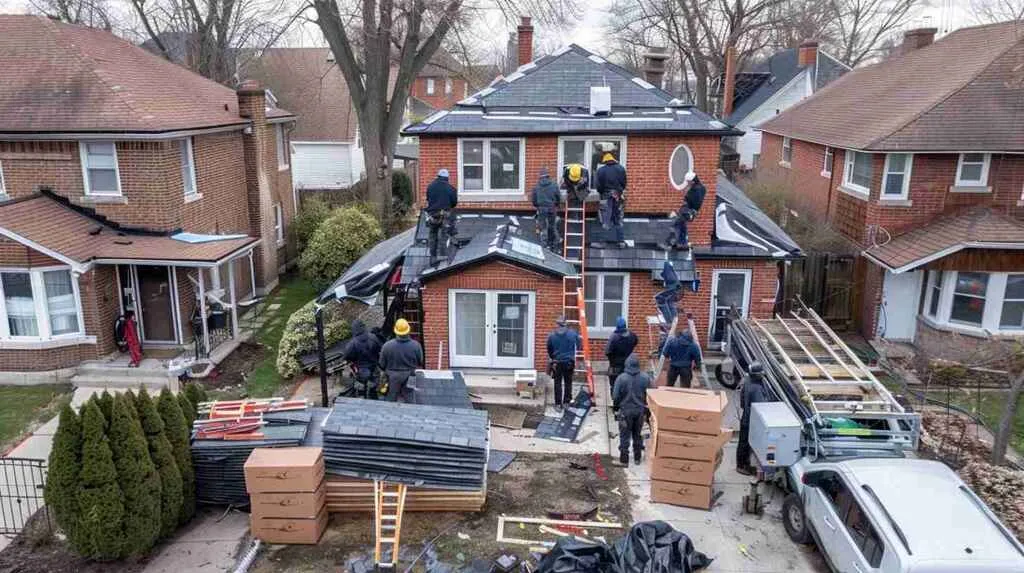
Shingle Roof Architecture Queens NY – How Shape Affects Install
Contours determine cost. On a corner lot in Flushing last summer, I measured two roofs with the same square footage but completely different personalities-one was a clean gable with a single valley, the other had three dormers, a turret, and an L-shaped wrap around an interior courtyard. Same shingles, same contractor, but the first house paid $8,500 and the second paid $16,200. If you’re getting quotes for shingle roofing in Queens and the numbers feel all over the map, the answer isn’t that contractors are making up prices; it’s that your roof’s shape controls how much time, skill, and material it takes to keep water moving correctly.
Why the Same-Size Shingle Roof Costs $8,000 on One House and $15,000 Next Door
Here’s my honest opinion: most Queens roofing quotes ignore how roof architecture affects labor, and I refuse to price roofs on square footage alone. The traffic metaphor I always use is this-imagine two highways with the same number of miles, but one is straight and flat while the other has merge lanes, cloverleaf exits, and a tunnel through a mountain. Same distance, wildly different construction cost. Your roof works the same way. Two 1,500-square-foot roofs can have completely different “traffic patterns” for water, and the one with more intersections, turrets, dormers, and dead-end valleys will always cost more because it demands more cuts, more custom flashing, more underlayment overlap, and more time crawling around tight angles where one mistake turns into a leak two winters from now.
Shingle roof architecture-the actual geometry of slopes, ridges, hips, valleys, and transitions-drives labor hours and materials far harder than raw square footage. A simple gable might need 12 hours of skilled work and standard valley metal; a hip-and-valley roof with two dormers and a low-slope section might need 28 hours, saddle flashing, ice-and-water shield in three places, and custom step flashing around every dormer window. The difference isn’t the shingles themselves; it’s the system you’re building to manage water as it flows down intersecting planes and around obstacles. In Jackson Heights, Flushing, Forest Hills, and Astoria, most of the housing stock was built between the 1920s and 1960s, so you’re dealing with cross-gables, mansards, and courtyard L-shapes that weren’t designed with modern shingle installation in mind-they were designed to look good from the street, and water management was an afterthought.
How Shingle Roof Architecture Changes Queens NY Re-Shingle Pricing
| Roof Scenario | Typical Shape Details | Estimated Price Range (Queens, NY) |
|---|---|---|
| Simple Gable | Two slopes meeting at a center ridge, 1-2 valleys, 6/12 or steeper pitch, normal access | $7,500 – $10,500 |
| Hip Roof with Dormers | Four sloping sides, 2-3 dormers, multiple hip ridges, standard pitch, typical flashing | $11,000 – $14,500 |
| L-Shaped or Cross-Gable | Intersecting rooflines, interior valleys, courtyard transitions, low-slope sections, turret or bay | $14,000 – $18,000 |
| Mansard or Multi-Level | Steep vertical sections, multiple pitch changes, complex flashing at every transition, limited access | $16,500 – $22,000+ |
Prices assume standard architectural shingles, full tear-off, normal access, and typical Queens conditions. Add 15-25% for limited access, heavy snow load prep, or premium materials.
Fast Facts About Shingle Roof Architecture and Cost in Queens
- Simple vs Complex Cost Per Square: Simple gable roofs run $350-$450/square installed; complex roofs with valleys, dormers, and turrets run $550-$750/square because of detail work.
- Project Duration Difference: A straightforward 1,500 sq ft gable takes 2-3 days; the same square footage with cross-gables and turrets takes 4-6 days due to precision cutting and flashing.
- Extra Labor for Complex Intersections: Each interior valley adds 2-4 hours of skilled labor; dormers add 3-5 hours each; turrets or bays add 4-8 hours depending on geometry.
- Detail Work Budget Allocation: On complex Queens roofs, 35-45% of your total budget goes to valleys, flashing, step work, and transitions-not the shingles themselves.
How Roof Shape Directs “Water Traffic” on Your Queens Home
Most leaks in Queens don’t come from bad shingles; they come from roofs that were installed as if they were flat rectangles. One August afternoon in Jackson Heights, it was 94 degrees and the asphalt shingles were soft like warm chocolate. The house had this complicated cross-gable roof with a little hexagon turret over the stairwell-beautiful from the street, a nightmare for water flow. A previous crew had treated it like a simple gable, ran the shingles straight through the valleys, and the homeowner couldn’t figure out why every thunderstorm meant a drip over the second-floor landing. I spent half an hour just sitting on the ridge sketching out where the water actually wanted to go before I touched anything, and once we re-framed one small section and re-cut the valleys, the leaks disappeared. That house taught me what I already suspected: if you ignore real water paths and just nail down shingles in straight rows, you’re building a roof that fights its own architecture.
Think of water as traffic on a highway system. The ridges are your main highways where water accelerates downhill; the open fields between ridges are your lanes; and the valleys, dormers, hips, and transitions are your on-ramps, off-ramps, and merge points. When you install shingles, you’re not just covering the roof-you’re shaping the lanes and exits so water never backs up, never pools, and never finds a crack to slip through. In prewar rowhouses and postwar Cape Cods across Flushing, Forest Hills, and Astoria, the roof shapes were designed for curb appeal and attic space, not drainage efficiency, so the installer has to compensate by overlapping shingles differently at every intersection, adding metal diverters in dead-end valleys, and sometimes redesigning transitions that the original builder never thought through. Miss one merge point and you’ve created a bottleneck where water sits, freezes, and eventually works its way under the shingle and into your ceiling.
✅ Key Shingle Roof Architecture Features That Change Water Flow
- ✅ Steep Gable: Water accelerates fast, so shingles need strong adhesive strips and proper nailing to resist wind uplift at the ridge and eaves.
- ✅ Low-Slope Section: Water moves slowly and can back up under shingles during wind-driven rain, requiring double underlayment and sometimes modified-bitumen base layers.
- ✅ Valleys: Water from two roof planes merges here at high speed, so valley metal or woven shingles must handle double the volume without creating turbulence that pushes water sideways.
- ✅ Hips: Water splits and flows down both sides, creating a natural “divide” that needs tight shingle overlap and ridge cap to prevent wind from lifting edges.
- ✅ Dormers: Water hits the dormer’s uphill side and has to divert around it, so step flashing and kickout diverters are critical to avoid water sneaking behind the dormer walls.
- ✅ Turrets and Mansards: Near-vertical sections create slow-moving water that can freeze or get pushed under shingles by wind, requiring ice-and-water shield and sometimes clips or starter strips mid-field.
Shapes That Demand Special Shingle Installation in Queens
I still remember the first time I saw a mansard roof in Forest Hills and thought, “This thing is basically a vertical wall pretending to be a roof.” Mansards look elegant-they add an entire extra floor of usable space and give a house that French Second Empire silhouette-but from a water-management perspective, they’re brutal. The steep lower slope moves water so slowly that wind can push rain uphill under the shingles, and snow sits on that near-vertical face for weeks. I’ll never forget a Saturday morning in Bayside after a nor’easter, standing on a low-slope hip roof at 7 a.m. with coffee in one hand and a moisture meter in the other. The owner had insisted on architectural shingles over a 3/12 pitch without proper underlayment because he “liked the look.” On a low slope with a long run and no real ridge for ventilation, the wind-driven rain had backed up under the shingles like traffic on the Cross Bronx Expressway. That job taught me how dangerous it is to ignore how roof shape, pitch, and shingle profile interact-now I refuse certain combinations, even if the customer waves extra money at me.
There was this narrow semi-attached in Astoria with an L-shaped roof that wrapped around a tiny interior courtyard; we did it on a cold, windy November evening under portable lights because the owner’s insurance deadline was the next morning. The courtyard created two dead-end valleys where snow would pile up, melt, and refreeze. A previous installer had done perfect-looking shingle work, but they never accounted for the way the shape trapped water-no saddle, no diverter, nothing. We ended up redesigning the whole transition around the courtyard corner, adding custom metal and stepping the shingles differently, and that awkward little inside corner became the most watertight part of the whole house. The insider tip I share with every homeowner is this: sometimes I turn down jobs where the roof shape and shingle choice don’t match, even if they offer more money, because the traffic pattern of water will always win. If you’re trying to use standard three-tab shingles on a mansard or architectural shingles on a 2/12 slope with no saddle, you’re not installing a roof-you’re scheduling a leak.
Pros of Complex Shapes
- Curb Appeal: Turrets, mansards, and cross-gables give your home architectural character that stands out in Queens neighborhoods.
- Usable Space: Dormers and mansards create livable attic rooms or extra bedrooms without expanding the footprint.
- Neighborhood Fit: Many Queens blocks have consistent roof styles (Tudor gables, Colonial hips), so matching that adds resale value.
- Ventilation Options: Complex roofs often have multiple ridge lines, giving you more options for ridge vents and attic airflow.
Cons of Complex Shapes
- Higher Install Cost: More valleys, dormers, and transitions mean more labor hours and custom flashing-often 40-60% higher than simple gables.
- Leak-Prone Intersections: Every valley and inside corner is a potential failure point if not installed with proper metal and underlayment overlap.
- Stricter Material Choices: Low-slope sections and mansards can’t use standard shingles; you’re limited to specific profiles and underlayment systems.
- Snow and Ice Management: Dead-end valleys and courtyard corners trap snow, creating ice dams that require heat cable or upgraded barriers.
⚠️ Warning: Installing Shingles on Low-Slope or Dead-End Valleys Without Upgraded Underlayment and Metal
Wind-Driven Rain Backup: On slopes under 4/12, wind can push water uphill under shingles faster than gravity pulls it down, especially in nor’easters and tropical storms common in Queens.
Ice Dam Formation: Interior corners and courtyard valleys trap melting snow, which refreezes at night and creates dams that force water under shingles and into walls.
Voided Warranties: Most shingle manufacturers void warranties if you install their products on slopes below their specified minimum without approved underlayment systems.
Hidden Rot: By the time you see a ceiling stain from a low-slope leak, the decking and framing around the valley have often been wet for months, requiring structural repairs that cost more than the roof itself.
My Queens-Specific Process for Matching Shingles to Roof Contours
When I walk a new job, the first question I ask a homeowner is, “Where does the water want to go, and where is your roof trying to fight that?” I do this driveway-style walkthrough where I sketch the roof on a pizza box or the back of my estimate sheet, drawing arrows to show the main highways (ridges), the merge lanes (valleys), and the tricky exits (dormers, skylights, courtyard corners). Most people have never thought about their roof as a water traffic system-they think shingles are shingles and the shape doesn’t matter-but once you see those arrows and understand why one corner always gets ice or why the dormer side wall is stained, the whole project clicks. I’m not selling you shingles; I’m designing a traffic pattern that keeps water moving from ridge to gutter without ever stopping, pooling, or reversing direction.
If you don’t understand your roof’s traffic pattern, you’re guessing with your money. I don’t guess.
What you should expect when you hire Shingle Masters is a process that treats your roof architecture as the foundation of the install plan, not an afterthought. We start with a phone consult where I ask about valleys, dormers, low-slope sections, and past leak locations so I’m not surprised when I show up. Then I do an on-roof inspection with a sketch pad, not just a drone photo, because I need to see how the planes intersect and where the water actually flows in a heavy rain. From that inspection, I build a water-flow and detail plan that shows you exactly where we’ll use ice-and-water shield, where valleys get metal or woven treatment, and which intersections need custom flashing. The install itself focuses on those critical intersections first-valleys, dormers, turrets, courtyard corners-because if those fail, the rest of the roof doesn’t matter. And at the end, we do a walkthrough where I show you every valley, every flashing detail, and every transition so you know what you paid for and why it’s built that way.
How a Shingle Roof Architecture Consultation and Install Works in Queens
- Phone Consult + Basic Shape Questions: We ask about valleys, dormers, low-slope sections, past leaks, and courtyard/L-shape layouts so I can estimate time and complexity before the site visit.
- On-Roof Inspection and Sketches: I walk your roof with a sketch pad and camera, drawing the water flow paths and identifying every intersection, transition, and dead-end valley that needs special attention.
- Water-Flow and Detail Plan: I create a written plan showing where ice-and-water shield goes, which valleys get metal vs woven treatment, what underlayment each slope needs, and how we’ll handle dormers and turrets.
- Install with Special Focus on Intersections: We tackle valleys, dormers, and complex transitions first, building the “traffic control” system before laying the main field shingles, so every critical junction is watertight.
- Walkthrough Showing Each Critical Area: Before final payment, I walk you around the roof (from ladder or window if you’re not comfortable climbing) and point out every valley, flashing detail, and transition so you see exactly what you paid for.
📋 What to Note About Your Roof Shape Before Calling Shingle Masters
-
☑
Count Your Valleys: From the street or yard, count how many places two roof slopes meet in a V-shape-more valleys mean more labor and flashing. -
☑
Note Flat or Low-Slope Sections: If any part of your roof looks almost flat or you can walk on it easily, that’s a low-slope area that needs special materials. -
☑
Identify Dormers and Skylights: Count how many windows or skylights poke through the roof-each one is a transition point that needs custom flashing. -
☑
Check for Interior Courtyards or Inside Corners: If your house has an L-shape or U-shape, those inside corners create dead-end valleys where water and snow get trapped. -
☑
Observe How Snow Piles in Winter: Look at old photos or remember where snow sits longest-those are low-flow areas that need upgraded ice barriers. -
☑
Gather Past Leak Locations: Note any rooms or ceilings that have leaked before-those spots tell me where the previous install ignored the roof’s traffic pattern.
Common Questions About Shingle Roof Architecture in Queens, Answered
Blunt truth: the fancier the roof shape, the more chances there are to mess up the shingle installation. If you’re the type of homeowner who reads three blogs and still feels skeptical about why your quote is higher than your neighbor’s, the FAQs below will help you dig into the real reasons-and if you’re still confused, call me and I’ll sketch it out on your driveway.
Why did my neighbor’s roof cost less even though our houses look the same size?
Square footage measures the flat area; it doesn’t measure valleys, dormers, hips, or pitch. Your neighbor might have a simple gable with two slopes and one ridge, while your house has a cross-gable with four valleys, two dormers, and a turret-same square footage, but your roof has three times as many “intersections” where water changes direction. Each intersection needs custom flashing, overlapped underlayment, and extra labor hours. That’s why a 1,500 sq ft simple roof costs $8,500 and a 1,500 sq ft complex roof costs $15,000-you’re paying for the geometry, not just the shingles.
Can I use architectural shingles on my low-slope section?
Most architectural shingles are rated for 4/12 pitch and steeper. If your roof has a 3/12 or 2/12 section, you’ll need either a special low-slope shingle designed for that pitch or a different roofing system entirely (modified bitumen, TPO, or metal). If you try to use standard shingles on a low slope without upgraded ice-and-water shield and proper ventilation, wind-driven rain will back up under the shingles and you’ll have leaks within the first year. I’ve turned down jobs where homeowners wanted architectural shingles on low slopes because I know the water traffic pattern will fail-better to say no upfront than fix it later.
Are valleys really that important, or is that just upsell talk?
Valleys are the most leak-prone part of any roof because they handle double the water volume of a regular slope-water from two planes merges at high speed, and if the valley isn’t built correctly, it backs up, overflows, or seeps under the shingles. In Queens, where we get nor’easters with sideways rain and freeze-thaw cycles all winter, a valley without proper metal or woven treatment will fail. I’ve seen valleys installed with just overlapped shingles and no metal that leaked within six months. It’s not upsell; it’s physics. Water moves fast in valleys, and if you don’t give it a clear path, it finds its own-usually into your ceiling.
How do dormers and skylights change the way you install shingles?
Dormers and skylights are obstacles in the water traffic system-water flowing downhill hits them and has to divert around. That means every dormer needs step flashing on the uphill and side walls, a kickout diverter at the bottom to push water back into the main flow, and proper counter-flashing tucked into the dormer siding. Skylights need curb flashing kits and ice-and-water shield around the entire opening. If you just run shingles up to the dormer or skylight without proper metal, water will back up behind the wall and leak into the room below. Each dormer or skylight adds 3-5 hours of labor and $150-$300 in flashing materials, but skipping it guarantees a leak.
What can you show me during an estimate so I understand my roof’s traffic pattern?
I bring a sketch pad and draw your roof from above, then add arrows showing where water flows from ridge to eave. I mark every valley, every dormer, every low-slope section, and every inside corner, and I explain what has to happen at each one to keep water moving. I also take photos from the roof and annotate them on my tablet so you can see exactly where the critical intersections are. By the end of the estimate, you’ll understand why your roof costs what it costs and what you’re paying for-it’s not magic, it’s traffic engineering for water. If a contractor can’t explain your roof’s water pattern in five minutes, they’re guessing.
Why Queens Homeowners Call Shingle Masters for Tricky Roof Shapes
Installed hundreds of roofs across Jackson Heights, Flushing, Forest Hills, Astoria, and Bayside-every housing style from prewar to modern.
Licensed roofer with full liability and workers’ comp coverage, meeting all NYC building codes and permit requirements.
Known as “the roof architect” for solving tough valley, turret, mansard, and courtyard intersection problems other contractors walk away from.
Typical response within 24-48 hours on business days, with on-site inspection and sketch-based water-flow plan included in every estimate.
Think of a Queens roof like the 7 train at rush hour-every dormer, valley, and hip is another station where water either flows smoothly or gets stuck. Shingle roof architecture isn’t about the brand of shingles you choose; it’s about building a system that keeps water moving from ridge to gutter without backing up, pooling, or reversing direction at intersections. If you’ve been getting wildly different quotes and nobody can explain why, it’s because most contractors price by square footage and ignore the geometry. Call Shingle Masters, and I’ll walk your roof, sketch the water traffic pattern on a pizza box if that’s what it takes, and give you a quote that matches your actual roof shape-not just the number on a tape measure.