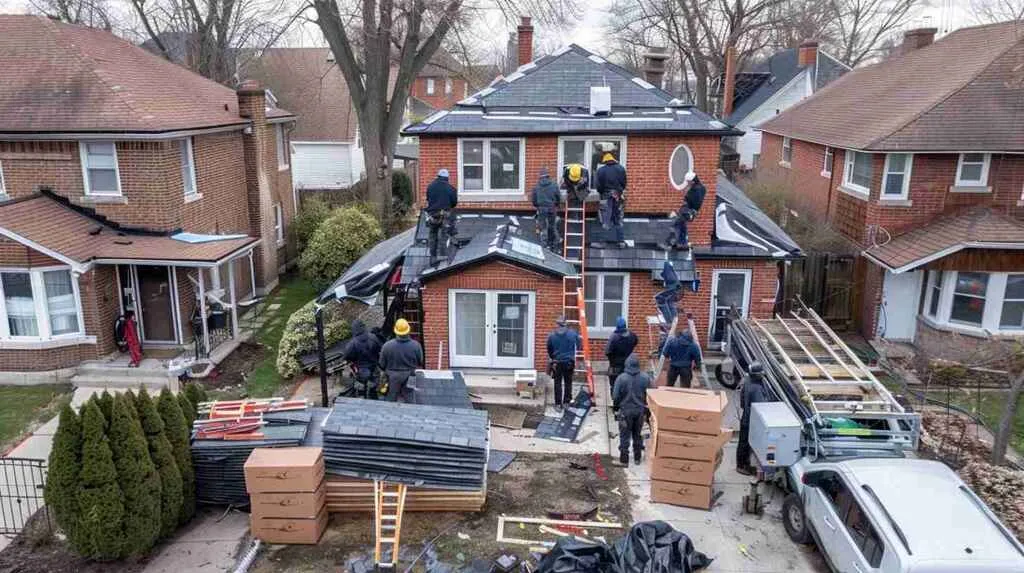
Roof Shingle Texture Queens NYC – From Flat to Deeply Dimensional
Layers matter. The flattest shingles you can buy often end up costing Queens homeowners more in the long run – they age ugly, catch leaks in ways textured shingles can quietly prevent, and when you stand across the street, they just sit there like a gray sheet instead of an actual design choice. Now picture two roofs on the same block: one catching the afternoon light in little ridges and shadow lines, the other completely flat and forgettable even though it was installed the same year.
Layers, Light, and Why Flat Shingles Cost You More in Queens
On a typical block in Queens, if you look up and actually pay attention, you’ll see two kinds of roofs: the ones that catch light and the ones that just sit there. The flat ones – those old-school three-tab shingles – might’ve been cheaper upfront, but they age in this ugly, streaky way, and water loves to sit in the tiny cracks where you can’t see it. From the sidewalk, especially in Jackson Heights or Astoria where houses are close and sight lines are short, a dead-flat roof makes the whole building read shorter, squatter, less finished. I frame every roof decision through what I call the “sidewalk test” – how does this roof look from across the street, right now and in five years?
Texture works with New York sunlight and even streetlamps at night to create dimension. One August afternoon in Elmhurst, I was standing on a two-family house where the owner swore her roof was “fine” but “just boring.” The old flat three-tabs were soaking up water in the hairline cracks, and from the sidewalk the whole roof looked like a single gray sheet. We switched her to a mid-range architectural shingle with medium-depth texture, and I’ll never forget standing across the street at sunset watching the new ridges catch the light and literally make the house look taller. That was the first time a customer said, “I feel like you just framed my house,” and I’ve chased that moment on every textured roof since.
| Feature | Flat Three-Tab Shingles | Dimensional Architectural Shingles | From-the-Sidewalk Effect in Queens |
|---|---|---|---|
| Thickness | Single layer, roughly 1/8″ – almost paper-thin once granules wear | Built-up layers, typically 3/8″-1/2″ thick with real depth | Dimensional shingles read as “finished construction,” flat shingles look temporary or builder-grade |
| Shadow Lines | Basically none – roof appears as one continuous, dull surface | Real shadow lines at every course, visible even on cloudy days | Neighbors notice the shadow-play on dimensional roofs; flat roofs fade into the background |
| Wind Resistance | Typically 60 mph rating – edges lift easily in Queens wind tunnels | Usually 110-130 mph rating, heavier weight keeps them locked down | After a storm, you’ll see flat shingles scattered in gutters; dimensional roofs stay quiet |
| Aging Pattern | Streaks and curling show up fast, often in ugly vertical lines | Ages in subtle, irregular patterns that blend with texture | Flat roofs become neighborhood eyesores by year 8-10; textured roofs stay sharp much longer |
| Typical Lifespan in Queens | 12-15 years before they’re clearly shot | 20-30 years with proper install and decent underlayment | You’ll re-roof flat shingles twice in the time one good dimensional roof lasts |
Myth vs Fact: Queens Roof Shingle Texture
| Myth | Fact |
|---|---|
| All “architectural” shingles have real texture | Nope. Some cheap “architectural” shingles are just printed color patterns on a single layer – zero physical depth. Stand across the street on a cloudy day; if the “texture” disappears, it’s fake. |
| Textured shingles are too heavy for rowhouses | Queens rowhouse framing handles dimensional shingles just fine – we’re talking an extra 50-75 lbs per square, not thousands of pounds. Your structure was built for slate or tile, which is way heavier. |
| Deeper texture means harder to repair | Actually the opposite. Dimensional shingles blend repairs better because the shadow lines hide new-old mismatches. Flat shingles show every color shift and patched spot from the street. |
| You only notice texture up close | Not even close. Real dimensional texture is the first thing you notice from across the intersection – it’s how your eye decides if a house looks finished or cheap before you even register the siding color. |
How Texture Helps Your Roof Fight Queens Weather
I’ll be honest with you: a dead-flat shingle roof in this borough is basically an invitation for water to misbehave. Water wants to sit, especially near dormers, valleys, and any transition where two roof planes meet, and when there’s no texture – no little ridges or layered edges to break up the flow – it just pools there until it finds a way under. One freezing January morning in Bayside, I got called to a leak that a handyman had “fixed” with a smear of roof cement over a flat patch of shingles near a dormer. The snow had drifted against that dead-flat area, melted, and snuck under because there was no texture or layering to break up the water flow. I peeled back the mess, showed the homeowner how the lack of dimensional shingles around the transition made the snow sit and pool, and we redesigned that section with deeper-cut shingles and properly layered underlayment. The next winter, he texted me a photo of the same dormer after a storm – snow naturally shedding along the textured courses instead of camping out in a puddle. Bayside and similar neighborhoods in Queens get drifting snow against dormers, and roofs near the water or on open corners behave completely differently with flat versus textured shingles.
Zoom out to the street view for a second. After a rainstorm, look up and notice how water tracks along textured courses in clean lines, following the little shadow valleys, versus how it sits in random blotches on a flat surface. That tracking isn’t just cosmetic – it’s how your roof stays dry at the deck level and how granules stay put instead of washing away in ugly streaks.
Risks of Flat, Low-Texture Shingles in Queens Freeze-Thaw Cycles
- Ice dams at dead-flat transitions: Where flat shingles meet a dormer or valley, melting snow refreezes in a flat puddle instead of draining off textured edges.
- Water sneaking under cement patches: Roof cement over flat shingles creates a hard lip with zero give – freeze-thaw pops it loose every winter.
- Granule loss where water repeatedly pools: Flat shingles trap water in the same spots storm after storm, washing away protective granules and exposing the asphalt underneath to UV damage.
- Hidden leaks around dormers and skylights: Water sits so quietly on flat surfaces you won’t see the damage until the drywall inside starts turning brown – by then you’re looking at framing repairs, not just shingles.
How Shingle Masters Designs a Textured Shingle Layout for Queens Weather
From Flat to Deeply Dimensional: Choosing the Right Texture Depth
I still remember the first time a homeowner in Forest Hills realized her “multidimensional” shingles were just painted-on color, not real texture. She’d picked them from a sample book indoors under fluorescent lights, and they looked great. But standing on her sidewalk a year later, she pointed up and said, “I thought there’d be, like, ridges.” There were no ridges – just a flat surface with a color blend that pretended to be texture. Here’s the insider tip: stand across the street on a cloudy day and look at your roof. If the “texture” disappears and you only see flat color, it’s just a printed-on pattern, not real dimensional depth. Real texture holds shadow lines even when the sun isn’t directly hitting it, and that’s what changes how a Queens roof reads from the sidewalk.
Late one summer evening in Corona, I was racing daylight trying to finish a small re-roof for an older couple before a predicted overnight windstorm. They’d chosen a cheap, very flat shingle because “it’s just the garage,” but I knew that angle took the full brunt of the prevailing wind. Halfway through, a gust ripped a bundle of those flat shingles out of my hands, while the sample of a heavier, more dimensional shingle sat solid on the deck. I stopped, called them outside, and in the fading light we tested both types right there on the roof – the deeper-texture shingle barely flexed. They agreed to upgrade on the spot, and after that night’s storm, not a single one had lifted; they still tell neighbors, “Hector made the garage tougher just by adding texture.” Texture depth isn’t just cosmetic – it’s wind resistance, weight, and how well the shingle grabs the deck when the weather gets mean, especially on open exposures like along wide Queens boulevards.
Printed-On Color Only
-
✗
No real shadow lines – texture vanishes on cloudy days -
✗
Single-layer thin shingle, usually under 200 lbs per square -
✗
Wind rating typically 60-70 mph -
✗
Ages ugly fast – pattern fades and streaks show within 5-7 years
Real Dimensional Texture
-
✓
Visible shadow lines at every course, even from across the street -
✓
Multi-layer construction, typically 240-400 lbs per square -
✓
Wind rating usually 110-130 mph, some premium lines up to 150 mph -
✓
Ages gracefully – texture hides normal weathering and color shift
Decide Which Shingle Texture Depth You Need
What Textured Roofing With Shingle Masters Looks Like, Step by Step
Street-View Design First
When I sit down at your kitchen table, the first thing I ask is, “How do you want this roof to look from across the street five years from now?” Not what color, not what brand – how should it feel when you pull up to your block. I sketch roof profiles and shade lines on scrap cardboard like brushstrokes in a painting, showing you where deeper texture will catch afternoon light, where shadow courses will frame the roofline, and where we can use shingle orientation to make a boxy house suddenly look taller or a squat garage look intentional instead of cheap.
Then the Technical Layers
That vision turns into specific shingle choices, underlayment patterns, and ridge details – but I keep the language simple and neighborly. We’re not just slapping down whatever’s on sale; we’re designing how water moves, how wind grabs (or doesn’t), and how your roof weathers over the next two decades while still looking sharp from the sidewalk.
Our Queens Roof Shingle Texture Design & Installation Process
Why Queens Homeowners Trust Shingle Masters for Textured Roofs
-
✓
19+ years of shingle experience exclusively in Queens neighborhoods -
✓
Licensed & insured in New York State with full liability and workers’ comp coverage -
✓
Typical response time: Free street-view estimate within 48 hours of your call -
✓
Neighborhoods served: Jackson Heights, Astoria, Elmhurst, Bayside, Forest Hills, Corona, Flushing, Rego Park, Kew Gardens, and throughout Queens, NY
Costs, Maintenance, and When to Call About Shingle Texture
Here’s the part most people don’t like hearing: you can’t get deep, rich texture with bargain-bin shingles, no matter what the package says. Spending a bit more upfront almost always avoids early replacement and fussy patch jobs down the road.
Think about a mural on a brick wall versus one on a sheet of glass – that’s roughly the difference between a well-textured shingle system and a flat one in Queens weather. The brick (dimensional shingles) holds detail even as it weathers; the glass (flat shingles) shows every scratch, streak, and fade. Maintenance on textured roofs is simpler because the texture itself hides minor wear, and when something does need fixing, blending a repair into shadow lines is way easier than trying to match a flat, color-only surface. It’s time to call Shingle Masters when your roof fails the sidewalk test – when you stand across the street and it just looks tired, flat, or patched – or when you’re seeing repeat leak spots near dormers and transitions that handymen keep “fixing” with more roof cement.
| Scenario | Description | Typical Price Range in Queens, NY |
|---|---|---|
| Small Front Slope Upgrade Only | Replace just the street-facing slope with dimensional shingles to improve curb appeal while keeping budget flat shingles on back/sides | $2,800-$5,200 |
| Whole-House Re-Roof (Flat Three-Tab to Mid-Range Dimensional) | Typical Queens single-family or two-family, 1,200-1,800 sq ft of roof area, medium-depth architectural shingles | $7,500-$13,500 |
| Upgrade on Wind-Exposed Garage or Addition | Standalone garage or addition on open corner, switching to heavy dimensional shingles with high wind rating | $3,200-$6,800 |
| Dormer/Transition Redesign With Better Texture | Fix a leak-prone dormer or valley by rebuilding with deeper-texture shingles and proper underlayment layers | $1,800-$4,500 |
| High-End Deeply Dimensional Profile for Curb Appeal | Premium thick, high-relief shingles on visible slopes, creating major shadow lines and street impact | $11,000-$19,000+ |
📞 Call ASAP
- Visible curling or lifting on flat shingles after a windstorm
- Active leak near a dormer or valley that keeps coming back despite “fixes”
- Roof cement patches that are cracking or peeling off flat shingles
📋 Can Wait for an Estimate
- Ugly streaking or fading making your roof look older than it is
- Boring, flat roofline hurting curb appeal and you’re thinking about selling
- Curious about upgrading texture on just the front-facing slopes before a full re-roof
Frequently Asked Questions: Queens Roof Shingle Texture
If your roof fails the sidewalk test – if you stand across the street and it looks flat, tired, or patched instead of finished – or if you’re dealing with repeat leak spots near dormers and transitions that handymen keep smearing with more roof cement, it’s time to call Shingle Masters in Queens, NY. We’ll do a roof shingle texture consultation and street-view walkthrough, sketch how deeper shingles will change your roofline, and give you an honest estimate on making your roof work with Queens weather instead of fighting it every winter.