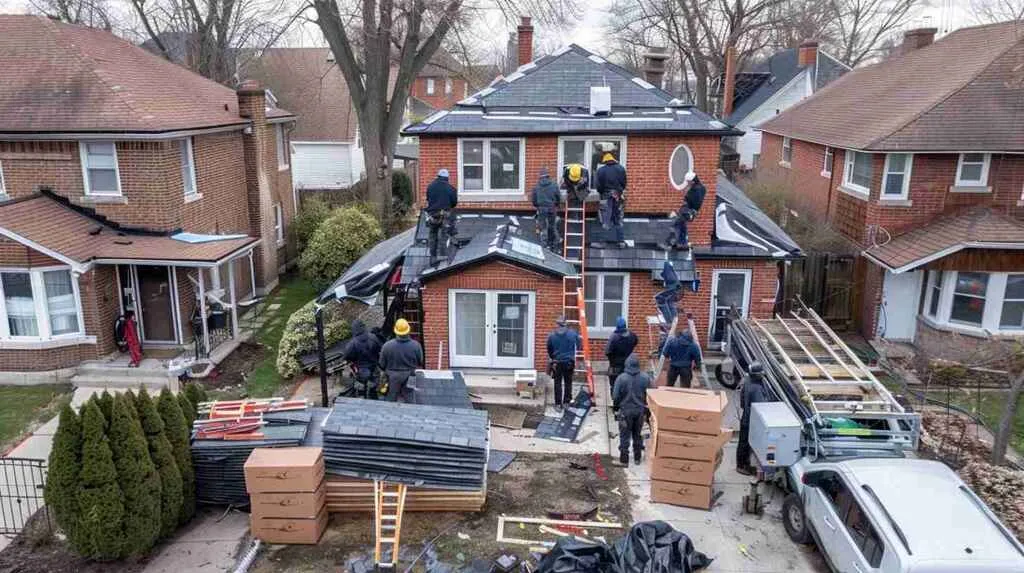
Pyramid Roof Shingle Cap Queens NY – Four-Sided Peak Done Right
Precision matters most where four sides meet at a point. I’ll tell you something nobody wants to hear: most pyramid roof leaks in Queens don’t start on those big, visible shingle fields you see from the street-they start at the tiny shingle cap, right at the peak where all four slopes come together in a one-foot square. After 19 years of roofing here, I’ve pulled off more failed pyramid caps than I can count, and they all fail for the same reason: somebody treated a four-sided peak like a simple ridge, slapped on some cap shingles without thinking about geometry, and called it a day. The thing is, that little intersection at the top is where wind, rain, ice, and snow converge from every direction, and if the overlap pattern, nail placement, and center alignment aren’t perfect-and I mean blueprint-perfect-you’re going to get water inside your house, guaranteed.
Why Pyramid Roof Shingle Caps in Queens Leak First
Here’s what catches most people off guard: the shingle field on your pyramid roof can look pristine from the yard, but if the cap at the very tip is crooked, twisted, or installed with the wrong overlap direction, water will find its way in every single storm. I compare a bad cap to a misaligned intersection in a drawing-if the angles don’t meet cleanly, the whole thing falls apart. In Queens, we get punishing nor’easters that drive rain sideways, freeze-thaw cycles that wedge ice under any lifted edge, and summer downpours that test every seam. All of that weather stress hits the pyramid peak first and hardest, because it’s the highest point and the most exposed. When I’m sketching a roof for a homeowner on a scrap of cardboard, I always draw the square footprint, then the diagonals, and circle that tiny center spot where the four lines converge-that’s your leak vulnerability, right there.
One August afternoon in Richmond Hill, it was 95 degrees and the sun was bouncing off a brand-new pyramid roof like a mirror. The homeowner kept saying, “But it looks fine from the street,” and I had to show him that the cap shingles were overlapped backwards, so water was driving under them every time a storm came in from the southeast. I ended up tearing off just the cap row and rebuilding it, and we timed the last nail right as a thunderstorm rolled in-standing under that tiny peak, watching the first raindrops run properly off the new cap, felt like winning a chess game in the last move. That job taught me to never skip the orientation check: which side of the roof usually catches the weather? Because if your cap overlaps are pushing water toward the storm direction instead of away from it, you’ve built a funnel, not a cap. And honestly, a pyramid cap that’s even a hair off-center bothers me like a crooked picture frame-if I can’t visualize the four angles meeting in perfect symmetry, like the clean joint you’d see in an architectural drawing, I won’t consider the job finished.
| Myth | Fact |
|---|---|
| If the main roof looks good from the street, the peak is fine. | On pyramid roofs in Queens, 70-80% of leaks I’m called for trace back to the tiny cap intersection, not the big shingle fields. |
| Any standard ridge cap method works on a four-sided pyramid. | Pyramid peaks need a specific four-way layout and nail pattern; standard two-sided ridge methods leave a vulnerable spiral at the apex. |
| Wind hits all four sides of a pyramid roof the same way. | In Queens, prevailing storm winds often punish one or two sides of the peak harder, so cap overlaps and nail placement must be biased to shed water away from that direction. |
| More sealant at the peak equals better protection. | Sealant is backup, not structure-if the shingle geometry is wrong, caulk just hides a leak waiting to happen. |
How I Build a Four-Sided Pyramid Shingle Cap That Actually Works
On the corner of 108th Street and 37th Avenue, I once climbed a ladder to inspect a pyramid roof leak during a brutal winter freeze. One winter morning in Bayside, I got a panicked call at 6:30 a.m. from a lady whose bedroom ceiling had a fresh brown ring after an overnight freeze-thaw. She had a small pyramid roof over a third-floor bump-out, and somebody had tried to “cap” it with three shingles meeting at the top instead of four, leaving a little open spiral right at the tip. I stood up there in biting wind, chipping away ice with a putty knife so I could install a proper pre-bent metal apex under a new shingle cap, and I remember my fingers going numb right when I finally felt the sealant bead squeeze out evenly in all four directions. That metal piece is the hidden backbone of a good pyramid cap-it bridges all four slopes underneath the visible shingles, sealing the center joint where no amount of overlapping alone will keep wind-driven rain out. In Queens, where we get hard freezes, ice dams, and nor’easters blowing off the Atlantic and Flushing Bay, that metal apex isn’t optional-it’s the difference between a cap that lasts 15 years and one that fails in three.
When I step into a homeowner’s yard, my first question is never “What color shingles do you want?”-it’s “Which way does the storm usually hit this house?” I always sketch a top-down square and diagonal lines on cardboard to show where each cap piece lands, walking them through the simple geometry so they can see why each intersection must be centered like a clean joint in a drawing. In neighborhoods like Bayside, where you’ve got open exposure to Flushing Bay winds, or Woodhaven, where tall trees and row houses create swirling gusts, the storm direction changes from block to block. I’ll walk around the property, ask about tree shade, note which side usually sees the worst of it, and plan the cap layout to push water off the roof in the direction it wants to go anyway. It’s not complicated-it’s just intentional.
Here’s my personal rule of thumb, and I don’t budge on this: if I can’t draw the four-way apex clearly on paper before I start nailing, I won’t build it. That means planning the cap sequence from the ground, deciding which side to start on based on wind, and making sure every piece is trimmed for equal reveal and aligned to an imaginary centerline. I check the peak from multiple yard angles like I’m staging a photograph, because if the geometry looks sloppy from below, it’s probably sloppy up top, too. The cap layout should be as precise as framing a corner in a blueprint, and that starts with knowing the angles before the first shingle goes down.
Exact Process: Building a Queens-Ready Pyramid Roof Shingle Cap
- Assess wind and storm direction – I walk around the house asking which side usually takes the storm, noting trees, open exposures, and Flushing Bay or Atlantic-facing sides.
- Sketch the geometry on cardboard – I draw a square (roof footprint), diagonals to the peak, and mark where each cap shingle will intersect, showing the homeowner the sequence like a simple roof blueprint.
- Install underlayment and pre-bent metal apex – I tuck a custom-bent metal piece under the top course to bridge all four sides, sealing it with a controlled bead, not a glob, to create a clean central joint.
- Set the first cap course from the dominant wind side – I start the cap on the side that usually catches storms, so overlaps push water away from incoming rain, not into the seams.
- Stagger, trim, and center each cap piece – Every cap shingle is trimmed for equal reveal and aligned to an imaginary centerline; I check all four sides from the yard to keep the geometry perfectly symmetrical.
- Nail and seal with precise pattern – Nails are kept off the exposed edges, with heads covered by the next shingle, and only a thin, even sealant bead is used where all four corners meet at the apex.
⚠️ What Goes Wrong When Contractors Improvise Pyramid Caps
- Using only three cap shingles at the peak, leaving a twisted spiral gap that pulls in wind-driven rain.
- Overdriving nails right near the apex, cracking shingles and giving water a straight path down the nail shaft.
- Copy-pasting a straight ridge cap pattern onto a pyramid, so overlaps face uphill toward the storm side instead of shedding water off the roof.
Pyramid Roof Shingle Cap Options and Costs in Queens, NY
$450 can be the difference between a cosmetic patch and a properly rebuilt pyramid shingle cap in Queens. Pricing depends on how accessible the peak is, how steep the roof pitches, and whether I find hidden rot or damaged sheathing once the old cap comes off. A minor tune-up where the cap is mostly intact and we’re just resealing and replacing a few shingles might run $250-$450. A full cap rebuild-tearing off the old cap to bare deck, installing fresh underlayment and a metal apex, and laying a new four-sided shingle cap with storm-optimized overlaps-typically falls in the $550-$900 range. If we discover rotted plywood at the peak or need to add flashing touch-ups, you’re looking at $850-$1,400 for cap rebuild plus localized repair. And if you’re doing a whole roof replacement and we’re integrating a new pyramid cap with upgraded underlayment and venting adjustments, that usually adds an incremental $250-$500 to the overall project. My blunt view: the cheapest cap is always the one you only have to build once, because a rushed job will cost you double when you call me back in three years to fix the leak.
| Scenario | What’s Included | Estimated Range (Queens, NY) |
|---|---|---|
| Minor cap tune-up (no rot, cap mostly intact) | Inspection, resealing four-way apex, replacing 2-4 cap shingles, correcting nail placement where accessible. | $250 – $450 |
| Full pyramid cap rebuild on existing roof | Tear-off of old cap to clean deck, install underlayment and metal apex, new four-sided shingle cap, storm-side overlap optimization. | $550 – $900 |
| Cap rebuild plus localized sheathing repair | Everything in cap rebuild plus replacing small rotted plywood area at the peak, new fasteners, and flashing touch-ups. | $850 – $1,400 |
| New pyramid cap as part of full roof replacement | Integrated design with new shingles, upgraded underlayment, metal apex, and venting adjustments if needed. | Incremental $250 – $500 |
DIY Check vs. When to Call for a Pro Cap Rebuild
I’ll be honest with you: most pyramid roof shingle caps I see in Queens are rushed, and it shows. You don’t need to climb up on the roof to spot trouble-just step back into your yard or look out an upstairs window and check if the peak looks centered and clean from all four sides. Look for crooked alignment where the cap shingles meet at the very tip, any shiny nail heads poking out near the apex, or shingles that seem crammed together like a bad knot instead of lying flat in even courses. If you see brown ceiling rings indoors, especially right under the pyramid roof, or notice the cap looks lopsided when you compare one side to another, those are red flags. A quick ground-level visual check can tell you a lot, and honestly, if something looks off from the yard, it’s probably worse up close.
Think of your pyramid roof shingle cap like the knot of a tie-if the knot is sloppy, it doesn’t matter how nice the rest of the fabric looks. If you spot spiral gaps at the very tip, exposed nail heads, or a vent that’s been stabbed through the center of the peak like a straw in a paper hat, it’s time to call. And here’s my geometric view again: if the cap doesn’t look like a clean, centered intersection from all four sides-like the point where two walls meet perfectly in a well-drafted floor plan-odds are the water path is just as sloppy, and you’re going to have leaks sooner or later.
✅ Quick Ground-Level Checklist for Your Queens Pyramid Roof Shingle Cap
-
✅
Look up at the very tip: do you see any visible gap, twist, or uneven meeting point where the four sides should touch? -
✅
Scan for shiny nail heads or nail pops near the peak-any exposed metal is a potential leak path. -
✅
Check if one side of the cap looks longer, shorter, or crooked compared to the others, like a lopsided pyramid. -
✅
Look inside for fresh brown rings on ceilings or wall corners directly under the pyramid roof. -
✅
Note which side of the house usually takes the brunt of storms or wind; this helps diagnose cap overlap direction issues. -
✅
Take a couple of clear photos from different yard angles so Vince can see the cap geometry before he arrives.
Should You Schedule an Urgent Pyramid Cap Repair in Queens?
Start: Do you see active dripping, ceiling stains growing, or wet drywall directly under the pyramid roof?
If YES → Call Shingle Masters immediately for an urgent cap inspection and temporary weatherproofing.
If NO → Next question: From the ground, does the cap look crooked, twisted, or have visible nail heads or gaps?
If YES → Schedule a non-emergency cap assessment within the next 1-2 weeks to prevent future leaks.
If NO → Next question: Was your roof installed or capped by a different contractor within the last 3-5 years?
If YES → Consider a preventive cap check-newer isn’t always better if the geometry was rushed.
If NO → Monitor during the next heavy Queens storm; if you see new stains or drips, book a cap evaluation.
Call Now (Urgent)
- Fresh, expanding ceiling stain after a recent Queens storm.
- Water actively dripping or bubbling paint directly under the pyramid roof.
- Visible spiral gap or missing shingles at the very tip of the cap.
Schedule Soon (Can Wait a Bit)
- Cap looks slightly crooked but no indoor signs of moisture yet.
- Older roof (10+ years) with dried, curling cap shingles.
- A vent or pipe exiting very close to the peak, but no current leaking.
Why Cap Geometry, Not Just Shingle Brand, Protects Your Queens Home
Here’s the blunt truth: if your roofer can’t sketch your pyramid roof cap layout on a napkin, they probably shouldn’t be building it on your house. I’ll never forget a Saturday in Woodhaven where we were redoing a pyramid roof shingle cap over a gazebo for an older couple who held tango parties in their yard. The original contractor had just mashed a vent through the peak, cutting right through the central intersection of the cap like a straw in a paper hat. Halfway through replacing it with an offset vent and a clean four-sided cap, the husband put on music and they started dancing in the grass while we worked above them, and I kept checking my layout from every angle like I was aligning a stage light for their little dance floor. That job taught me that small geometric decisions-where you place a vent, how you orient the cap overlap, whether the four-way intersection is centered or crooked-affect both function and aesthetics. The couple wanted their gazebo to look sharp for their dances, and I wanted their ceiling to stay dry through every Queens winter, so we rebuilt that peak three times until the symmetry was perfect and the water shed cleanly in all four directions.
I compare a good pyramid cap to a perfectly tied knot or a clean intersection in an architectural drawing-it’s not about the brand of rope or the color of the ink, it’s about whether the pieces meet at the right angles and stay locked together under stress. Shingle brand matters, sure, but it matters a lot less than how those pieces intersect at the peak. My personal opinion: you can put the most expensive designer shingles on a pyramid roof, but if the cap geometry is sloppy, you’re just wrapping a leaky joint in fancy paper. And here’s a practical insider tip I give every homeowner: always ask a roofer to explain which side they’ll start the cap on and why. Listen for them to mention wind direction, storm exposure, or water path-if they just shrug and say “doesn’t matter,” walk away, because it absolutely does matter. A roofer who understands geometry will talk about angles, overlaps, and the invisible lines that carry water off your roof; a roofer who’s guessing will just nail stuff down and hope for the best.
Why Queens Homeowners Trust Shingle Masters for Pyramid Caps
-
✓
19+ years hands-on roofing experience, specializing in complex peaks and pyramid caps. -
✓
Fully licensed and insured in New York City, with permits handled for you when needed. -
✓
Local Queens focus-familiar with Jackson Heights walk-ups, Bayside bump-outs, Woodhaven gazebos, and everything in between. -
✓
Straightforward, photo-documented inspections: you see the cap geometry problems before and after the repair.
I still remember the first time I realized the wind direction over Flushing Bay was beating up one specific side of a pyramid peak more than the others-it changed how I plan every cap job in Queens. Your pyramid roof is only as good as its shingle cap knot, and if that knot is twisted, crooked, or nailed down without thinking about where the water wants to go, you’re going to have problems no matter how nice the rest of the roof looks. Call Shingle Masters and I’ll walk you through your own peak geometry on-site, sketching it out on cardboard if I have to, so you can see exactly what’s working, what’s failing, and how we’ll rebuild it the right way. Let’s schedule a cap inspection or rebuild and get that four-sided peak locked down tight-because in Queens, the storm doesn’t care if your roof looks good from the street; it only cares if the cap sheds water or lets it in.