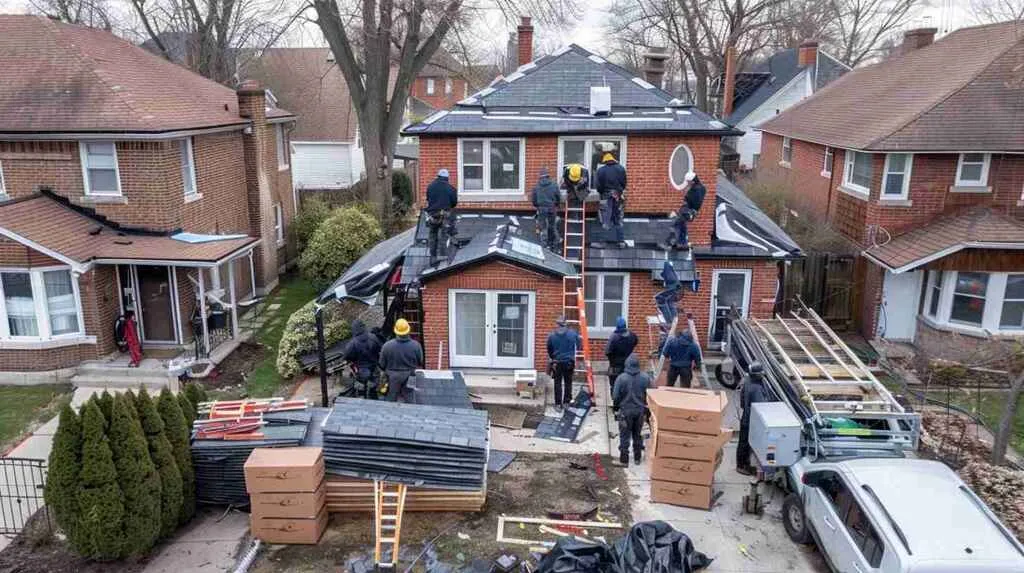
Minimum Slope for Shingle Roof Queens NY – Code Requirement | Free Quotes
Gravity doesn’t negotiate, and neither does New York code when it says you can install asphalt shingles down to a 2:12 pitch with special double-layer underlayment-but here in Queens, where wind-driven rain turns every October nor’easter into a horizontal pressure test, that legal minimum still lets water behave like it’s got all day to find a seam. I’m Victor Delgado at Shingle Masters, the guy inspectors call “the code hawk,” and I spend half my time translating those IRC pitch numbers into something useful: whether your own roof will actually leak in the next big storm.
What Queens Code Really Says About Minimum Slope for Shingle Roofs
On my level, anything under 4:12 gets my attention fast, but the code lines start at 2:12 for a reason. The New York City Building Code (which adopts most of the International Residential Code for one- and two-family homes) allows asphalt shingles on slopes as low as 2-in-12-that’s 2 inches of vertical rise for every 12 inches of horizontal run-as long as you install two layers of underlayment. Standard pitch for shingles is 4:12 and up, where felt paper alone is enough. But here’s my opinion after 19 years watching Queens roofs: just because code says “you can” doesn’t mean physics agrees once wind starts pushing rain sideways across your deck in Flushing or Jackson Heights. When I frame minimum slope as a fluid dynamics problem, shingles and underlayment are like little canals and dams controlling how water actually moves-or stalls and seeps-on your roof instead of how we wish it behaved.
One February afternoon around 3:30, the sky over Flushing turned that ugly gray that means “you’ve got 40 minutes before it dumps.” I was on a two-family house where the previous contractor had laid shingles on a low slope that barely hit 2:12. The owner kept insisting, “But it hasn’t leaked yet.” I set my digital level on the deck, showed him the exact pitch, and then popped off a few shingles to reveal water stains tracking under the felt. By the time the rain started, he watched water bead right along that underlayment seam-perfect live demonstration of why code minimum slope is not a suggestion.
Rule of thumb for Queens homeowners: treat 4:12 and up as the safe zone for standard shingle installations, 3:12 as borderline territory needing upgraded ice-and-water shield along the eaves and valleys, 2:12 as the special-detail zone requiring two full layers of underlayment and honest conversations about whether membrane roofing is smarter, and anything under 2:12 as “don’t even think about shingles.” On my level, anything under 4:12 gets my attention, and I’ll walk it with a four-foot level before I quote any repair or replacement.
| Roof Pitch (rise:run) | Code Status for Asphalt Shingles | Victor’s Recommendation for Queens Weather | Typical System Used |
|---|---|---|---|
| Under 2:12 | Not allowed for asphalt shingles per NYC/IRC | Use membrane roofing only (TPO, EPDM, or modified bitumen) | Low-slope membrane systems |
| 2:12 to under 4:12 | Allowed with double underlayment or special low-slope underlayment | Borderline-requires two layers of ice & water shield, full photographic documentation, and honest conversation about wind exposure | Shingles over dual-layer peel-and-stick underlayment |
| 4:12 to 6:12 | Standard installation allowed with asphalt felt underlayment | Safe zone for standard shingle installs in Queens-single layer felt plus ice & water at eaves and valleys | Standard asphalt shingles over #30 felt |
| Over 6:12 | Standard installation, no special requirements | Excellent water-shedding pitch; main concern shifts to walkability and wind uplift at ridges | Standard shingles, may add extra fasteners for wind zones |
How Minimum Slope Affects Leaks, Inspections, and Queens Weather
From a pure engineering standpoint, minimum slope for a shingle roof isn’t about looks, it’s about how fast water stops being water and starts being a leak. Think of rain like traffic: a steeper roof is the express lane where every drop accelerates downhill fast, while borderline slopes in Queens-especially on the flat sections of row houses in Ridgewood or two-family homes in Jamaica-are more like Queens Boulevard at rush hour. Everything slows down, water pools in microscopic divots, wind shoves it sideways under shingle tabs, and ice dams in February turn your eaves into little frozen reservoirs. When slope drops below 4:12, you’re essentially asking shingles to do a job they weren’t optimized for, and every storm is a test. I’ve measured dozens of roofs in Flushing, Astoria, and Jackson Heights where the front gable hits 5:12 but the back porch addition barely scrapes 2:12, and guess where the leaks show up first every single time.
I’ll never forget a humid August evening in Jamaica, Queens, when a real estate investor begged me to “just patch the edges” on a nearly flat shingle roof so he could pass a refinance inspection. It was 7 p.m., my crew was exhausted, and I knew the inspector that was coming-guy fails roofs for fun. I walked the roof with a 4-foot level, showed the investor that half the area was under the minimum shingle slope, and explained he’d be paying for the job twice if we played games now. He grumbled, but he let us tear off and convert that section to a low-slope membrane and shingles only where we had proper pitch. He later called back to say the inspector praised the fix and that the bank appraiser took photos of the new work to add value to the comp. That’s the reality: inspectors and insurance adjusters will measure slope if they suspect a problem, and a failed inspection can kill a sale or refinance overnight.
2:12-3:12 Low-Slope Shingle Roof in Queens
- Leak Risk: High-water moves slowly, wind-driven rain infiltrates shingle overlaps, ice dams form easily in winter
- Code Scrutiny: Inspector will verify double underlayment is present; any deviation = red tag
- Insurance: Some carriers exclude coverage or raise premiums on roofs under 3:12 in wind zones
- Maintenance: Requires annual inspections, debris removal after every storm, proactive sealant checks
4:12+ Properly Sloped Shingle Roof in Queens
- Leak Risk: Low-gravity moves water fast, shingles shed rain and snow efficiently, minimal ponding
- Code Scrutiny: Standard install passes with basic felt underlayment and ice & water at eaves; no special documentation
- Insurance: Full coverage with no slope-related exclusions or premium increases
- Maintenance: Routine 3-5 year inspections, standard gutter cleaning, typical 20-25 year shingle life
⚠️ Warning: Installing Shingles Below Minimum Slope to “Pass” an Inspection
Putting asphalt shingles on a sub-2:12 roof or skipping the required double-layer underlayment on a 2:12-4:12 roof might get shingles to stay physically nailed to the deck, but it will usually fail a code inspection the moment an official steps on the roof with a level. Even if it somehow slips through initial approval, the first leak will void your manufacturer’s warranty, give your insurance company grounds to deny a claim, and create liability if you try to sell the house. I’ve been called to “fix” three of these situations in the last two years alone, and every single one ended in a full tear-off because there’s no compliant patch for a fundamentally non-compliant installation.
Is Your Queens Roof Too Flat for Shingles? Quick Self-Check
When a homeowner in Queens asks me, “Can I put shingles on this low slope?” my first counter-question is, “Do you want the cheapest roof today or the cheapest roof over 10 years?” Because here’s the thing: you can get a rough sense of your roof pitch at home with a 12-inch level and a tape measure. Set the level horizontal on the roof surface, measure straight up from the 12-inch mark to where it touches the roof deck, and that vertical measurement in inches is your rise-so if you measure 3 inches, you’ve got a 3:12 pitch. But and this is a big “but”-if your measurement comes out anywhere between 2 and 4 inches, don’t trust your own reading to make a $7,000 decision. Call before re-roofing a low-slope area, because borderline slopes can often be saved with the right underlayment strategy instead of a full system change to membrane, and a pro with a digital level will catch sags, dips, and localized low spots your eyeball and hardware-store level will miss.
One windy Saturday morning in Astoria, a DIY-savvy homeowner had me out “just to confirm” that his 3:12 porch roof was okay for shingles because he’d already bought all the materials from a big-box store. It was about 10 a.m., gusts pushing 25 mph, and he proudly showed me his shingle bundles while the fascia rattled. I measured the slope, then took out a code book from my truck and went line by line on what extra underlayment was needed for that marginal pitch. When I showed him how wind-driven rain moves on a barely-legal slope-water doesn’t just fall down, it gets pushed up and under tabs when the wind hits 30 mph-he admitted he’d completely underestimated the risk and ended up hiring us to do the install instead of trying it himself. Simple memory aid: if your roof is flat enough that you can comfortably stand and walk around without feeling tippy, it’s probably under 4:12 and worth a professional check before you re-roof.
Determine if Your Queens Roof Is a Good Candidate for Shingles
✓ Before You Call Shingle Masters: What to Note About Your Low-Slope Roof
- Measure the approximate slope yourself using a 12-inch level and tape measure (see method above) so we can triage your call faster
- Take photos from ground level showing the roof plane, especially any flat-looking sections, porches, or additions that look different from the main roof
- Note the age of your current roof and whether you’ve had any leaks, ice dam problems, or failed inspections in the past 3 years
- Check for standing water or wet spots on the roof deck 24 hours after a rainstorm-if water is still sitting, your slope is likely below 2:12 in that area
- If you’re under contract to buy or sell, or facing a refinance inspection, mention that timeline up front so we can prioritize your inspection
Typical Fixes and Budget Ranges for Low-Slope Shingle Roofs in Queens
I still remember a roof over by 108th Street where a half-inch of extra pitch would’ve saved the owner thousands-but once you’re looking at re-roofing, $1,500 of patch work on a too-flat shingle roof can turn into a $9,000 tear-off in under five years if the underlying slope problem isn’t solved. Real costs depend on whether we’re adding upgraded ice-and-water underlayment to a borderline 3:12 section that’s still code-legal, converting sub-2:12 areas to membrane and keeping shingles only where slope allows, or doing a full low-slope replacement on a nearly flat row-house roof. Long-term, fixing it right once-so the next inspector, buyer, or storm doesn’t force you to do it again-saves serious money and keeps your insurance valid.
| Scenario | Typical Roof Area (sq ft) | Recommended System | Estimated Price Range (Queens, NY) |
|---|---|---|---|
| Upgrading 3:12 gable section with compliant underlayment | 400-600 sq ft | Tear off old shingles, install dual-layer ice & water shield, re-shingle with architectural grade | $2,800-$4,200 |
| Partial conversion: membrane on sub-2:12 porch, shingles on 4:12+ main roof | 800-1,000 sq ft total (200 sq ft membrane, 600-800 sq ft shingles) | TPO or EPDM membrane on flat section, standard shingle install on properly sloped areas | $5,500-$8,000 |
| Full tear-off and re-roof of borderline 2:12-3:12 two-family roof | 1,200-1,500 sq ft | Complete shingle replacement with code-compliant double underlayment, new flashing, upgraded ventilation | $8,500-$12,500 |
| Inspector-failed low-slope roof requiring full membrane conversion | 600-900 sq ft | Remove all shingles, install tapered insulation if needed to improve drainage, fully adhered TPO or modified bitumen | $6,000-$9,500 |
| Emergency repair: re-underlayment of leaking 2:12 section to buy 2-3 years | 200-400 sq ft | Peel back shingles, add peel-and-stick underlayment, re-nail shingles (temporary measure, not a permanent fix) | $1,200-$2,400 |
Prices assume standard access, no structural repairs, and typical Queens two-family or row-house footprint. Costs may increase for difficult access, multiple stories, or if decking replacement is needed.
Common Myths About Minimum Shingle Slope in Queens
Here’s the blunt part: just because a shingle will physically stay nailed to a 2:12 roof doesn’t mean it should ever have been installed there. I hear the same misconceptions every week from homeowners who got bad advice from a neighbor’s cousin or a lowball contractor chasing a quick check. “It hasn’t leaked yet, so it must be fine.” “The last guy said code allows it, so we’re good.” “I saw shingles on flat roofs all over Queens, so mine’s probably okay.” And my personal favorite: “If the nails are holding, the roof is holding.” Not quite. These myths survive because shingles can stay attached to a low-slope deck for years without an obvious catastrophic failure-water damage creeps in slowly, mold grows silently in the attic, and by the time you see a stain on the ceiling, you’re looking at rotten decking and a four-figure repair.
Let me translate those myths into simple physics: water on a roof behaves like water in a canal. When slope is steep, gravity accelerates every drop downhill fast-think of a mountain stream rushing over rocks. When slope flattens out to 2:12 or 3:12, water slows to a crawl, and any tiny obstruction-a shingle edge, a nail head, a bit of granule buildup-acts like a little dam, creating a microscopic pond. Add wind, and suddenly that pond gets pushed uphill under the shingle tabs instead of flowing over them. That’s why code-minimum slopes leak during storms but stay dry during calm drizzle, and it’s why I compare Queens roof inspections to traffic engineering: you design for the worst-case scenario-the nor’easter with 40 mph gusts-not the best-case Sunday sprinkle.
| Myth | Fact for Queens, NY Roofs |
|---|---|
| “My roof is almost flat and hasn’t leaked in 10 years, so the slope must be fine.” | Shingles on sub-minimum slope can stay watertight in calm weather but fail during wind-driven rain or ice dams. That 10-year streak often ends suddenly during one bad nor’easter, and by then the decking underneath may already be compromised. |
| “Code says 2:12 is legal, so my 2:12 roof with regular felt underlayment is up to code.” | Code allows 2:12 only with special double-layer underlayment (typically two layers of ice & water shield). If your roofer used standard asphalt felt on a 2:12 slope, that install is not code-compliant and will fail inspection. |
| “I see shingles on flat roofs all over Queens, so mine must be okay too.” | Many older Queens roofs were installed before stricter code enforcement or by contractors cutting corners. Just because a non-compliant roof exists doesn’t mean it’s legal, insurable, or sale-able-inspectors will red-tag it the moment someone tries to refinance or transfer the property. |
| “Adding more nails or better shingles will make a too-flat roof work fine.” | Premium shingles and extra fasteners help with wind uplift on steep roofs, but they do nothing to solve the fundamental fluid dynamics problem on low slopes-water still slows down, ponds, and seeps under tabs regardless of shingle quality or nail count. |
Frequently Asked Questions: Minimum Shingle Slope in Queens
Q: What is the exact minimum code-legal slope for asphalt shingles in Queens, NY?
A: New York City adopts the International Residential Code, which sets the minimum at 2:12 (2 inches of vertical rise per 12 inches of horizontal run) if and only if you install two layers of underlayment or approved low-slope underlayment. Standard shingle installs require 4:12 minimum with single-layer felt. I’ve measured hundreds of Queens roofs, and anything under 4:12 gets flagged for special attention during my inspections.
Q: Can I use shingles on a 2:12 roof if I cover the whole thing with ice and water shield?
A: Technically yes-code allows it-but in my 19 years of Queens roofing I’ve seen that setup leak during heavy wind-driven rain because ice & water shield seams can still let water migrate horizontally when there’s no gravity assist. If you’re already budgeting for full ice & water coverage, you’re better off spending roughly the same money on a proper low-slope membrane (TPO or EPDM) that’s actually designed for near-flat applications and comes with a real watertight warranty.
Q: My Queens two-family has a 5:12 main roof and a nearly flat 1:12 back porch-can I mix shingles and membrane on the same house?
A: Absolutely, and that’s exactly what I recommend. Install standard shingles on the properly sloped main roof (5:12 is great for shingles) and a low-slope membrane-TPO, EPDM, or modified bitumen-on the sub-2:12 porch. The transition between the two systems gets flashed with a custom metal termination bar and sealant. I’ve done dozens of these hybrid roofs in Jackson Heights and Elmhurst, and they pass inspection every time because each material is used where it’s code-appropriate.
Q: Will my shingle warranty or homeowner’s insurance cover a roof that’s below minimum slope?
A: Most asphalt shingle manufacturers void the warranty if shingles are installed below 2:12 or below 4:12 without the specified underlayment upgrades-read your warranty certificate carefully. On the insurance side, I’ve seen Queens carriers exclude wind and water damage claims on roofs under 3:12 or require engineering letters proving code compliance before they’ll cover a low-slope shingle roof at all. If you’re buying a house with a borderline-slope roof, get it inspected before you close so you know what you’re inheriting.
Q: How fast can Shingle Masters inspect a low-slope roof anywhere in Queens?
A: We offer same-week inspections throughout Queens-Flushing, Jamaica, Astoria, Jackson Heights, Ridgewood, Forest Hills, you name it. I personally walk every borderline-slope roof with a digital level, take photos showing the pitch measurements, and provide a written assessment of code compliance within 24 hours. If you’re under contract or facing an inspection deadline, call us in the morning and we’ll usually have someone on your roof that afternoon or the next day. No guesswork, no surprises-just the real numbers and what they mean for your wallet.
Why Queens Homeowners Call Shingle Masters for Borderline-Slope Roofs
Licensed & Insured in NYC
Full NYC Department of Buildings licensing and $2M liability coverage on every job
19+ Years in Queens
Victor has personally measured and spec’d low-slope roofs in every Queens neighborhood since 2006
Same-Week Inspections
Call before noon, roof inspection scheduled within 3 business days anywhere in Queens
Red-Tag Rescue Experience
We’ve fixed inspector-failed roofs and provided code documentation that saved refinances and sales
Photo & Level Documentation
Every quote includes digital level readings and annotated photos showing exact pitch measurements
Borderline slopes are where most Queens leaks start, and after 19 years of walking these roofs with a level in one hand and a code book in the other, I can tell you that guessing costs homeowners thousands in avoidable repairs every single year. My team at Shingle Masters can measure, photograph, and quote fixes for minimum-slope issues anywhere in Queens-Flushing, Jamaica, Astoria, Jackson Heights, Ridgewood, Forest Hills, Bayside, you name it. Call us today or request a free on-roof slope and code-compliance assessment, and we’ll give you the real numbers and the real options, no upselling and no surprises.