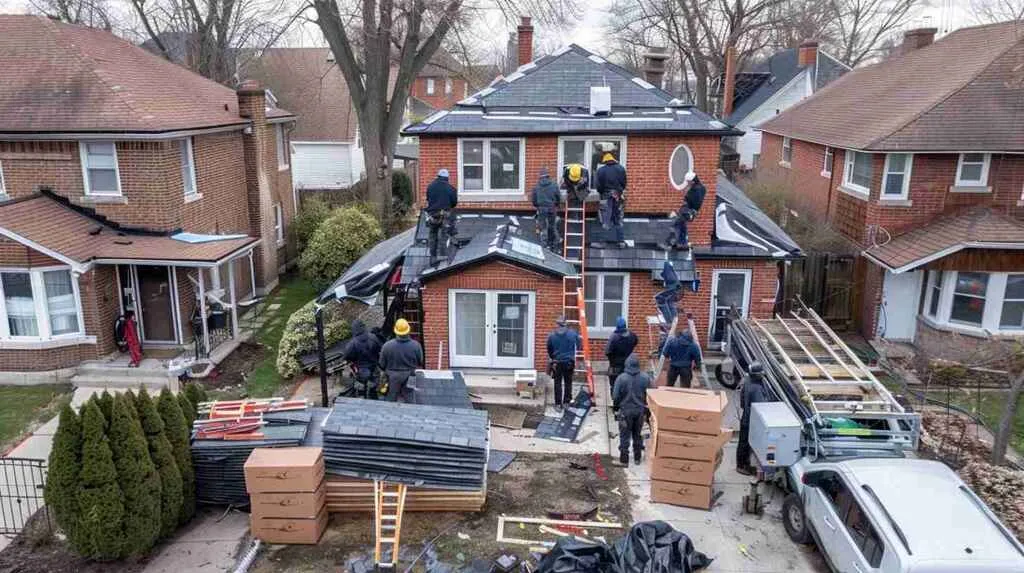
How Long Do Shingle Roofs Last Queens NY – What to Expect | Free Estimates
Honestly, in Queens, those “30-year shingles” most contractors sell you? They usually live more like 15-22 years-and the reason your neighbor’s roof died at 12 while someone else’s on the block made it past 25 comes down to sun exposure, ventilation, and who nailed them down.
How Long Shingle Roofs Really Last in Queens (Not the Label Number)
On a typical block in Queens, I’d bet half the shingle roofs are already showing their age by year 13 or 14, even though the packaging bragged about three decades. I’ve been looking at roofs like they’re health charts for 19 years now, checking symptoms and prognosis, and I can tell you: those advertised lifespan numbers are built for perfect lab conditions-not for our salt air, traffic soot, freeze-thaw cycles, and brutal summer UV. One August afternoon around 3 p.m., it was so hot in Elmhurst that my tape measure felt like a frying pan, and I was inspecting a 13-year-old shingle roof for a retired school principal who swore her roof was “good for at least 30 years” because that’s what the previous contractor told her. I showed her a single south-facing slope where the shingles were curling like potato chips and cracking at the edges from UV abuse, and I remember her going quiet when I said, “This is what an early 20s roof looks like, not a teenager.” That job taught me how misleading “30-year shingle” labels can be in real Queens conditions.
The big-picture factors specific to Queens hit shingles from all directions: you’ve got salt air blowing in from the coast, diesel soot from truck routes, intense summer sun cooking south- and west-facing slopes, and then winter freeze-thaw cycles that crack the weak ones. Basic 3-tab shingles typically give you 12-18 years here before they’re curling hard; architectural (dimensional) shingles usually make it 18-25, sometimes beyond if everything goes right. The rest of this article will walk you through exactly where your own roof sits on that health chart and what you can do before it ends up in the “roof ER.”
| Shingle Type | Advertised Lifespan | Typical Queens Lifespan | Best-Case Queens Lifespan | Key Conditions |
|---|---|---|---|---|
| 3-Tab Asphalt Shingles | 20-25 years | 12-18 years | 20 years | Poor ventilation, south/west exposure, cheap underlayment cut life short |
| Architectural (Dimensional) Shingles | 30 years | 18-25 years | 28+ years | Thicker material holds up better; still needs good install and attic airflow |
| Premium/Designer Shingles | 40-50 years | 25-35 years | 40+ years | Heavy-duty materials; rarely worth the cost in Queens rowhouse context |
| “Ideal Conditions” Homes (well-ventilated, north slope, pro install) | – | 22-28 years | 30+ years | Proper attic venting, quality underlayment, good installation, shaded or north-facing |
| Myth | Fact |
|---|---|
| “30-year shingles will last 30 years in Queens.” | In real Queens conditions-salt air, UV, freeze-thaw-most 30-year shingles last 18-22 years; the warranty is prorated and rarely covers labor. |
| “All roofs on the block age at the same rate.” | South- and west-facing slopes cook faster; poor attic ventilation can age one roof twice as fast as its neighbor’s, even with identical shingles. |
| “Once my roof hits 15 years, I need to replace it immediately.” | Not necessarily-many 15-year roofs in Queens have 5-7 good years left if they were installed right and maintained; an inspection tells the real story. |
| “New shingles = long life, no matter what.” | Bad installation (wrong nailing, skipped underlayment, no drip edge) can cut lifespan by a third, even with top-tier shingles; the install matters as much as the material. |
The 5 Big Factors That Make Your Roof Age Faster (or Slower) Here
Before we talk numbers, I always ask one question: “How’s your attic ventilation?” One winter morning just after a freezing rain, I got a call in Flushing from a landlord panicking about leaks over three top-floor apartments. The roof was only 11 years old, but I found they’d cheaped out on underlayment and ventilation, so the shingles were cooked from underneath and brittle from ice on top. I was sliding around up there at 8 a.m., chipping little ice dams to even see the nail patterns, and I realized the roof had “aged” about 18-20 years in just over a decade. Since then, whenever someone asks “how long do shingle roofs last,” I automatically ask about ventilation before I even look at the shingles. Neighborhoods like Flushing, Elmhurst, and Astoria get hammered with wind, traffic soot, and ice, and poor ventilation plus cheap underlayment cook shingles from below while stress piles on from above.
Now let’s move down a level and talk about the five major lifespan drivers on every Queens roof I inspect. First is ventilation and attic heat-trapped heat in summer bakes shingles from the underside, while in winter it melts snow into ice dams that crack them. Second is sun exposure and orientation: south- and west-facing slopes get blasted with UV all afternoon and age visibly faster, sometimes by years. Third is installation quality and nailing patterns-if the nails are too high, crooked, or overdriven, shingles blow off or crack early no matter how good the product is. Fourth is roof design: flat or low-slope sections hold water and stress shingles, while steeper pitches shed weather better. Fifth is maintenance and small leak repairs-catching a bad flashing detail at year 8 can add 5+ years to your roof’s life, while ignoring it turns a $300 fix into a $12,000 replacement. Think of these as risk factors on your roof’s health chart.
Here’s the thing: some Queens roofs are overworked from day one because landlords or flippers cut costs on ventilation, underlayment, and flashing details. Small investments-adding soffit vents, upgrading to synthetic underlayment, sealing around chimneys properly-can add 3-5 real years of life to many roofs, and that’s not hype, that’s what I’ve watched happen over nearly two decades on blocks from Corona to Bayside.
Top 5 Roof Lifespan “Risk Factors” in Queens
⚠️ Warning: Under-Ventilated Attics & Cheap Underlayment
Inadequate attic ventilation and bargain-bin underlayment are hidden problems that can age a 12-year roof like it’s 18-20 years old, especially in Queens winters and humid summers. Trapped attic heat bakes shingles from below in July and August, while poor ventilation in winter causes ice dams that crack and lift shingles along eaves and valleys. If your roof is aging faster than expected, check the attic first-it’s often the real culprit, not the shingles themselves.
How I Read Your Roof’s “Health Chart” in Under Two Minutes
Here’s how I read a roof’s “health chart” in under two minutes: I start at the ridge and work my way down to the gutters, checking symptoms in a specific order. One evening right before sunset in Jackson Heights, I was called to give a quote on a “failed” 9-year-old roof that supposedly needed full replacement, and the owner was furious at the original roofer. When I got up there, I saw the shingles themselves were in decent shape, but three small areas around a bathroom vent and a satellite dish were installed wrong and funneled water under the shingles. The golden hour light made every ripple and soft spot show up clearly, like an X-ray. We fixed the flashing, swapped out about 40 shingles, and that roof is still going strong seven years later. That job reminded me how often people are told a roof is “done” when really it’s a few bad details shaving years off its life, and catching those details early often means a repair, not a replacement.
If you were standing up here next to me, I’d point at the ridge caps first to see if they’re cracking or missing granules, then slide down and look at field shingles for curling, bald spots, or soft decking underneath. I check every flashing detail-chimneys, vents, skylights, satellite mounts-because that’s where 80% of “mystery leaks” come from. Then I pop my head in the attic to look for moisture stains, daylight through the decking, or that musty smell that says water’s been getting in for a while. These are like vital signs on a patient chart, and spotting early-stage problems-a loose pipe boot, a few cracked shingles, a missing drip edge-usually means you’re looking at a repair, not writing a check for a full tear-off.
Carlos’s 2-Minute Roof “Health Check” From Ridge to Gutters
Do You Need Repair, Tune-Up, or Full Replacement?
→ YES: Monitor + Maintenance (inspect yearly, clear gutters, watch for leaks)
→ NO: Any active leaks or soft spots around vents/chimneys?
→ YES: Targeted Repair (fix flashing, replace damaged sections)
→ NO: Monitor + Maintenance (you’ve got 3-5+ years left)
→ YES: Plan for Replacement in 1-3 Years (start budgeting, monitor closely for leaks)
→ NO: Are there multiple leaks or soft decking in several areas?
→ YES: Plan for Replacement in 1-3 Years (poor install or ventilation issue aging roof early)
→ NO: Targeted Repair + Ventilation Check (fix what’s broken, extend the life you have left)
Queens Roof Lifespan Benchmarks and Maintenance Timing
At 10 years old, a Queens shingle roof should still look like it’s in its prime-tight, flat shingles with good granule coverage and no widespread curling. If yours already has bald spots and edges lifting like potato chips at that age, something went wrong with the install or ventilation.
On a typical block in Queens, I see three common lifespan paths. First are the well-installed, well-ventilated roofs that cruise into their early 20s looking decent, maybe needing a flashing tune-up around year 18 but otherwise handling our weather fine-these are the ones that got proper attic airflow, quality underlayment, and a crew that nailed every shingle correctly. Second are average roofs that start showing real stress in the 15-18 year range: curling on south slopes, granule loss, maybe a small leak that needs targeted repair-they’ll make it to 20-22 if you fix the problems, but they’re entering what I’d call the “stress test” years where you need to watch closely. Third are the problem roofs that start leaking around 10-12 years because someone skipped ventilation, used cheap materials, or rushed the install; these need serious attention or replacement well before their theoretical lifespan, and they’re a reminder that the “30-year” label is only as good as the system underneath. Think of year 5 as a routine checkup, year 10 as your first real physical exam, year 15 as the age where symptoms start showing up if anything’s wrong, and anything past 20 as bonus time you earned through good health habits-ventilation, maintenance, and a little luck with storm damage.
Roof Lifespan & Maintenance Milestones in Queens NY
🚨 Urgent – Call Today
- Active leaks or water stains spreading on ceilings
- Visible sagging or dips in roofline
- Large sections of missing shingles after storm
- Widespread curling with bald spots across multiple slopes
⏰ Can Wait – But Don’t Ignore
- Heavy granules collecting in gutters every season
- Roof over 15 years old with no pro inspection yet
- Small ceiling stains that aren’t growing (yet)
- Curling starting on south-facing slopes only
What a Roof Checkup Costs in Queens & How Shingle Masters Helps
Quick visual estimates for lifespan checks are free-I’ll come out, spend 20 minutes on your roof, tell you honestly where you are on the health chart, and you’re not writing a check for that. More detailed leak diagnostics, where I’m tracking down a mystery stain or checking multiple penetration points, might run a small service-call fee that usually gets credited toward any repair work we end up doing. The point is this: catching a bad pipe boot or failing chimney flashing at year 12 typically costs $300-$800 to fix, while waiting until it rots your decking and soaks your insulation turns into a $10,000-$15,000 roof replacement plus interior repairs-so the “checkup” always pays for itself. Shingle Masters has been working Queens blocks for years, and we’re licensed, insured, and straightforward about what you actually need versus what can wait.
Why Queens Homeowners Call Shingle Masters for Roof Lifespan Checks
19+ Years Hands-On Shingle Experience in Queens
Licensed & Fully Insured in NYC
Free Local Estimates in All Queens Neighborhoods
Specialized in Asphalt Shingles & Roof Ventilation Fixes
Common Questions About Shingle Roof Lifespan in Queens NY
Can I squeeze a few more years out of an older roof safely?
Sometimes, yes-but it depends on the roof’s actual condition, not just its age. If your 18-year-old roof still has flat shingles, no widespread curling, and only minor wear on south-facing slopes, targeted repairs (fixing flashings, replacing a few dozen damaged shingles, improving ventilation) can often buy you 3-5 more solid years. But if you’ve got widespread bald spots, curling across multiple slopes, soft decking, or active leaks, you’re gambling with interior damage that’ll cost way more than a replacement. I always tell people: an honest inspection tells you whether you’re looking at preventive care or playing roof roulette.
Do I really need to replace the whole roof if just one area is leaking?
Not necessarily. A lot of “failed roof” diagnoses are really just bad flashing around chimneys, vents, or skylights-and those can be fixed for a few hundred bucks instead of $12,000. I’ve seen plenty of 10-15 year roofs where one small penetration detail was installed wrong and caused a leak, but the rest of the roof was fine. The key is getting someone up there who’ll actually diagnose the problem instead of defaulting to “you need a new roof” because that’s the bigger sale. If the shingles themselves are still in decent shape and the leak is isolated, a targeted repair often solves it and gives you years more life.
Does Queens weather void the shingle warranty?
Most shingle warranties don’t cover “normal wear and tear” from weather-which basically means they don’t cover the real-world conditions in Queens: UV exposure, freeze-thaw, wind, salt air, etc. The warranty typically covers manufacturing defects (shingles that fail way earlier than they should due to a material problem), but it’s prorated, so by year 10 you’re only getting a fraction of the material cost back, and labor isn’t covered at all. Bottom line: don’t count on the warranty to save you money; count on good installation and maintenance to get your roof to its realistic Queens lifespan of 18-22+ years.
How long does a replacement actually take on a typical Queens home?
For a typical Queens rowhouse or detached single-family home (1,200-1,800 square feet of roof), a full tear-off and shingle replacement usually takes 2-4 days, weather permitting. Day one is tear-off and underlayment; day two is shingle install and flashing details; day three (if needed) is finishing touches, ridge caps, and cleanup. Bigger homes, complex rooflines with lots of valleys and dormers, or weather delays can stretch it to a week, but most straightforward jobs are done in under a week start to finish. We tarp and protect everything overnight, so you’re never left exposed.
Understanding your roof’s real health in Queens comes down to how it’s aging-symptoms, not just its birthday-and a quick on-roof check can tell you whether you’re looking at routine maintenance or an upcoming replacement. Call Shingle Masters today for a free, no-pressure estimate on shingle roof lifespan checks, targeted repairs, or full replacement anywhere in Queens, NY-we’ll give you the honest read you won’t get from a sales pitch.