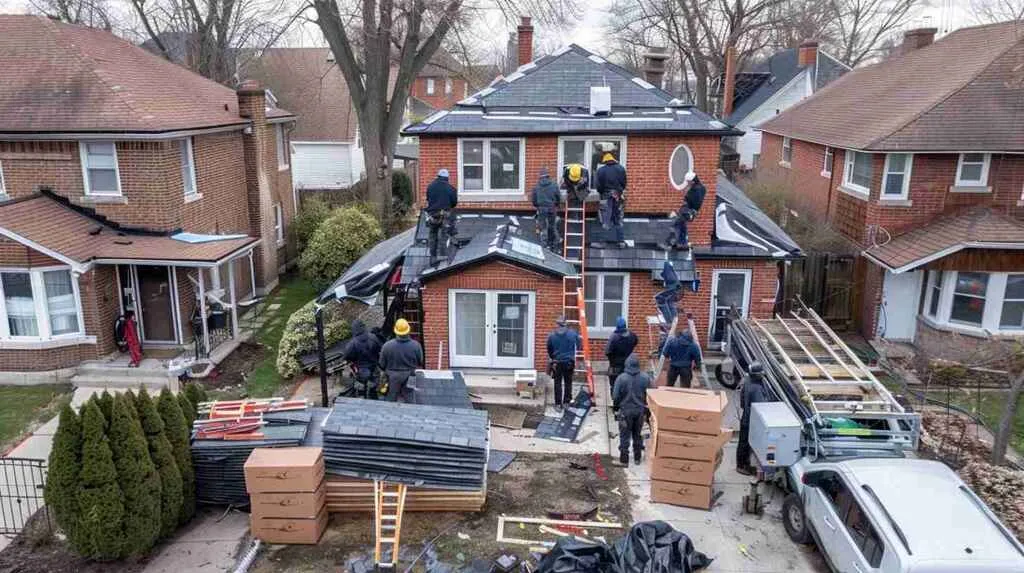
How Big Is a Roof Shingle Square Queens NY – The Number to Know
Perspective: a “roofing square” isn’t a bundle of shingles, a physical box, or even a literal square-it’s a 100-square-foot measurement of roof surface that, if you misunderstand it, can quietly add hundreds of dollars to your Queens project before you notice. My name’s Victor Santos, and I’ve spent 14 years roofing across this borough turning confusing square-footage guesses into precise shingle counts, because I’m annoyingly precise and I actually enjoy the math part of roofing.
What a Roofing Square Really Is (and Why Queens Homeowners Mix It Up)
A roofing square equals 100 square feet of roof surface-not ground area, not floor plan, just the actual skin of your roof. It’s a measurement, not a product you can stack in your driveway or touch with your hands. Think of it like pricing meat at the grocery store: you buy by the pound, not by “however much fits in this bag,” and a roofing square works the same way-it’s just the unit roofers use to convert your roof’s total area into bundles of shingles. Here’s the thing: no matter how steep, flat, or weirdly shaped your Queens roof is, if it covers 100 square feet, that’s one square, and that’s the baseline number for every material calculation, waste factor, and price estimate that follows.
Quick Facts: Roofing Squares for Queens Homeowners
Two numbers matter more than anything when I’m standing on a Queens roof: total square footage and how many shingle squares that really turns into. One August evening in Jackson Heights, around 7 p.m., I was standing on a three-story flat roof with a landlord who swore he ordered “10 squares because that’s 1,000 square feet, right?” The humidity was brutal, I could smell someone’s curry and someone else’s barbecue, and I had to explain that 10 squares only covered 1,000 square feet of roof, but his place was 1,380 after we measured. We ended up short by exactly three bundles because he misunderstood what a “roofing square” meant, and he paid extra for rush delivery-around $340 more than if we’d measured together up front. That night is why I now refuse to start a job until we’ve measured together and converted everything into squares right there on the roof.
Honestly, no job should start until you and your roofer measure together and agree on the number of squares-it’s a little math problem you really want to get right, especially on Queens roofs where row houses share walls, garages jut out at odd angles, and every dormer or bay window adds complexity. I’ve seen too many homeowners sign contracts based on guesswork, and then halfway through the install we’re scrambling for more material because someone assumed “square” meant something square-shaped instead of 100 square feet of roof surface. Big picture: the square is your budget’s baseline, and getting it wrong means either wasted money on extra shingles sitting in your yard or a panicked mid-job trip to the supplier while your roof sits half-stripped under a tarp.
How to Convert Your Queens Roof into Shingle Squares (Step-by-Step Math)
Here’s the unglamorous truth: most of roofing is just careful counting-counting feet, counting squares, counting bundles-long before we swing a hammer. On a cold, windy November morning in Bayside, I had a retired math teacher watching me like a hawk while I checked her Cape Cod roof. She had her notebook out, pencil sharpened, and she kept asking, “So how does that shingle square actually translate to what you’re installing?” We walked through her entire roof, section by section, breaking it down: area, waste factor, bundles per square. By the time I was done, she corrected my arithmetic once-and she was right-but she also admitted she never realized a “square” was 100 square feet of roof surface, not a square-shaped piece of anything. That’s super common in Queens because we’ve got such varied housing: Cape Cods in Bayside with steep pitches, attached brick row houses in Woodside with shared parapets, split-levels in Forest Hills with multiple roof planes, and two-family homes in Astoria with flat garage roofs tacked onto gable mains-each one calculates differently, but the square stays 100 square feet no matter what.
Walk through a simple example: say your Queens roof measures 1,300 square feet total after you account for all the planes, dormers, and overhangs. Divide 1,300 by 100 and you get 13 roofing squares. Standard three-tab or architectural shingles come three bundles per square, so 13 squares × 3 bundles = 39 bundles. But don’t order exactly 39-add 10-15% for waste (cuts, starter strips, ridge caps), so you’re really looking at 43-45 bundles to be safe. Think of it like a MetroCard calculation: you know your fare, you add a little cushion for transfers or mistakes, and you don’t want to run short halfway through your commute. That’s the subway-fare-style calculation I use on every Queens roof, and it’s saved my customers from emergency runs to the big-box store on a Saturday afternoon when they’re two bundles short and the crew’s standing around waiting.
Step-by-Step: Converting Your Roof Size to Shingle Squares & Bundles
| Roof Type (Queens Example) | Approx. Roof Area (sq ft) | Squares Needed (area ÷ 100) | Suggested Waste Factor | Total Squares Ordered | Estimated Bundles (3 per square) |
|---|---|---|---|---|---|
| Small row house (Woodside) | 1,200 | 12 | 10% | 13.2 → round to 14 | 42 bundles |
| Medium detached home (Bayside) | 1,800 | 18 | 12% | 20.2 → round to 21 | 63 bundles |
| Larger two-family (Astoria) | 2,500 | 25 | 15% | 28.8 → round to 29 | 87 bundles |
Why Odd-Shaped Queens Roofs Eat Up Extra Squares
One thing I learned measuring a steep little hip roof in Woodside at 8 a.m. on a frosty January day is that small mistakes in square counts get expensive very fast. There was a messy job in Ozone Park where I got called in after another crew bailed mid-project. It was a hot day, black shingles, 3 p.m. sun beating down, and half the roof was stripped. The owner showed me a crumpled Home Depot receipt and said, “They told me 20 squares would be plenty.” He had a tricky L-shaped roof, dormers, and a low-slope garage attached, and whoever estimated it just guessed off Google Maps. We re-measured carefully, found out he really needed 24 squares to do it right with proper waste, and I could literally show him on the roof sketch where those extra four squares were going to disappear-into valleys, ridges, and cut pieces the first crew never accounted for. Here’s the insider tip: on complex Queens roofs with lots of valleys and cut pieces, expect and budget for higher waste-15-20% is realistic, not paranoid-and ask your roofer to draw a simple roof map showing where those extra squares go, because valleys and dormers aren’t just cosmetic, they’re material-eaters that turn a 20-square guess into a 24-square reality.
Big picture, then details: simple rectangle roofs (classic Cape Cods, some ranches) waste less material because you’re cutting fewer angles and you can run long straight rows. But complex roofs in Queens-older two-family homes with multiple additions, row houses with shared parapets and setbacks, homes with dormer clusters in Forest Hills-those roofs chew up shingles in ways satellite photos never show. It’s like buying extra tiles for a bathroom: if your bathroom’s a perfect rectangle, you waste almost nothing, but if it’s got alcoves, angled walls, and a weird tub surround, you’re cutting and tossing pieces all day. Roofing’s the same, and that’s why precise square counts matter-you’re not just paying for the shingles that end up nailed down, you’re paying for all the little cut pieces that fall into the dumpster, and on a chopped-up Queens roof, those pieces add up to real money.
| Myth | Fact |
|---|---|
| A roofing square is a square-shaped bundle of shingles | A square is 100 sq ft of roof surface-a measurement, not a physical product |
| You can calculate squares just by measuring your house’s footprint | Roof area is always bigger than floor area because of pitch, overhangs, dormers, and multi-plane layouts |
| 10% waste is always enough, no matter the roof shape | Complex Queens roofs with valleys and dormers need 15-20% waste to avoid mid-job shortages |
| All shingles come in the same bundle size per square | Most standard asphalt shingles are 3 bundles per square, but thicker architectural or specialty shingles can be 4 bundles per square |
| Google Maps or satellite tools give you an exact square count | Satellite estimates miss dormers, pitch changes, and porches-always verify with on-roof measurements in Queens |
⚠️ Warning: Online Roof Estimates Can Cost You Big in Queens
Relying on rough online calculators or satellite measurements for your shingle square count is risky on Queens roofs because those tools routinely miss dormers, porch roofs, pitch changes, and shared-wall setbacks that are super common here.
A satellite image can’t see that your Bayside Cape Cod has three dormers adding 200 square feet, or that your Astoria two-family has a low-slope garage tacked onto a steep gable main-so you end up ordering 18 squares when you really need 22, and now you’re paying rush fees and delaying the job by two days while more material arrives.
Always get an on-roof measurement from a local Queens roofer before you sign anything or order materials-it’s the only way to catch those hidden square-eaters and budget accurately.
Quick Reference: Squares, Bundles, and When to Call a Roofer in Queens
Think of your roof like a jigsaw puzzle that’s already the right size; the shingle squares are just the box label telling you how many pieces you need to cover it. This section is your cheat-sheet, the quick lookup that turns all the earlier math into a simple reference you can check twice before signing a contract-because in Queens, small differences in square count (even just two or three squares) can mean a few hundred dollars, and that’s a little budgeting problem worth solving before the first nail gets hammered.
Before You Call Shingle Masters: What to Know About Your Roof Squares
-
✓
Approximate total roof area in square feet (measure from the ground if safe, or use your attic dimensions plus overhang estimates) -
✓
Number of roof planes (front, back, sides, dormers, garage-each plane adds complexity and waste) -
✓
Pitch or slope (steep roofs are harder to walk and measure, and they have more actual surface area than flat roofs of the same footprint) -
✓
Any unusual features like skylights, chimneys, vents, or bay-window roofs that will need flashing and cut shingles -
✓
Age and condition of existing shingles (if we’re tearing off multiple layers, that affects labor and dumpster size, not squares, but it’s good context) -
✓
Your budget range so Victor can recommend shingle types (three-tab vs architectural) that fit your square count and wallet -
✓
Photos if possible (even smartphone shots from the street help spot dormers, valleys, or shared-wall setbacks common in Queens)
🚨 Urgent: Call Right Away
- Roof is half-stripped and you’re short on squares/bundles-we can deliver and install same-day in Queens
- Original estimate was way off and now your contractor’s asking for hundreds more mid-job
- Visible leaks or damage that might mean your square count includes rotted decking needing replacement
- Job starts tomorrow and you don’t have a written square-by-square breakdown of materials on your contract
📅 Can Wait: Plan Ahead
- You’re gathering estimates and want to compare how different Queens roofers calculate squares and waste
- Roof is still sound but you’re planning a replacement in the next 6-12 months and want accurate square counts for budgeting
- You measured yourself and got a rough number, but want Victor to verify before you order materials from a big-box store
- Complex roof shape and you’d like a detailed roof map showing exactly where each square goes before signing
Why Queens Homeowners Trust Shingle Masters with Their Square Counts
Licensed & insured in New York-all permits, DOB compliance, and liability coverage in place for every Queens job
14+ years roofing experience across Queens-Victor has measured everything from Bayside Capes to Astoria two-families
Fast turnaround on written, itemized estimates showing squares, bundles, waste factor, and total material cost broken out clearly
Familiar with local housing types and DOB requirements-we know Queens roofs inside-out and what inspectors look for
Straight Answers About Roofing Squares in Queens, NY
If you’re still a little fuzzy on how squares translate to your actual roof, think of this section like double-checking a grocery receipt before you leave the store-worth the 30 seconds to make sure the math adds up. Below are the most common shingle-square questions I get from Queens homeowners, answered straight.
What exactly is a roofing square, and how is it different from a square foot?
How many shingles or bundles are in one roofing square?
Does roof pitch or steepness change how many squares I need?
Can I measure my own roof and calculate the squares myself before calling a roofer?
Do I need a permit in Queens if I’m replacing shingles based on square count?
Why do Queens row houses and attached homes have tricky square counts?
Once you know your roof’s total square footage, turning it into shingle squares is just simple division and multiplication-math that Victor and the team at Shingle Masters do every single day across Queens, from Bayside to Ozone Park. If you want a precise, on-roof measurement and a written square-by-square shingle estimate for your Queens, NY home, call Shingle Masters today-we’ll measure together, sketch out exactly where each square goes, and give you a clear, honest number you can budget around with zero guesswork.