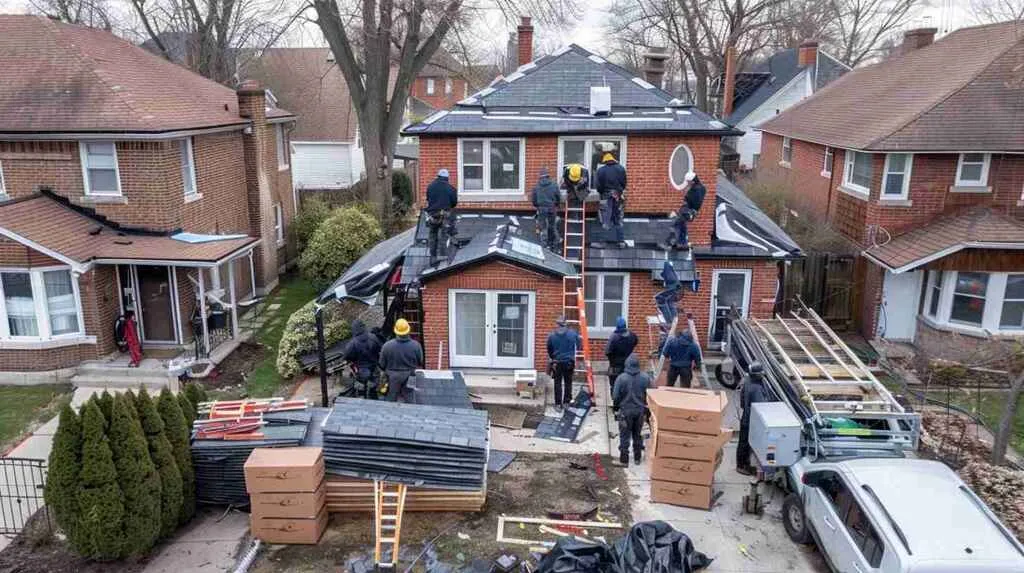
Carport with Brick and Shingle Roof Queens NY – Building Right | Call Today
Blueprint numbers don’t lie: a properly built brick-and-shingle carport in Queens runs $12,000 to $28,000 depending on span and finish, and the single biggest failure point isn’t your shingles-it’s that thin, badly flashed line where roof meets brick. Most cheap carports ignore the transition detail entirely, slapping shingles against vertical brick with nothing but a prayer and some caulk, and that’s exactly where the water thinks it’s going during the next storm. Carmen’s blunt take after 19 years roofing in Queens: if a quote comes in way under that range, someone’s skipping the flashing, the ice-and-water shield, or both, and you’ll pay for it in drips and wind damage before the warranty ink dries.
What a Solid Brick-and-Shingle Carport Really Costs in Queens
On 97th Street last winter, I watched a carport fail exactly where yours is weakest right now: where the shingles kiss the brick. One August afternoon, right after a freak thunderstorm, I got a panicked call from a retired bus driver in Flushing whose “cheap metal carport” had basically turned into a sail and twisted itself into his neighbor’s yard. I drove over in soaked jeans, and we stood in his driveway under a dripping umbrella while I explained how a brick base and a properly tied-in shingle roof would’ve given that structure weight and wind resistance. The metal kit he’d bought for $1,800 looked fine in the catalog, but Queens wind had other ideas. Three months later, we finished him a brick-and-shingle carport that matched his brick ranch so perfectly that his daughter thought we’d just extended the house-price landed around $16,200, which included proper step flashing, footings below frost line, and a transition detail designed to outlast the mortgage.
Queens labor rates, DOB permits, and the cost of matching existing brick all push prices up compared to suburban builds, but the real value is in that brick-to-shingle joint. We’re talking copper or aluminum step flashing that tucks into the brick mortar, ice-and-water shield running six inches up the wall, and counterflashing that overlaps everything so water has nowhere to sneak. That retired bus driver now parks two trucks under a roof that doesn’t rattle, doesn’t leak, and sheds coastal wind like it’s nothing-because the transition detail gave the whole carport its backbone. If you’re getting quotes that skip those words or dodge the joint conversation, you’re looking at the same twisted-metal outcome, just on a longer timeline.
💰 Typical Queens Brick-and-Shingle Carport Costs by Size and Finish Level
| Scenario | Description | Estimated Price Range (Queens, NY) | Notes on Brick-to-Shingle Detail |
|---|---|---|---|
| Single-Car Freestanding | 12×20 ft, four brick piers, basic 3-tab shingles, tied to existing house for stability | $12,000-$16,500 | Step flashing where roof meets house wall; counterflashing embedded in brick mortar; permits included |
| Two-Car Attached | 20×22 ft, brick columns match existing façade, architectural shingles, gutter system | $18,000-$24,000 | Full ice-and-water shield at ledger board; copper step flashing; pitch designed to shed water away from brick |
| Luxury Standalone | 24×24 ft, custom brick veneer, high-grade shingles, electrical for lighting, permit expediting | $26,000-$35,000 | Continuous membrane at all brick-to-shingle transitions; custom-bent flashing; engineered load calculations |
| Partial Conversion | Existing concrete slab, add brick columns and new shingle roof, reuse old footings if code allows | $10,500-$14,800 | Focus cost on proper flashing retrofit; may need thicker ice-and-water shield if pitch is shallow |
| Budget Hybrid | 10×18 ft, two brick piers + two steel posts, economy shingles, no gutters, permit only | $9,000-$12,500 | Minimal brick-to-shingle joints; all flashing still code-required; savings come from smaller footprint and mixed materials |
All prices include proper step flashing, ice-and-water shield at transitions, and Queens DOB permit fees. Prices do NOT include bare-bones work that skips the critical brick-to-shingle waterproofing.
Where Carports Fail: That Thin Line Between Brick and Shingles
On 97th Street last winter, I watched a carport fail exactly where yours is weakest right now: where the shingles kiss the brick. Most cheap or DIY carports in Queens ignore that seam entirely, running shingles straight into vertical brick with nothing but a bead of caulk, maybe some tar if you’re lucky, and zero understanding of how water behaves when it hits a cold brick wall at 3 a.m. in February. I’ll never forget a February morning in Bayside: 18°F, windy, and a thin sheet of black ice on the driveway. A young couple had tried to DIY a carport with decorative brick columns and a shingle roof they’d seen on YouTube, and every shingle course was stepped wrong where it met the brick ledger. I showed them how the meltwater was running straight into the joint instead of onto the shingles by tossing a cup of hot water on the roof and letting them watch the path-it dripped right into the garage. Bayside winters are brutal on lazy flashing: freeze-thaw cycles crack caulk in weeks, shallow pitches let ice dams form right at the brick line, and that coastal wind coming off the sound grabs under any shingle edge that isn’t nailed tight to a proper ledger. We tore that roof off, rebuilt the slope to shed water forward instead of sideways, flashed the brick properly with copper step pieces tucked into fresh mortar, and I made them promise: no more “influencer engineering.”
Here’s my blunt take: if the brick doesn’t carry the load and the shingles don’t carry the water, you don’t have a carport-you have a problem on posts. Water thinks it can sneak behind any vertical surface, especially brick, which is porous and full of mortar joints that wick moisture like a sponge. Wind wants to grab under the bottom edge of every shingle course and peel it back like a stuck label. At the brick-to-shingle transition, both forces team up: wind lifts the shingles just enough for water to slide underneath, and once you’ve got moisture behind the flashing-or worse, no flashing at all-the rot clock starts ticking. My insider tip after nearly two decades: always overbuild that transition compared to the rest of the roof. If code says one layer of ice-and-water shield, I run two and extend it six inches higher. If standard calls for aluminum step flashing, I spec copper and bed it in sealant before the counterflashing goes on. That joint is where your carport lives or dies, and it costs maybe $400 extra to do it right versus $4,000 to fix it later when the ceiling drywall is sagging.
⚠️ Critical Failures at the Brick-to-Shingle Joint
Water seeps through the caulk within one freeze-thaw cycle, then wicks into the brick mortar and travels horizontally until it finds the wood framing underneath.
Wind-driven rain hits the wall and runs straight down under the shingles; wind itself grabs the exposed shingle edges and starts lifting tabs with every gust over 30 mph.
Water can’t flow fast enough to clear the transition, so it pools against the brick, soaks through every nail hole, and eventually rots the ledger board from the outside in.
One winter ice dam and you’ve got meltwater backing up under the shingles, finding every gap in the felt, and dripping into the carport ceiling-assuming you even have a ceiling to catch it.
🔧 Common DIY vs Professional Brick-to-Shingle Details in Queens
| Detail Area | Typical DIY Approach | Professional Queens Roofer Approach | What Water Tries to Do | What Wind Tries to Grab |
|---|---|---|---|---|
| Flashing Type | Drip edge only, maybe a continuous L-flashing stuck to brick with adhesive | Copper or heavy aluminum step flashing, each piece lapped and embedded in repointed mortar joints | Run down the brick face and slip behind adhesive flashing | The loose bottom edge of L-flashing that’s not mechanically fastened |
| Pitch at Ledger | Whatever the YouTube video said, often 2:12 or flatter to save on rafter cuts | Minimum 3:12, often 4:12, calculated to clear water before it reaches the brick transition | Pool at the low-pitch joint and soak into any crack or nail penetration | Shingle tabs at shallow angles that flutter and lift in gusts over 25 mph |
| Fastener Patterns | Standard four nails per shingle, sometimes skipping the top courses near the brick | Six nails per shingle in the first three courses, ring-shank in the transition zone, all hitting solid blocking | Seep through loose nail holes that weren’t sealed or were driven at an angle | Under-nailed top courses where tabs can flap and eventually tear free |
| Sealant Use | Heavy bead of caulk along the brick-shingle line, reapplied every spring after it cracks | Minimal exterior sealant; all waterproofing handled by lapped metal and membrane under the shingles | Get through caulk cracks, then travel horizontally along the felt until finding a seam or nail | Any loose caulk bead that’s peeling away from the brick surface |
Designing a Carport That Matches Your Brick House and Survives Queens Weather
When customers in Queens tell me, “I just want a simple carport with brick and a shingle roof,” I always ask the same question: simple to look at, or simple to build? Because a visually clean carport-four brick piers, a nice gable, shingles that match the house-often hides the most complex structural and waterproofing decisions we make. One evening just before sunset in Jamaica, Queens, I was finishing a punch list on a brick-and-shingle carport for a family who ran a landscaping business. Their trucks had been baking in the sun for years, and their old polycarbonate cover kept cracking. While I was checking the ridge vent, a sudden gust of coastal wind kicked up, and you could see how the shingle roof shed it while the solid brick piers kept the whole thing rock steady. The owner climbed up the ladder halfway, looked at the brick tie-ins, and said, “I thought you were overdoing it with all this metal and sealing,” and I just pointed at the skyline and said, “That’s why your roof isn’t in the neighbor’s yard.” My insider tip after nearly two decades: match your brick coursing and roof pitch to the existing house so the carport looks like it was part of the original build, not an afterthought. When the brick pattern lines up and the roof slope echoes the main house, the whole thing reads as intentional-and bonus, it sheds wind better because the airflow doesn’t hit a sudden mismatch in geometry.
Now, slide that idea over one notch and picture it from the side view I’d sketch on your kitchen table: brick piers down here carry the vertical load from the roof, rafters span between them and tie into a ledger board on the house, and the shingles carry water down and away from that ledger-to-brick joint. The tricky part is maximum span-if your driveway is 24 feet wide and you try to run rafters that far without a center beam, you’re asking for sag, bounce, and eventually a roof that looks like an old bookshelf. Load paths matter: every pound of snow, every sheet of plywood, every shingle has to travel through the rafters, down the brick piers, and into footings that sit below Queens’ frost line-42 inches deep, minimum. Local zoning in Bayside, Flushing, and Jamaica affects the final layout too: setbacks from property lines, driveway width restrictions, and whether the carport counts as an “accessory structure” or needs full foundation inspections. We design all that before the first brick gets laid, because if the geometry doesn’t work on paper, it definitely won’t work when a nor’easter dumps 18 inches of wet snow on your roof.
📋 How Shingle Masters Designs and Builds Your Brick-and-Shingle Carport in Queens
We measure your driveway, check soil conditions, note existing drainage patterns, and sketch how water currently flows during rain-this tells us where to pitch the roof and where footings need extra depth to avoid frost heave.
Full drawings go to Queens DOB showing rafter sizes, brick pier spacing, and-most critical-the brick-to-shingle flashing detail; at this stage we calculate wind uplift so we know exactly how many fasteners the transition zone needs to resist coastal gusts.
We dig footings below frost line, pour concrete, and build brick piers that match your house coursing and mortar color; the top of each pier gets a steel plate or embed so the ledger and rafters bolt down solid-wind can’t lift what’s bolted through brick and steel.
Rafters go up, sheathing and felt get stapled, and we install the shingles starting from the eave and working up-critical step: at the brick-to-ledger transition, we lay ice-and-water shield first, then copper step flashing every course, so water that hits the brick face runs onto the next shingle down, never behind it.
Before DOB signs off, we run a garden hose along the brick-to-shingle joint for ten minutes straight, checking every seam and nail from inside the carport; if one drop comes through, we pull shingles and redo the flashing-wind and water get no second chances once the inspector leaves.
✓ Why Queens Homeowners Trust Shingle Masters for Brick-and-Shingle Carports
-
✓
NYC Licensed & Fully Insured: Active NYC Home Improvement Contractor license and $2M liability coverage on every carport project in Queens -
✓
19+ Years Roofing in Queens: Carmen Ortiz and her crew have built brick-and-shingle carports from Bayside to Jamaica, through every kind of Queens weather -
✓
Queens DOB Permit Expertise: We handle all permit filings, structural drawings, and inspection scheduling-you don’t chase paperwork or wait on hold with the city -
✓
48-Hour On-Site Estimate: Call before noon and we’ll walk your driveway, sketch the side view, and email a line-item quote within two business days -
✓
10-Year Warranty on Flashing & Shingle Work: If the brick-to-shingle joint leaks due to our workmanship in the first decade, we tear it open and redo it at zero cost to you
Is Your Queens Driveway Ready for a Brick-and-Shingle Carport?
Picture this from the side-like a little drawing on a napkin: brick down here, shingles up here, and water trying to sneak in between. If what’s over your parking spot right now is a flimsy metal kit, a cracked polycarbonate canopy, or just open sky and sun-baked paint, the next Queens storm can move it or break it as easily as you can. If you can shake the structure by hand, wind will shake it harder.
✅ Quick Checks Before You Call Shingle Masters to Price Your Carport
- Measure driveway length and width in feet-grab a tape measure or pace it out, then write it down so we can estimate rafter spans and brick pier placement over the phone
- Note distance to property line on both sides and the rear, because Queens zoning requires minimum setbacks and we’ll need those numbers for the permit application
- Take photos of your house’s brick and roof style-close-ups of mortar color, brick pattern, and shingle color/texture help us match materials so the carport looks like it belongs
- Check for visible cracks in the slab where you’ll park; if your driveway is already heaving or crumbling, we may need to pour new footings or add steel reinforcement before any brick goes up
- Note any previous leaks near the driveway-water pooling against your foundation or garage door tells us about drainage and helps us pitch the new roof to send water away, not toward your house
- Confirm any HOA or co-op rules if applicable; some Queens neighborhoods and co-op boards require design approval before construction, and we can adjust drawings to meet those requirements up front
🔀 Do You Need a New Carport, a Rebuild, or Just a Flashing Fix?
├─ NO → Is your driveway slab in good shape with no major cracks?
│ ├─ YES → Service: NEW BUILD – Design and construct a complete brick-and-shingle carport with new footings, piers, and roof
│ └─ NO → Service: FOUNDATION + NEW BUILD – Pour new concrete footings, repair or replace slab, then build carport
└─ YES → Is it a lightweight metal frame or polycarbonate panel kit?
├─ YES → Does it rattle in the wind or show rust/cracks?
│ ├─ YES → Service: FULL REBUILD – Demo cheap kit, reuse slab if sound, build permanent brick-and-shingle structure
│ └─ NO → Service: HYBRID UPGRADE – Reinforce existing frame with brick piers, add proper shingle roof over current skeleton
└─ NO, it has brick and shingles → Are you seeing leaks at the brick-to-shingle joint or inside the carport?
├─ YES → Service: TRANSITION REPAIR/UPGRADE – Pull shingles at joint, install proper step flashing and ice-and-water shield, reroof transition zone
└─ NO → Preventive Inspection – Schedule a flashing check and maintenance visit before leaks start
Straight Answers About Brick-and-Shingle Carports in Queens
One mistake I see over and over is people copying house-roof details onto a freestanding carport and hoping Queens wind won’t notice. Carmen gets the same handful of questions on every driveway walk, and here are the clear, no-nonsense answers framed in terms of what water and wind will actually allow you to get away with in this climate.
What’s the typical lifespan of a brick-and-shingle carport in Queens weather?
The brick piers will outlast you-100+ years if the mortar is repointed every 30 years or so. The shingle roof itself is good for 20-30 years depending on shingle grade, but the real variable is that brick-to-shingle transition detail. If it’s built right with copper step flashing and ice-and-water shield, you’ll get the full shingle lifespan. If it’s caulk-and-prayer construction, water starts finding gaps in year three, and by year seven you’re looking at rotted ledger boards. Wind can peel poorly fastened shingles in a single nor’easter, but a properly detailed roof with ring-shank nails in the transition zone laughs at Queens gusts.
Can the carport be tied into my existing house roof, or does it need to be freestanding?
Both work, but tied-in is almost always stronger and cheaper because you’re using the house wall as one support line instead of building four separate brick piers. The key is that ledger board bolted to your house-it has to hit solid framing, not just siding or brick veneer. When we tie in, we through-bolt every 16 inches into the rim joist or wall studs, then flash the connection so water that runs down your house wall flows onto the carport roof and away. Wind loves tied-in carports less because there’s no gap for gusts to wedge under; the roof is basically an extension of your house envelope. Freestanding works if you can’t access the house wall or if zoning makes you stay a few feet clear, but you’re adding two more brick piers and footings, which bumps cost and gives wind more edges to grab.
How do permits and inspections work for carports in Queens?
Queens DOB classifies most carports as accessory structures, so you need a building permit that includes structural drawings, a site plan showing setbacks, and sometimes a zoning review if you’re close to property lines. We file everything-takes about 2-4 weeks to get approved if drawings are clean. You’ll get two inspections: one after footings and framing are up (before sheathing goes on), and one final after the shingles and flashing are complete. The inspector specifically checks that brick-to-shingle joint for proper step flashing and that the roof pitch meets code minimum. If anything’s DIY’d or under-detailed, they red-tag it on the spot. Water and wind don’t care about paperwork, but the city does, and honestly the permit process forces you to build it right because an inspector will catch shortcuts that would leak in six months.
What maintenance is required to keep the brick-to-shingle joint leak-free?
If the joint is detailed correctly-step flashing, counterflashing, ice-and-water shield-you’re looking at almost zero maintenance for the first decade. Once a year, ideally in early fall, walk up there and check that no shingle tabs have lifted near the brick line and that the counterflashing is still tight in the mortar joints. If you see any caulk someone applied after the fact (which you shouldn’t if we built it), scrape it off because it just traps water behind the flashing. Every 5-7 years, have a roofer pull a couple of shingles at the transition, inspect the step flashing for corrosion, and check the membrane underneath. Water wants to sneak in through nail holes and mortar cracks; wind wants to lift tabs. Maintenance is just making sure neither has found a new path since the last check.
Can I reuse existing brick columns or do I need new footings?
Depends entirely on whether those columns are sitting on proper footings below frost line (42 inches in Queens) and whether the brick is structurally sound-no crumbling mortar, no lean, no cracks that go all the way through. If they were built for a previous carport or porch, we can often reuse them, saving you $2,000-$4,000 in footing and masonry costs. But if they’re decorative columns that were never meant to carry a roof load, or if the footings are shallow, we’ll need to either sister in new footings alongside or demo and start fresh. Water doesn’t care about the columns much, but wind does: if a column isn’t sitting on solid concrete and the roof isn’t bolted down through steel plates embedded in the brick, wind will try to rock the whole structure until something lets go. We always load-test existing columns before we commit to reusing them.
❌ Myth vs ✓ Fact: Brick-and-Shingle Carports in Queens
| Myth | Fact |
|---|---|
| ❌ Brick is always too expensive for a carport-metal or wood is the budget option. | ✓ Brick costs more up front, but it never rusts, rots, or needs repainting, and it anchors the structure so wind can’t move it. Over 20 years, brick is cheaper than replacing two metal kits. The real cost is in the brick-to-shingle transition detail, not the piers themselves. |
| ❌ Carports don’t need permits in Queens-they’re just a roof on posts. | ✓ Queens DOB requires a building permit for any structure over 200 square feet or anything permanently attached to your house. Skip the permit and you risk a stop-work order, fines, and having to tear it down. Plus, unpermitted work kills resale value and voids homeowner’s insurance if the carport fails and damages your car. |
| ❌ Any shingle works the same on a carport roof as long as it matches the color. | ✓ Carport roofs take more abuse than house roofs because they’re often lower-pitch and fully exposed to sun and wind on all sides. You want architectural shingles rated for high wind and a minimum 25-year warranty. Cheap 3-tabs will cup and crack faster, especially at the brick transition where thermal expansion is highest. |
| ❌ If you can roof a shed, you can roof a carport-it’s the same process. | ✓ A shed roof usually dies into open air or a simple rake edge. A carport roof dies into brick, which means step flashing, counterflashing, ice-and-water shield, and pitch calculations to keep water moving away from the joint. Get the brick-to-shingle detail wrong and you’ll have leaks no amount of caulk will fix. This isn’t DIY territory unless you’ve done it before. |
Here’s the thing: a carport with brick and a shingle roof in Queens lives or dies at that brick-to-shingle transition, and after 19 years of walking driveways and sketching side-view details on cardboard scraps, I can tell you that every leak and every wind failure I’ve seen traces back to someone who thought the joint was “just cosmetic.” It’s not cosmetic-it’s the single most engineered detail on the whole structure, because that’s where water thinks it can sneak in and where wind wants to grab under the shingles and peel them back like a stuck label. Call Shingle Masters, and we’ll walk your driveway, measure your brick, sketch the side view with those little raindrop arrows, and price you a build that outsmarts both rain and wind for the next three decades.