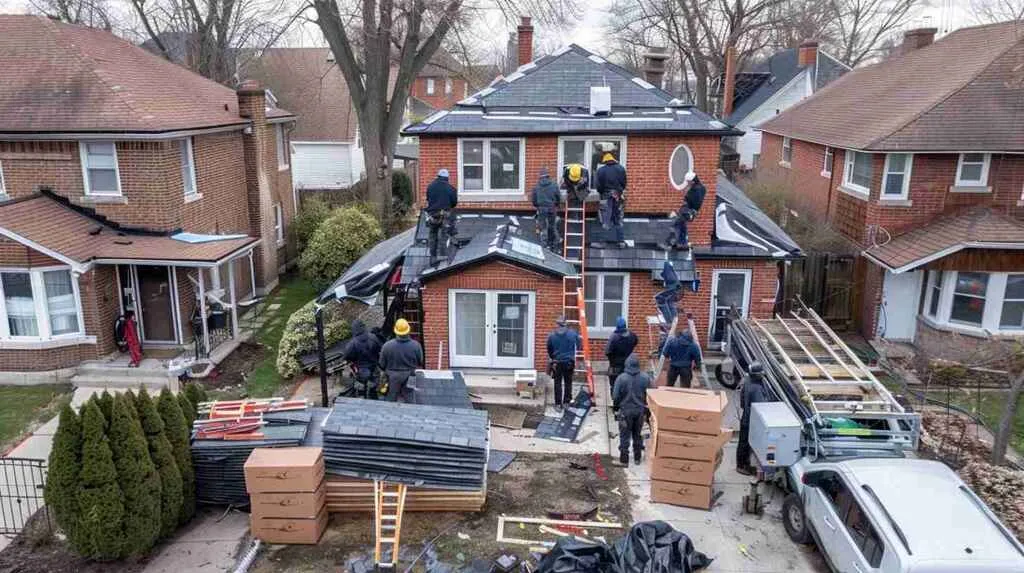
Calculate Shingles Needed for Roof Queens NYC – The Right Formula
Hidden in plain sight on every shingle bundle is a number-33.3 square feet-and once you know how to use that number, calculating shingles for a typical 1,200-1,600 square foot Queens home becomes simple math: divide your roof area by 100, add 15-25% for waste, and multiply by three bundles per square, landing you somewhere between 45 and 65 bundles depending on your roof’s pitch and complexity. But here’s what trips up most folks: your interior square footage is not your roof area-overhangs, porches, dormers, and that weird back extension you forgot about all add up, and in Queens, those extras can push your roof 20-30% larger than the footprint you’re standing in.
The Exact Formula Queens Homeowners Should Use
On a typical two-story house in Queens, I start with one thing: the tape measure along the eave, not the guess in my head. The core formula is straightforward: take your total roof area in square feet, divide by 100 to get your “squares,” then multiply by the number of bundles per square (usually three for standard architectural shingles), and finally add your waste percentage. So if you’ve got 1,600 square feet of roof and you’re planning 15% waste, you’re looking at (1,600 ÷ 100) × 1.15 × 3 = 55 bundles. Think of your roof like a floor plan-you’ve got your main living room (the big front slope), your kitchen (the back slope), and those little closets and hallways (dormers, porches, shed roofs). Don’t pay living-room prices for closet-sized areas, but don’t skip measuring the closets either.
I’m telling you this because I don’t trust round-number estimates or anyone who says, “Oh, your house is 1,400 square feet inside, so just buy 50 bundles.” That’s like saying a railroad apartment in Jackson Heights has the same usable space as a studio with the same square footage-it doesn’t. Your roof has eaves hanging over the walls, sometimes two feet past the siding. You’ve got a front porch that adds another 200 square feet. You’ve got that dormer over the second bedroom that looks tiny from the street but adds another section to measure. If I wouldn’t accept an interior-footage guess for my own mother’s house in Astoria, I’m not accepting it for yours.
One August afternoon in Flushing, around 3 p.m., I was on a two-family house roof so hot my tape measure was almost burning my hand. The owner handed me a handwritten “calculation” from a handyman who told her she needed 110 bundles. I walked the roof, measured properly, accounted for the two dormers and a pretty big waste factor at the valleys, and my math came to 78 bundles. We ordered 80, finished the job, and had just one unopened bundle left. That day reminded me how quickly bad estimating can turn into paying for a whole extra pallet you’ll never use-in this case, 30 bundles at about $30 each, so nearly $900 sitting in her driveway for no reason.
Typical Queens Roof Bundle Range Using the Formula
| House Type / Layout | Approx. Interior Sq Ft | Estimated Roof Area (sq ft) | Waste Factor | Total Squares | Estimated Bundles |
|---|---|---|---|---|---|
| Simple Ranch (4/12 pitch) | 1,200 | 1,350 | 10% | 13.5 × 1.10 = 14.85 | 45 bundles |
| Two-Story Colonial (6/12 pitch, one dormer) | 1,500 | 1,720 | 15% | 17.2 × 1.15 = 19.78 | 59 bundles |
| Cut-Up Victorian (8/12 pitch, multiple gables) | 1,600 | 2,000 | 20% | 20.0 × 1.20 = 24.0 | 72 bundles |
| Attached Two-Family (5/12 pitch, rear porch) | 1,400 | 1,620 | 12% | 16.2 × 1.12 = 18.14 | 54 bundles |
⚡ Fast Queens Shingle Math Snapshot
Step-by-Step: Measure Your Roof Like a Pro in Queens
On a typical two-story house in Queens, I start with one thing: the tape measure along the eave, not the guess in my head. I walk the perimeter first, measuring the length of each wall at ground level, then I add the overhang-usually 12 to 24 inches past the siding on each side. Then I break the roof into rectangles, just like rooms on a floor plan. In Jackson Heights, where I grew up, you’ve got a lot of attached houses and row homes with small front porches and rear additions, so I’ll measure the main house footprint, then tackle each little “room” separately-front stoop roof, back porch, side mudroom. I sketch it all on a notepad, label each section like apartments in a building, and calculate the area for each piece. Safety first: if you can get most measurements from the ground using your house dimensions and a little trigonometry for pitch, do it-don’t climb a two-story ladder in Ridgewood on a windy afternoon just to save five minutes.
One cold November morning in Astoria, I got a panicked call from a landlord who had started re-roofing with his cousin using a YouTube video. They calculated only the flat planes, forgot the hip ends and starter/ridge shingles, and ran out halfway through the back slope-right before a nor’easter. I climbed up, flashlight in my teeth because the sun was already dropping, re-measured every section, and showed him he was off by almost 35% because he didn’t factor waste or special trim shingles. We tarp-covered what we could and I walked him through a proper material list right there on the sidewalk. That’s when I realized most people treat their roof like one giant rectangle when it’s really a puzzle of smaller shapes-hips, valleys, ridges-each needing its own count. Measure each “room” of your roof individually, add them all up, and then apply your waste factor to the total.
Common Measuring Mistakes in Queens
- Ignoring hip ends on attached houses: Those triangular sections on the sides add up fast and many people skip them entirely.
- Skipping porches and rear extensions: That little roof over your back steps might look tiny but it’s another 80-150 square feet you need to cover.
- Not adjusting for steep pitch: A 7/12 or 8/12 roof has 25-32% more surface area than the flat footprint-skip this and you’ll run short.
- Forgetting starter and ridge shingles: These aren’t part of your field coverage; they’re separate line items that add 3-5 bundles on a typical Queens roof.
Waste, Pitch, and Extras: Where Your Bundle Count Jumps
Here’s the truth nobody likes to hear-waste isn’t a mistake, it’s a line item. On a simple gable roof with two clean slopes and no valleys, you might get away with 10% waste if you’re careful with your cuts and layout. But in Queens, where we’ve got Victorians in Jamaica with three gables, row houses in Maspeth with dormer windows punching through the roofline, and split-levels in Ridgewood with wraparound porches, your waste factor climbs to 20% or even 25% because every valley, every hip, every change in direction means more cuts, more odd pieces, and more shingle ends you can’t use. I’ll give you an insider tip: if your roof has more than two roof planes or you’re looking at a house built before 1960 with complicated lines, I automatically plan for 20% waste minimum, and I’ve never regretted ordering those extra bundles-but I’ve regretted running short plenty of times.
Six bundles short is exactly where most DIY calculations land in Queens.
One Saturday just after sunrise in Jamaica, Queens, I was re-checking measurements on a complicated Victorian roof with three gables and a wraparound porch. My crew had done the initial count, but something in the math bothered me-too neat, too round. I re-drew the roof like a subway map and recalculated each “line,” and sure enough, we would’ve been short about six bundles once we hit the upper gable. That would’ve meant stopping mid-job and paying emergency delivery fees-probably $200 just for the rush truck, plus my guys standing around on a naked roof waiting. Catching that mistake early saved the homeowner money and kept the job moving. Think of it this way: every extra corner on your roof is like an extra subway stop on your commute-it doesn’t look like much on the map, but it adds time, distance, and in this case, shingles.
✅ Roof Features That Increase Waste in Queens
-
✅
Dormers – Each dormer adds valleys, ridges, and small planes that require extra cuts and boost waste by 3-5%. -
✅
Valleys – Every valley requires shingles to be cut at an angle, creating scrap pieces and pushing waste up by 5-8% per valley. -
✅
Multiple gables – Victorian and Dutch Colonial homes in Queens often have 3-5 separate gable ends, each needing separate starter rows and edge treatment. -
✅
Wraparound porches – Low-slope porch roofs with multiple direction changes force you to rip shingles and trim constantly, adding 10-15% waste just for that section. -
✅
Complex L-shaped additions – Common in Queens two-families, these create inside corners, extra hips, and irregular angles that spike waste to 20%+.
DIY vs Calling a Queens Roofing Pro for Your Shingle Count
When I’m standing in your driveway and you ask, “Can I do this calculation myself or should I call someone?” my answer depends on your roof’s floor plan. If you’ve got a simple ranch with a straightforward 4/12 gable-basically a studio apartment roof, two clean slopes, no tricks-you can absolutely measure it yourself, apply 10-12% waste, run the math, and order with confidence. But if you’re looking at a railroad-style roof with extra closets everywhere-dormers popping out, a side porch, a garage attachment, three different roof heights-that’s when I’d tell my own mother to have a pro walk it and double-check the layout before you drop two grand on materials. That’s where Shingle Masters comes in: we’ll lay out your roof, confirm your bundle count, catch those hidden sections you didn’t see from the ground, and make sure you’re not over-ordering or, worse, running short halfway through and scrambling for an emergency delivery that costs you time and money.
🏆 Why Queens Homeowners Call Shingle Masters
Quick Answers: Calculating Shingles Needed for a Queens Roof
These are the questions I hear most in Queens driveways and on front stoops, and I’m giving you the answers straight-no sales pitch, just the real numbers you need.
📋 Info to Have Ready Before Calling Shingle Masters
-
✅
Rough house dimensions: Length and width of your house at ground level, plus any obvious additions or porches. -
✅
Number of visible roof sections: Main house, garage, dormers, porches-helps us estimate complexity. -
✅
Presence of dormers or wraparound porches: These features significantly affect waste and bundle count. -
✅
Last time the roof was replaced: Age and condition help us plan timeline and spot hidden issues. -
✅
Photos from the sidewalk or backyard: Even a quick phone pic helps us prep before the site visit.
Once you’ve sketched your roof layout and run the numbers using the formula I gave you, you’re 80% of the way there. But if you want to be absolutely sure before you spend a couple thousand dollars on materials, I can double-check your layout and bundle count for free-it takes me about 20 minutes on-site and I’ll show you exactly where those extra squares are hiding. Call Shingle Masters in Queens, NY and we’ll schedule an on-site estimate, confirm your shingle count, and get you set up with exactly what you need, not a bundle more or less.