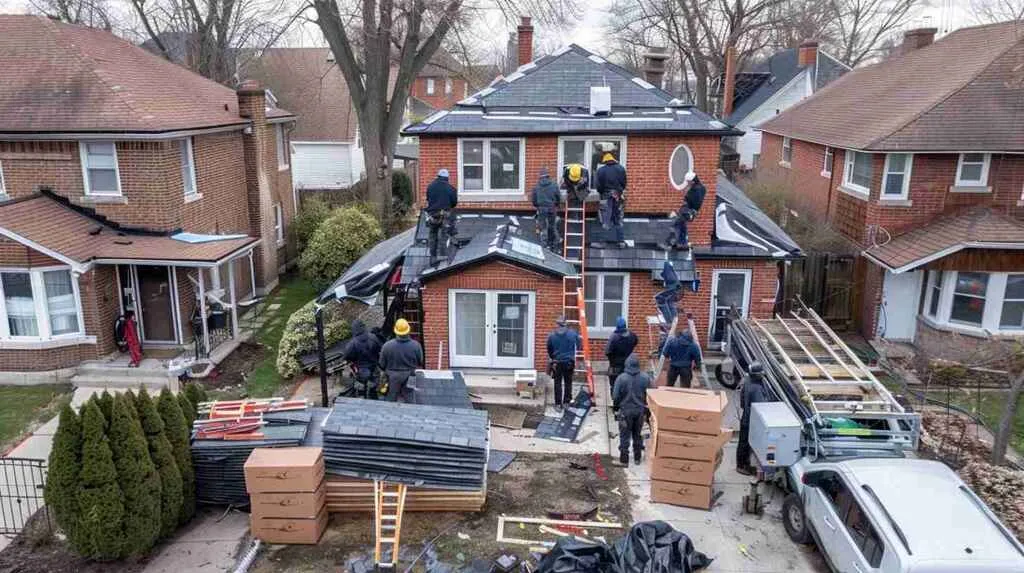
Calculate Shingles for Gable Roof Queens NY – The Right Formula
Blueprints show the floor plan, not what you actually need to cover with shingles. Walk through any block in Jackson Heights or Bayside, and you’ll see rows of gable roofs that look identical from the street, but the homeowners who tried to calculate shingles using their inside room measurements-or worse, what their cousin ordered on Long Island-all ended up short or stuck with 15 extra bundles in the garage. Let me show you the real formula we use in Queens, the one that matches what you’ll actually nail down on plywood.
Start With the Real Roof Area, Not Your Floor Plan
On a typical 20′ × 40′ house in Queens, the first mistake people make is measuring the inside rooms instead of the outside roof planes. One August afternoon in Jackson Heights, I was measuring a small gable roof in 95° heat, and the homeowner kept insisting he “already knew” he needed 25 bundles because that’s what his cousin used in Long Island. I sat on the curb, drew his roof on a takeout menu from the deli next door, and walked him through the actual area and waste factor. Turned out he only needed 19 bundles; he called me later laughing because the cousin had three bundles left sitting in his garage. I’ll be honest: I hate when contractors act like homeowners can’t handle simple math, so I’m going to give you the exact ingredients you need to get your number right the first time.
Here’s the blunt truth: gable roofs look simple from the street, but the way shingles overlap means you always need more than the raw square footage. You can’t measure what you see when you stand in your bedroom-you measure from the sidewalk, you include the overhangs that extend past the walls, and you account for both sloped planes of the gable. Think of your roof the way you think of cooking arroz con pollo-if you don’t measure the rice and water right, the whole pot comes out wrong, and shingles are the same way.
| What You’re Measuring | Measurement Used | Area (sq ft) | Why It’s Wrong or Right |
|---|---|---|---|
| Inside room dimensions | 18′ × 38′ (typical) | 684 | ❌ Wrong. Walls take up space, and this ignores overhangs and pitch completely. |
| Outside footprint (no pitch) | 20′ × 40′ | 800 | ⚠️ Better, but incomplete. You’ve measured the base, but your roof slopes up-you’re still short. |
| Roof planes with pitch & overhangs | 22′ × 42′ both sides, 6/12 pitch factor 1.12 | 2,067 | ✅ Right. This is the actual shingle coverage needed before you add waste. |
✅ Minimum “Ingredients” You Must Measure Before Calculating Shingles
- ✅ House length (outside wall to wall) – Walk the perimeter with a tape measure or use your deed survey; include gable ends.
- ✅ House width including overhangs – Most Queens homes have 12-18″ eave overhangs; measure from fascia to fascia, not wall to wall.
- ✅ Both gable roof planes – A gable has two sloped sides; you calculate one and double it, or measure each separately if they’re not symmetrical.
- ✅ Any small add-ons like porches – Attached entryway roofs in Queens rowhouses count; sketch them separately and add them to your total.
Plug Your Queens Gable Roof Into the Shingle Formula
I’ll be honest: if your shingle count doesn’t start with a tape measure on the sidewalk and a sketch in your hand, you’re guessing, not calculating. Here’s the exact formula I use on every job: (length × width × pitch factor × 2) ÷ 100 = squares, then add 10-15% waste for a simple gable in Queens. One winter evening around 6 p.m., just as it started snowing in Bayside, a landlord called me in a panic because he was mid-DIY and had run out of shingles halfway across one side of his gable roof. He’d measured only the “flat part” and ignored the overhangs and the starter course. I climbed up, headlamp on, snow hitting my glasses, and re-did his takeoff on the ridge. We recalculated together, and he finally understood why his math failed-he’d forgotten waste and valleys completely. Typical Queens housing-attached rowhouses in Jackson Heights, capes in Bayside, colonials in Flushing-all have pitches that fall into a few common ranges, and knowing your pitch is the difference between nailing it and running short.
When I’m standing in your driveway and I ask, “Do you know your roof pitch?”, I’m not making small talk-I’m trying to save you from buying the wrong number of bundles. Pitch is the slope of your roof, written as a ratio like 6/12, which means for every 12 inches you move horizontally, the roof rises 6 inches vertically. Think of it like a recipe ratio-one cup of rice to two cups of water. Ignore the pitch and it’s like baking a cake with half the flour: the final product won’t cover what you need. Most homes in Queens run between 4/12 (gentler slope) and 8/12 (steeper colonial look), and each pitch gets its own multiplier in the formula.
Step-by-Step Formula to Calculate Shingles for a Simple Gable Roof in Queens
| Roof Pitch (rise/run) | Pitch Factor (multiplier) | Where You Commonly See It in Queens |
|---|---|---|
| 4/12 | 1.05 | Ranch-style homes, some mid-century bungalows in eastern Queens and Bayside |
| 6/12 | 1.12 | Classic cape cods, most 1940s-1960s detached homes across Flushing and Whitestone |
| 8/12 | 1.20 | Steeper colonials, newer builds in Douglaston, Little Neck, and upscale blocks |
| 10/12 | 1.30 | High-pitch Tudors, Victorian-style add-ons, uncommon but dramatic when you see them |
Convert Squares to Bundles Without Running Short
One time in Flushing, a very meticulous accountant showed me his spreadsheet, and I could tell in 10 seconds where his shingle math went wrong-he ignored the pitch. Let’s walk through a real Queens example using a 20′ × 40′ gable at 6/12 pitch. Outside footprint: 20 × 40 = 800 sq ft. Add the pitch multiplier: 800 × 1.12 = 896 sq ft per side. Both sides: 896 × 2 = 1,792 sq ft total roof surface. Divide by 100 to get squares: 1,792 ÷ 100 = 17.92, round to 18 squares. Now add 12% waste for a simple gable: 18 × 1.12 = 20.16, call it 20 squares. Since three bundles of architectural shingles cover one square, you need 20 × 3 = 60 bundles. I’ll never forget a job in Ozone Park where a flipper wanted “the absolute minimum bundles” because he was rushing to sell. His spreadsheet showed perfect math, but it didn’t match my field measurements, especially at the overhanging eaves. I walked him through each plane, chalk line by chalk line, and showed him that if he ordered what he wanted, he’d either have a patchwork roof or exposed plywood on the windward gable. Two months later he admitted the buyer’s inspector praised the “extra clean shingle layout”-those were the two extra bundles he fought me over. In windy parts of Queens near the Rockaways or along wide avenues, I always round up by one bundle per side for safety and consistency of color batch-think of it like cooking extra rice so the pot doesn’t stick; you’re buying insurance against surprises.
📊 Example Bundle Counts for Typical Queens Gable Roofs
| House Size (outside) | Approx. Squares (with pitch & waste) | Bundles Needed | Estimated Shingle Cost (at $35/bundle) |
|---|---|---|---|
| 14′ × 28′ (starter home) | 11 squares | 33 bundles | $1,155 |
| 16′ × 32′ (rowhouse) | 14 squares | 42 bundles | $1,470 |
| 20′ × 40′ (classic cape) | 20 squares | 60 bundles | $2,100 |
| 22′ × 50′ (larger colonial) | 29 squares | 87 bundles | $3,045 |
All estimates include 6/12 pitch factor and 12% waste already built in.
⚠️ Risks of Trying to Cut Bundles Too Close on a Windy Queens Gable
Under-ordering by even one or two bundles can leave exposed plywood after a wind gust rips a starter course, and you’ll scramble to find matching shingles mid-job.
Mixing shingle batches or colors from different supplier runs creates visible streaks that kill curb appeal and flag your home during resale inspections in Queens.
Delays cost you time and labor-stopping mid-install to drive back to the supplier in Jamaica or Maspeth means your crew sits idle and weather can move in fast.
Queens inspectors and buyers notice incomplete work, and patched roofs or mismatched shingles drag down appraisals and slow closings when you’re trying to sell.
Quick Queens Checklist Before You Order Shingles
Double-check your measurements now, and you’ll save money and avoid emergency trips to the supplier later. Think of this moment like sliding a notepad across the kitchen table and saying, “Let’s verify these numbers like a recipe before we turn on the oven.”
✅ What to Verify Before You Call a Queens Roofer or Place Your Shingle Order
- ✔ Confirm outside length and width – Measure fascia to fascia, not wall to wall; include those 12-18″ overhangs on all sides.
- ✔ Confirm pitch – Use a pitch finder, ask a neighbor with the same model home, or climb up with a level and tape measure.
- ✔ Confirm overhangs included – Walk around and visually check that your sketch shows the roof edge past the walls, not just the footprint.
- ✔ Confirm waste percentage chosen – Simple gable with no valleys or chimneys = 10-12%; anything more complex = 15%.
- ✔ Confirm you added starter and ridge shingles – Most calculators don’t auto-include these; budget an extra bundle for starter and one for ridge cap per 30 linear feet.
- ✔ Confirm you noted any porches or extensions – Small entryway gables in Queens rowhouses add 2-4 squares; measure them separately and add to your total.
| Myth | Fact |
|---|---|
| “I’ll just order what my neighbor ordered for their roof.” | Your neighbor’s roof might have a different pitch, overhangs, or additions. Even identical-looking Queens houses can need 5-10 bundles more or less depending on exact measurements. |
| “Waste is for beginners-I’ll measure perfectly and skip it.” | Cuts, starter courses, ridge caps, and wind-damaged pieces are unavoidable. Every professional roofer in Queens adds 10-15% waste, no exceptions. |
| “Pitch doesn’t matter much-it’s just a slightly slanted roof.” | A 6/12 pitch adds 12% more surface area than a flat roof; an 8/12 adds 20%. Ignore pitch and you’ll be short by entire bundles, not inches. |
| “I can reuse leftover bundles from another job in Long Island.” | Shingle colors vary by batch and weather exposure. Mixing old and new bundles creates visible streaks; buy fresh from a single lot for a uniform look. |
Questions Queens Homeowners Ask Me About Shingle Math
Calculating shingles is like following a reliable recipe-once you understand the portions (length × width × pitch × waste), you can adjust for any gable roof in Queens. You don’t have to guess, and you don’t have to overpay for bundles you’ll never use or underbuy and leave plywood exposed to the next rainstorm.
❓ Shingle Calculation FAQs for Gable Roofs in Queens, NY
How many bundles do I need per roofing square in Queens?
Standard three-tab shingles cover one square (100 sq ft) with three bundles. Architectural shingles-the most common choice in Queens today-also use three bundles per square but are thicker and heavier, so double-check your supplier’s coverage specs before ordering.
What waste percentage should I use for a simple gable roof?
For a straightforward two-sided gable with no valleys, dormers, or chimneys, use 10-12% waste. If your gable has a small front porch addition or a hip on one side, bump it to 15%. In windy sections of Queens near open streets or water, I personally go 12% minimum.
Do I calculate starter and ridge shingles separately?
Yes. Starter shingles run along the bottom edge of your roof (the eaves) and ridge cap shingles cap the peak. Budget one extra bundle of starter for every 100 linear feet of eave, and one bundle of ridge cap for every 30 linear feet of ridge on your Queens gable.
How much extra should I order in case of repairs later?
One or two bundles stored in your garage or basement can save you from color-mismatch headaches if a storm damages a few shingles in three years. Keep them sealed, flat, and out of direct sunlight. Most Queens homeowners I work with order an extra two bundles and never regret it.
Can I reuse my cousin’s leftover bundles from another job in Long Island?
Only if they’re the exact same product, from the same batch, stored indoors, and you’re okay with potential color variation. Shingles age and fade differently depending on sun exposure and warehouse conditions, so mixing old and new batches creates visible streaks that hurt resale value in Queens neighborhoods.
🏆 Why Let a Local Pro Double-Check Your Shingle Math
✓ Licensed & Insured in NYS
Full liability coverage and workers’ comp so you’re protected if anything goes wrong on your Queens property.
✓ 19 Years Roofing Across Queens
From Jackson Heights rowhouses to Bayside colonials, we know every pitch and overhang pattern in this borough.
✓ Fast Written Bundle Counts
We’ll measure your gable, run the formula, and email you an exact material list in under 24 hours-no guessing.
✓ Permit & Inspector Experience
We handle Queens DOB paperwork, work with local inspectors daily, and know exactly what passes code here.
One quick double-check of your measurements with a pro can prevent wasted money or mid-job shortages-and honestly, after 19 years measuring Queens gables in every weather condition, I’d rather spend 20 minutes walking your roof than have you stuck with exposed plywood and a mismatched batch of shingles. Call Shingle Masters in Queens today, and let Rosa and the team verify your gable roof shingle count, walk you through the formula one more time if you want, and schedule a clean install or arrange material delivery so you can start with confidence.