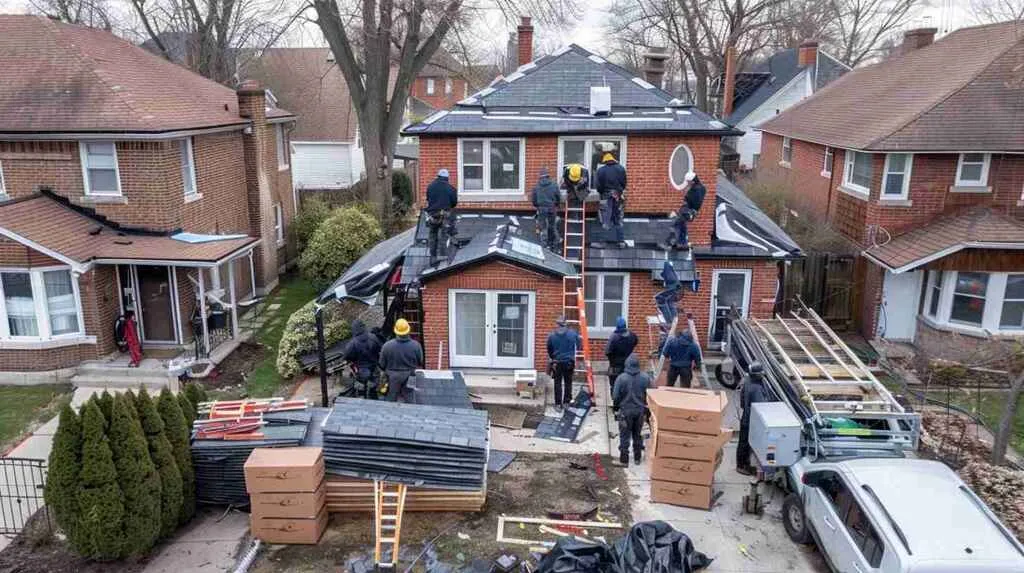
Calculating Roof Shingles Queens NY – The Right Formula to Use | Call Today
Blueprint truth from 19 years on Queens roofs: most two-family homes here need about 10-15% more shingles than the flat square footage suggests – that usually translates to roughly 3 to 6 extra bundles on a typical house, and if you’re ignoring pitch, valleys, and waste you’re going to be short. I’m Victor, and I’ve been on Queens roofs since I left a drafting desk in 2006, and I’m known in the neighborhood as the guy who can eyeball within one bundle – but more importantly, I can walk you through the actual calculation like I’m drawing a subway map so you understand where every shingle’s going.
How Many Extra Shingle Bundles Queens Roofs Really Need
On a typical two-family in Jackson Heights with a modest pitch, I can tell you right now you’re probably underestimating by at least three bundles. People look at their listing square footage, divide by 100, order that many “squares” of shingles, and then wonder why they’re scrambling for material mid-job. The reason? They’re calculating the floor plan, not the actual sloped surface you’re covering – and they’re completely skipping the bundles needed for starters along the eaves, caps along the ridge, and all the cuts and waste around hips, valleys, and dormers. That 10-15% gap is real, and on a typical Queens two-family (say, 1,800 sq. ft. of footprint), it’s the difference between ordering 20 squares and actually needing 23.
One August afternoon in Woodhaven, it was about 92 degrees and the shingles were practically melting in my hands. The homeowner had bought “enough shingles” based on the flat square footage from his Zillow listing, and by 3 p.m. we were three bundles short with a thunderstorm rolling in from the west. Standing on that roof, watching the radar on my phone, I had to re-calc on the fly, factoring in the steep pitch and the big waste around two dormers – that’s when I started double-checking every homeowner’s numbers before I step foot on a ladder. Now I don’t care if you bring a spreadsheet or a napkin sketch, I’m running my own formula and matching it to yours before we order.
| Roof Type / Example Neighborhood | Approx. Roof Area (sq. ft.) | Pitch Category | Raw Squares (Area ÷ 100) | Realistic Shingle Squares (with 10-15% extra) | Typical Extra Bundles Needed |
|---|---|---|---|---|---|
| Small Cape / Astoria, Sunnyside | 1,200 sq. ft. | Moderate (5/12-7/12) | 12 squares | 13.5-14 squares | 3-4 bundles |
| Two-Family / Jackson Heights, Elmhurst | 1,800 sq. ft. | Moderate (6/12) | 18 squares | 20-21 squares | 4-6 bundles |
| Large Colonial / Bayside, Forest Hills | 2,400 sq. ft. | Steep (8/12-10/12) | 24 squares | 27-28 squares | 6-9 bundles |
| Complex Hip Roof / Maspeth, Middle Village | 2,000 sq. ft. | Moderate-Steep (7/12) | 20 squares | 23-24 squares | 5-8 bundles |
The Right Formula to Use (Explained Like a Queens Subway Map)
Here’s my honest take: most online “shingle calculators” are decent at math and terrible at reality. They spit out a number based on pitch and square footage, but they don’t account for the fact that your roof isn’t one simple rectangle – it’s a collection of intersecting planes, hips, valleys, dormers, and ridges, each of which changes the bundle count. Think of your roof like the Queens subway lines: each section looks simple until you see how it connects at the “transfer stations” – your valleys and intersections. A typical two-family in Jackson Heights or Elmhurst has maybe four or five distinct roof planes that meet at valleys or hips, just like the 7 train meets the E at Jackson Heights-Roosevelt, and at every one of those junctions you’re cutting shingles, adding waste, and burning through material faster than a flat run. The core formula I use is straightforward: measure each plane separately, convert to squares (area in sq. ft. ÷ 100), multiply by a pitch factor to account for the slope, then add 10% for waste and tack on bundles for starters and ridge caps.
Around 7:30 on a chilly October morning in Bayside, I had a retired engineer stop me mid-measurement and ask to see my “formula.” He had a notebook, a calculator, and every intention of catching me in a mistake. So I walked him through each plane, broke down the pitch factor, the waste for hips and valleys, and then we both did the math separately. We landed on the exact same bundle count – and he laughed and said, “You’re the first contractor who’s ever beaten my spreadsheet.” That job is why I always show my work when I talk about calculating roof shingles. The formula I’m giving you is the same one I’ll use for your house, and if you want to follow along with a pencil and paper, you’ll see every step.
Let’s walk through a real example: say you’ve got a 1,600 sq. ft. footprint with a 6/12 pitch and a few hips and valleys. First, I’d measure each roof plane – maybe you’ve got a main front section that’s 800 sq. ft., a rear section that’s 700 sq. ft., and a small dormer at 100 sq. ft. That’s 1,600 total footprint, which sounds like 16 “squares.” But now we apply the pitch multiplier – at 6/12, that’s about 1.12, so 16 × 1.12 = 17.9 squares, call it 18. Then I add 10% waste for all the cuts at hips and valleys: 18 × 1.10 = 19.8, round to 20 squares. Finally, I add one extra square (three bundles) for starter strips and ridge caps. Total: 21 squares, or 63 bundles. If we pull back and look at the whole roof like a map, you can see the main “lines” of shingle run, the “transfers” where valleys force cuts, and the express route of water flow down the steepest plane – every one of those junctions costs you shingles.
Step-by-Step Shingle Calculation Formula for Queens Roofs
- Measure each roof plane separately – treat every distinct sloped section as its own “subway line” and record the length and width in feet.
- Calculate area for each plane – multiply length × width for each section, then add them all together to get total footprint square footage.
- Divide by 100 to get raw squares – this is your baseline if your roof were perfectly flat (which it’s not).
- Multiply by pitch factor – use 1.00 for flat, 1.05 for 4/12, 1.12 for 6/12, 1.16 for 8/12, 1.22 for 10/12, and 1.41 for 12/12 to account for actual slope.
- Add 10% for waste – this covers all the cuts around hips, valleys, chimneys, and any piece under 3 feet you can’t use.
- Add 1 extra square (3 bundles) for starters and ridge caps – these don’t come from your field shingles and they’re non-negotiable.
✅ Key Factors Your Shingle Formula Must Include
- ✅Roof pitch multiplier – a 6/12 roof has 12% more surface area than the flat footprint
- ✅Waste allowance (minimum 10%) – every hip, valley, and edge generates scrap you can’t reuse
- ✅Starter strip bundles – full-length runs along every eave, not pulled from field shingles
- ✅Ridge cap shingles – specialized pieces for every foot of ridge and hip line
- ✅Complex roof shape adjustments – dormers, intersecting gables, or multiple valleys add another 5% on top
Pitch, Waste, and All the “Hidden” Shingles Everyone Forgets
When I come to your place, the first thing I’m going to ask is: do you know your roof pitch, or are we just guessing from the sidewalk? Pitch is the single biggest reason DIY calculations fall short – a 6/12 roof (six inches of rise for every twelve inches of run) adds about 12% to the actual surface area compared to a flat roof, and an 8/12 pitch bumps that to 16%. If you’ve got a steep roof in Maspeth or Middle Village, you’re not just covering more square footage, you’re also cutting more shingles at weird angles around hips and valleys, which means more waste. I use a simple pitch gauge that costs about $10 from the hardware store, or honestly I can eyeball it pretty accurately from a ladder after doing this for 19 years – but if you want to check it yourself, there are free apps that use your phone’s level and camera to measure the angle in about ten seconds.
One winter evening in Astoria, it was already dark by 5 p.m. and lightly snowing when I got called to check a “small leak” over a third-floor walk-up. Turned out the last crew had miscalculated and ran out of caps for the ridge, so they pieced together regular shingles and left exposed nail heads right along the peak. They had ordered exactly the number of field shingles with no allowance for starters and caps. Fixing that mess on an icy ridge taught me to hammer home – literally and figuratively – that caps, starters, and waste are not optional add-ons in your calculation, they’re part of the core formula. Starter strips run the full length of every eave to give the first course something to seal against, and ridge caps cover every linear foot of ridge and hip – on a typical Queens two-family, that’s easily 60-80 linear feet, which translates to at least two extra bundles. Skip them in your math and you’ll end up with exposed fasteners, wind-driven rain sneaking under the ridge, and a patch job that looks worse than the original leak.
⚠️ What Happens If You Don’t Budget for Waste, Starters, and Ridge Caps
- Exposed nails along the ridge – without proper caps, you’re left with fasteners that rust, leak, and void any manufacturer’s warranty on the shingles.
- Ugly patched-in mismatched areas – when you run short mid-job, you’re buying whatever’s in stock that day, and dye lots vary even within the same product line.
- Emergency supply runs in bad weather – nothing slows a job like realizing at 4 p.m. on a Friday that you’re three bundles short and the supplier closes at 5, with rain forecast overnight.
| Myth | Fact |
|---|---|
| “My house is 1,800 sq. ft., so I need 18 squares of shingles.” | That’s the floor area, not the roof surface – factor pitch, and you’ll need closer to 20-21 squares, plus starters and caps. |
| “Waste only matters if you make a lot of mistakes.” | Even a perfect install generates 10% waste from hip/valley cuts, edge trims, and any piece shorter than 3 feet. |
| “I can use leftover field shingles for the ridge.” | Ridge caps are pre-cut, tapered pieces designed to bend over the peak – field shingles don’t seal properly and will blow off or leak. |
| “A simple gable roof doesn’t need extra bundles.” | Every roof needs starter strips along the eaves and caps along the ridge – even the simplest gable adds at least 2-3 bundles on top of field coverage. |
DIY vs Letting a Queens Pro Run the Numbers
I still remember the first time I misjudged a big hip roof in Richmond Hill and had to drive back to the supplier at 6:45 a.m. – that was 17 years ago, and the embarrassment of standing in line with a half-done roof waiting overhead has kept me sharp ever since. Here’s the thing: miscalculating shingles on a Queens roof can easily cost you $480 worth of extra material you didn’t need, or worse, leave you scrambling mid-job when you’re short three bundles and the next storm’s rolling in. DIY calculations work fine if your roof is a perfect rectangle with no hips, valleys, or dormers and you’re comfortable doing pitch math and adding waste – but the moment you’ve got intersecting planes, a steep pitch, or any kind of complexity, you’re essentially navigating the subway system without a map and hoping you end up in the right borough. I can double-check your numbers in about ten minutes, walk you through every step of the formula like I’m sketching the 7 train meeting the E at Roosevelt, and if my count matches yours we’ll order together; if it doesn’t, you’ll know exactly why before a single bundle shows up.
DIY Calculation
- Requires measuring, pitch math, and waste estimates on your own
- Risk of under-ordering by 10-15% if you skip any factor
- No double-check from a pro who’s done hundreds of Queens roofs
- You’re responsible if the count’s wrong and you run short mid-job
Victor / Shingle Masters Calculation
- On-site measurement with pitch gauge and 19 years of local roof experience
- Formula accounts for pitch, waste, starters, caps, and complex shapes
- I show you the math step-by-step so you understand every bundle
- If my count’s off, I’m the one making the emergency supply run, not you
Why Queens Homeowners Trust Shingle Masters
- ✓ Fully licensed and insured in New York – verify credentials on request
- ✓ 19 years of hands-on roofing experience on Queens homes of every style
- ✓ Same-day or next-day on-site measurements in most neighborhoods
- ✓ Written shingle calculations provided before you order or commit to any work
Before You Call: Quick Queens Roof Info Checklist
Blunt truth – shingles don’t care what your listing says your square footage is; they care about every angle, slope, and cut. Before you call for an estimate or try to order material on your own, it helps to have a few pieces of basic info ready so we can get you an accurate number fast. Think of it like planning a subway trip: you need to know your starting point (your address and neighborhood), how many “lines” or roof sections you’re dealing with, and any “transfers” – valleys, dormers, or weird intersections – that complicate the route. You don’t need exact measurements or a degree in geometry, just a rough sense of what you’re looking at when you step back from the curb and look up.
📋 Info to Have Ready Before You Call Shingle Masters in Queens
- Your full address and nearest cross street (helps me estimate travel time and check any past work in the area)
- Approximate house footprint or listing square footage (I’ll adjust for actual roof area, but it’s a starting point)
- How many distinct roof sections or “planes” you can see from the street (front, back, sides, dormers)
- Any visible valleys, hips, or intersecting gables (these are the “transfer stations” in my subway analogy)
- Rough idea of pitch if you know it (steep, moderate, fairly flat) or just say “I have no idea” and I’ll measure on-site
- Whether you’re planning a full replacement, repair, or just getting a materials estimate for now
How many bundles of shingles do I actually need for a 1,500 sq. ft. house in Queens?
Is it better to overbuy shingles or order exactly what I need?
Do steep roofs in Queens really use that many more shingles?
What if my roof has a bunch of odd shapes and dormers – can you still calculate it accurately?
Small miscalculations turn into big headaches – you’re either stuck mid-job waiting for a supply run in the rain, or you’ve overbought by $600 and have a garage full of shingles you’ll never use. A proper Queens-specific formula keeps your project on budget, on schedule, and leak-free. If you want to make sure your shingle count is right before you order or start tearing off the old roof, call Shingle Masters in Queens, NY and I’ll walk you through the calculation like I’m drawing a subway map on a napkin – every plane, every transfer, every bundle accounted for, so you know exactly what you’re getting into before the first nail goes in.