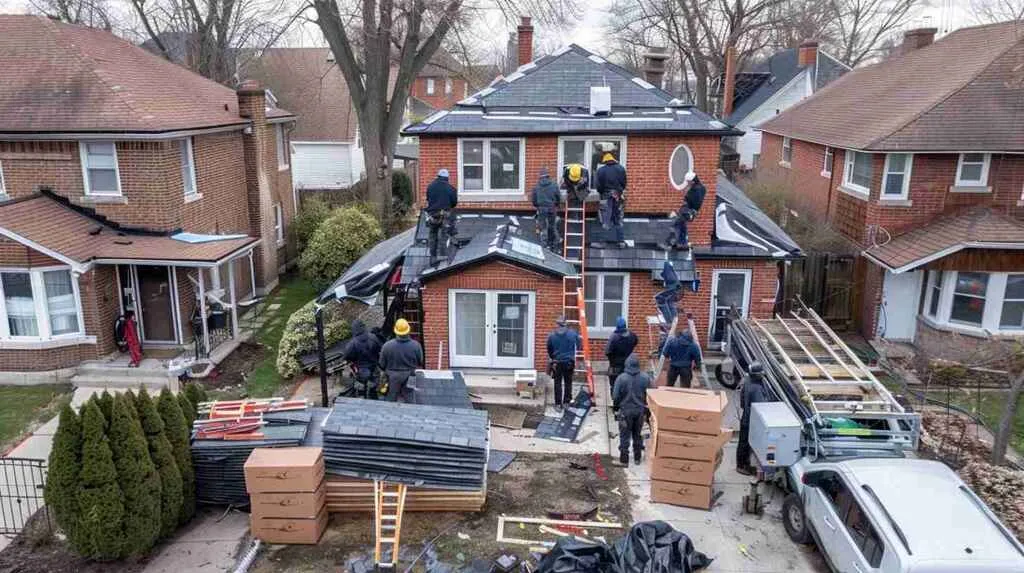
Barndominium with Shingle Roof Queens NY – What It Involves | Free Quotes
Blueprint’s the wrong word for what most people bring me when they’re turning an old Queens barn or warehouse into a barndominium-usually it’s a back-of-napkin sketch and a lot of enthusiasm. The surprise is how often these homeowners pick shingle roofs over metal, even in an urban setting where you’d think standing seam would rule. But here’s the thing: that choice lives or dies on one structural detail that gets decided before the first nail goes in-roof pitch.
If you don’t get the slope right from the start, you’re not just buying a roof that looks wrong; you’re buying a slow leak that’ll show up on the first heavy Queens rain and never really stop.
Is a Shingle Roof Right for Your Queens Barndominium?
Here’s my unfiltered opinion: a barndominium with a shingle roof can be brilliant in Queens, or it can be a slow-motion disaster, and the difference starts on the drawing board. Roof pitch is the make-or-break detail, and I mean that literally-if your pitch is wrong, the shingles will fail no matter how much you spend on materials. Let me walk you through the water story on a proper slope: a single raindrop lands on your ridge, gravity pulls it down an architectural shingle that’s laid at, say, a 5:12 pitch, the drop accelerates across the smooth surface, rides the overlap to the next shingle, never ponds, never sits, and ends up in your gutter two seconds later. That’s how it’s supposed to work. Drop that same raindrop on a 1:12 or 2:12 slope and it hesitates, pools in the tiny gaps between shingle tabs, works its way under the edges when wind pushes it sideways, and eventually finds a nail hole or a seam in your underlayment.
On a typical Queens block, you don’t expect to see a barn-style home squeezed between two brick colonials, but that’s exactly what I walk into more often now. Homeowners are picking shingles over metal for a few solid reasons: shingles are quieter when JFK flight paths send planes rumbling overhead every four minutes, they cost less upfront for most roof shapes, and they blend visually with the neighborhood instead of screaming “I used to store hay.” But-and this is the part where I lose people who just want to hear good news-if your roof pitch is below about 4:12, you really shouldn’t use standard asphalt shingles on a barndominium. Technically you can go as low as 2:12 with special underlayment and a lot of expensive detailing, but anything flatter than that and you need a completely different roofing system. I’ve seen too many beautiful barn conversions in Maspeth and Woodside where someone tried to cheat the pitch, and now they’re dealing with stains on their vaulted ceilings.
Shingle Roof vs Metal Roof for Queens Barndominiums
Shingle Roof on Barndominium
- ✓ Quieter in Queens rain and plane noise; better for bedrooms near the roof.
- ✓ Lower upfront cost for most roof shapes, easier to repair small areas.
- ⚠ Needs proper pitch (ideally 4:12 or steeper) and robust underlayment.
- ⚠ Shorter lifespan than metal (about 20-30 years with good ventilation).
- ✓ Blends visually with surrounding Queens homes and HOAs more easily.
Metal Roof on Barndominium
- ⚠ Louder without added insulation, especially under heavy Queens rain.
- ⚠ Higher upfront cost, especially on complex rooflines.
- ✓ Can handle lower slopes better than shingles when detailed correctly.
- ✓ Longer lifespan (40+ years) but repairs and matching panels can be trickier.
- ⚠ More overt “barn” look that may stand out on a tight Queens block.
| Myth | Fact |
|---|---|
| “If the old barn roof is holding now, you can just add shingles on top.” | Existing barn decks often weren’t framed for shingle loads or modern codes; layering over can trap moisture and hide rot. |
| “Any pitch is fine for shingles as long as you use ‘good materials.'” | Below about 4:12 pitch, you need very careful detailing and some slopes are simply wrong for standard shingles. |
| “Barndominiums don’t need much roof ventilation because there’s lots of open space inside.” | Open interiors often mean less concealed attic space, making intentional intake and exhaust ventilation even more critical. |
| “Shingles can’t handle Queens wind on big barn-style roofs.” | Proper nailing patterns, starter strips, and wind-rated shingles handle Queens gusts well, even on wide spans. |
| “Shingle roofs always look out of place on a barndominium.” | With the right color and profile, shingles can complement both barn architecture and neighboring Queens homes. |
Pitch, Layout, and Wind: How We Design Shingle Roofs for Queens Barndominiums
I still remember the first time I saw a barndominium framed wrong for shingles-everything about the ceiling looked gorgeous, and everything about the roof was doomed. One August afternoon in Maspeth, it was 94 degrees and the humidity felt like soup. A couple was converting a metal-sided storage barn into a barndominium, and they wanted to keep the old nearly-flat roof and just “throw shingles on it.” I remember standing on that roof, sweat running into my eyes, explaining why a low-slope like that with shingles is basically an invitation for ponding and leaks. We ended up redesigning the structure with added rafters to increase pitch, and I still use that job as my go-to example of why shingle roofs and slope are non-negotiable on a barndominium. Maspeth’s full of these old warehouse conversions, and they almost all start with the same problem: the existing structure was built for commercial storage with the flattest roof possible to maximize ceiling height inside, and that’s exactly backward from what you need for residential shingles.
Now let’s walk the roof from ridge to eave and talk about how pitch actually works in real numbers. When I sketch a side-view “rain path” on cardboard for clients-yeah, I do this on actual pizza boxes sometimes-I’m showing them how 4:12 pitch means the roof rises four inches for every twelve inches of horizontal run. That’s the comfort zone for architectural shingles on barndominiums: water moves fast, valleys drain clean, and you’ve got room to work with dormers or covered porches without creating weird flat pockets. Go steeper, say 6:12 or 8:12, and you get even better water performance, but now you’re dealing with taller walls, more material, and accessibility challenges when it’s time to clean gutters or patch a shingle. Drop below 4:12 and you’re in the danger zone-between 3:12 and 4:12 you can still use shingles, but you need to obsess over underlayment, limit complex valleys, and avoid any roof-to-wall tie-ins that create horizontal ledges where water wants to sit. The layout matters just as much as the pitch: big, clean slopes without a lot of interruptions generally perform better in Queens wind, and barn-style gables demand precise shingle patterning because those wide-open faces catch gusts head-on.
Wind’s the other half of the design story, and I’ll get into the Whitestone windstorm disaster in detail later, but for now just understand that those big, broad barn-style roof planes are beautiful and simple until a nor’easter rolls through. When I’m planning shingle layout for a barndominium, I’m looking at exposure-is your building tucked behind a row of two-story homes in Glendale, or is it standing alone near the water in Broad Channel?-and I’m calculating fastening patterns zone by zone. The code calls for different nailing specs at edges, ridges, and field areas, and on a barn roof where you might have 40-foot gable runs with no interruptions, those specs aren’t suggestions.
| Roof Pitch (Rise/Run) | Shingle Recommendation | Design Notes for Barndominiums |
|---|---|---|
| Below 2:12 | Do not use standard asphalt shingles; consider low-slope systems or metal. | Redesign structure or choose a different roofing system for long-term performance. |
| 2:12 to 3:12 | Use specialty underlayment and enhanced waterproofing; only with careful detailing. | Limit complex valleys and roof-to-wall tie-ins; avoid large dead-flat areas. |
| 4:12 to 6:12 | Ideal range for architectural shingles on barndominiums. | Good balance of aesthetics and performance; allows for dormers and covered porches. |
| Above 6:12 | Excellent for shedding Queens rain and snow; plan for safe access during maintenance. | Mind wind exposure on tall gables; ensure strong fastening and bracing. |
How I Evaluate Your Barndominium Roof Design in Queens
Walk the Existing Structure or Review Plans
I physically walk the roof deck if it’s already framed, or I sit down with your drawings and measure pitch, span, and any transitions between roof planes.
Sketch the Water Story
Using cardboard or a notepad, I draw the side profile and literally trace where rain will land, flow, and exit-looking for any spot where water might hesitate or pond.
Check Wind Exposure and Code Zones
I note your location in Queens, nearby buildings or trees that might block wind, and determine which nailing and fastening zones apply under NYC code.
Map Ventilation Paths
I figure out where intake air enters (soffits, gable vents) and where exhaust leaves (ridge vents, powered fans) to make sure your roof deck can breathe properly.
Recommend Shingle Type, Underlayment, and Timeline
Based on everything above, I tell you which architectural shingles will work, what underlayment you need, and how long the install will take so you can plan your move-in.
Noise, Ventilation, and Everyday Comfort Under a Shingle Roof
When I meet a homeowner asking about a barndominium with a shingle roof, the first question I ask is, “How long do you plan to live here, and how much noise can you tolerate?” That’s not a joke-it’s the beginning of the comfort conversation, and it matters more on a barn-style home than on a standard ranch. One chilly November evening in Glendale, I was finishing a shingle roof on a barndominium that had a big vaulted great room with exposed beams. The owner was obsessed with keeping every inch of that ceiling open and refused to box in any ductwork. Halfway through, we realized the original plans had almost no real ventilation path for the roof deck. I sat at their kitchen table with a cup of too-strong coffee, drawing air flow arrows on a pizza box, walking them through why ridge vents plus smart intake vents were the only way to keep their shingles from baking and their attic area from molding up. We adjusted the build mid-stream, and that roof is still performing perfectly. Here’s the insider tip I gave them and I’ll give you: combine continuous ridge vents with properly sized soffit intake vents-use the 1:300 rule as a starting point, meaning one square foot of net free vent area for every 300 square feet of attic floor-and install baffles between each rafter bay to keep insulation from blocking airflow. On a barndominium where you might not have a traditional attic but instead have cathedral ceilings or lofts, those baffles become even more critical because air needs a clear path from eave to ridge.
Now let’s talk noise. Shingles are quieter than metal, full stop. If you’ve got bedrooms or a loft directly under the roof and you’re anywhere near the JFK flight path, LaGuardia approach, or even just heavy rain rolling off the Atlantic, you’ll notice the difference. Metal roofs drum when rain hits them-some people love that sound, others can’t sleep through it-but architectural shingles absorb and deaden impact noise. The trick is that comfort also depends on your insulation and deck thickness. A barndominium with 2×6 rafters, spray foam insulation, and 5/8-inch OSB deck will stay quieter and more temperature-stable than one with 2×4s and fiberglass batts. Ventilation ties back into this because proper airflow keeps your roof deck cooler in Queens summers-think mid-90s with humidity that makes the shingles feel like they’re melting-and prevents ice dams and condensation in chilly Novembers. When those systems work together, you get an interior that feels solid, quiet, and dry year-round.
Key Comfort Decisions for a Shingle-Roof Barndominium in Queens
-
✓
Install continuous ridge vents paired with soffit or gable intake vents to create steady airflow across the roof deck. -
✓
Use vent baffles in every rafter bay to keep spray foam or batt insulation from blocking air channels, especially on cathedral ceilings. -
✓
Upgrade to thicker decking (5/8″ OSB or plywood) for better noise dampening and structural stability on wide barn spans. -
⚠
Don’t skip insulation under the roof deck just because your interior is open-heat transfer and noise both worsen without it. -
⚠
Avoid blocking soffit vents with insulation or storage in finished loft areas-blocked intake kills the whole ventilation system. -
⚠
Don’t rely on gable vents alone on a big barndominium roof-dead zones in the middle won’t get fresh air without ridge ventilation.
Ventilation and Comfort Checkpoints After Your Shingle Roof Is Installed
First Heavy Rain: Walk through your interior during and after a downpour, checking for any signs of moisture, staining, or drips near ridge beams, valleys, and wall tie-ins.
Summer Heat Check: On a 90-degree day, feel the underside of your roof deck or exposed beams-they should be warm but not hot to the touch, indicating ventilation is working.
Annual Vent Inspection: Clear any debris from soffit intakes and ridge vents, confirm baffles are still in place, and check that no insulation has shifted to block airflow.
Professional Roof Inspection: Have a roofer walk the deck, check shingle condition, re-seal any lifted edges, and verify that ventilation components haven’t degraded.
Queens Codes, Wind, and What a Proper Install Really Looks Like
The blunt truth is, your barn-style dream doesn’t care about Queens building codes, but the inspector definitely does. In 2021, right after a brutal windstorm, I got a call at 6:30 a.m. from a woman in Whitestone who’d turned her family’s old horse barn into a barndominium. Half her architectural shingles were sitting in the neighbor’s yard because the original contractor skipped proper nailing patterns and starter strips along the big gable. I spent the day carefully stripping back the damaged areas, redoing the underlayment, and re-flashing a weird roof-to-wall transition over her loft. That project taught me how unforgiving Queens wind can be on these big, broad barn-style roofs if you don’t anchor shingles correctly. The specific problem was that the first contractor used random tab nailing instead of the manufacturer’s six-nail pattern, and he didn’t install a proper starter course at the eaves-so when wind got under the bottom edge, it just peeled shingles off like Post-it notes. Queens sits right on the water with exposure to nor’easters and summer thunderstorms that pack serious gusts, and wide barn-style roof planes catch that wind head-on. Code-compliant fastening isn’t optional; it’s the difference between a roof that lasts 25 years and one that needs emergency repairs every two winters.
Let me walk you mentally from ridge to eave to wall tie-in and narrate the water story on a properly installed shingle roof. A single drop of Queens rain lands on the ridge cap shingles-those are specially cut and nailed in an overlapping pattern so wind can’t lift them. The drop accelerates down the first architectural shingle, which is nailed with six fasteners in the proper pattern and overlaps the one below it by exactly the amount the manufacturer specifies. It crosses the field shingles, each one bedded on a high-quality synthetic underlayment that’s lapped and sealed, and reaches the starter course at the eave-that’s a special strip that prevents wind uplift and gives the first full shingle something to seal against. From there it hits the drip edge, a metal flashing that directs water into the gutter and away from the fascia board. At every roof-to-wall transition-say, where your barndominium’s main roof meets a covered porch or a bump-out-there’s step flashing woven into the shingle courses and tucked under the siding, so water can’t sneak behind. At Shingle Masters, we document every one of these details with photos during the install, so you’ve got a clear record that your roof was done to code and you’re not guessing when the inspector shows up or when you need to file an insurance claim five years down the road.
⚠️
Common Code and Installation Mistakes on Queens Barndominium Shingle Roofs
- Skipping or improperly installing starter strips at eaves and rakes, leaving edges vulnerable to wind uplift and water infiltration.
- Using the wrong nailing pattern-random placement instead of the manufacturer’s six-nail spec-especially on high-wind zones near gables and ridges.
- Failing to integrate step flashing at roof-to-wall transitions, which is the #1 leak point on barndominiums with attached covered porches or loft bump-outs.
- Overlaying new shingles on an old barn deck without verifying load capacity or addressing hidden rot and moisture damage underneath.
Why Queens Barndominium Owners Hire Shingle Masters
Luis has installed shingle roofs on barn conversions, mixed-use warehouses, and custom barndominium builds across Queens since 2006.
You’ll get cardboard sketches and plain-language walkthroughs of pitch, ventilation, and water flow-not corporate jargon and guesswork.
Every critical detail-underlayment laps, nailing patterns, flashing tie-ins-is photographed during the job so you have proof for inspectors and insurance.
From Maspeth warehouse conversions to Whitestone waterfront exposure, Luis knows the quirks, wind zones, and inspection standards across every Queens neighborhood.
Costs, Next Steps, and When to Call for a Free Shingle Roof Quote
$18,000. That’s a real-world ballpark for a mid-sized Queens barndominium shingle roof-say, 1,800 square feet of roof deck with a straightforward gable design and a 5:12 pitch-but design complexity, pitch changes, dormers, and local structural upgrades can swing that number up or down by several thousand dollars. A site visit lets me walk the roof path with you, sketch your options on cardboard, and turn your water story into a fixed number on paper instead of guessing over the phone.
Typical Shingle Roof Investment Ranges for Queens Barndominiums
| Barndominium Scenario | Roof Size (Approx.) | Typical Price Range |
|---|---|---|
| Small conversion, simple gable, 4:12 pitch | 1,200-1,500 sq ft | $12,000-$16,000 |
| Mid-size barndominium, 5:12 pitch, one dormer | 1,800-2,200 sq ft | $18,000-$24,000 |
| Large custom build, complex valleys, 6:12+ pitch | 2,500-3,000 sq ft | $26,000-$35,000 |
| Existing barn re-roof with structural pitch upgrade | 1,500-2,000 sq ft | $20,000-$30,000 |
| Waterfront or high-wind zone, premium wind-rated shingles | 2,000+ sq ft | +$3,000-$6,000 above base |
Prices assume professional installation, code-compliant materials, proper ventilation, and all required permits for Queens, NY. Structural repairs, deck replacement, or major framing changes add to the base cost.
Common Questions About Barndominiums with Shingle Roofs in Queens, NY
How long does a shingle roof last on a Queens barndominium?
With proper pitch (4:12 or steeper), good ventilation, and quality architectural shingles, you’re looking at 20 to 30 years in Queens. Poor ventilation or low slope can cut that lifespan in half, and coastal wind exposure means you should inspect and maintain it more often than an inland suburban roof.
Do I need special permits to re-roof a barndominium in Queens?
Yes-any re-roof or new roof in NYC requires a permit, and if you’re modifying the structure to change pitch or add dormers, you’ll need plan approval from the Department of Buildings. A licensed contractor like Shingle Masters handles the paperwork and inspections as part of the job.
How long does a shingle roof install take on a barndominium?
For a mid-sized barndominium (around 1,800 square feet of roof), expect 4 to 7 days depending on weather, complexity, and whether we’re tearing off an old roof first. Larger or more complex roofs with multiple pitches, dormers, or structural upgrades can take 10 to 14 days.
Can I switch from metal to shingles on an existing barndominium roof?
Absolutely, as long as the pitch is right. Metal roofs can often handle lower slopes than shingles, so if your existing metal roof is below 4:12 pitch, you’ll need to either redesign the framing or stick with metal. If the pitch works, we strip the metal, inspect and repair the deck, install proper underlayment, and shingle it like new.
Can you install shingles on a barndominium roof in winter in Queens?
Yes, but with limitations. Most asphalt shingle manufacturers require temperatures above 40°F for proper seal-down, so we schedule winter installs during warmer stretches and use hand-sealing techniques when needed. Snow, ice, and frozen deck conditions can delay the job, so fall or spring is ideal for barndominium re-roofs in Queens.
What to Have Ready Before You Call Shingle Masters for a Barndominium Roof Quote
-
☑
Rough roof dimensions (length, width, or total square footage if you know it) and the number of roof planes or sections. -
☑
Current pitch or roof angle if you know it, or just describe whether the roof looks steep, moderate, or nearly flat. -
☑
Photos of the roof from the ground and any visible problem areas-leaks, lifted shingles, or weird transitions. -
☑
Your Queens address so Luis can factor in local wind exposure, permit requirements, and travel for the site visit. -
☑
Interior layout details-are there vaulted ceilings, exposed beams, or lofts directly under the roof that affect ventilation planning? -
☑
Timeline and budget range you’re working with, so we can tailor the quote to what makes sense for your project.
If you’re serious about turning that Queens barn or warehouse into a home you’ll actually want to live in, the roof decision isn’t something you wing on a weekend. Let me walk your design with you-literally or on paper-sketch out the water story, and price it so you know exactly what you’re getting. Call Shingle Masters for a free, no-pressure shingle roof quote in Queens, NY, and we’ll make sure your barndominium roof works the way it’s supposed to from day one.