Blueprint first: yes, a barndominium in Queens can absolutely have a shingle roof, but only if the roof framing, decking, and wind-resistant detailing are engineered specifically for that tall, wide building type-not slapped together like a basic ranch house. Here’s my honest opinion: your barndominium can absolutely wear shingles-as long as its bones are right. Most people think of a barndominium as just a big garage with some bedrooms tossed in, and they picture the roof as a simple gable-easy, right? But when you’re dealing with those long spans, taller walls, and Queens wind coming off the bay or swirling around JFK flight corridors, that roof assembly has to be designed from the ground up, like a real blueprint. I still draw it on pizza boxes sometimes: cross-section view, showing the rafters or trusses, the deck thickness, the shingles on top, and all the bracing and uplift clips hidden underneath that nobody ever sees but that keep the whole thing from peeling off in a Nor’easter.
One August afternoon in Maspeth, with planes dragging shadows across a steel-framed barndominium shell, I had a couple arguing on the gravel about metal vs. shingles while the humidity felt like soup. He wanted the “barn look,” she wanted something quiet and cozy. I walked them up a temporary scaffold, had them listen to a passing JetBlue over a metal test panel, then over a multilayer shingle mockup. By the time we climbed down, they both decided on an upgraded shingle assembly because, as she said, “I’m not living in a drum set.” That job taught me something simple: in Queens, where you’ve got airport corridors, highway noise, and dense neighborhoods, a properly installed shingle roof on a barndominium can actually be quieter and more comfortable than metal-if the structure underneath is built to handle the weight, the wind, and those big open spans without flexing or letting the shingles curl at the edges.
Myth vs. Fact: Shingle Roofs on Queens Barndominiums
| Myth | Fact |
|---|---|
| Barndominiums are just big sheds, so any shingle works fine. | The long spans and tall walls create different wind loads and deflection patterns. You need engineered framing, thicker decking (often 5/8″ or 3/4″), and high-wind shingles rated for Queens’ exposure. |
| Shingles are too noisy under JFK and LaGuardia flight paths. | A multilayer shingle assembly (quality underlayment + dimensional shingles) is actually quieter than bare metal, especially during rain and low overflights-proven on that Maspeth job. |
| Shingles can’t handle the wind on a big, flat barndominium roof. | When installed with proper starter strips, enhanced nailing (6-nail pattern in the field, hand-sealed edges), and uplift clips on the deck, high-wind shingles (110+ mph rated) perform well even on larger roofs in Queens. |
| Building codes in Queens won’t allow shingles on a barndominium. | Queens (NYC) code treats barndominiums as residential or mixed-use structures. Shingles are absolutely allowed-they just need to meet the same wind, fire (Class A), and structural attachment standards as any other residential roof here. |
The Structural Blueprint: What Has to Be Different on a Barndominium Roof
Framing, Decking, and Wind in Queens
When you ask me, “Can a barndominium have a shingle roof?” I shoot back with my own question: “What’s holding that roof up?” Think of your barndominium like a big umbrella: the bigger and flatter it is, the more the wind wants to snatch it away. In Queens, you’re dealing with Nor’easters rolling in off the Atlantic, gusty days around the airports, and those weird wind-tunnel effects you get in open neighborhoods like Howard Beach, Jamaica, or out near the edge of Queens Village. A typical ranch house might have 16-foot rafter spans and a low, tight roof profile-easy for shingles. But your barndominium? You’re looking at 20-, 30-, sometimes 40-foot clear spans, taller sidewalls, and big roof planes that catch wind like a sail. That means your framing-whether it’s engineered trusses or steel purlins with wood over the top-has to be stiff enough that the deck doesn’t flex and pop nails, and your decking needs to be thicker (5/8″ or 3/4″ plywood or OSB) so it doesn’t sag between supports or let the shingles ripple.
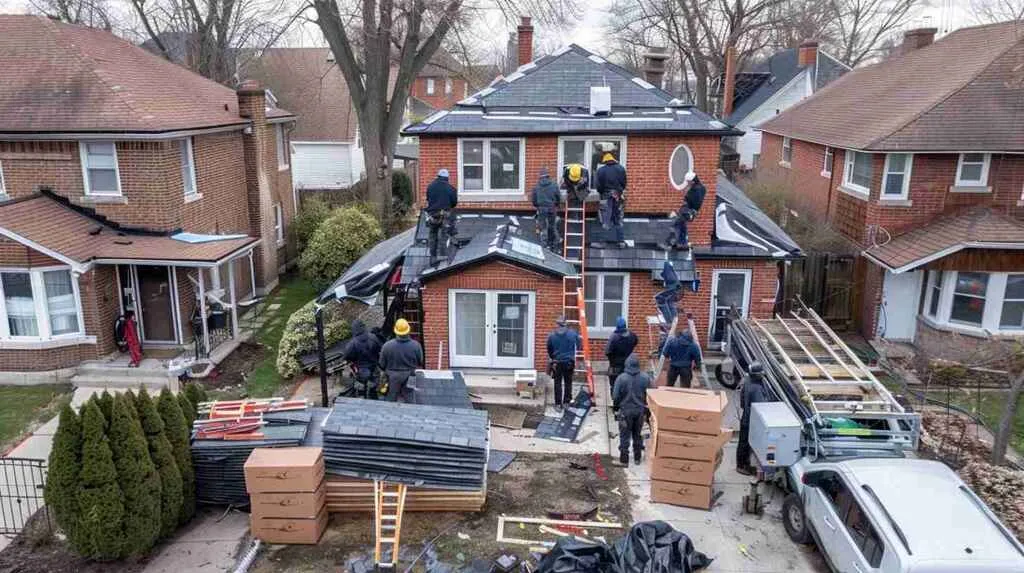
In late November, just before first frost, I was in Queens Village re-roofing a barndominium that had been botched by a guy who treated it like a regular ranch house. The roof deck had 4-foot overhangs and no proper bracing, and the shingles were literally curling at the gable edges because the wind uplift was brutal. I remember standing there in a cold drizzle at 7 a.m., coffee in one hand, explaining to the owner how we’d redesign the overhangs and use a high-wind shingle system so his “barn loft” didn’t peel off in the first Nor’easter. We ended up shortening the overhangs to 2 feet, adding ladder blocking and outrigger bracing at the gables, installing hurricane clips at every rafter-to-deck connection, and using a 6-nail shingle pattern with hand-sealed tabs. Picture the roof from the side, like a simple sketch: you’ve got your rafters or trusses running perpendicular to the ridge, your deck sitting on top, then your underlayment and shingles. At the overhang, that deck is cantilevered out past the last rafter-if it’s too long and not braced, Queens wind gets under there and starts lifting. Add proper bracing, shorter overhangs, and real uplift hardware, and suddenly your shingle roof behaves like it should.
| Feature | Typical Small House Roof | Barndominium Roof for Shingles in Queens |
|---|---|---|
| Rafter/Truss Span | 12-20 feet, standard 2×6 or 2×8 rafters | 20-40+ feet, engineered trusses or steel frame with wood purlins; requires engineered stamped plans |
| Overhang Length | 12-18 inches, minimal bracing needed | Limited to 18-24 inches max, with ladder blocking or outrigger bracing at gables to prevent uplift and curling |
| Roof Deck Bracing | Standard nailing, 6″ on edges / 12″ field | Enhanced nailing (4-6″ on edges), plus hurricane clips or structural screws at every rafter connection in high-wind zones |
| Decking Thickness | 1/2″ OSB or plywood, acceptable for small spans | 5/8″ or 3/4″ plywood/OSB to minimize deflection over longer purlin or rafter spacing and support shingle warranty |
| Uplift Hardware | Often none, or basic toe-nails | Hurricane clips, straps, or structural screws at all rafter-to-wall and rafter-to-ridge connections; required for Queens wind ratings |
Warning: Don’t Treat Your Barndominium Like a Regular House
Risks you’re taking if you skip proper engineering in Queens wind:
• Long overhangs without bracing: Wind gets underneath, lifts the deck, pops shingle nails, and curls tabs within the first year.
• Undersized decking (1/2″ or thinner): Deck flexes between supports, shingles crack, leaks start at nail holes.
• No hurricane clips or uplift hardware: In a 60+ mph gust (common in Queens Nor’easters), the entire roof deck can start to separate from the framing-catastrophic failure risk.
• Generic 4-nail shingle pattern: Standard residential nailing isn’t enough on big, exposed roof planes; you need 6-nail field pattern and hand-sealed edges for real wind resistance.
Bottom line: skipping these details turns your barndominium roof into a liability, not an asset.
Shingles vs. Metal on a Queens Barndominium: Which Roof Picture Fits You?
Here’s the thing: both materials can work on a barndominium in Queens, but they behave very differently once they’re up there. Picture your roof from the top down-big rectangle, maybe some dormers or a ridge vent running down the middle-then imagine it finished in standing-seam metal versus dimensional asphalt shingles. Metal is loud during rain and plane overflights, goes on fast, and handles big open spans with fewer seams, but every penetration (vents, skylights, chimneys) becomes a custom flashing detail that costs real money. Shingles are quieter, easier to repair in small sections, give you more color and style options to match the neighborhood, but they demand perfect underlayment, proper wind detailing, and attention to transitions where roof planes meet. And honestly, don’t pick between them based only on the upfront material cost-factor in the sound under those JFK flight paths, how you’ll handle future repairs, and whether your roof has complex hips, valleys, or shed-roof additions that make metal flashing a nightmare.
Asphalt Shingles on Barndominium
- Noise: Much quieter during rain and overflights; multilayer assembly dampens sound well
- Upfront Cost: Moderate; quality high-wind package runs $4.50-$7/sq ft installed in Queens
- Wind Resistance: Excellent when properly detailed (110-130 mph ratings available with enhanced nailing)
- Maintenance: Easy to patch/replace individual shingles; local roofers familiar with repairs
- Aesthetic Flexibility: Wide color/style range; blends into Queens residential neighborhoods easily
Metal Roofing on Barndominium
- Noise: Loud during rain/hail and low plane passes unless you add insulation or sound board underneath
- Upfront Cost: Higher; standing-seam typically $8-$12+/sq ft installed; custom flashing adds cost
- Wind Resistance: Excellent; mechanically fastened panels resist high wind inherently
- Maintenance: Very low; but repairs require specialized tools/skills and panel matching can be tough years later
- Aesthetic Flexibility: Limited colors; rural/industrial look may clash with some Queens neighborhoods
| Pros of Asphalt Shingles | Cons of Asphalt Shingles |
|---|---|
| Quiet and comfortable, especially under airport flight paths and in urban noise | Requires very precise wind detailing (enhanced nailing, sealed edges) on large roof planes to avoid blow-off |
| Easy to repair and match; any Queens roofer can patch a section without special tools | Shorter lifespan than metal (20-30 years typical vs. 40+ for metal) in Queens’ freeze-thaw cycles |
| Wide range of colors and architectural styles; easier to blend with residential neighbors | More vulnerable to algae, moss, and staining in humid Queens summers if not algae-resistant shingles |
| Lower upfront cost than metal for equivalent wind rating and performance | Complex roof transitions (valleys, hips, dormers) need careful flashing and can be leak-prone if rushed |
How We Build a Queens-Ready Shingle Roof for Your Barndominium
From first sketch to final nail
Blunt truth: if you treat a tall, wide barndominium like a little Cape house, Queens wind will prove you wrong fast. The barndominium can wear shingles-as long as its bones are right-but that means we start with the structure, not the color swatch. First, we evaluate your framing: are your trusses or rafters engineered and stamped, or are they generic lumber that’ll flex? Is your deck thick enough and fastened with hurricane clips or just toe-nailed? Then we design the roof assembly like a real blueprint: underlayment choice (synthetic is best; we often use a high-temp ice & water shield in valleys and at eaves even though code doesn’t mandate it everywhere), shingle selection (dimensional, high-wind rated, algae-resistant), and the nailing/sealing pattern for Queens’ exposure. Picture that cross-section again: you’re walking from inside the barndominium, up through the insulation and vapor barrier, onto the deck, then the underlayment, then the shingles on top-every layer matters, and every transition (ridge, hip, valley, penetration) is where cheap installs fail.
One job that still bugs me was a summer project in Ridgewood where the owner insisted on the cheapest shingle because “it’s just a barn with beds.” Six months later, during a nasty wind-driven rain at about 10 p.m., he called me in a panic-water stains blooming across his vaulted great room. I drove over, flashlight in my teeth, tracing the leak path up a poorly flashed transition between the steep barndominium roof and a lower shed roof. The original guy had used step flashing that was too short, no ice & water shield, and a basic 3-tab shingle that had already started to curl. We ended up tearing back a big chunk and rebuilding with better shingles (architectural, 130-mph wind rating) and a full ice & water shield underlayment at that transition, plus proper counterflashing and a kickout diverter at the bottom. He told me I was right, and I told him I’d prefer being wrong and dry. That Ridgewood job taught me to never skip the details at roof transitions on a barndominium-those spots where planes change direction or height are where water wants to sneak in, and once it’s inside that big open structure, it can travel 20 feet along a rafter before you see the stain.
Step-by-Step: Installing a Barndominium Shingle Roof in Queens
-
1
On-Site Structural Assessment: We visit your Queens property, measure the roof planes, check framing type and spacing, verify deck thickness, and look for existing uplift hardware or lack thereof. We also review local wind zone and proximity to open water/airport corridors. -
2
Blueprint-Style Roof Plan: We sketch (literally) a plan and cross-section showing deck layout, underlayment zones (ice & water shield at eaves, valleys, and complex transitions), shingle layout, and nailing/bracing upgrades needed. You see exactly what’s going in before we touch a nail. -
3
Material Selection & Specification: Choose your shingle (we recommend architectural, 110-130 mph wind rating, Class A fire, algae-resistant), underlayment (synthetic or rubberized), and all flashing/trim metals. We provide samples and explain warranties-both manufacturer and our workmanship guarantee. -
4
Deck Prep & Structural Upgrades: Install or verify hurricane clips, add ladder blocking at overhangs if needed, replace any damaged or undersized decking, and ensure the whole deck is stiff and secure before the first roll of underlayment goes down. -
5
Installation (Underlayment, Flashing, Shingles): We start at the eaves with drip edge and ice & water shield, work up the roof in courses, hand-seal all perimeter and high-wind-zone tabs, use 6-nail pattern in the field, and install all ridge, hip, and valley details to manufacturer high-wind specs. -
6
Final Inspection & Post-Storm Check Advice: Walk the roof with you (or show photos/video), confirm all penetrations are sealed, ridge vent is secure, and gutters/downspouts are clear. We also give you a simple checklist for what to look at after the first big Queens storm.
💰 What Does a Barndominium Shingle Roof Cost in Queens?
Every barndominium is different-size, roof complexity, and existing structure all matter. Here are five real-world scenarios with estimated price ranges (materials + labor, as of 2025 in Queens, NY). These are not quotes, just ballpark figures to help you plan:
| Scenario | Description | Estimated Price Range |
|---|---|---|
| Small Barndominium, Simple Gable | 1,200-1,800 sq ft roof, basic gable, properly framed, minimal penetrations | $6,500-$11,000 |
| Medium Barndominium with Dormers | 2,500-3,500 sq ft roof, hip or gable-and-valley, 2-3 dormers, high-wind shingle package | $14,000-$22,000 |
| Large Barndominium, Complex Rooflines | 4,000+ sq ft, multiple roof planes, shed-roof additions, premium architectural shingles, ice & water shield everywhere | $26,000-$42,000+ |
| Tear-Off & Rebuild (Failed Roof) | Full tear-off of old failed shingles, deck repairs, structural bracing upgrades, new high-wind system (like the Ridgewood job) | $18,000-$35,000 depending on damage extent |
| Metal-to-Shingle Conversion | Remove existing metal, add/upgrade deck and underlayment, install new shingle system with structural tweaks | $15,000-$28,000 for typical barndominium size |
Prices vary based on material choice, roof access, permit/inspection fees, and whether structural work is needed. Call for a real on-site estimate-we don’t guess from photos.
Is Your Barndominium a Good Candidate for Shingles in Queens?
On a Tuesday morning in Queens, when I’m standing in a muddy lot looking at a steel frame barndominium shell, the first thing I’m asking myself is: how tall, how wide, how exposed? If your building is taller than a standard two-story house or sits in a very open, windy spot near the water or the airport, we need to have a real conversation about whether the structure can handle a shingle system-or whether you should be looking at metal, hybrid approaches, or serious structural upgrades first.
Should Your Queens Barndominium Use Shingles? (Simple Decision Tree)
START: Is your barndominium taller than a typical two-story house (ridge above ~25 feet) or located in a very open/windy Queens area (e.g., near water, airport, wide-open lot)?
→ YES: Does the roof structure have engineered trusses/rafters and proper uplift hardware already?
→ YES: Proceed to roof complexity check below.
→ NO: Stop-need structural review and upgrades first before shingles are safe.
→ NO (building is modest height, sheltered location): Structure is likely fine; proceed to roof complexity check.
Does your roof have multiple planes, dormers, valleys, or shed-roof additions?
→ YES (complex roof): Shingles can work well here-easier to flash transitions than metal-but only with proper underlayment and detailing. Expect higher labor cost.
Recommendation: Shingles with high-wind detailing and enhanced ice & water shield at all transitions.
→ NO (simple gable or hip): Either shingles or metal will work; proceed to noise sensitivity check.
Are you sensitive to noise, or is the barndominium under JFK/LaGuardia flight paths or near a busy road?
→ YES (noise is a concern): Strong recommendation for shingles-much quieter than metal during rain and overflights.
→ NO (noise not a big deal): Proceed to budget check.
What’s your budget and long-term plan?
→ Lower upfront cost, plan to re-roof in 20-25 years: Shingles are the best fit.
→ Higher upfront cost OK, want 40+ year roof, minimal maintenance: Consider metal or hybrid (metal main roof, shingles on dormers).
→ Unsure / want professional advice: Call for on-site assessment-we’ll walk the structure and roof plan with you.
Why Call Shingle Masters for Your Queens Barndominium Roof?
Licensed & Insured in NYC
Fully licensed contractor, carry liability and workers’ comp insurance, bonded for your protection throughout Queens.
19+ Years Roofing Experience
Been on Queens roofs since 2006; seen every wind pattern, code change, and material failure mode there is.
Barndominium & Steel-Frame Expertise
We understand the structural differences between a barndominium and a regular house, and we design the roof system accordingly-not a cookie-cutter approach.
Fast Response for Assessments
Typical turnaround within 48 hours for on-site visits in Queens; we’ll walk your structure and roof plan with you, not just email a generic quote.
Queens Neighborhood Focus
We know Maspeth, Ridgewood, Queens Village, Howard Beach, Jamaica-every micro-climate, wind pattern, and code quirk across the borough.
Blueprint-Style Communication
Victor still draws cross-sections and roof sketches so you can “see” exactly what we’re building-no jargon, no guesswork, just clear visuals and plain talk.
I still remember the first time I saw a barndominium roof in Queens try to lift like an airplane wing in a fall storm-long overhangs, no bracing, shingles flapping like flags. The owner called me the next morning, voice shaking, asking if his whole roof was going to peel off. We got it fixed, but that job taught me that barndominiums need a different blueprint from the start: the structure has to be designed for the size and exposure, the roof assembly has to be detailed for Queens wind, and every transition, overhang, and penetration has to be treated like the critical detail it is. If you’re thinking about putting shingles on your barndominium here in Queens, call Shingle Masters for an on-site assessment-I’ll walk the structure with you, sketch out a cross-section on a piece of plywood if I have to, and help you decide if a shingle system is the right fit or if we need to talk about structural upgrades, metal, or a hybrid approach first. Let’s build it right the first time.