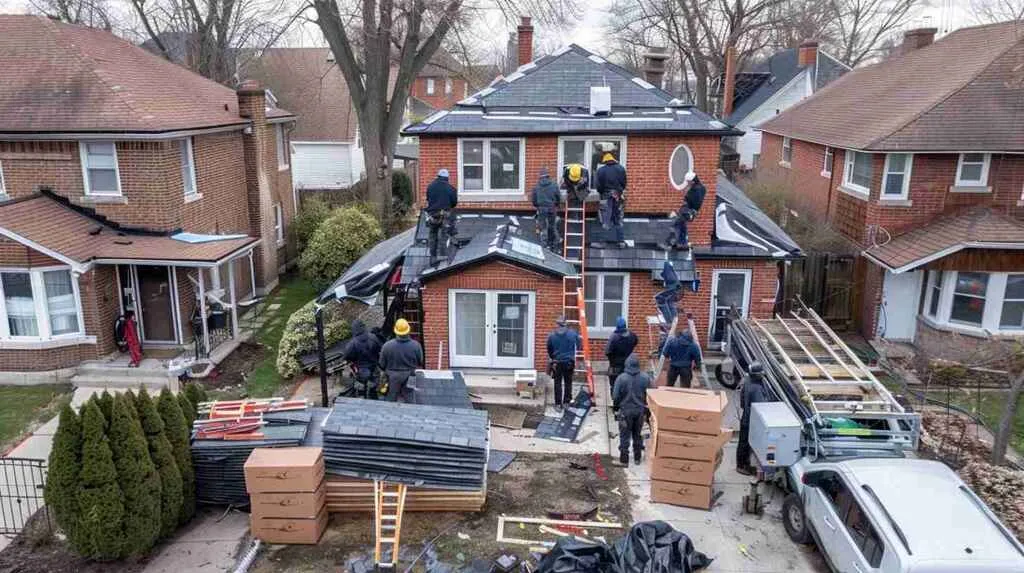
Wind Damage Wood Shake Shingles Queens NY – Expert Assessment | Free Quotes
Sideways gusts slammed Queens last night, and this morning your wood shake roof looks “fine” from the sidewalk. But if you’re reading this because you heard something rattle up there – or because a neighbor just found shake splinters on their driveway – that “fine” roof might be 24 hours from an active leak. Think of your roof like a drumhead in a strong gust: even if the drum still looks intact, the first hard hit after the tension’s gone wrong will punch straight through.
Sideways Wind, ‘Fine-Looking’ Shakes, and Why Queens Roofs Leak Overnight
On 41st Avenue last March, I saw a homeowner point up at his roof with total confidence – “Dennis, nothing’s missing, we’re good” – while I was staring at a row of shakes along the west eave that had quietly lifted a half-inch after a 50‑mph gust the week before. From the sidewalk? Perfect. From my ladder, five minutes later? Each shake was cracked at the nail line, curled just enough to funnel the next rainstorm straight under the underlayment. Judging wind damage from the street is like trying to judge a band from outside the club door: you’ll miss the real problems. And honestly, roofs that look fine can be one gust – or one windy rain – away from leaking into your ceiling.
One February morning right after a nor’easter, about 7:10 a.m., I was standing on a driveway in Bayside watching a homeowner argue with his insurance company on speakerphone. The wind had ripped three rows of wood shakes clean off the west slope, and you could see straight to the underlayment. Because I’d logged that storm in my notebook the night before – wind gusts over 60 mph from the northeast – I could tell the adjuster exactly why the pattern of missing shakes matched uplift, not “wear and tear.” That little detail got the claim approved after they’d already tried to deny it. The blunt truth: when an adjuster shows up, your memory of “it was really windy Tuesday” won’t help. A storm log, photos with timestamps, and someone who understands how Queens wind directions match damage patterns? That’s the difference between a check and a denial letter.
| Myth | Fact |
|---|---|
| If I don’t see missing shakes from the street, the wind didn’t hurt my roof. | Sideways Queens gusts often crack and loosen shakes at the edges and fasteners long before entire rows go missing. |
| Wind damage is just normal aging, insurance won’t cover it. | Documented storm events with directional damage patterns are usually classified as sudden events, not wear and tear, when properly presented. |
| Only hurricanes or nor’easters can damage wood shakes. | Gusts in the 40-50 mph range, which Queens sees regularly, can lift older or improperly nailed shakes. |
| If there’s no leak inside today, I can wait a few months. | Cracked or lifted shakes can funnel water into your underlayment the very next windy rain, causing hidden rot. |
| Any roofer can spot wind damage to wood shakes. | Wood shakes respond to wind differently than asphalt; you need someone who understands grain, nailing patterns, and local wind directions. |
How to Tell If Wind Really Hit Your Wood Shakes (Without Climbing a Ladder)
Here’s what most folks get wrong about wind damage to wood shake shingles: they expect drama. Missing rows. Shakes hanging like loose teeth. But in Queens, where gusts funnel differently block by block – coastal pressure in Bayside, river corridors in Astoria, tower-block turbulence in Jamaica – the real damage starts subtle. A 45‑mph gust down a Bayside side street can torque fasteners just enough to crack the shake at the nail line without tearing it free. The shake stays put. You see nothing from below. Then humidity swells the grain, the next wind lifts it a quarter-inch, and suddenly water’s running under your roof during a rainstorm you barely noticed.
One summer evening in Astoria, brutal humidity, about 6 p.m., I inspected a three‑story wood shake roof where the top corner looked fine from the street. Once I got up there, I found a cluster of shakes that had been quietly cracked and lifted by a wind event months before, then baked by the sun until they curled like potato chips. The owner only called because of a small stain in a bedroom ceiling – he had no idea the wind damage had basically created a funnel for water every time it rained with a breeze. I showed him slow‑motion video on my phone of similar shakes flexing in wind, and it finally clicked for him. Insider tip: after any big wind event, walk room-by-room under the roofline – top floor, near eaves – and look for faint new stains, hairline cracks in paint, or tiny water rings. You spot those? Don’t wait. Call before it becomes a buckled ceiling and a mold problem.
Street-Level Signs Your Wood Shake Roof Took Wind Damage in Queens
- ✓ Fresh wood splinters or small shake fragments on the driveway, balcony, or in gutters after a windy night.
- ✓ Shakes along the eaves that look slightly tilted, crooked, or casting uneven shadows at sunset.
- ✓ A new water stain or faint tan ring on ceilings or high wall corners after a storm with gusts.
- ✓ Light visible between shakes at the eaves when you stand back and look up along the edge line.
- ✓ Rattling or flapping sounds from the roof during gusts, even if you don’t see missing shingles.
- ✓ One side of the house consistently showing more granule dust, debris, or wear than the others after storms.
Do You Need an Emergency Wind Damage Inspection Today?
- Start: Did you have wind gusts strong enough to move patio furniture or tree branches in the last 24-48 hours?
- No → Monitor and schedule a routine wood shake check-up within the next month.
- Yes → Do you see missing, hanging, or twisted shakes anywhere along the roof edge?
- Yes → Call Shingle Masters for same-day or next-day wind damage inspection.
- No → Do you see any new ceiling stains or smell a musty odor after the storm?
- Yes → Treat it as urgent – call for a leak-focused inspection within 24 hours.
- No → Look for small debris piles or splinters at ground level; if present, schedule a professional roof assessment this week.
Our Queens Wind-Damage Wood Shake Inspection: Verse, Chorus, Fix
When I pull out my little black storm notebook, I’m usually about to show someone exactly how their roof damage tells a story – and how the repair follows like a song structure. Verse: I document what happened (wind speed, direction, date). Chorus: I identify the damage pattern (lifted nails, cracked grain, missing courses). Bridge: I explain the fix (targeted replacement, fastener correction, underlayment patch). The worst one was a job in Jamaica on a bitterly cold, clear night after a strong windstorm; it was almost 11 p.m. when I got the call from a panicked landlord. A chunk of wood shakes had torn loose, slid down, and smashed onto a tenant’s terrace, and when I climbed up I realized a previous contractor had nailed the shakes too high, so the wind had a perfect grip underneath. I had to temporarily fasten a tarp in 20‑degree weather with my fingers going numb, cursing whoever skipped the extra nails on that ridge line. That roof became my go-to “what happens when you ignore wind patterns and proper nailing” story for months.
This isn’t rushed improvisation. It’s methodical, like a bandleader building a set list. I walk the property with you, check the ground for debris patterns, then get on the roof with a camera and that beat-up notebook. Every photo gets a timestamp. Every lifted shake gets a wind-direction note. Why? Because when your insurance adjuster shows up – or when you’re deciding whether to repair one slope or multiple – you need a clear, documented plan. You’re not gambling on memory or a “looks about right” estimate. You’re working from a scored chart. And if I’m tapping out a rhythm on the ladder while I think? That’s just how I process the puzzle.
Step-by-Step Queens Wood Shake Wind Damage Inspection
- Pre-visit wind review – I check recent Queens storm records, gust speeds, and directions for your exact timeframe.
- Ground-level scan – we walk the perimeter together, looking at eaves, siding, and ground debris for wind patterns.
- Roof-level shake check – I inspect shake courses, fastener lines, and ridges for lift, cracks, and improper nailing.
- Interior leak hunt – quick look at top-floor ceilings, attic (if accessible), and ventilation paths for hidden moisture.
- Notebook rundown – I show you photos, storm notes, and a simple plan: immediate patch, targeted repair, or full section replacement if needed.
Call Shingle Masters Today (Urgent)
- Visible missing or dangling wood shakes, especially near ridges or valleys
- Active drip, new ceiling stain, or bulging paint after a windy rain
- Large splinters or broken shakes found on a balcony, terrace, or driveway
- Previous patch or tarped area has shifted or started flapping in the wind
Can Usually Wait a Few Days
- Older wood shakes that look weathered but intact, with no interior leaks
- Small cosmetic edge curls on sun-facing slopes only
- Gutters holding a modest amount of shake debris but no signs of leakage
- You just want a post-storm checkup for peace of mind and documentation
What Wind-Damage Repairs Really Cost for Wood Shakes in Queens
$350 can be the difference between a quick edge repair that stops a leak and ignoring cracked shakes until water rots your sheathing and you’re looking at a $4,000 section replacement. Real pricing depends on your slope steepness, access (three-story walk-up versus ranch), and how scattered the wind damage is. A tidy eave repair where ten shakes lifted in one neat line? That’s straightforward. Scattered damage across a whole slope because wind came from two directions during back-to-back storms? That takes more time, more matching shakes, and careful underlayment work. I’m not gonna sugarcoat it: wood shake repairs cost more per square foot than asphalt because the material’s thicker, the nailing has to be precise, and you can’t just slap patches over cracks and call it done.
Think of your roof like a drumhead in a strong gust: if one section of the head has loose tension (lifted shakes), the whole drum sounds wrong when you strike it. Scattered wind damage across a slope is like trying to tune six spots on that drumhead separately – it takes more labor than replacing one clean section. A good repair keeps the whole “instrument” in tune, which means matching shake thickness, exposure lines, and grain direction so the roof sheds water consistently. Cutting corners saves you $200 today and costs you $2,000 in hidden leaks next winter.
| Scenario | What’s Included | Typical Price Range (Queens, NY) |
|---|---|---|
| Quick post-storm inspection only | On-site assessment, photos, storm log review, written findings | $150-$250 (often credited toward repair) |
| Minor edge repair (5-10 shakes) | Replace damaged shakes at eaves/rakes, match thickness and exposure, seal and fasten correctly | $350-$650 |
| Localized slope repair (20-40 shakes) | Tear-out of loose/cupped shakes, replacement with quality wood shakes, underlayment touch-up | $850-$1,600 |
| Emergency tarp and stabilization at night or in active leak | Trip charge, temporary tarp, emergency fastening, return visit estimate | $450-$900 |
| Insurance-backed storm repair section | Detailed documentation, adjuster coordination, section repair or partial re-shake | $2,000-$5,000+ depending on slope size |
Queens-Specific Wind Patterns, Maintenance Rhythm, and Your Next Step
The blunt truth with Queens wind is it doesn’t care how “historic” your wood shakes are or how much you paid for them in 2008. Coastal gusts from the bay, river-corridor funnels in Astoria, and the weird turbulence around elevated blocks in Jamaica all mean your roof takes hits from multiple angles every storm season. Staying ahead of wind damage – spring checks after nor’easters, fall prep before winter gusts – keeps the whole roof “in tune” so one bad gust doesn’t cascade into a $4,000 leak.
| Interval | Wood Shake Maintenance Task |
|---|---|
| Every Spring | Post-winter wind check of eaves and ridges, clear debris, look for lifted or split shakes from nor’easters. |
| Every Fall | Pre-storm-season inspection, confirm fasteners and flashing are sound before coastal winds pick up. |
| After Any Storm With 40+ mph Gusts | Ground-level walk-around and optional pro inspection focused on wind-facing slopes. |
| Every 3-5 Years | Full wood shake condition assessment, strategic replacements, and documentation for future insurance baselines. |
Why Queens Homeowners Trust Shingle Masters for Wind-Damaged Wood Shakes
Fully compliant for residential wood shake and steep-slope roofing in Queens.
From Bayside to Jamaica, thousands of local roofs inspected and repaired.
Priority scheduling after high-wind events and nor’easters.
Photos, notes, and wind-direction logs you can share with your insurance adjuster.
Wind Damage and Wood Shake Shingles in Queens – Common Questions
Can wind damage wood shake shingles even if they’re thick and high quality?
Absolutely. Thickness helps with impact resistance and longevity, but it doesn’t eliminate uplift risk when fasteners are spaced wrong, nails are set too high, or the shakes have aged to the point where the grain splits easily. Gust direction and roof exposure matter more than thickness alone – a 50‑mph gust hitting a perfectly nailed shake at the wrong angle can still crack it at the fastener line.
How fast can a small wind-damaged area turn into a leak?
In Queens, faster than you’d expect. One or two windy rainstorms after the initial damage can start pushing water under lifted or cracked shakes. If the underlayment’s old or if there’s no ice-and-water barrier at the eaves, you can go from “no visible problem” to an active ceiling drip in 24 hours. I’ve seen it happen twice on the same block in Bayside after back-to-back nor’easters.
Will you help me talk to my insurance adjuster?
Yes. Shingle Masters can provide timestamped photos, written storm notes with wind speeds and directions, and a clear explanation of why the damage pattern matches a sudden wind event rather than gradual wear. That Bayside nor’easter story I told earlier? The notebook entries and directional damage photos were what flipped the claim from “denied” to “approved.” I won’t be on the phone with your adjuster, but I’ll give you everything you need to make the case.
Do you work on historic or older wood shake roofs?
Definitely. I’ve handled plenty of older shakes in Bayside and Forest Hills where matching the original thickness, exposure, and grain pattern was critical. The key is preserving character while improving wind resistance through correct nailing schedules and proper underlayment. If your roof’s from the ’80s or earlier, I’ll source shakes that match the look but won’t repeat the fastening mistakes that probably caused the wind damage in the first place.
You don’t have to diagnose wind damage alone – and honestly, you shouldn’t try from the sidewalk. If your Queens wood shake roof took a hit from recent gusts, or if you just want peace of mind after a nor’easter, call Shingle Masters for a professional wind-damage inspection and a free, no-pressure quote. We’ve been on thousands of Queens roofs for 19 years, and we understand exactly how local wind patterns interact with wood shakes. Let’s make sure your roof stays in tune.