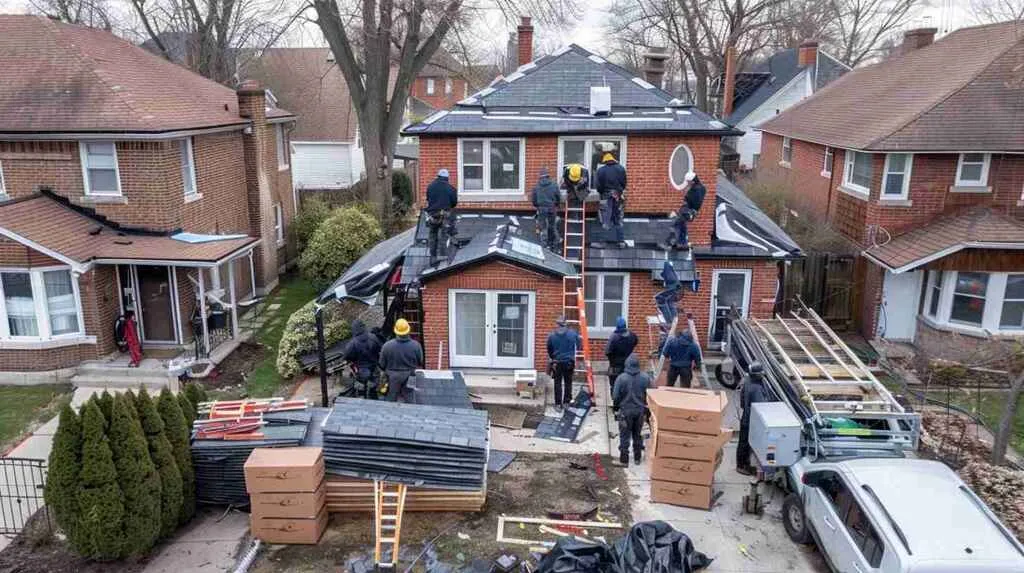
Wind Damage to Shingles Queens NY – Inspect and Repair Fast | Free Quotes
Crosswind between a brick three-story and your low-slung colonial has already loosened forty shingles before you even notice one missing. By the time you spot that torn tab lying in your backyard or see black underlayment peeking through from the sidewalk, the wind has been walking across your roof like a rude guest for months-entering at the eaves, racing down the slope, and slamming every shingle edge it passes. Rosa Delgado, who spent nineteen years on Queens roofs after trading fluorescent-lit bookkeeping for a harness and nail gun, treats wind damage the way she used to catch small errors in ledgers before they snowballed: find the quiet problems early, fix them fast, and save yourself the expensive headache later.
How Wind Really Damages Shingles in Queens (Before You Even Notice)
Think of wind as that rude guest who shows up unannounced, walks straight through your front door without knocking, takes the shortest path down your hallway, and slams every door along the way-banging the bedroom, rattling the bathroom, shaking the closet-before finally kicking the back door open and leaving. That’s exactly what happens on your roof: the gust enters at the eaves (your “front porch”), accelerates between neighboring buildings (your “hallway”), and lifts every shingle edge it encounters, loosening the seal strips, bending the tabs, and sometimes pulling nails halfway out of the deck. You won’t see any of this chaos from the street because the shingles often settle back into place after the gust passes, but the damage is done-creases form, sealant breaks, and the next round of wind picks up right where the last one left off. Not gonna lie, I’ve seen roofs that looked pristine from the sidewalk but had forty shingles ready to blow off in the next 50 mph gust, all because someone assumed “no missing pieces” meant “no problem.”
On a corner house in Woodside last winter, I watched a 40 mph gust lift shingles like playing cards being shuffled-one after another, neat as you please, then slapping back down in almost the same spot. The homeowner had called because a neighbor spotted a couple of loose tabs, but when I climbed up I found that the previous roofer had nailed every single shingle about an inch too high, which meant the wind could slide under them like fingers under a lid. I spent the whole afternoon before the next rainstorm hit, tearing off an entire slope and re-laying it to manufacturer specs, because “good enough” on a calm day is a total lie once Queens gets those crosswinds funneling between buildings. That job taught me that wind reveals bad installation the same way a strong flashlight reveals dust-you don’t notice the mess until something exposes it.
The quiet signs of wind damage are what most people miss: granules piling up in your gutters like pepper in a dish, shingles that wiggle when you gently lift a corner, tiny creases running across the middle of a tab that look fine from twenty feet below but mean that shingle will crack wide open in the next freeze-thaw cycle. It’s like bookkeeping-if you catch the small entries early, you avoid the big write-offs later. I’ve walked homeowners around their yards, pointing up at edges that don’t quite line up anymore or ridges where one shingle sits a quarter-inch higher than its neighbor, and watched the lightbulb go on: “Wait, is that wind damage?” Yes, and it’s been happening for months.
| Myth | Fact |
|---|---|
| If I don’t see missing shingles, the wind didn’t hurt my roof. | Creases, loosened nails, lifted sealant, and edge damage can be serious even when not visible from the street-many problems hide in plain sight until the next storm finishes the job. |
| Wind only rips shingles off during huge storms. | Smaller, repeated Queens gusts (30-50 mph) do long-term damage by flexing and loosening shingles over months, not just in one dramatic blow. |
| A quick tack-down is enough after shingles flap in the wind. | Flapping shingles often have broken seal strips and creased tabs that need replacement, not just more nails-tacking them down is like gluing a cracked egg back together. |
| Newer roofs in Queens don’t need wind inspections. | Newer roofs can still suffer from poor installation and local wind tunnels created by neighboring buildings-age isn’t the only risk factor in Queens. |
Wind Damage Checklist: Is This an Emergency or Can It Wait a Week?
I’ll be honest with you: wind doesn’t “like” or “hate” your roof, it just follows the easiest path, and bad installs make that path worse. In Queens, that path is almost always the gap between buildings-wind acts like water running downhill, and it’ll take any shortcut it can find. If you live on a corner in Astoria where a three-story apartment building stands next to your two-story house, the gust accelerates through that space like it’s racing through a hallway, then slams into your roof at full speed. Same thing happens in Jackson Heights when taller co-ops create wind tunnels that aim straight at lower single-family homes, or in Jamaica where open stretches near the expressway give gusts a long runway before they hit your shingles. The guest-walking-through-your-house analogy is perfect here: the wind enters your “front door” at the eaves, sprints down the “hallway” between buildings, and kicks open every “room” (shingle section) along the way-edges first, then ridges, then anything around vents or chimneys that sticks up and catches the flow.
Remember the last time you opened your oven and the heat hit you in the face? That’s how I want you to think about wind slamming into your shingles-it’s looking for the path of least resistance, and once it finds a lifted edge or a poorly sealed tab, it just keeps pushing. After any wind event in Queens, do a quick glance from the ground: look at the edges where your roof meets the sky, check the ridgeline for shingles that seem out of alignment, scan around vents and chimneys for anything that looks folded or shiny (that’s often the back of a shingle flipped up), and walk your yard for fallen pieces. You don’t need to climb up there yourself-just spot-check the “hot zones” the same way you’d glance at your stovetop burners to make sure nothing’s still on.
Do You Need Emergency Shingle Wind Damage Service in Queens Right Now?
START → Did the last storm leave visible damage or leaks?
YES → Do you see missing shingles or active leaks inside?
YES → Call Shingle Masters for emergency inspection within 24 hours.
NO → Schedule a priority inspection within 2-3 days to check for creases and lifted edges.
NO visible issues → Was there a wind advisory or gusts over 40 mph in your part of Queens?
YES → Book a preventive inspection within 1-2 weeks, especially for older roofs or corner houses.
NO → Add a roof check to your seasonal home maintenance list and call if you notice granules or ceiling spots.
Our Queens Wind-Damage Inspection & Repair Process: Room by Room on Your Roof
When I climb down and knock on your door after an inspection, the first thing I’ll ask is, “Do you want to see the safe problems or the expensive problems first?” One Saturday evening in Flushing, right before a predicted wind advisory, a landlord wanted “just a couple shingles tacked down” above a top-floor rental because he’d already promised a new tenant move-in on Monday. As the sun went down and the temperature dropped, I discovered the underlayment had been shredded weeks earlier and water had already traveled sideways under the shingles into a bedroom ceiling-way past what a “quick fix” could handle. I had to stand in his kitchen at 9 p.m., showing him photos and explaining that if we didn’t open it up properly that night, the wind tomorrow could peel half the slope and soak his tenant’s belongings before they even unpacked. That’s when I started using the house-walk analogy: I treat your roof like a floor plan-start in the “kitchen” (the main slope where most damage shows up), move to the “hallway” (edges and transitions), check the “bedroom” (ridge and high-wind zones), then inspect the “closets” (vents, chimneys, anything that sticks up). If water has traveled from one “room” to another under the shingles, a quick tack-down is like mopping the hallway floor while ignoring the burst pipe in the bathroom.
Now, slide over a few feet and look at this angle: I approach every wind-damage inspection like I’m walking you through your own house, pointing out what’s in each “room” and why it matters. First stop is always the eaves and edges-that’s where the wind enters and where most tabs lift first-then I move up to corners where two slopes meet, because that’s where gusts hit from two directions at once. Next is the ridge, which catches the worst of the crosswinds funneling between buildings, then I carefully check around every penetration-vents, chimneys, skylights-because those are the “furniture” in your roof’s “rooms,” and wind loves to swirl around obstacles. Here’s the thing: I document everything with clear photos and short videos on my phone, showing you exactly what I’m seeing in real time, and I do this whether you’re filing an insurance claim, negotiating with a landlord, or just want proof before we start repairs. That habit has saved homeowners thousands in arguments with adjusters who tried to say “that damage was already there” or “wind doesn’t do that.” Yes it does, and I’ve got the before-and-after to prove it.
Step-by-Step: What Happens When Shingle Masters Inspects and Repairs Wind Damage to Shingles in Queens
Why Queens Homeowners Call Shingle Masters for Wind-Damaged Shingles
What Wind Repairs Cost in Queens & How to Avoid the Big Bills
From about $250 for a small patch of lifted edge tabs to over $2,000 when multiple slopes need work and there’s already water damage inside-that’s the range I see most often for wind-damaged shingle repairs in Queens, and the single biggest factor in where you land is how fast you catch the problem. If you call me the day after a windstorm because you spotted a couple of loose shingles, we’re talking a few hundred dollars and maybe two hours of work; if you wait until the next nor’easter peels half your slope and soaks your bedroom ceiling, we’re talking a full day, underlayment replacement, interior drywall patching, and a bill that makes you wince. It’s the same principle I used when I kept books in Jackson Heights: catch the small entry errors early and you avoid the big audit write-offs later. These ranges are typical for Queens residential work, but every roof is different-height, pitch, shingle type, and how quickly we can safely get to you all affect the final number, so the only way to know for sure is a quick on-site inspection and free quote.
Simple Steps to Protect Your Shingles Before the Next Queens Wind Advisory
If you spread your roof out on your kitchen table like a big map, the spots that catch the most wind are the corners, ridges, and anywhere two buildings make a shortcut for the air. One August afternoon in Jamaica, brutally hot and humid, I inspected a homeowner’s roof after a summer thunderstorm that tore through overnight. He swore the roof “looked fine from the street,” but up close I saw half a dozen shingles creased clean across the middle, like someone had folded them to fit in an envelope. I remembered a similar case that later leaked during a nor’easter, so I pulled out my phone and filmed how the creased shingles flexed when I lifted them, showing him the damage in slow motion in his air-conditioned living room. That was the first time I used video as a teaching tool, and now I do it all the time so people understand that wind damage isn’t always big, dramatic missing patches-it’s often quiet, hidden problems that cost way less to fix early than to ignore until they leak. Prevention really is cheaper, and it follows the same logic I used in bookkeeping: spending a little on regular checks beats scrambling to cover a massive unexpected loss.
Too many times I’ve arrived after a storm and thought, “If someone had fixed this small section last fall, this whole mess wouldn’t be here.” Worth doing a quick pre-wind-season roof check every spring or late fall, clearing leaves and branches from valleys and gutters, and keeping an extra-close eye on high-wind zones if you live on a corner or near taller buildings. Use this short checklist before you pick up the phone.
Quick Homeowner Check Before Calling Shingle Masters for Wind Damage to Shingles
- Walk the sidewalk and backyard – note any shingles or shingle pieces on the ground.
- Stand back and look at the roof edges and ridge – do any shingles look crooked, lifted, or out of line?
- Check gutters and downspouts for an unusual amount of shingle granules after a storm.
- Look at ceilings, especially near exterior walls – any new stains or bubbling paint?
- Note the date and approximate time of the wind event and any weather alerts you received.
- Take clear photos from the ground of any suspicious roof areas or fallen debris.
- Write down your roof’s age if you know it – this helps us estimate how vulnerable it is to wind.
Common Questions About Wind Damage to Shingles in Queens, NY
Can I wait until spring to fix wind-damaged shingles if it’s not leaking now?
I wouldn’t risk it. Queens gets a mix of winter winds and nor’easters that can turn a minor crease or lifted tab into a full-blown missing patch in a single storm, and once water gets under your shingles into the underlayment or deck, the repair bill jumps from a few hundred to a few thousand. Even if you’re not seeing leaks right now, creased or loosened shingles are already compromised-they’re like a cracked egg that hasn’t spilled yet but will the second you bump the counter. At minimum, get an inspection now so you know exactly what you’re dealing with and can decide whether to fix it before winter hits or take the gamble.
Will my homeowners insurance cover wind damage to my shingles?
Most homeowners policies in New York do cover sudden wind damage-like a storm that rips off shingles or a gust that creases a bunch of tabs in one event-but they won’t cover long-term neglect or damage that’s been there for years. The key is to document the damage as soon as you notice it: take photos, note the date of the wind event, and get a professional inspection with clear before-and-after pictures. I provide detailed photo reports and basic documentation that show exactly what the wind did and what needs repair, which has helped plenty of homeowners file successful claims, but I don’t handle the insurance side myself-you’ll want to contact your adjuster directly and give them the evidence.
How long does a typical wind repair take on a Queens home?
Most wind repairs are wrapped up in a few hours to a full day, depending on how many slopes are affected, how easy it is to access your roof, and what the weather’s doing. A simple edge patch or a handful of replaced shingles on one slope? We’re usually in and out by lunchtime. A bigger job with multiple creased areas, underlayment repair, or work on a steep pitch or three-story walkup? Plan on a full day, sometimes split across two if we need to let sealant cure or wait out rain. If there’s active leaking and another storm rolling in, I’ll tarp the vulnerable spots first so you’re protected while we schedule the full repair.
Do you service my part of Queens?
Yes. I’ve worked all over Queens for nearly two decades-Astoria, Long Island City, Jackson Heights, Elmhurst, Woodside, Sunnyside, Corona, Flushing, Forest Hills, Rego Park, Jamaica, Bayside, and just about every neighborhood in between. If you’re in Queens or right on the border in a nearby area, we can get to you, and we keep same-day emergency slots open after major wind events so you’re not stuck waiting a week while your roof leaks.
Small, early wind repairs save you money and a lot of stress-catching a few creased shingles now costs hundreds, ignoring them until they leak costs thousands, and the difference is just a phone call. If you’ve noticed lifted edges, missing tabs, granules piling up in your gutters, or you just want a pro to check your roof after the last windstorm, call Shingle Masters for a fast, photo-documented inspection and free quote on wind damage to shingles anywhere in Queens, NY.