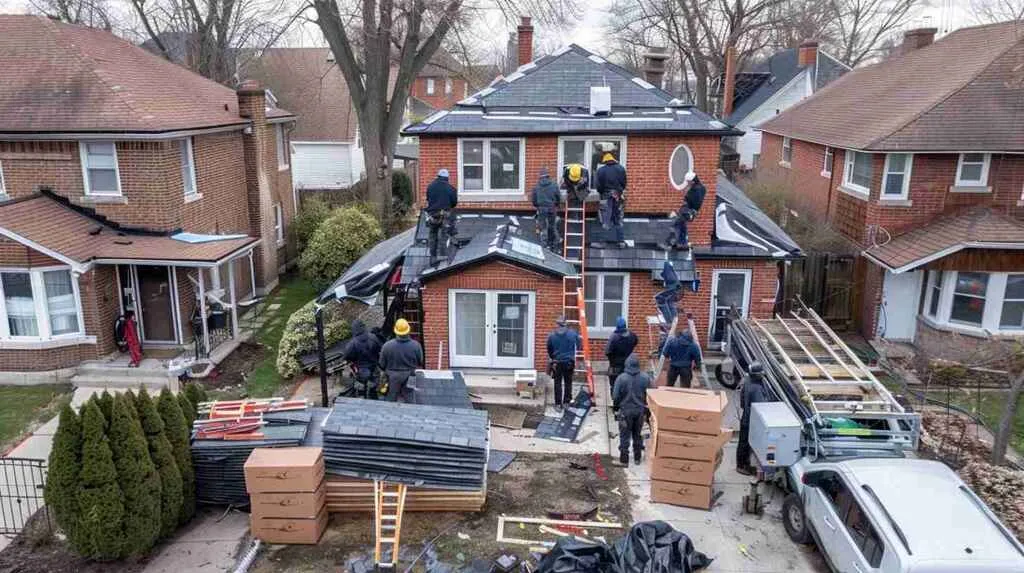
Temporary Fix for Missing Shingles Queens NY – Buy Time Right | Free Quotes
Backstages and loading docks taught me one lesson that still holds: stop the immediate damage fast, then fix it properly. A temporary fix for missing shingles makes financial sense in exactly two situations-when you’ve got an active leak dripping into your living space and need emergency control right now, or when you’ve already scheduled a permanent repair but you’re facing 12 to 72 hours of heavy weather and you need a clean bridge to protect your roof deck and insulation until the crew arrives. Under typical Queens weather-wind off the East River, sudden thunderstorms, and temperature swings that flex your sheathing like a drum skin-a well-executed temporary patch can buy you anywhere from 24 hours to three weeks, depending on the materials, the pitch, and whether another nor’easter blows through.
But here’s my honest opinion: a temporary fix is worth doing only if it protects what’s underneath-your plywood, insulation, and interior-from turning into a moldy, swollen mess. You’re not buying beauty, you’re buying time, and the goal is to keep water out of the scene long enough to arrange financing, get insurance approval, or simply wait for daylight and dry conditions to do the work right.
When a Temporary Fix for Missing Shingles Actually Makes Sense
If you and I were standing on your sidewalk in Queens right now, looking up at those missing shingles, my first question to you would be: “How long do you actually need this patch to last-days, weeks, or a season?” That answer decides whether a temporary fix is smart or just expensive stalling. The two scenarios where a patch makes financial sense are clear-cut: you’re either in emergency leak-control mode-ceiling dripping, storm rolling in tonight, full repair crew can’t get there for three to ten days-or you’ve already got a permanent repair on the calendar within the next two to four weeks and you just need a dry bridge across that window. In those situations, a professional temporary fix can buy you 24 hours to three weeks of solid protection, depending on how aggressive the wind and rain decide to be.
One November night around 11:30 p.m., right after a nor’easter, I got a call from a nurse in Jackson Heights who had just finished a double shift and came home to find shingles in her front yard like confetti. The wind was still whipping, so I’m on a two-story roof with a headlamp, cold rain sideways, putting down a temporary patch with plastic cement and tarp strips while she keeps flashing her porch light to let me know where the worst leak was dripping. That temporary fix held for three weeks until we could strip and reshingle properly-if I’d tried to “fix it for real” that night, the wind would’ve ripped everything off again. The patch worked because it matched the timeline: she needed emergency control that night, and we had a solid plan for permanent work once the weather calmed and materials arrived.
What a temporary fix can’t do is serve as a season-long solution or act as a bandaid over rotten deck boards. Think of your roof deck like a theater catwalk-if the surface under the equipment is rotten, it doesn’t matter how shiny the lights are; everything above it is one storm away from a disaster. Gravity and water are trying to enter the scene at every gap, and your job-or mine-is to give them fewer entry points until the real repair locks them out permanently. That means protecting the plywood and insulation first, because once those saturate, your claim gets bigger and your interior damage spreads faster than any tarp can stop.
| Situation | Typical Temporary Fix Goal | Realistic Protection Window in Queens | Lou’s Recommendation |
|---|---|---|---|
| Storm just passed, active leak over living space, crew can’t fully repair for 3-10 days | Buy 24-72 hours of solid leak control, possibly up to 2-3 weeks if weather is mild | Overnight to 3 weeks, depending on wind gusts and follow-up storms | Yes – call for an emergency temporary fix immediately. |
| You see missing shingles, more rain due in 12-24 hours, permanent repair scheduled within 2-4 weeks | Bridge the gap for 1-4 weeks to keep deck and insulation dry | 1-4 weeks with proper materials, correct overlap, and no severe wind events | Yes – temporary fix is smart if permanent repair date is already on the calendar. |
| Hoping to “stretch” a 20+ year-old roof for another 2-3 years using tarps and caulk | Patch repeatedly instead of addressing failing roof system | Unreliable; may fail next storm and cause worse hidden damage within days | No – invest in a planned replacement or major repair instead of band-aids. |
⚠️ Warning: Relying on repeated temporary patches season after season in Queens winds up costing more in hidden deck, insulation, and interior repairs than addressing the underlying roof failure. A temporary fix is a bridge between “emergency” and “proper scheduled repair,” not a substitute for either. Once your roof system is truly failing-multiple leak zones, curling shingles across entire slopes, exposed felt-patching becomes like changing stage curtains on a collapsing catwalk. Fix the structure, then hang the curtain.
DIY vs Pro: Which Temporary Fix Buys You More Time in Queens?
At 3:17 in the afternoon last August, standing on a roof in Woodhaven with the sun bouncing off every nail head, I had to tell a homeowner something they really didn’t want to hear: their “quick YouTube repair” was making the leak worse. Not all temporary fixes are equal-some add hours of protection, others create new leak paths by channeling water sideways into the deck. One Saturday morning in July, blazing hot, I showed up to a duplex in Flushing where the owner’s cousin had tried a DIY patch on missing shingles using duct tape and cardboard from an Amazon box. We’d had one heavy rain and the cardboard basically turned into oatmeal under the remaining shingles, funneling water straight into the bedroom ceiling. I remember kneeling on that roof with my digital thermometer reading 142°F, carefully cutting out the soggy cardboard mess and building a clean, temporary repair with underlayment strips and properly nailed tabs to buy them a month until they got financing together. Material choice matters-roofing cement and synthetic underlayment are designed to flex with temperature swings and resist UV breakdown, while duct tape, household caulk, and painter’s tarps break down in hours under Queens heat, humidity, and sudden thunderstorms. And here’s the local reality: many Queens roofs are asphalt shingle over multiple older layers, with low-slope tie-ins and valley transitions that complicate even a simple patch; if you don’t know how water flows across those planes, you’ll seal one gap and open three more.
A reasonably handy homeowner can safely attempt a ground-level or single-story minor patch if the missing area is small-one to three tabs-weather is dry, and the pitch is gentle enough to stand without sliding. But the moment you’re on a ladder higher than one story, looking at wide damage zones, steep pitches, or active wind warnings, that’s when you call a pro. Think of it like backstage access: not everyone’s allowed on the catwalk, and there’s a reason. Wind loading on tarps is real-those blue sheets turn into sails in a 30 mph gust, and if the fasteners aren’t sized for your sheathing type and spaced correctly, the tarp rips loose and takes more shingles with it. Shingle Masters brings proper ice-and-water shield strips, plastic roof cement rated for movement, and fasteners sized for typical Queens sheathing depths and local code, plus fall-protection gear and the experience to spot hidden deck damage you can’t see from the ground.
Careful DIY Patch (Best-Case)
- Used on: 1-story, easy-access roof with 1-3 missing shingles, dry conditions.
- Materials: Store-bought replacement shingles, roofing nails, small tube of roofing cement.
- Protection window: 24-72 hours if installed correctly and weather stays calm.
- Risks: Hidden deck damage missed, improper overlap, nails under-driven or over-driven, falls from ladder.
- When it’s reasonable: No active thunderstorm warning, you’re steady on ladders, and leak area is small and clearly visible.
Pro Temporary Fix (Shingle Masters)
- Used on: 1-3 story homes, multi-family buildings, complex tie-ins, steep pitches.
- Materials: Professional underlayment strips, plastic roof cement, correct fasteners, sometimes weighted tarp systems.
- Protection window: Designed to hold 1-4 weeks under typical Queens wind and rain until full repair.
- Benefits: Full leak path inspection, deck condition check, valley and flashing review, safe roof access and fall protection.
- When it’s best: Nighttime leaks, wide missing-shingle areas, ceilings already stained, or high/steep roofs.
Call Shingle Masters Now (Emergency)
- Active dripping inside during or right after a Queens storm.
- Missing shingles above bedrooms, nurseries, or electrical panels.
- You see daylight through attic boards where shingles blew off.
- Roof is two stories or more, or pitch is too steep to stand comfortably.
- Wind warnings in effect and tarp or shingles are already flapping.
Can Usually Wait a Day or Two
- A few tabs missing but attic is dry and no ceiling stains yet.
- You already have a temporary interior catch system (bucket, plastic) and leak is slow.
- Permanent repair appointment already set within the next 1-2 weeks.
- Damage is on a detached garage with nothing valuable underneath.
- You just need an inspection to confirm storm damage for insurance.
How a Professional Temporary Fix Works, Step by Step
During that freak windstorm a couple years back, a property manager in Astoria called me at 6 a.m. about a three-family building where shingles had peeled off right above a third-floor nursery. The parents were panicking because water was spotting the ceiling over the crib. I got up there, phone in my pocket on speaker so they could hear what I was doing, and walked them through every step of my temporary fix as if they were my backstage crew-where I was sealing, why I was overlapping up-slope, how I was weighting the tarp so gusts wouldn’t grab it. I started where the water was trying to enter the scene, checking the sheathing for soft spots and moisture before laying anything down, then worked upslope first to make sure every layer sheds water over the one below it, just like shingles are designed to do. I secured the tarp edges with proper deck screws and battens-not bricks-because wind direction in Queens shifts fast and loose edges turn into lift zones. That quick, careful patch kept the nursery dry for over a month until the full replacement, because it was built like a scene change: deliberate, sequenced, and weighted for the load.
In an emergency, your goal isn’t beauty-it’s buying time without losing the roof deck.
The standard Shingle Masters emergency-stabilization process starts the moment you call our 24/7 line and describe what’s happening-active drip, wind damage, ceiling stains, or exposed deck. We prioritize based on interior risk and weather forecast, then dispatch a crew typically within two to four hours if you’re in Queens and the leak is active. On-site, we assess the full leak path-not just the missing shingle zone but the valley, flashing, and any hidden moisture in the deck or insulation. We select the method based on damage size and weather window: for small areas, we might install matching shingle tabs with roofing cement and proper fastener overlap; for larger zones or complex tie-ins, we use ice-and-water shield strips or weighted tarp systems anchored to resist gusts. Every temporary fix gets documented with photos and notes for your insurance claim, because carriers expect you to mitigate damage and a well-described, professionally executed temporary measure often helps your case. Before we leave, we schedule the permanent repair and give you a realistic timeline for how long the patch should hold under typical Queens conditions. And here’s an insider tip: take photos of your ceiling stains and exterior damage before we arrive, and note exactly when dripping started-those details speed up diagnosis, help us trace the water path faster, and give your insurance adjuster the timeline they need to approve the claim without argument.
Shingle Masters Emergency Temporary-Fix Process in Queens, NY
Avoid These Queens-Style Temporary Fix Mistakes
Blunt truth: most “temporary fixes” I see in Queens aren’t fixes at all; they’re just colorful ways of letting more water in a slightly different route. I still remember the first time I watched a tarp fail in real time during a Queens thunderstorm, flapping like a ripped stage curtain because someone had tied it to the weakest rafters. Wind off the East River and sudden summer downpours expose bad shortcuts fast-duct tape loses adhesive at 95°F and peels like a sticker, bricks on tarps become projectiles in 40 mph gusts, and cardboard fillers turn to mush in the first rain and funnel water sideways into the deck. These tricks don’t stop water; they reroute it into places you can’t see until the stains spread across your ceiling or your insulation starts to sag.
Common Bad “Temporary Fixes” That Fail on Queens Roofs
| Myth | Fact |
|---|---|
| “A blue tarp and some bricks will hold all winter.” | Wind can work under loose tarps in a single storm, ripping them like a stage curtain and exposing more roof area. |
| “Any sealant in a tube is fine for roof leaks.” | Many generic sealants crack in UV and temperature swings; roofing cement and compatible materials are designed for roof movement. |
| “If the ceiling isn’t dripping yet, I can wait until spring.” | By the time you see stains, insulation and deck may already be saturated; fast temporary control keeps claims smaller and easier to approve. |
| “Duct tape over missing shingles is better than nothing.” | Duct tape adhesive fails under heat and moisture, and tape edges can actually channel water into the decking. |
| “Temporary fixes void insurance claims.” | Professionally documented, clearly described temporary measures often help show you acted to mitigate damage, which insurers expect. |
Quick Decision Guide and FAQs for Queens Homeowners
Now, before we move the spotlight to your actual choices, here’s a simple yes/no flow and the most common questions I hear on emergency calls. Think of it like checking the rigging before the curtain goes up-you want to see your options clearly before the next storm hits.
Do You Need a Temporary Shingle Fix, a Full Repair, or Both?
Common Questions About Temporary Fixes for Missing Shingles in Queens, NY
How much does an emergency temporary fix typically cost in Queens?
How long will a professional temporary fix actually last under Queens weather?
Will a temporary fix be loud or disruptive, especially at night?
Does getting a temporary fix hurt my insurance claim or void coverage?
What can I do to help before the Shingle Masters crew arrives?
Before You Call: Quick Checklist
- Locate the interior drip or stain and note which room and ceiling area is affected.
- Check your attic (if safe) for visible daylight, wet insulation, or water stains on rafters.
- Take ground-level photos of any visible missing or damaged shingles from the street or yard.
- Note the approximate time the leak started and whether it’s constant or only during rain.
- Clear the driveway or street space near the damaged area so our truck can park close and safe.
A solid temporary fix for missing shingles is a bridge to a proper repair, not a replacement for one. It buys you predictable hours or weeks of protection so you can schedule the real work without panic, arrange financing, or wait for insurance approval-all while keeping your roof deck, insulation, and interior dry. If you’re in Queens and you’re looking at missing shingles, active leaks, or a storm bearing down and you’re not sure whether a temporary patch makes sense in your situation, call Shingle Masters for a fast, safety-focused temporary stabilization and a free quote on permanent shingle repair or replacement. We’ll tell you exactly what you need, how long it’ll hold, and what it’ll take to fix it right.