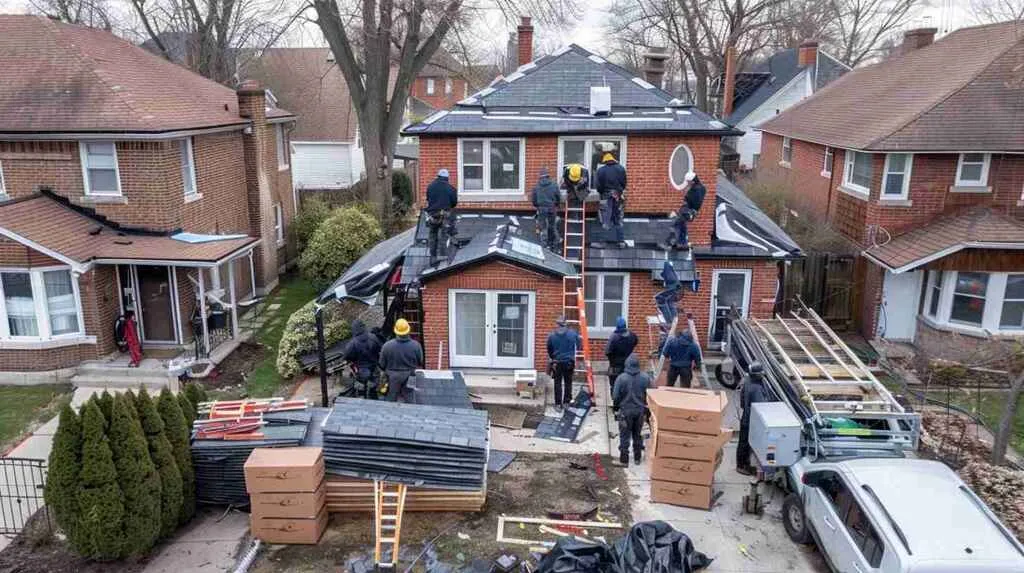
Roof Shingle Damage from Wind Queens NY – Spot It and Fix It | Free Quotes
Hidden wind damage on your Queens roof can snowball into a $3,000-$8,000 interior repair bill before you even realize something’s wrong. Here’s what I’m going to do for you right now: walk you backward from that worst-case scenario to the small, early signs you can check for today-standing on your own sidewalk, without climbing anything-so you can catch wind damage before it catches you.
Hidden Wind Damage: What Your Queens Roof Is Really Doing After a Storm
Last week on a roof in Elmhurst, I spotted something that really drives home how sneaky wind damage is. The homeowner called because she thought she heard “flapping” sounds whenever the wind picked up at night-like a loose piece of metal somewhere. Turned out six shingles on her south-facing slope were still technically attached, nails still in place, but the adhesive seal strip had completely broken. From the street? You’d never see it. From the attic during a rainstorm? Water was already starting to migrate sideways under those shingles, and she was maybe two heavy rains away from ceiling stains and drywall replacement. If we’re being honest, most Queens homeowners don’t realize wind damage happens in stages-first the seals break, then tabs lift, then nails back out, then you’ve got active leaks-and each stage costs more to fix than the last.
I’ll never forget a Friday in March 2021, about 6:30 in the morning, still dark, freezing wind ripping down 31st Avenue in Astoria. A retired teacher called me, panicked, because she kept hearing a “flapping” above her bedroom. When I got up there, half her front slope shingles were lifted like piano keys someone had run a hand across-nails still there, but the seal strip had completely broken from a wind gust the night before. She thought because nothing had fallen off in the yard everything was fine; I had to show her, piece by piece, how “almost” detached shingles are already a leak waiting for the next storm. That sound she heard? Her roof going out of rhythm. And here’s the thing-you can hear it from inside the house if you know what you’re listening for: that light rattling or tapping when the wind direction changes, or a sudden flapping noise that stops when the gust dies down.
The early visual cues are just as telling if you know where to look. Lifted edges along a shingle row, even if they’re only raised a quarter-inch. Creases or fold lines across individual tabs where wind bent them backward. Missing granules in a diagonal streak pattern-that’s wind scrubbing away the protective surface layer. Shingle lines that look uneven or wavy when you step back and scan the whole slope. Any of those signs mean your roof’s “song” has changed, and the next windstorm is going to play those weak spots even harder. If you’ve had a windy night in Queens recently-especially if trash cans moved or tree branches came down-and you’re seeing or hearing any of this, you’re already in the damage window.
⚠️ Don’t Ignore These After a Windy Night in Queens:
- You hear a light flapping or rattling on one side of the house when the wind picks up.
- A single shingle is missing or hanging at a corner-even if it’s “just one.”
- You see a shiny nail head or dark line between shingle rows where the overlap should be tight.
- One strip of shingles looks slightly raised compared to the rest, like a warped board.
- You suddenly find small gravel-like granules piled in your gutters or at downspouts after one storm.
Wind-damaged shingles that still “look fine” from the sidewalk are the ones that cost you the most-because you don’t see the problem until water’s already inside.
Spotting Roof Shingle Wind Damage from the Sidewalk
If we were standing on your sidewalk right now, I’d ask you to look for a few specific things before we even think about ladders or calling anyone. First, scan the roofline from corner to corner-do the shingle rows look straight and even, or is there a wavy, bumpy section where tabs are lifted? Step back about 15 feet and look at the color and texture: does one area look lighter or shinier because granules have worn off? Check the ground near your downspouts and along the foundation-after a windstorm you’ll often find small piles of those sand-like granules or even pieces of torn shingle. Around here in Queens, depending on your house style, you’ve got different weak spots: row houses in Astoria tend to get hit on the side slopes where wind funnels between buildings; detached homes in Jamaica Estates see ridge damage because there’s no wind break; two- and three-family homes in Elmhurst often lose shingles on the back slope that faces the prevailing northwest wind. Knowing your neighborhood’s wind pattern helps you know where to look.
One summer afternoon around 3 p.m., blazing hot, I was on a roof in Jamaica Estates working for this real estate investor who wanted to close on a multi-family in two days. He swore the roof was “mint” because the shingles looked straight from the curb. Up close I found a line of wind damage where a nor’easter had crept under a ridge line months before-granules gone on one side, tabs creased like folded cardboard, and a few nails backed out just enough to let water travel. He got angry at first, but then I showed him on my moisture meter how water had already started moving sideways under what he thought were “good” shingles. Here’s an insider tip I give everyone: use your phone’s zoom camera from the sidewalk to really inspect your ridgelines and valley areas. Zoom in on the spots where two roof planes meet, or where shingles meet a chimney or vent pipe-those are the areas wind loves to pry at. And right after a storm, walk your yard and check your fences for shingle pieces; if you find torn tabs or whole shingles in your grass, you’ve got damage up there guaranteed.
✅ Ground-Level Signs Your Shingles Took a Wind Hit
-
✅
Wavy or uneven shingle lines when you scan the roof from a distance-should be perfectly straight rows -
✅
Shiny or lighter patches where protective granules have blown off, exposing the asphalt layer underneath -
✅
Granule piles in gutters, at downspout exits, or along the foundation-especially after just one storm -
✅
Torn shingle pieces or whole tabs lying in your yard, driveway, or caught in bushes or fences -
✅
Dark streaks or visible gaps between shingle rows when you zoom in with your phone camera -
✅
Flapping, rattling, or tapping sounds from the roof when wind picks up-your roof’s new “song” telling you something’s loose
Do You Need a Professional Roof Inspection After Wind in Queens?
Did you have wind strong enough to sway trees, move trash cans, or knock down branches?
Do you see any missing shingles or loose tabs from the ground?
Do you hear flapping, rattling, or any new roof noises when wind picks up?
Any interior ceiling stains or attic moisture since the storm?
Is your roof older than 12 years?
Pro tip from Rafael: If you answered YES to any question above, don’t wait for the leak to announce itself. Wind damage spreads-what starts as one loose shingle becomes five, then ten, then a repair bill that makes your stomach drop.
Would you bet $8,000 that those shingles over your head are still in tune with the wind without even taking a proper look?
When Wind Damage Can’t Wait: Queens Roof Emergencies vs Slow Leaks
The difference between an urgent situation and something you can monitor for a few days comes down to exposure and scale. If wind tore off enough shingles to expose bare wood or underlayment-especially near a valley, ridge, or around a chimney-you’re in emergency territory because the next rain goes straight through. On the other hand, if you’ve got a couple of lifted tabs or one missing shingle in the middle of a slope and no active leak yet, you’ve got a small window to get it handled properly without panic. But here’s the mistake I see over and over, especially after windy nights: people patch the one obvious problem spot and ignore the surrounding shingles that got loosened by the same wind event. There was a job that went sideways on me in late October, around 9 p.m., in Ozone Park after a long, gusty day. We had done an emergency patch on a three-family house earlier because wind had ripped a bundle of shingles clean off near a vent stack. I warned the owner we needed to come back the next day to properly re-shingle the whole affected area; he insisted the “temporary fix” was enough. Two weeks later he called furious about a ceiling stain-when I went back, the patch was intact, but the untreated, wind-loosened shingles next to it had started wicking water during every rain. That night taught me to be even more stubborn about explaining that wind damage spreads like a crack in a windshield-you don’t see it right away, but it keeps moving.
How We Fix Wind-Damaged Shingles in Queens, Step by Step
Before we talk about fixing anything, we have to answer one question: is this damage localized to a small repairable area, or has the wind knocked your roof out of rhythm across a larger section? I’ll be blunt here-here’s my honest take: I won’t do “band-aid” repairs on a roof with widespread wind damage. If I’m up there and I see that the surrounding shingles are compromised-seal strips broken in multiple spots, nails backing out, tabs showing stress lines even if they haven’t torn yet-then patching just the one visible hole is a waste of your money and my reputation. You’re going to call me back in three months when the next storm plays those weak spots and opens up new leaks. At that point you’re better off re-shingling the full affected slope or section so everything’s back in rhythm and sealed properly. It’s like trying to fix one warped record on a turntable while the rest of the stack is wobbling-you haven’t actually solved the playback problem.
Think of your shingles like overlapping records on a turntable, each one sitting on top of the next, sealed down tight so wind can’t get underneath. When wind lifts those edges, even a little, it breaks that seal and changes how the whole “stack” plays together. When we repair wind damage properly, we’re not just slapping a new shingle in the gap-we’re pulling up the overlapping rows above, checking the underlayment and deck for moisture or damage, replacing any compromised pieces, then re-laying the shingles in the correct overlap pattern with fresh sealant and properly driven nails. On a typical Queens house, if wind has damaged a concentrated area-say around a dormer or along one ridge section-we’ll often remove shingles in a slightly larger perimeter than what looks damaged, because the stress from that wind event has already weakened the edges of the “good” shingles next to the obvious damage. And honestly, once you see how shingles are supposed to sit-flat, tight, every edge sealed to the one below it-you understand why cutting corners on a wind repair just sets you up for the next expensive call.
From Wind-Storm Call to Finished Shingle Repair with Shingle Masters
Phone Triage & Quick Assessment
You call, we ask targeted questions: When was the storm? What are you seeing or hearing? Any active leaks? How old is your roof? We’ll tell you right away if it’s emergency-level or scheduled-inspection-level, and give you an honest timeline for when we can get there.
On-Site Inspection & Full Documentation
Rafael or one of our lead techs comes out, gets on the roof safely, and inspects not just the obvious damage but the surrounding area to find hidden problems. We take photos and videos you can use for insurance claims, and we’ll walk you through what we found-no jargon, just plain language about what the wind actually did.
Temporary Protection (If Needed)
If there’s exposed deck or a big section missing and rain’s in the forecast, we’ll tarp it or apply an emergency patch that same day. This buys you time to make a decision about the full repair without worrying about water getting in while you wait.
Detailed Repair Plan with Options
We give you a written breakdown: exactly what needs to be fixed, material and labor costs, timeline, and-this is important-whether a small patch is realistic or if a larger repair makes more sense long-term. You’ll get options so you can decide what fits your budget and your roof’s actual condition, not what’s easiest for us.
Finished Repair, Cleanup & Walkthrough
Once you approve the plan, we schedule the work, complete the repair with matching shingles and proper sealing techniques, clean up every nail and scrap from your yard, then walk you through what we did and what to watch for going forward. You’ll know your roof is back in rhythm, and we’ll give you simple maintenance tips to keep it that way.
Rough Cost Ranges for Wind Shingle Repairs in Queens, NY
Single-Shingle or Small Spot Repair
Typical situation: One or two shingles torn off in an isolated spot, no surrounding damage, quick in-and-out fix.
Cost range: $250-$450
Small Patch (Up to 1 Bundle / ~25-30 Shingles)
Typical situation: Wind damaged a concentrated area-maybe around a dormer, along one edge, or near a roof penetration. Surrounding shingles checked and a few extras replaced as preventive.
Cost range: $600-$1,100
Medium Section Repair (1-3 Squares / 100-300 sq ft)
Typical situation: One full slope or large section where wind lifted multiple rows. May include minor underlayment or deck repairs if moisture got in. This is common after a big Queens windstorm when entire neighborhoods get hit.
Cost range: $1,400-$3,200
Large Slope Re-Shingle
Typical situation: The wind damage is widespread across a front, back, or side slope and patching isn’t practical. Better to strip and re-shingle the entire plane so the whole surface is uniform, sealed, and warrantied.
Cost range: $3,500-$6,500
Full Storm-Damage Restoration with Interior Touch-Ups
Typical situation: Major wind event caused extensive shingle loss, water intrusion that damaged ceilings/walls inside, and possibly some deck or structural work needed. Often an insurance claim situation.
Cost range: $7,000-$15,000+
Important note: These are ballpark ranges based on typical Queens homes and labor/material costs as of 2025. Your actual quote will depend on roof pitch, accessibility, shingle type match, and whether any deck or underlayment work is required. We’ll always give you a detailed written estimate before starting any work-no surprises.
Keeping Your Roof in Rhythm: Simple Checks and Straight Answers
Here’s my honest take: most Queens homeowners wait way too long after wind events because they think if nothing’s dripping inside, everything must be fine. Your roof’s “song” changes when shingles get loose-they start to play a different note in the wind, and if you listen during a windy night you can actually hear it: that light flapping or rattling sound that wasn’t there before. Think of your shingles like overlapping records on a turntable-when one gets warped or lifted, the whole stack starts to skip and hiss instead of playing smoothly. That’s your cue to check things out. Here’s an insider tip I give everyone: the day after any windstorm strong enough to move your trash cans or sway tree branches, do a quick visual walk around your house. Look for shingle pieces in the yard, check your gutters for extra granules, scan the roofline for anything that looks off, and-this is key-actually stop and listen when the wind picks up again. If your roof sounds different, it is different, and you should call someone before the next storm plays those loose shingles even harder.
Around here in Queens, I recommend a quick ground check after every major wind advisory or storm-just five minutes walking your property and looking up. Then do a more thorough visual inspection every spring (check the whole roof plus clean gutters so you can see if granules are piling up) and again every fall before winter hits. And any time you hear new noises on the roof-flapping, rattling, tapping-don’t wait to investigate. When you’re ready to call us at Shingle Masters, it helps if you’ve already done your own sidewalk scan and can tell us what you’re seeing or hearing; that way Rafael can prioritize the call and bring the right materials if it’s an emergency. After 17 years tuning roofs in neighborhoods like Astoria, Elmhurst, Jamaica Estates, and Ozone Park, I know exactly where wind loves to attack on different house styles, and I can usually tell you over the phone whether what you’re describing is urgent or something we can schedule in the next few days. But don’t gamble on it-if you’ve got even a small doubt, make the call.
Wind-Focused Roof Check Schedule for Queens Homeowners
After Every Major Wind Advisory or Storm
Walk your property perimeter, scan the roofline for missing shingles or lifted tabs, check yard and gutters for shingle debris or granules. Takes 5 minutes, can save thousands.
Every Spring (April-May)
Full visual inspection of all roof planes from the ground, clean gutters and check for granule accumulation, use your phone zoom to inspect ridges and valleys. Good time to schedule a pro inspection if your roof is 10+ years old.
Every Fall (September-October)
Pre-winter inspection to make sure no damage accumulated over summer storm season. Check flashing around chimneys and vents, look for any shingles that curled or lifted during hot months. Address small problems before freeze-thaw cycles make them bigger.
Any Time You Hear New Noises on the Roof
Flapping, rattling, tapping when wind picks up-these are your roof’s way of telling you it’s out of rhythm. Don’t ignore it. Listen during windy nights, and if the sound is new or getting louder, call for an inspection within a few days.
Common Questions About Roof Shingle Wind Damage in Queens
Will my homeowners insurance cover wind damage to my shingles?
Most homeowners insurance policies in New York cover sudden wind damage-meaning a storm that ripped shingles off or lifted them significantly. The key is documentation: take photos right after the storm, document the date and wind conditions if you can (weather reports help), and get a professional inspection quickly so the damage doesn’t worsen or get blamed on “lack of maintenance.” We work with insurance adjusters regularly and can provide detailed reports and photos that support your claim. Just know that if your roof is already old and deteriorating, the insurer might depreciate the payout or argue the damage was pre-existing, which is why it’s smart to have a recent inspection on file if your roof is over 15 years old.
Can I just replace the one shingle that blew off?
Sometimes yes, sometimes no-it depends on what happened to the shingles around it. If wind was strong enough to tear off one shingle, it probably stressed or loosened the surrounding tabs even if they didn’t come all the way off. When I get up there, I’m checking the adjacent shingles for broken seal strips, backed-out nails, and stress lines. If everything else is tight and the one missing shingle is truly isolated, then a single replacement makes sense and is cost-effective. But if I find that three or four other shingles in that area are compromised, you’re better off replacing a small section so you don’t end up calling me back in two months when those weakened shingles finally give up. I’d rather be straight with you upfront than sell you a cheap fix that doesn’t last.
Is it safe for me to go on the roof to check wind damage?
Not gonna lie-I don’t recommend it. Roofs are slippery, especially after rain or in cold weather, and if shingles are already loose from wind you could step on one and have it slide right out from under you. Plus, walking on a damaged roof can actually make the problem worse if you step on a lifted tab and crack it or push water under the shingle. Everything I’ve told you to check can be done safely from the ground, and honestly you can see most wind damage from your sidewalk or yard if you know what to look for. If you really want a closer look, use your phone’s zoom or a pair of binoculars to inspect ridges and problem areas. Leave the climbing to us-we’ve got the safety gear, the experience walking on steep pitches, and the insurance if something goes wrong.
How fast can Shingle Masters come out after a storm in Queens?
If you’ve got an active leak or major damage with exposed roof deck, we’ll prioritize you and typically get someone out the same day or next day depending on how many other emergency calls we’re handling-big storms hit whole neighborhoods at once, so there’s always a rush. For non-emergency inspections where you’re seeing lifted shingles or hearing noises but no water’s coming in yet, we’ll usually schedule within 2-4 days. When you call, be ready to describe what you’re seeing, when the storm happened, and whether there’s any interior damage; that helps us triage and get you on the schedule appropriately. And here’s the thing-even if we can’t get there instantly, we’ll give you temporary advice over the phone (like tarping a section if rain’s forecast) so you’re not sitting there panicking.
What if my roof looks fine but I hear a flapping sound?
That flapping sound is your roof telling you something’s loose-probably a shingle or a section of shingles where the seal strip broke but the nails are still holding (for now). This is actually one of the most common calls I get after windy nights in Queens, and it’s not something you want to ignore. Loose shingles flap and bend every time the wind blows, which stresses them further, bends them, and eventually either tears them off or breaks the seal completely so water can get under. The sound you’re hearing is the early warning-your roof going “out of rhythm”-and it means you should call for an inspection within the next few days. Catching it at the flapping stage is way cheaper and easier than waiting until the shingle tears off and water starts coming in. Schedule an inspection, and we’ll pinpoint exactly where that sound is coming from and what it’ll take to fix it before it becomes a bigger problem.
Why Queens Homeowners Call Rafael at Shingle Masters After Windstorms
-
✓
Licensed and insured in New York-full liability and workers’ comp so you’re protected if anything goes wrong on your property -
✓
17+ years roofing in Queens neighborhoods-we know exactly how wind hits different house styles in Astoria, Elmhurst, Jamaica Estates, Ozone Park, and beyond -
✓
Same- or next-day storm inspections when schedules allow-we prioritize active leaks and major damage so you’re not left waiting while water spreads -
✓
Experience working with insurance adjusters on wind claims-we document everything properly and provide the detailed reports you need to support your claim -
✓
Local references available from homeowners across Queens who’ve trusted us with their wind-damage repairs and full re-roofs
Wind already changed the “song” of your Queens roof if you’ve seen or heard any of these signs-lifted shingles, missing tabs, that rattling sound when the breeze picks up. Don’t wait for the next storm to play those weak spots even harder and turn a $600 repair into a $6,000 interior restoration. Call Shingle Masters today for a fast, no-pressure inspection and a free quote on getting your shingles back in rhythm before the weather hits again.