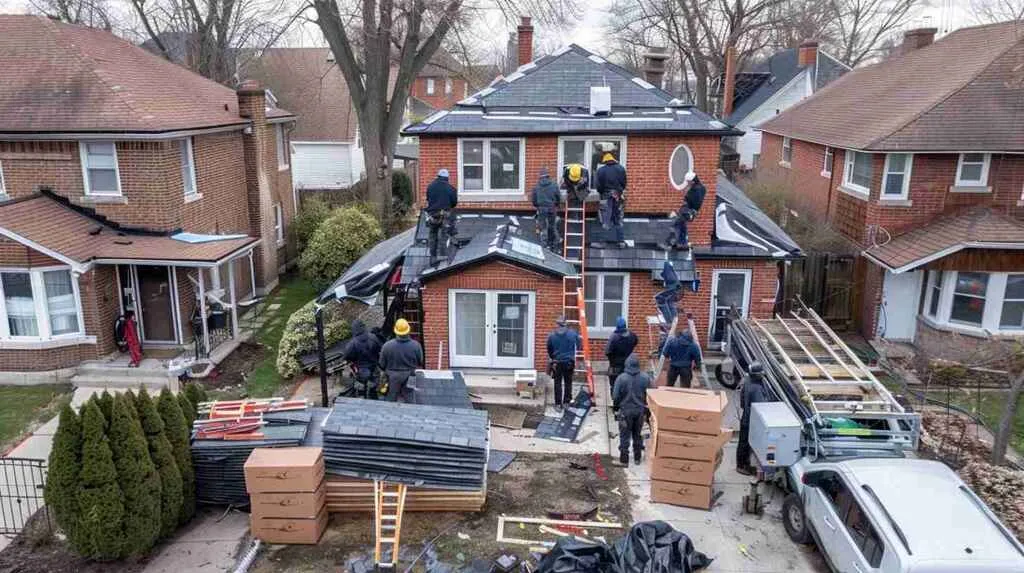
Roof Damage Shingles Queens NY – Repair or Replace? Find Out | Free Quotes
Balance is what you’re looking for: a typical shingle repair in Queens runs $350 to $1,200 for localized storm damage, while tearing off and replacing the whole roof on an average two-family or single-family home lands between $8,500 and $18,000-plus. The first reliable way to know which side of that canyon you’re standing on is to combine how old your shingles are with what a pro sees when they gently lift a tab-if the black underlayment beneath is still supple and the deck feels solid, you’re often in repair territory; if that underlayment crumbles like old newspaper or the wood gives a soft, spongy bounce, you’re closer to replacement.
Repair vs. Replace: What Roof Damage Shingles Really Cost in Queens
Last Tuesday in Elmhurst, I stood over a shingle that told me more truth than the entire home inspection report. The granules were gone, the edges curled like potato chips left in the sun, and when I lifted it the underlayment underneath literally tore in my hand. That one shingle-just one-showed me the whole roof was living on borrowed time. Miguel’s warm but direct, and he won’t tell you to replace if a safe, lasting repair makes sense, but he also won’t patch a roof he wouldn’t trust for his own mother’s house. If this was my family’s place, I’d be honest about the age of your shingles plus what the underlayment and deck condition say when we actually get up there and look. Most folks underestimate what a single lifted shingle can reveal-it’s not just about the missing tab you see from the driveway; it’s about what’s hiding beneath every course around it.
Here’s my honest opinion: most people in Queens either replace too early out of fear or too late out of denial. You see a few shingles blow off after a nor’easter and panic into a $15,000 quote, or you ignore granules piling in your gutters for three years until water’s dripping onto your dining table. The truth sits in the middle, and it shows up in things like how curled your field shingles are across multiple slopes, whether you’ve got bald spots spreading like a bad haircut, and if your attic’s letting in little stripes of daylight around the roof deck. In Queens neighborhoods-Corona, Astoria, Jackson Heights-you’ve also got to think about how attached or semi-attached homes change the game: wind hits sidewalls differently, water travels along shared party walls, and flashing between you and your neighbor can fail without either of you noticing until stains show up inside.
Typical Queens Roof Damage Shingle Scenarios & Cost Ranges
These are ballpark ranges for Queens, NY. Final quote depends on inspection, access, materials, and what we find under the shingles.
| Scenario | Typical Cost Range | What It Usually Includes | When It’s Enough |
|---|---|---|---|
| Small Wind Damage Repair (5-10 shingles, easy access) |
$350-$750 | Tab replacement, minor flashing check, quick sealant touch-up | Roof under 12 years, underlayment still flexible, isolated damage |
| Moderate Storm Repair (one side, 1-2 bundles) |
$800-$2,200 | Strip damaged section, inspect deck, install new shingles with proper overlap | Damage contained to one slope, rest of roof serviceable, no soft decking |
| Leak Repair Around Penetration (vent, pipe, small chimney) |
$450-$1,500 | Re-flash vent or pipe boot, replace surrounding shingles, seal and test | Leak only shows near that one spot, no widespread granule loss or curling |
| Partial Slope Replacement (one plane failing, others OK) |
$3,500-$7,500 | Tear-off one or two slopes, new underlayment, shingles, ridge cap, match existing color | South-facing slope cooked but north side still solid, or front garage roof failing early |
| Full Shingle Tear-Off & Replacement (typical Queens single or 2-family) |
$8,500-$18,000+ | Complete removal, deck inspection/repair, ice & water shield, new shingles, ridge vents, cleanup | Roof 18+ years old, widespread curling or granule loss, multiple interior leaks, soft decking |
Simple At-Home Checks: Is Your Shingle Damage Minor or a Red Flag?
Here’s my honest opinion: most people in Queens either replace too early out of fear or too late out of denial. What you can safely check from the ground or a low ladder-without walking the roof yourself-gives you a head start: look for a pattern of missing shingles after a storm (random and scattered usually means wind damage you can repair; a whole section gone means trouble), check your gutters and downspouts for piles of those little granules that look like coarse sand (a handful is normal aging; scoops full means your shingles are bald and dying), and scan the roofline from the street for any sag or wave that shouldn’t be there. In neighborhoods like Corona, Astoria, and Jackson Heights, where homes share walls or sit inches apart, you’ve also got to think about sidewall flashing and how water from your neighbor’s downspout might be hitting your roof edge-those party walls can hide slow leaks for years.
One August afternoon in Jackson Heights, during that nasty heat wave in 2022, I got a call from a retired school principal who’d been talked into a full tear-off by some door knocker. When I got up there with my infrared camera, I saw only one small area-maybe a 6×6 section-was trapping heat and moisture; the rest of the roof was solid. I ended up documenting every square foot, showing her shade-by-shade what was fine and what was failing, and we did a targeted repair for about 20% of what she’d been quoted. She’s still my favorite “don’t replace what you don’t have to” story. If your roof damage shingles are limited to one zone and the broader field is still doing its job, a smart repair can give you years before replacement, and I’d rather show you that truth than sell you on fear.
✅ Usually OK for Repair
-
•
A few missing shingles clustered in one area after wind -
•
One or two cracked or slipped shingles you can spot from the ground -
•
Minor granule loss near downspouts (small piles, not buckets) -
•
Leak appears only around one vent or pipe during heavy rain
⚠️ Often Points to Bigger Trouble
-
•
Shingles curled or cupped on multiple slopes of the roof -
•
Widespread bald spots where granules are completely gone -
•
Soft or bouncy feeling when you step on the roof (if you’ve been up there) -
•
Interior ceiling stains in multiple rooms or daylight visible through attic boards
Roof Damage Shingles in Queens: Call Now or Can It Wait?
🚨 Call Miguel at Shingle Masters ASAP
- Active dripping or running water during normal rain
- Shingles missing down to black underlayment or bare wood
- Damage directly over electrical panels or kids’ bedrooms
- Multiple shingles blown off after a windstorm, exposing large areas
- Visible sagging or dip in part of the roofline
📅 Usually Can Wait a Few Days
- One missing shingle with underlayment still intact beneath
- Small ceiling stain that hasn’t grown in several months
- Cosmetic scuffs or dings after hail or debris impact
- Minor granule piles in gutters with no interior water signs
How I Decide on Your Roof: The Same Way I’d Decide for My Mother
When I step on your roof, the first thing I’m asking myself is, “If this was my mother’s house, would I patch it or tear it off?” That’s not some marketing line-it’s the actual test I use every single time, because the moment I start treating your roof different than I’d treat my own family’s, I’ve lost what makes this work honest. If a repair is safe and will give you real years, I’ll say so and show you exactly why with photos and a plain-English walkthrough. If replacement is the smarter move to avoid water damage eating your ceiling joists and attic insulation, I’ll spell it out the same way, sometimes sketching the roof planes on a scrap of cardboard so you see the sequence of what’s failing and why. That moral compass-“if it were my mother’s place”-anchors every recommendation, and it means I won’t push a $15,000 tear-off when a $900 targeted fix does the job, and I won’t sell you a band-aid when your roof’s telling me it’s done.
One job that went sideways on me was in Bayside, a spring storm repair for a young couple who’d just bought their first place. It started as replacing a handful of wind-damaged shingles on the front slope, but when we pulled back a few courses, we found an old, hidden layer of shingles underneath and a patch of rotted decking right over the nursery. I had to stop everything, walk them through photos on my phone while rain clouds were literally rolling in, and help them decide between an emergency temporary fix or an unplanned partial replacement. Standing in their driveway, watching them stress about money and safety, really sharpened how I talk people through the “repair now vs. replace now” decision-I showed them exactly what I’d do if my own kid was sleeping under that section of roof, and we made the call together. Here’s an insider tip for anyone buying an older Queens home: budget for the possibility that “small shingle repairs” can open up and reveal hidden layers, soft decking, or failed flashing once you start peeling things back-it’s not a scam, it’s just the reality of homes that have been patched over and over without anyone looking underneath.
Should You Repair Your Roof Damage Shingles or Plan a Replacement?
START: Do you know the age of your shingle roof?
→ YES, and it’s under ~12 years:
Next question: Is the damage limited to one area (less than 20% of roof)?
✓ YES: Miguel will usually recommend a targeted repair after checking underlayment and deck condition.
✗ NO: Schedule an inspection-may be time to plan a phased replacement.
→ NO, or roof is 15-20+ years old:
High chance you’re near end of shingle life-inspection will focus on whether you can safely squeeze a few more years with repairs or should replace soon.
URGENT PATH: Active leaks in more than one room?
If YES → Strong candidate for replacement or major partial replacement. Multiple leak points usually mean widespread shingle failure.
What Happens During a Shingle Damage Inspection in Queens
The blunt truth is, shingles almost never “just fail”; they usually tell you they’re quitting for years before anyone listens. When I inspect your roof, I’m walking a specific sequence like I’m reading chapters in a book: start at the gutters and downspouts to see what’s washing off (granules, shingle bits, or just leaves), move up to the field shingles to check for curling, cracking, and soft spots in the decking underneath, then hit the ridges and valleys where water concentrates and wear shows up first, next I look close at every penetration-pipes, vents, chimneys-because that’s where most leaks sneak in, and finally I’ll check your attic or top-floor ceilings for stains, moldy smells, or those tell-tale streaks of daylight peeking through roof boards. It’s not random poking around; it’s a deliberate walk across your roof like I’m showing you a map of where the trouble is and where it’s headed next.
One February morning around 6:30 a.m., I was on a two-family house in Woodside after a windstorm; the owner swore he only needed “a couple shingles” replaced. I remember my fingers going numb in the cold while I lifted a tab and saw the underlayment was brittle and cracked like old parchment. I had to explain to him that sure, I could patch it, but the next nor’easter would peel half his roof because the deck was already soft-he chose the cheap patch, and three months later I was back, this time doing the full replacement and drying out his soaked attic insulation. That job taught me exactly how dangerous it is to let customers believe every problem is “just a few shingles.” So now I show homeowners photos on my phone, sometimes even quick sketches on a piece of cardboard, to make absolutely sure they really see what’s going on before they choose between a repair and a replacement-you deserve to understand your roof, not just trust a number on a proposal.
Miguel’s Step-by-Step Roof Damage Shingle Inspection
Check gutters, siding stains, and where water likely travels off the roof-this tells me drainage patterns and what’s been washing down.
Look for missing, curled, or mismatched shingles from the street-what you can see from the ground often hints at what’s happening up close.
Check for soft spots in the decking (spongy bounce means rot or water damage), lift shingle tabs to inspect underlayment flexibility, and look for granule loss patterns across the field.
Examine every chimney, skylight, sidewall, and vent pipe for cracked sealant, lifted metal, or gaps where water sneaks in-most leaks start here, not in the field shingles.
Look for water stains, moldy smells, or streaks of daylight through the roof deck-what you see inside confirms what I found outside and shows how far water’s been traveling.
Show you photos on my phone, sometimes sketch the roof planes on cardboard, and give a clear repair-or-replace recommendation based on risk, age, and your budget-no guessing, just straight talk.
Why Queens Homeowners Call Miguel at Shingle Masters for Roof Damage Shingles
-
✓
Fully licensed and insured in NYC with all required permits and liability coverage -
✓
19 years on Queens roofs in Bayside, Woodside, Jackson Heights, Elmhurst, Corona, Astoria, and beyond -
✓
Same-day or next-day response on active leaks when possible-we know roof damage shingles don’t wait for your schedule -
✓
Written, photo-backed estimates that separate “must-fix now” from “can-wait”-no pressure, just honest priorities -
✓
Specialization in detailed leak detection rather than one-size-fits-all replacements-Miguel’s known as the “leak detective” for a reason
Before You Call: Quick Checks That Help Me Help You Faster
A couple of simple observations from you before calling can speed up the whole diagnosis: where you see stains inside (which rooms, near what part of the ceiling), what type of weather makes the leak show up (heavy rain only, wind-driven rain, or even light drizzle), and any past roof work you know about-even if it was before you bought the place. Think of it like bringing notes to the doctor; it doesn’t have to be perfect, but it gives me a running start so I’m not guessing blind when I show up.
What to Note About Your Roof Damage Shingles Before Calling Shingle Masters
-
☑
Take 2-3 photos from the street of the damaged area if it’s safe-even blurry phone pics help me see the scope before I arrive. -
☑
Note if leaks appear only in heavy rain or any rain-this tells me whether it’s a small penetration leak or a bigger shingle failure. -
☑
Check if neighbors’ roofs on the same block had recent work-common in Queens after big storms, and it gives context on local wind patterns. -
☑
Find any old roof paperwork or warranties-even if it was before you bought the house, it helps me know what you’re starting with. -
☑
Note interior ceiling or wall stains and their locations-which rooms, near windows or in the center, one spot or multiple. -
☑
Check if you hear dripping sounds during storms-even if you can’t see water, sound can point me toward hidden trouble in walls or ceilings. -
☑
Write down how long ago you first noticed the issue-a brand-new leak after a storm is different from a slow stain that’s been growing for months. -
☑
Mention if you’ve had any tree branches, debris, or ice dam issues-these can cause hidden punctures or flashing damage beyond what you see.
Common Roof Damage Shingles Questions from Queens Homeowners
Can I just replace the shingles that blew off?
Sometimes, yes-if your roof is under 12 years old, the underlayment beneath is still flexible, and the decking feels solid, replacing just the missing or damaged shingles works great. But if the underlayment tears when I lift it or the wood deck has soft spots, patching those few shingles is like putting a band-aid on a crack in the foundation-it’ll hold for a bit, then fail somewhere else. I’ll show you exactly what’s under those tabs so you can make an informed call.
Will my homeowners insurance cover roof damage shingles?
It depends on the cause. Storm damage-wind, hail, falling tree limbs-is usually covered under most policies, but slow wear-and-tear or aging shingles are on you. The key is prompt reporting: take photos right after the storm, file a claim quickly, and get a contractor’s assessment that documents the damage before your insurance adjuster shows up. I’ve helped plenty of Queens homeowners walk through that process, and good photos plus a clear timeline make all the difference in getting a fair settlement.
How fast can you get to my house in Queens?
For active leaks or storm damage, I aim for same-day or next-day response when possible-roof emergencies don’t wait for your schedule, and neither do I. For non-emergency inspections or estimates, I’ll usually get to you within two to three business days. If a nor’easter or heavy wind event just hit the area, I prioritize homes with active dripping or major shingle loss first, but I’ll always let you know the realistic timeline when you call.
Can you match my existing shingle color?
I’ll get as close as possible, but perfect matches can be tricky on roofs older than 10-12 years because shingle colors fade and manufacturers discontinue lines. What I do is bring samples that are the nearest current equivalent, and I’ll show you side-by-side before we order. On newer roofs or common colors like charcoal, brown, or gray, matching is usually no problem. On older or custom colors, expect a close match rather than invisible-it’s honest, and it beats pretending I can magically find discontinued shingles from 1998.
Do you offer temporary emergency tarping if a storm is coming?
Absolutely. If you’ve got major shingle loss or a leak that’s about to get hammered by incoming rain, I can get a heavy-duty tarp secured over the damaged area to buy you time until we can do the real repair or replacement. Tarps are short-term protection-they’re not a fix-but they’ll keep water out of your ceilings and attic until the weather clears and we can safely get up there and do it right. Just call as soon as you know a storm’s headed your way, and I’ll prioritize getting you covered.
You don’t have to guess alone whether your roof damage shingles need a quick repair or a full replacement. Miguel will walk your Queens roof the same way he’d walk his own mother’s place-lifting tabs, checking underlayment, scanning for soft decking, and showing you exactly what he sees with photos and plain-English explanations, not scare tactics or sales pitches. Call Shingle Masters today for a free, photo-backed quote on your roof and a clear repair-or-replace plan that fits your budget and keeps your family dry.