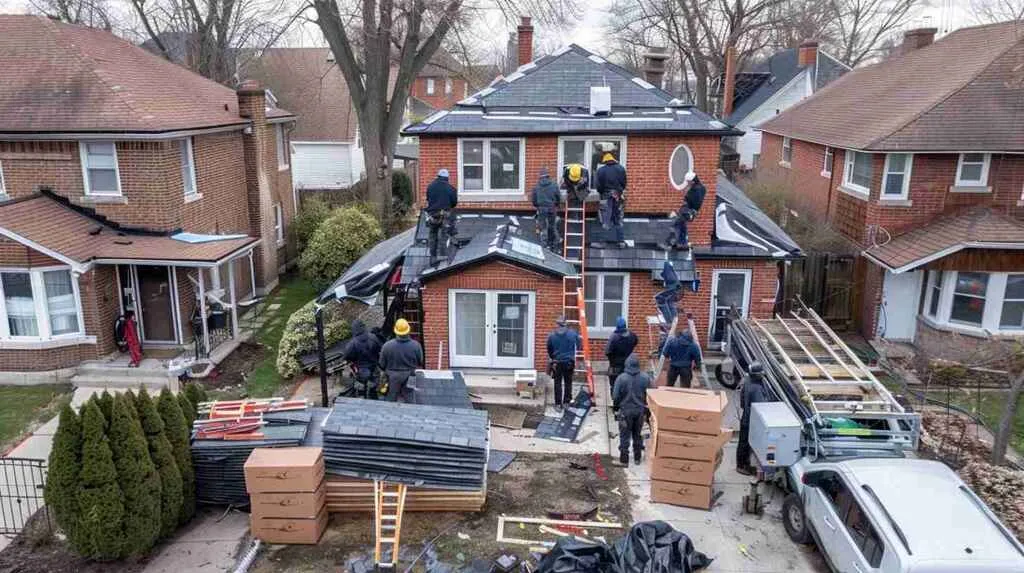
Repair Loose Roof Shingles Queens NY – Fix Before They Blow Off
Sideways rain during a nor’easter, a few seconds of wind gusting at 45 mph, and suddenly that one loose shingle you noticed last month turns into a $750 leak repair inside your Queens home. The structural chain reaction is simple but brutal: wind gets under the tab, breaks the adhesive seal, lifts the neighboring shingles, and lets water run under the whole “scene” like a script gone wrong-traveling sideways along the deck until it finds a nail hole or gap to drop through into your ceiling. This page walks through exactly how I diagnose and repair loose shingles in Queens before the next storm rewrites the script on your roof.
Why a Loose Roof Shingle in Queens Turns Into a Leak So Fast
On a two-story attached house off Queens Boulevard last winter, I watched $80 worth of loose shingles turn into $900 of ceiling damage in one storm. The owner called me after the February nor’easter, and standing on that semi-frozen roof around 6:30 a.m., I could actually trace the path where the wind had peeled three ridge shingles up like someone lifting a carpet, starting from a single high nail that had missed the deck by half an inch. I remember having to warm up the asphalt adhesive with my gloved hands and a heat gun because it was so cold, and thinking, “If I don’t fix this line exactly, the next storm will just finish the job.” Here’s my honest take: if a shingle is moving enough for you to notice it from the sidewalk, it’s already past the “wait and see” stage. Think of your shingles as actors following a script-the overlapping pattern, the seal strip bonding, the nails in the right spots. When one shingle misses its cue-maybe a high nail, maybe a failed seal strip-it rewrites the scene for water, giving it a bad “entrance” straight onto the roof deck instead of staying on top and draining toward the gutter.
I still remember the first time I realized how Queens wind patterns treat corner houses differently from mid-block homes. Wind coming off the East River or pushing in from the ocean doesn’t blow straight; it funnels between attached buildings, creates uplift at ridges and edges, and hits corner homes hardest. That means a loose shingle on a corner house in Jackson Heights or Astoria is under way more stress than the same shingle on a mid-block row house in Woodhaven. Add in Queens’ older construction quirks-layered roofs, small additions, porches with thinner plywood-and you’ve got a perfect setup for tiny gaps around a loose shingle to become 2×2-foot ceiling stains after just one strong wind-and-rain combo. What looks like an $80 shingle repair today can become $750+ in interior drywall and paint repairs by next week if the forecast brings weather and you haven’t locked down that loose tab.
Typical Loose Shingle Situations in Queens & What They Cost
These are ballpark ranges in Queens, not exact quotes. We confirm on site after seeing the scene on your roof.
How I Diagnose a Loose Shingle Before It Becomes a Leak
A summer evening in Woodhaven, just after a thunderstorm, I got called to a house where loose shingles over a small porch addition had been ignored for a full year. The owner was proud of his DIY skills, but his “patch” was three roofing nails and a strip of duct tape, which had funneled water straight into the plywood. As I pulled back the loose shingles, I could smell the rot before I saw it-sweet, damp, and wrong. We ended up replacing that whole section of decking, and I remember explaining to him, gently but firmly, that the $40 fix he skipped last fall had just turned into a $1,600 rebuild. That’s the kind of thing I see on older Queens additions, porches, and extensions-they’re weak spots where loose shingles start bigger problems because the framing underneath was never built to the same spec as the main house. When I come out to look at a loose shingle, the first thing I ask is, “Did you hear anything flapping or banging during the last storm?” That answer tells me a lot about how much movement has already happened and whether neighboring shingles are also compromised.
Pulling back from that single shingle, here’s what’s happening to the rest of your system when I do an on-site inspection: I ask about the sounds, I check the direction of the prevailing wind on your block (corner houses near major avenues like Queens Blvd or 31st Ave tend to get hit hardest), and I look closely at nail placement, adhesive strip condition, and underlayment visibility. In Queens, many roofs are layered-one set of shingles over another-and that means the nails might be grabbing two or three layers of old asphalt instead of solid wood, so I’m checking depth and angle. I frame it as watching a dress rehearsal for a storm, looking for the missed cues where water will make its entrance. If the seal strip isn’t bonding, if the nails are riding high or popping, if the underlayment has torn from repeated lifting, I’m seeing the script for the next leak already written-I just need to rewrite it before the curtain goes up on the next weather event.
Step-by-Step: What Happens When Shingle Masters Checks Your Loose Shingles
- Listen to your story – I ask about noises during the last storm, when the loose shingle was first noticed, and whether you’ve seen shingles on the sidewalk or in the gutter.
- Exterior walk-around – From the ground, I note shingle pattern, sagging lines, and where wind likely hits hardest (corners, ridges, edges), plus look at how your house sits relative to neighbors.
- On-roof safety setup – I secure the ladder, harness where appropriate, and confirm the roof surface is safe and dry enough to walk-no shortcuts on steep or brittle decking.
- Hands-on shingle check – I gently lift suspect shingles, inspect nails, seal strips, and underlayment for tears or nail pops, and look 2-3 courses above and below for hidden loosening that hasn’t shown up yet.
- Clear repair plan and photos – I show you close-up photos on my phone, explain what needs to be refastened, replaced, or sealed, and give you a firm price before starting any work.
Should You DIY a Loose Shingle or Call a Queens Pro?
One windy Saturday in April in Astoria, I was halfway through a railing repair at my cousin’s place when a gust hit and I heard this distinct flapping sound six houses down the block. I actually stopped mid-sentence, looked up, and saw a row of three-tab shingles on a neighboring roof lifting in rhythm with each gust like a bad curtain cue. I walked over, knocked on the door, and told the tenant, “You’re about to have shingles in the street.” Two hours later, after we refastened and sealed that whole edge course, the landlord showed up and admitted he’d seen one shingle slightly askew a month earlier and “didn’t think it was anything.” That roof would have donated half its shingles to 31st Avenue if I hadn’t heard them. I get it-you’re handy, you’ve got a ladder, and you’re thinking about saving a couple hundred bucks by nailing down that loose tab yourself. But here’s the thing: on a two-story Queens home, the risks-ladder falls, improper nailing that breaks surrounding shingles, broken seal strips, voided manufacturer warranties-usually outweigh the savings. From the top step of the ladder, you’ll see how quickly a “simple” DIY patch can rewrite the whole set in a bad way, especially if you don’t know where the deck studs are or how to lift a shingle without cracking it.
If you can hear your shingles, your roof is already sending you a warning.
⚠️ Avoid stepping onto steep or wet shingles without proper fall protection. A loose shingle often means the surface under your foot may not be fully attached. In Queens, many older homes have brittle decking or multiple roof layers-one bad step can send you through soft wood or off the edge. If you feel uneasy even picturing yourself up there, stay on the ground and call a licensed roofer.
Is Your Loose Shingle an Emergency or Can It Wait a Few Days?
Blunt truth: loose shingles almost never stay “just loose”-they either get fixed, or they leave. Now, if we step back and look at the whole roof and the weather forecast, you can decide how quickly this scene needs to be fixed before the next storm rehearsal. Flapping sounds, exposed black felt or bare wood visible from the sidewalk, or missing corner shingles on the windward side of your Queens home are all reasons to treat it as urgent and call the same day if possible. On the other hand, a slightly lifted shingle on a one-story porch roof with clear weather in the forecast can usually wait a few days for a scheduled visit-just don’t let “a few days” turn into “a few weeks” because wind doesn’t wait for your calendar.
Shingle Masters Quick Facts for Loose Shingle Repairs in Queens
Typical Response Time
Same day for active leaks, 24-72 hours for non-emergency loose shingles
Service Area
All Queens neighborhoods including Astoria, Jackson Heights, Woodhaven, Flushing, and Rockaway
Loose Shingle Repair Range
$150-$450 in most non-leak cases
Experience on Shingle Roofs
19+ years on Queens roofs, fully licensed and insured
Check This From the Sidewalk Before You Call
Think of your roof like a row of stage props-pull one piece out of position, and suddenly everything around it looks and behaves differently. From the sidewalk, you’re in the audience seat, but you can still see if the scenery (shingles) is out of line-edges not lying flat, gaps between tabs, or odd shadows where the light shouldn’t be getting through. Here’s a tip that’s saved a lot of Queens homeowners money: listen for flapping during overnight storms, and if you live on a corner house near major avenues, watch your roof more closely because wind routinely lifts shingles there first. You should never climb onto the roof just to investigate-these are safe ground-level checks that help you explain the “scene” to me when you call, so I know exactly what tools and materials to bring the first time.
Sidewalk Inspection Checklist for Loose Roof Shingles in Queens
-
1
Note exactly where the loose shingle is (front, back, left/right corner, over porch, near chimney) -
2
Look for any dark gaps between shingles or spots where the roof pattern looks “jagged” -
3
Check for shiny nail heads or metal flashing that suddenly looks more exposed than nearby areas -
4
Look at your neighbors’ roofs on the same block to see if wind tends to hit your corner harder -
5
Check inside for fresh ceiling stains or bubbling paint under the area of the loose shingle -
6
Take clear photos from the sidewalk or upstairs window to show the roofer
Common Questions About Repairing Loose Shingles in Queens, NY
Can one loose shingle really cause a big leak?
Yes, absolutely. Water follows the path of least resistance under the shingle, and it can travel sideways along the deck-sometimes several feet-before it finds a nail hole or gap to drop through into your ceiling. That’s why you’ll see a ceiling stain three or four feet away from the actual loose shingle, especially on older Queens roofs with multiple layers where water has more cracks and seams to wander through before it shows up inside.
Do you have to replace my whole roof if a few shingles are loose?
Most of the time, no. If the surrounding shingles and deck are still solid, we can do localized repairs-refasten, reseal, replace just the damaged tabs. A full roof replacement is only on the table when your roof is already near the end of its lifespan (15-20 years for three-tab, 20-25 for architectural), the plywood is compromised in multiple spots, or when repairing one section just highlights how weak the rest of the roof has become.
What if the loose shingle is on a rainy day-should I wait for dry weather?
If you’re actively leaking, don’t wait. I can do emergency temporary measures-tacking the shingle down, covering with waterproof membrane, sealing exposed edges-even in wet conditions to stop water from getting in. Then we come back when it’s dry to do the permanent repair with proper adhesive and fasteners. Wet shingles don’t bond well and can’t be nailed without tearing, so the permanent fix does need dry conditions, but we won’t leave you leaking while we wait for sunshine.
Can you match my existing shingles?
I carry common colors used all over Queens-grays, browns, blacks, weathered wood tones-and can get close matches for many others through suppliers. On older roofs, exact matches may not exist because manufacturers discontinue colors or change formulas, but I place repairs in less visible areas where possible (back slopes, lower courses) and blend the color as tightly as I can. If your roof is more than 12-15 years old and the shingles have faded, even a “perfect” match from the factory will look slightly different next to weathered tabs, so I set that expectation up front.
A loose shingle is a small fix today and an expensive leak tomorrow-that’s the script I’ve seen play out on hundreds of Queens roofs over 19 years. If you’ve noticed a tab lifting, heard flapping sounds during the last storm, or spotted shingle pieces in your gutter, call Shingle Masters for a quick inspection and same-week repair before the next wind event rewrites the whole scene on your roof and sends water where it was never supposed to go.