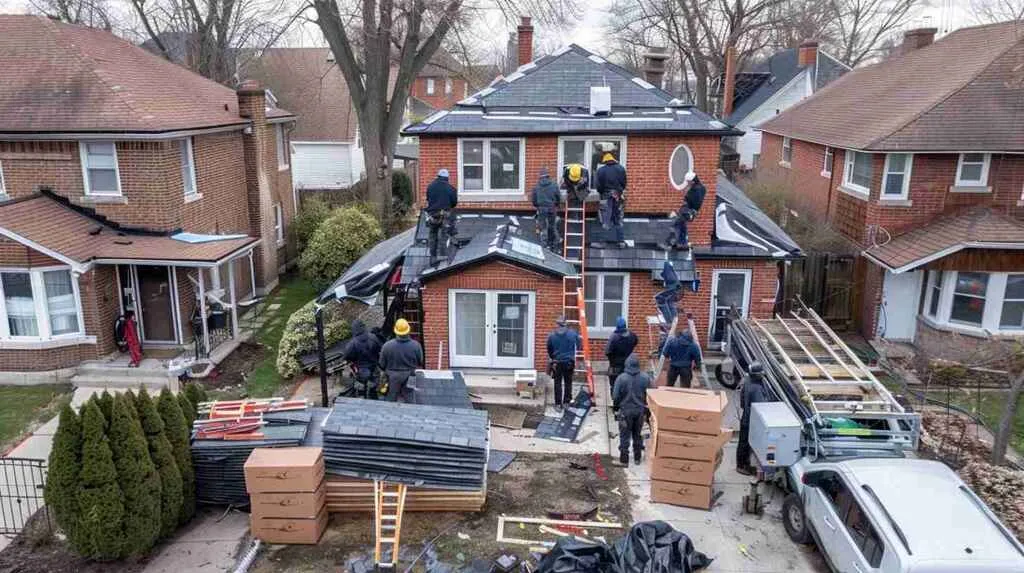
One Shingle Fell Off a Roof Queens NY – Is It a Bigger Problem?
Quiet. That single shingle lying in your backyard or gutter can quietly cost you thousands in hidden repairs inside walls and ceilings before you even notice the brown stain spreading across your bedroom ceiling. The first critical factor that decides whether you’re looking at a $150 quick fix or a $3,500 deck replacement isn’t how the shingle looks-it’s exactly where on your roof that piece was sitting before the wind grabbed it.
Is One Missing Shingle a Big Deal on a Queens Roof?
On a typical Queens block, like 45th Avenue in Sunnyside, I can spot three or four houses where “just one shingle” is already curling up trouble for later. From a technical standpoint, I never judge a missing shingle by how it looks from the ground-I only care about the water’s favorite path across that spot. If that shingle sat on a flat field area mid-roof, you might have a week or two before it becomes urgent. But if it was near a valley, straddling a ridge, or right next to a chimney where flashing meets shingle, that’s a different conversation entirely, because now you’ve opened a direct highway for every drop of rain to slide under your underlayment and start eating your plywood.
One February afternoon, right before sunset, I went to a brick semi-attached in Maspeth where the owner swore it was “just one missing shingle” the wind blew off. Standing in her attic with a flashlight, I could see daylight through three nail holes where the shingle had torn off, and the plywood around them was already soft from weeks of tiny leaks every time it rained. She showed me the one shingle she found in her backyard like it was no big deal, but when I pulled back the surrounding shingles, the whole row’s nails were rusted out because the original installer over-drove the nails. That “one shingle” was just the first soldier to fall.
Here’s how I break down location-based risk in Queens weather: low risk means the shingle was in the middle of a wide, unbroken slope with good underlayment still visible-you can usually wait 48-72 hours for a pro inspection. Medium risk is anything near a roof edge, dormer, or where two slopes change pitch, because wind-driven rain during our typical nor’easters loves those transition zones. High risk-and I mean call-the-same-day high-is valleys, chimneys, skylights, or anywhere two different roof planes meet, because those spots channel more water per square inch than any other part of your roof, and one missing shingle there is like leaving a window cracked during a hurricane.
| Roof Area Where Shingle Fell | Leak Risk in Queens Weather | What I Usually Find Underneath |
|---|---|---|
| Middle of flat slope, 6+ ft from edges | Low – can wait 48-72 hrs | Dry underlayment, no nail rust, clean deck |
| Near roof edge or rake (side) | Medium – schedule within 24 hrs | Drip edge lifting, occasional small water marks on fascia |
| Valley (where two roof slopes meet) | High – call same day | Metal flashing exposed, underlayment wet, granule buildup blocking water flow |
| Ridge cap or hip | Medium-High – don’t wait past next rain | Ridge vent open to attic, lifted adjacent caps ready to blow off |
| Against chimney, vent pipe, or skylight | High – emergency if rain forecast | Step flashing gaps, old caulk crumbled, water stains on masonry or metal |
Quick Self-Check: Is Your Missing Shingle an Emergency?
From a technical point of view, a missing shingle is less about the piece you see on the ground and more about the water path it just opened. You don’t have to climb your roof to figure this out-stand on the sidewalk, look up from your backyard, or peek through an upstairs window if you’ve got one, and ask yourself: is that gap close to an edge, a valley, or metal flashing? So what does that mean for you in Queens weather? If you’re in a typical two-family in Astoria, Jackson Heights, or Richmond Hill, those roofs usually have at least one or two valleys where additions or dormers were built years ago, and those valleys are magnets for debris and concentrated water flow. A single missing shingle on that valley? That’s a same-day call, not a “I’ll get to it next week” situation.
I’ll never forget a Sunday morning call from a landlord in Astoria during one of those hot July stretches-90 degrees by 10 AM-who was upset because a tenant complained about a brown ceiling stain after a storm. He told me, “I walked around the house, only one shingle is missing, can you just nail another one on?” When I got on the roof, I saw the missing shingle was right at the bottom of a valley, so every drop of water from half the roof was running over that exposed spot. I showed him with a water hose test how fast the leak appeared inside; his face changed when he realized that one missing piece was like pulling the plug in a bathtub.
⏰ When to Call: Urgency Guide for Queens Homeowners
🚨 Urgent – Call Same Day (Queens Weather)
- Missing shingle is in or near a valley or chimney
- You can see dark underlayment or bare wood from the ground
- Storm or heavy rain is forecast within 24 hours
- You notice water stains, drips, or bulges inside on ceilings or walls
- Shingle was on a ridge, hip, or near vent pipes
✅ Can Usually Wait 24-72 Hours
- Shingle fell from the middle of a flat slope, far from edges or features
- No rain forecast for at least 48 hours
- No visible water damage or stains inside your home
- Surrounding shingles still look flat, sealed, and intact
- You can still see intact underlayment (black felt or synthetic sheet) in the gap
Do I Need an Emergency Roofer for One Missing Shingle in Queens?
↓ Question 1: Can you see brown stains, wet spots, or bulges on any ceiling or wall inside?
→ YES: CALL SAME DAY
→ NO: Go to Question 2
↓ Question 2: Is the missing shingle near a valley, chimney, skylight, or ridge?
→ YES: CALL SAME DAY
→ NO: Go to Question 3
↓ Question 3: Is heavy rain or a storm forecast in the next 24 hours?
→ YES: SCHEDULE WITHIN 24 HRS
→ NO: CAN WAIT 48-72 HRS (but don’t ignore it)
DIY Patch vs. Pro Repair: What Actually Happens to the Water
Water always takes the easiest path it can find, not the one you wish it would take.
Here’s the blunt part nobody likes to hear: wind strong enough to take one shingle often loosened five or six neighbors that haven’t fallen yet. When homeowners try to fix this with a surface-only patch-slapping down a new shingle with some roofing cement and calling it done-they’re ignoring the way water actually travels under those overlapping layers, especially on older Queens two-family homes where the original roof might be 18 or 20 years old and the seal strips between shingles have lost their grip. Water doesn’t care what you patched on top; it’s already sliding underneath, following the nail holes, riding the seams, looking for the next weak spot in your underlayment. And here’s an insider tip I give everyone: never, ever caulk over lifted shingles in a valley or against metal flashing, because that can trap water behind the sealant and drive it sideways into your deck instead of letting it drain out-you’re basically building a dam that redirects the leak instead of stopping it.
There was a time in 2018 during a fall nor’easter when a guy in Flushing tried to save money and patched a single missing shingle himself with a piece of sheet metal and a tube of clear caulk. By the time he called me-9 PM, rain blasting sideways-the water had followed his sheet metal “patch” right under the shingles and soaked a 6-foot strip of insulation. The next day, I lifted that area and found the underlayment wrinkled like a prune and the deck starting to delaminate. He kept saying, “I thought it was just one shingle,” and I told him, “It was just one shingle-until the water got a better idea.” That’s the difference between a surface fix and actually tracing where the water wants to go: a pro lifts the surrounding shingles, checks the underlayment, inspects the flashing if it’s nearby, and maps out the water’s favorite path before deciding what needs replacing.
DIY Patch vs. Professional Shingle Repair in Queens
Common DIY Patch (What Homeowners Try)
- Nail a new shingle over the gap from the top surface only
- Squeeze roofing cement or caulk around the edges and call it sealed
- Slide a piece of sheet metal or tar paper under adjacent shingles without lifting them
- Don’t check what’s happening to the underlayment or deck below
- Hope the patch holds until “someday” when they can afford a real repair
Pro Repair by Shingle Masters (What I Actually Do)
- Lift surrounding shingles to inspect underlayment, nails, and deck condition
- Trace the water path from the missing spot to find hidden damage
- Replace damaged underlayment or flashing before putting down a new shingle
- Use proper starter strips and seal methods so shingles lock together correctly
- Check and re-seal 4-6 adjacent shingles if they’ve lifted or lost adhesive
⚠️ Dangers of DIY Fixes on a Single Missing Shingle
- Using caulk as the primary seal instead of proper shingle adhesive-caulk cracks in freeze/thaw cycles and traps water
- Sliding metal or tar paper under shingles without lifting them first-this can push water sideways into areas that were previously dry
- Nailing through the exposed face of a shingle instead of under the overlap, creating new leak points with every nail hole
- Working on steep Queens roofs without proper safety gear-two-family homes often have 8/12 or steeper pitches, and falls are the #1 roofing injury
What a Proper One-Shingle Inspection and Repair Looks Like in Queens
Step-by-Step: How I Trace the Leak Source
Let me ask you something: if I poured a bucket of water on your roof right where that shingle fell off, do you know where that water would go? Most homeowners guess “straight down,” but that’s almost never true on a sloped shingle roof. Water hits that spot, then it follows the path of least resistance-sliding under the next shingle up-slope, riding along a nail line, pooling against a piece of step flashing, or running down to the nearest valley. My job when I arrive at your Queens home isn’t just to slap a new shingle in the gap; it’s to trace that entire water path from the missing shingle all the way to where it would (or already did) come through your ceiling. I start by looking at the roof from the street to see the pitch, the layout, and where that missing spot sits in relation to valleys, chimneys, and vents. Then I get up there, carefully lift the shingles around the gap without tearing them, check the underlayment for dark water stains or soft spots, and inspect the flashing if it’s nearby-especially on older two-family homes in Queens where the original flashing might be 25 years old and starting to rust through along the seams.
Rafael’s On-Site Process for One Missing Shingle in Queens, NY
Typical Costs for One-Shingle Roof Repairs in Queens, NY
The honest answer about cost is this: a single-shingle repair can stay cheap when you catch it early and the damage is truly surface-level, but it climbs fast once water has soaked your insulation, softened your plywood deck, or caused interior ceiling damage that needs patching and repainting. These price ranges reflect what I typically see across Queens-your actual cost can vary depending on how high your roof is, whether I can access it easily (two-story with a ladder vs. three-story requiring scaffolding), and what I find once I lift those surrounding shingles.
| Scenario | What’s Involved | Typical Price Range (Queens, NY) |
|---|---|---|
| Simple shingle replacement | One shingle missing, underlayment dry, no deck damage, easy roof access | $150-$300 |
| Shingle + minor underlayment patch | Replace shingle and patch small torn section of felt or synthetic underlayment | $300-$500 |
| Shingle + flashing repair | Missing shingle was near chimney or vent; step flashing needs re-sealing or replacement | $400-$700 |
| Deck repair + shingle replacement | Plywood deck is soft or delaminated; cut out and replace 2-4 ft section, then new underlayment and shingle | $600-$1,200 |
| Full section repair + interior patching | Water already leaked inside; fix 6-10 shingles, deck repair, and interior ceiling drywall/paint coordination | $1,200-$2,500+ |
Why Queens Homeowners Call Shingle Masters for “One Shingle” Issues
Before You Call About One Missing Shingle in Queens
Think of your roof like overlapping scales on a fish-pull out one in the wrong spot, and suddenly the water doesn’t slide off, it sneaks underneath. A few quick checks from inside your house and outside on the ground will help me diagnose the problem faster when I arrive, and in some cases might even save you the cost of a second trip if I can bring exactly the right materials the first time. These observations are safe-no climbing, no ladders, just using your eyes from the sidewalk, your backyard, or inside your attic if you’ve got access.
✅ Before You Call Shingle Masters: Simple Checks to Do First
- Photograph the missing area from the ground – Use your phone to zoom in and capture where the gap is; I can often tell from a photo whether it’s urgent or can wait a day.
- Check all ceilings directly under that part of the roof – Look for brown rings, wet spots, peeling paint, or sagging drywall; even small stains mean water’s already inside.
- Note any recent storms or high winds – Knowing when the shingle likely blew off helps me estimate how long water might have been getting in.
- Find the shingle if it’s in your yard or gutter – Bring it inside; I can match the color, brand, and thickness to your existing roof or tell you if it’s too old to match.
- Look for other lifted or curling shingles nearby – If you see 3 or 4 edges lifting on the same slope, that tells me the adhesive strip is failing across a larger area.
- Check your attic for daylight or water stains (if safe to access) – Grab a flashlight and look at the underside of the roof deck; any light coming through nail holes or dark streaks on the wood is critical info.
Frequently Asked Questions: One Missing Shingle in Queens, NY
How long can I wait before fixing one missing shingle on my Queens roof?
It depends entirely on where that shingle was and what the weather’s doing. If it’s in the middle of a flat slope and no rain is forecast, you can usually wait 48-72 hours to schedule a repair. But if it’s in a valley, near a chimney, or on a ridge, and there’s any chance of rain, you’re looking at same-day urgency-water will find that gap fast and start working its way under your underlayment.
Will my homeowners insurance cover a single missing shingle repair in Queens?
Maybe, but probably not if it’s truly just one shingle and no interior damage. Most Queens homeowners insurance policies have deductibles around $1,000-$2,500, and a simple shingle replacement costs $150-$500, so it doesn’t make sense to file a claim. However, if that missing shingle caused a leak that damaged your ceiling, insulation, or walls, then you’d file for the interior water damage, and the roof repair would be part of that larger claim. Always document everything with photos before any work starts.
Can you match the color and style of my existing Queens shingle roof?
Usually yes, especially if your roof is less than 15 years old and uses a common brand like GAF, CertainTeed, or Owens Corning. I keep samples and references for dozens of shingle lines. If your roof is older or discontinued, I’ll get as close as possible in color and texture-keep in mind that even a “perfect” match will look slightly different because your existing shingles have weathered and faded over the years. In some cases, if the mismatch would be really obvious from the street, I’ll recommend replacing a whole visible section so it blends better.
Is it safe for me to walk on my roof to check the missing shingle myself?
No. I’m being straight with you: most two-family homes in Queens have steep pitches (8/12 or higher), and one slip can put you in the ER or worse. You don’t need to go up there to give me the info I need-a photo from the ground, a look at your ceilings inside, and a quick description of where the shingle was is plenty for me to assess urgency and bring the right tools when I arrive. Let someone with safety equipment, experience, and insurance take that risk instead of you.
If one shingle blew off, does that mean my whole roof is failing?
Not necessarily, but it’s a yellow flag worth investigating. Sometimes one shingle gets hit by a freak wind gust, a falling branch, or was just installed poorly in that one spot years ago. Other times-especially if your roof is over 15 years old-that missing shingle is the first sign that the adhesive strips are failing across a larger area, and more will follow. When I come out, I’ll inspect the surrounding shingles for lifting edges, brittleness, or granule loss and give you an honest read on whether this is isolated or part of a bigger pattern.
You don’t need to panic when one shingle falls off your Queens roof, but you also shouldn’t brush it off and hope for the best-because that single gap can quietly turn into a $2,000 problem if water finds the right path and starts soaking your deck, insulation, or drywall. Call Shingle Masters so I can trace water’s favorite route across your roof, stop the leak while it’s still a small, local repair, and give you straight answers about what’s really happening up there.