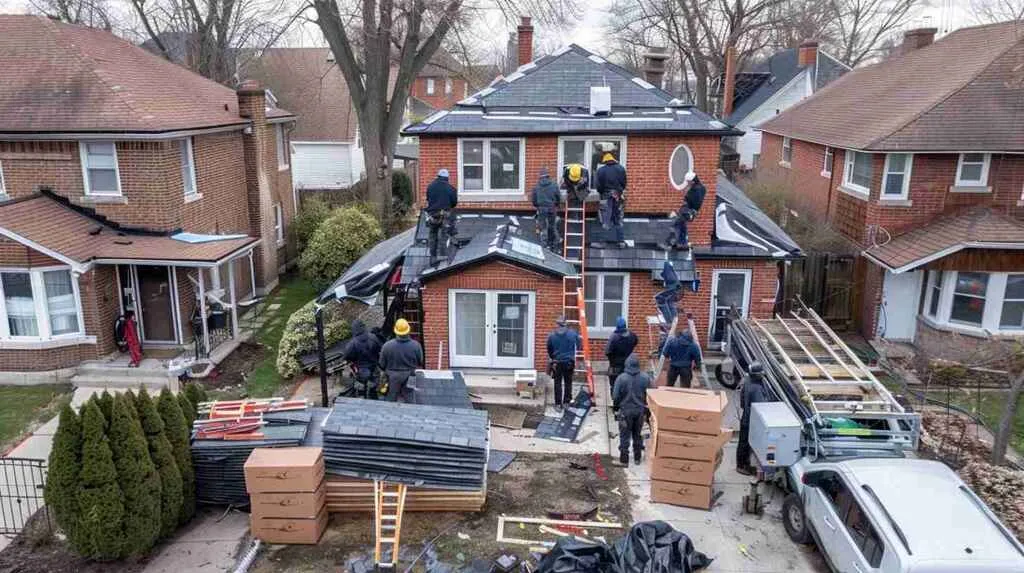
Identify Hail Damage on Shingle Roof Queens NY – What to Look For
Quiet bruises on your shingles can cost you thousands if you don’t catch them early. After a hailstorm rolls through Queens, most damage looks like nothing at all-just faint scuff marks or dark spots you’d walk right past in bright sunlight-but press gently with your thumb and the surface feels soft, or even crunchy, like the granules protecting your asphalt have been crushed down into the mat below. I’m Carlos Mendez, and for 19 years I’ve been teaching homeowners how to read their roofs the way they read the 7 train schedule: line by line, connection by connection, looking for the small “delays” that eventually cause bigger service disruptions inside your home.
Quiet bruises: the first thing to check on your shingle roof after hail in Queens
One July afternoon around 3 p.m., brutally hot, I was on a two-family in Jackson Heights where the owner swore her insurance adjuster said there was “no hail damage.” I brought her up to the top landing of the fire escape and had her look across the roof while I angled my flashlight low-suddenly those “dark smudges” on her shingles popped out like polka dots. She got so quiet and said, “How did he not see that?” and I had to explain that if you only look straight down in bright noon sun, you walk right past half the bruises hail leaves behind. In my view, surface bruises are the number one thing Queens homeowners underestimate after a hailstorm, because they don’t look scary-but think of each one like a stuck turnstile on the E line: one little jam point and suddenly water backs up, takes a detour under the shingle edge, and shows up as a ceiling stain three rooms away from where the hail actually landed.
You can do a decent at-home check without climbing-use a ladder to get eye level with your roof edge, or zoom in tight with your phone camera in early morning or late afternoon light when shadows exaggerate surface dents. Queens has a mix of older three-tab shingles and newer architectural styles, and bruises show up differently: on flat three-tabs you’ll see round dark spots where granules got hammered into the asphalt, while thicker architectural shingles might show a shallow crater or a glossy “bald” patch where the protective layer is gone. Either way, if you press gently and it feels mushy instead of firm, that’s your sign the mat underneath took a hit.
Surface signs of hail bruising on asphalt shingles you can spot without stepping on the roof
Round dark spots or shiny patches where colored granules have been crushed away or knocked loose
Soft or spongy feel when you gently press the shingle surface with your thumb-undamaged shingles stay firm
Cracked or fractured fiberglass mat visible through the asphalt layer if you look closely at a bruise
Random pattern of marks scattered across the roof slope, not lined up along seams or edges like wind damage would be
Fresh granule buildup in gutters and downspouts right after the storm, often black or brown colored depending on your shingle
On a typical Queens block, start with gutters, metal, and your neighbors’ roofs
Right after a spring storm in 2021, I inspected a hip roof in Bayside at 7:30 in the morning, cold and drizzly, for an older couple who’d just done a big interior renovation. The hail had been small-pea-size-but it hammered the ridge caps and the soft aluminum around the skylight. I remember watching condensation form on the skylight glass while I gently pressed a shingle bruise with my thumb and it literally crumbled under the surface; from the sidewalk it looked fine, but I knew they’d be chasing leaks in a year if we didn’t document it right then. Here’s the thing about Queens housing stock: you’ve got row houses in Jackson Heights sharing gutter leaders, Bayside hips with skylights and dormers, Astoria two- and three-families where one bad downspout backs water onto three roofs-so checking metal and gutters first gives you a wider lens on whether the hail that hit your block was strong enough to bruise asphalt, not just ping off harmlessly.
That’s why I always walk the perimeter before I climb. Look at your gutters for fresh dings or dents, check aluminum chimney caps and drip edges for small craters, scan your neighbors’ vinyl siding and parked cars for impact marks-if you see damage on those softer targets, your shingles definitely took hits too. On a typical Queens block where houses are close together and storms come from the same direction, you’ll often find three houses with identical hail patterns and two that got nothing; that cluster of damage helps confirm what you’re seeing on your own roof isn’t just normal wear, and it gives you leverage when you’re talking to your insurance adjuster about whether the storm was “severe enough” to file a claim.
| What to check from ground | What hail damage looks like | What it tells you about your shingles |
|---|---|---|
| Aluminum gutters & downspouts | Fresh round dings or craters on the top edge and sides, often clustered on the storm-facing direction | If softer metal is dented, asphalt shingles almost certainly have bruised surfaces even if you don’t see them yet |
| Metal chimney caps & vents | Small dimples or pockmarks, sometimes with paint chipped off at impact points | Hail was large and fast enough to break protective coatings-your shingle granules took the same beating |
| Vinyl siding on your house or neighbors’ | Cracked panels, small punctures, or spiderweb fractures that weren’t there before the storm | Confirms hail size was at least ¾ inch or larger-big enough to crack shingle mats and drive granules deep into asphalt |
| Air conditioning units or mailboxes | Dented top surfaces, bent fins on AC condensers, or fresh scratches on painted metal | Proof the storm hit hard enough to cause functional damage, not just cosmetic marks-your roof is likely in the same boat |
| Neighbors’ roofs on the same block | Missing shingles, visible bruise patterns, or blue tarps going up within a few days of the storm | Strong evidence your roof took similar hits-hail doesn’t skip houses, so if they filed claims you probably should too |
!
Queens hail-and-roof facts
I’ll be blunt: what real hail damage on shingles looks and feels like
The one that sticks with me is a New Year’s Eve emergency call in Astoria at 10 p.m.-light snow coming down, wind cutting through every layer I had on. A tenant’s bedroom ceiling had just started leaking, and the landlord thought it was “just old age.” When I got up there with my headlamp, I could see a perfect trail: hail impact marks from a storm six months earlier, one small shingle crack that had finally opened with freeze-thaw cycles, and water marching straight to a poorly nailed flashing. I traced it out loud for him, step by step, like following the N train from Astoria Boulevard to Queensboro Plaza to the leak dripping onto that tenant’s bed-and you could see the moment he realized ignoring those “little dots” on the shingles last summer had just turned into ruined plaster and an angry tenant. Here’s the insider tip I give every homeowner: start at the ceiling stain, trace uphill through the attic to where water’s entering, then keep going uphill on the roof surface until you find the bruise or crack that kicked the whole route off; nine times out of ten, the “station” where water gets in is three or four feet upslope from where you first see damage inside.
This is the part where tiny dots on a shingle turn into real money.
Real hail damage isn’t always dramatic-it’s functional, not cosmetic. You’re looking for spots where the impact fractured the fiberglass mat underneath the asphalt, or drove granules so deep they can’t protect the shingle from UV anymore, or created a soft depression that’ll hold water instead of shedding it. That’s completely different from algae streaks, scuff marks from a careless roofer’s boot, or the normal granule loss that happens as shingles age-all of which look ugly but don’t reroute water or speed up your roof’s clock toward failure.
⚠️
Walking your roof or pressing too hard can void your warranty and your claim
- Aggressive poking or lifting shingle tabs to “check for damage” can crack already-weakened mats, and adjusters are trained to spot fresh breaks versus storm damage.
- Walking a steep Queens roof-especially older shingles that are brittle-crushes granules and creates new bruises that look identical to hail, giving insurance companies reason to deny your claim.
- Most manufacturer warranties explicitly exclude damage caused by foot traffic or improper inspection, so let a licensed pro do the close-up work and keep your coverage intact.
Think of your roof like the Queens subway lines: follow the water routes
A single hail bruise up near your ridge is like a signal delay at Forest Hills on the E line-doesn’t seem like much on its own, but it slows down the whole flow and suddenly water that should’ve shed cleanly off your roof backs up at a valley, pools around a skylight curb, or sneaks under a chimney flashing and reappears as a stain on your living room ceiling two floors down and ten feet away from the original impact. I’ve traced routes that started with three pea-size bruises on the upper slope, channeled water sideways along a worn seal, sent it under a ridge cap that was already lifting slightly in the wind, and dumped it straight into an attic rafter bay where it sat quietly rotting the plywood for eight months before anyone noticed the bedroom corner was soft. That’s why hail damage is sneaky: the “station” where you see the problem-drips, stains, ceiling bubbles-is almost never the station where the damage actually happened, and if you don’t map the whole line from bruise to leak, you end up patching the wrong spot and riding the same busted train next spring.
Have hail impacts already created a leak route on your Queens roof?
START: Did you see or hear hail hitting your home during the storm?
↓ YES → Do you have any ceiling stains, drips, or water marks inside that appeared after the storm?
↓ YES → CALL A LOCAL ROOFER AND YOUR INSURANCE IMMEDIATELY – Water’s already found a route from bruise to interior, and delay will only make damage worse in Queens freeze-thaw cycles.
↓ NO → Are there visible soft spots, craters, or dark bruises on your shingles when you zoom in with a camera or check from a ladder?
↓ YES → Do your gutters have fresh granule buildup or do nearby metal surfaces show dents?
↓ YES → CALL A LOCAL ROOFER AND YOUR INSURANCE – You’ve got multiple confirming signs; document now before granules wash away and bruises fade in UV light.
↓ NO → MONITOR AND DOCUMENT – Take dated photos, keep an eye on neighbors’ roofs, and watch for new interior stains over the next few months.
↓ NO → MONITOR AND DOCUMENT – Hail may have been too small or your shingles may have held up; still worth a quick pro inspection if neighbors file claims.
↓ NO → MONITOR AND DOCUMENT – Storm may not have been severe enough, but take photos and note the date in case damage appears later.
What to do next in Queens: document, then call a roofer (not just your insurance)
Here’s the order that keeps you out of trouble and gets your claim paid: first, take date-stamped photos from the ground showing any visible marks, granule piles in gutters, or dents on metal-your phone’s camera app automatically embeds the date, so don’t skip this step. Second, check your attic and top-floor ceilings with a flashlight, looking for wet spots, stains, or drips, and photograph those too. Third, note which side of your house took the storm-wind direction matters because hail hits hardest on the windward slope and barely touches the lee side-and write down what you noticed first, whether it was noise during the storm or a stain you found days later. Then call Shingle Masters or another local Queens roofer before or alongside calling your insurance, because a good roofer will map the whole “route” from bruise to potential leak, translate it into language adjusters understand, and make sure you’re not leaving money on the table by missing hidden damage on ridge caps, valleys, or flashing that your carrier would’ve covered if you’d documented it right.
Info to gather before you call a Queens roofer about hail damage
Exact date and approximate time of the hailstorm, including whether you heard it hit or just saw damage afterward
Location and color of granule piles you found in gutters, downspouts, or on the ground near the house
Any interior stains, drips, or ceiling bubbles you’ve noticed, with notes on which rooms and how far from outside walls
Photos taken from multiple angles-especially early morning or late afternoon when low light shows surface bruises best
Approximate age of your roof and type of shingle if you know it (three-tab, architectural, designer), or the year it was last replaced
Visible dents or damage on nearby metal surfaces like gutters, vents, air conditioners, or siding to confirm hail size
Whether neighbors on your block have reported damage, filed claims, or had roofers out inspecting after the same storm
Common Queens questions about hail damage on shingle roofs
▶
How small does hail have to be before it stops hurting asphalt shingles?
Honestly, anything over half an inch can bruise shingles if it’s falling fast enough-and Queens storms often produce ¾-inch to 1-inch hail that looks tiny on the ground but hits hard enough to fracture the fiberglass mat underneath. I’ve seen pea-size hail crack ridge caps and drive granules so deep into architectural shingles that the surface goes soft within weeks. Size matters, but so does wind speed, the age and quality of your shingles, and whether the storm came with cold rain that made asphalt brittle right before impact.
▶
Should I wait for a leak before calling a roofer or insurance about hail damage?
No-and here’s why waiting backfires: most hail bruises don’t leak right away; they sit there quietly for months while freeze-thaw cycles crack the mat and UV exposure eats through the exposed asphalt, and by the time water shows up inside you’ve got rotten plywood, stained ceilings, and a much bigger repair bill that insurance may only partially cover because the “new” damage mixed with the old storm damage. Document and inspect within the first few weeks after a hailstorm, when granules are still fresh in the gutters and bruises haven’t faded, so your claim is clean and your repairs stay small.
▶
How does insurance in Queens usually handle hail damage on roofs?
Most homeowner policies in New York cover hail as a “sudden and accidental” peril, meaning if you can prove the storm happened and the damage matches the timeline, they’ll pay to repair or replace affected areas minus your deductible. The tricky part is adjusters often lowball the first estimate or claim “normal wear” instead of storm damage, so having a local roofer who knows Queens housing stock and can document bruise patterns, granule loss, and metal damage makes a huge difference in getting full coverage rather than a partial patch that leaves you paying out of pocket later.
▶
Do mixed roofs-like a flat section and shingle slopes-get inspected differently after hail?
Absolutely-hail shows up completely differently on flat rubber or TPO membranes versus pitched asphalt shingles, so a good inspector checks both systems separately. On the flat sections I’m looking for punctures, surface cracks, or seam splits where hailstones punched through, while on the shingle slopes I’m checking for bruises and granule loss. A lot of Queens two- and three-families have exactly this setup, and it’s common for insurance to approve the shingle claim but deny the flat roof because the adjuster didn’t understand how hail damages membrane differently-that’s why you want a roofer who can document and explain both in the same report.
▶
How long does a hail-damage inspection by Shingle Masters usually take?
For a typical Queens one- or two-family, I spend about 45 minutes to an hour on site: I check gutters and metal from the ground, climb up to inspect shingle surfaces with my flashlight at different angles, photograph bruises and any cracked mats, then walk the attic and interior to see if water’s already found a route inside. After that I’ll sit down with you for another 15 minutes to show you the photos, sketch out the “route” on a simple diagram, and explain exactly what I’m documenting for your insurance-so you leave understanding your roof the same way you understand the subway map, one line at a time.
Why Queens homeowners call Shingle Masters after hail
Fully licensed & insured in NYC – We carry all required New York City permits and liability coverage so your claim and your property stay protected
19+ years on Queens and Brooklyn roofs – Carlos personally knows the housing stock, typical storm patterns, and what adjusters expect to see in this area
Inspection scheduled within 24-48 hours after storms – We prioritize hail calls when granules are fresh and bruises are easiest to document for your claim
Photos and simple ‘route map’ explanation – Every inspection includes date-stamped images and a clear sketch showing how water travels from hail impacts to potential leaks
Catching hail bruises early keeps your roof running on schedule-no delays, no detours, no surprise leaks showing up at the wrong “station” six months from now. If you’ve had a hailstorm roll through Queens and you’re seeing soft spots on shingles, granules in the gutters, or dings on metal surfaces, don’t wait for the first drip to hit your ceiling. Call Shingle Masters for a Queens-focused hail inspection-we’ll map the whole route from impact to potential leak, help you document everything your insurance needs to see, and make sure those quiet little bruises don’t turn into loud, expensive problems down the line.