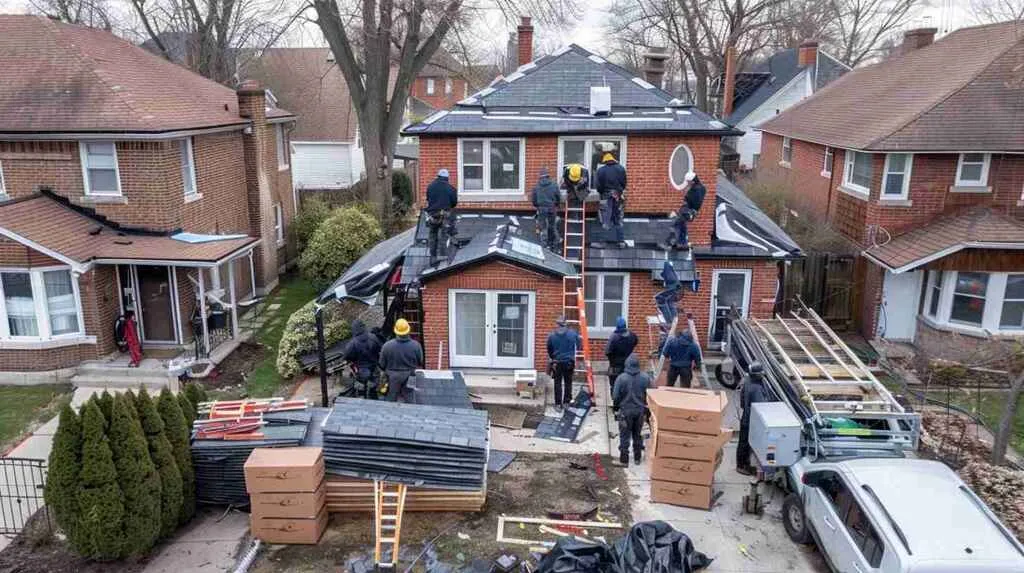
Architectural Shingles Wind Damage Queens NY – What You Face | Free Quotes
Crosswinds that tunnel between apartment blocks in Jackson Heights and gusts that race off Jamaica Bay into Howard Beach don’t care what the shingle box says. So-called “130 mph wind-rated” architectural shingles in Queens will peel back in 40-50 mph gusts if they’re high-nailed, missing a starter strip, or installed without understanding where the wind actually hits your house-and I’ve spent 19 years watching nail guns and lazy installs turn supposedly indestructible shingles into yard confetti.
Why Your “130 mph” Architectural Shingles Still Failed in a 45 mph Queens Gust
Here’s the unfun truth nobody likes to hear: Queens is basically a giant wind lab, and your roof is the test sample. Those impressive wind ratings printed on every architectural shingle bundle assume perfect installation-nail placement in the exact zone, full seal-strip adhesion, correct starter course, and ideal conditions where wind flows evenly across a simple gable like some textbook diagram. Corner lots, subway corridors, narrow alleys between row houses, and open stretches near the bay create wind paths that manufacturers never test for. I treat every Queens house like a wind blueprint, mapping invisible traffic patterns in the air-front-to-back, alley-to-ridge, bay-to-gable-because understanding those paths explains why certain shingles fail and others don’t. Let me be blunt: most “wind damage” I see on architectural shingles didn’t start with the wind-it started with a nail gun set too high.
One February morning around 6:30 a.m., I was on a two-family in Jackson Heights after a nasty overnight windstorm; the owner called me in a panic because shingles were literally flapping like playing cards. I got up there, and you could see where cheaper architectural shingles had been “high-nailed” by whoever installed them-half the row had peeled back in a straight line facing the subway tracks, creating a perfect uplift zone. As I was checking the ridge, a gust ripped one loose shingle completely off and it sailed into the neighbor’s plastic greenhouse; that moment drilled into me how unforgiving Queens wind tunnels can be if the install is even an inch off. The nail placement has to be in the manufacturer’s designated zone-usually just above the sealant strip and through both layers-or the shingle won’t lock down properly. Seal strips themselves need time and warmth to bond, and if installers walk all over fresh shingles or don’t line them up right, you’ve got tabs that’ll lift the second a crosswind hits. None of this shows up until the storm arrives.
Real wind damage on architectural shingles means tabs bent upward or torn away, creases across the surface from flapping, missing shingle courses exposing underlayment or bare wood, ridge caps shifted out of position or gone entirely, and broken seal strips where you can slide a finger under tabs that should be flat. Normal wear-granule loss in thin patches, slight curling at very old edges, fading-happens slowly over years and doesn’t correlate with storm dates. Right after a Queens windstorm, walk your property line and look for shingles on the ground, check eaves and rakes for lifted or missing tabs, scan the ridge for gaps, and note which side of your house took the hit. If you see daylight or plywood where shingles used to be, that’s urgent.
Quick Facts: Architectural Shingles & Queens Wind Reality
On-Home Wind Paths: How Queens Roofs Actually Take a Beating
On a corner lot in Queens, the wind doesn’t hit your roof the way the brochure drawings show it. One Saturday last spring, right before lunch, I inspected a hip roof in Howard Beach for an older couple who swore “the roof is only five years old.” It turned out the shingles were fine, but the starter strip along the eaves was missing, so every time the wind came off the bay at just the right angle, it got under the first course and snapped seals-classic uplift pattern. I ended up showing them on their Ring camera footage the exact gust that pulled a tab up and dumped water down their fascia; that job taught me how important it is to connect wind damage to something homeowners can actually see and understand. Jamaica Bay winds hit Howard Beach and Rockaway roofs from the south, alley winds in Jackson Heights and Ridgewood funnel west-to-east between tight row houses, and corner lots near wide cross-streets face crosswinds from two directions at once. Those patterns create uplift zones at eaves (where the wind first catches the edge), rakes (the angled edge along gables), and hips or ridges where slopes meet. The wind doesn’t blow evenly-it accelerates around chimneys, over porch roofs, and through gaps, prying at any weak point in the shingle line.
When I walk up to a house after a storm, the first thing I ask the owner is, “Where did you find the shingles-front yard, backyard, or the street?” That answer tells me which slope failed and which direction the wind was moving. Then we walk around together and I point out the wind path for each side: the front slope that faces the open street, the backyard slope sheltered by neighboring houses but exposed to alley gusts, the street-facing gable that catches crosswinds head-on. Insider tip: if you have a Ring doorbell or security camera, review the footage from the storm-listen for the rattling noise and watch for visible flapping or debris. You can often match the timestamp and wind direction to the exact area of damage, which makes the inspection faster and more targeted.
Identify Your Roof’s Likely Wind Path Problem Area
If you already know which side the wind hit last storm, you’re halfway to diagnosing your own roof.
Architectural Shingle Wind Damage Checklist: What to Look For Today
This is what I run through after storms in Jackson Heights, Bayside, Ridgewood, and every other Queens neighborhood-a quick walk-around that tells you whether you need a pro or you’re fine for now. One job that still bugs me was a re-repair in Bayside on a rental property where another crew had “fixed” wind damage the week before I got called; I found three different brands of architectural shingles woven together, none matching the existing wind rating, and a microburst hit two months later and blew half that patch clean off again. Patchwork fixes fail in wind-prone sections, so use this checklist to catch problems early.
Before You Call: Quick Roof & Yard Check After a Queens Windstorm
⚠️ Warning: Unsafe DIY Inspections & Quick Patch Kits
Don’t climb steep or multi-story roofs after wind events-walking on lifted architectural shingles can break seals and tabs that might’ve survived otherwise. Slapping down store-bought mastic or mixed-brand shingles can void warranties and fail in the next microburst, especially in high-exposure neighborhoods like Bayside and Howard Beach. Wind-damaged areas need matching shingles, correct nailing in the manufacturer’s zone, and re-sealing following manufacturer specs. A $15 tube of goop and mismatched colors won’t cut it when the next 50 mph gust rolls through.
What Shingle Masters Actually Does on a Wind-Damaged Roof in Queens
From First Call to Final Nail
When you call, I’m not going to guess from the sidewalk or schedule you three weeks out unless you’re fine waiting. Phone triage comes first: when did the storm hit, where did you find the shingles, any active leaks or just cosmetic damage? That tells me whether we’re looking at an emergency tarp situation or a scheduled inspection. On-site, I walk the wind path-front, back, street side, alley side-checking nail lines through a close-up look at lifted tabs, inspecting starter strips at eaves, scanning ridge caps and hips, and mapping which slopes failed and why. I refuse to guess; I get on the roof, document with photos, and explain what I see in plain English right there on your driveway, sometimes sketching wind direction and uplift zones on a scrap of cardboard so you can actually picture what happened.
That Bayside rental job I mentioned-one of those hot July afternoons, tar sticking to your boots-taught me a hard lesson. The landlord had tried to save a buck with a cheap patch, and I found three different brands of architectural shingles woven together, none matching the existing wind rating or color. The first crew didn’t even check the manufacturer’s installation manual. Two months later, a microburst storm hit that block and I got the 11 p.m. call: half that patch had blown clean off again, ripping underlayment and dumping rain into the top-floor unit. Now I lay out the manufacturer specs on the hood of my truck, show homeowners the nailing diagrams and wind-rating charts, and refuse to mix in off-brand shingles for wind-prone sections. If the exact match isn’t available, I’ll source the closest approved alternative and explain where the transition line will be and why it won’t fail. Personal rule: no shortcuts on edges that face the bay, the subway corridor, or wide cross-streets.
When a Patch Isn’t Enough
Localized repair makes sense when you’ve got five to fifteen shingles damaged in one area, the rest of the roof is sound, and the underlayment isn’t compromised. Section or full replacement comes into play when you’re seeing repeat blow-offs in multiple areas, the roof’s over fifteen years old with brittle seals, or previous patches have already failed and you’re chasing leaks every storm. I won’t sell you a whole roof if ten shingles and a ridge cap fix the problem, but I also won’t keep patching a 20-year-old roof that’s shedding granules and fighting the wind every season-that’s throwing money into the alley. Insider tip: when we do localized repairs on windward sides in Queens, I quietly over-build those edges within manufacturer specs-correct extra nailing patterns where allowed, better starter courses, attention to corner and ridge details-so the next storm doesn’t peel the same spot again. The spec sheets allow for additional fasteners in high-wind zones; most installers skip that step because it takes time, but on a corner lot in Howard Beach or a bay-facing slope, those extra nails are the difference between staying put and ending up in your neighbor’s yard.
Shingle Masters Wind Damage Service Process in Queens, NY
Typical Queens Architectural Shingle Wind Damage Scenarios & Price Ranges
| Scenario | Typical Situation in Queens | Approx. Price Range |
|---|---|---|
| Minor Edge Repair | 5-10 lifted or missing shingles along one eave or rake, no interior leak yet | $350-$650 |
| Localized Slope Repair | One small slope or corner section peeled back, some exposed underlayment | $750-$1,500 |
| Multiple Slope Wind Damage | Blow-offs on two or more slopes, older roof, early signs of leaks | $1,800-$4,000 |
| Wind + Age Full Replacement | Architectural shingle roof 15+ years old with repeated wind damage and patches | $7,500-$15,000+ |
Final pricing depends on roof height, access, materials, and how many wind-prone details (hips, ridges, valleys) we’re correcting.
Myths, Facts, and When to Call for Architectural Shingle Wind Damage in Queens
Think of your roof like a stack of playing cards on a picnic table-how they’re stacked and where the gusts come from matters more than what the box says on the cards. Here’s what’s true and what’s marketing, and exactly when you should pick up the phone.
Wind Damage Situations: Call Now vs Can Wait a Day
Call Shingle Masters Immediately
- You see daylight or bare wood where shingles blew off.
- There’s active dripping or new stains on top-floor ceilings after the storm.
- Multiple shingles or a whole strip are missing along a ridge or eave.
- You hear flapping or rattling on the roof with every gust.
Can Usually Wait 24-48 Hours
- A couple of tabs are missing but underlayment is still covered.
- You only see minor creasing at a few shingle corners.
- No interior leaks yet and damage is limited to one small area.
- You’re waiting for daylight to safely get photos from the ground.
Queens Architectural Shingle Wind Damage FAQs
Can you match my existing architectural shingles after wind damage?
▼
Do you work in my Queens neighborhood?
▼
Will a small wind repair affect my roof warranty?
▼
How fast can you get here after a big storm?
▼
Why Queens Homeowners Call Shingle Masters for Wind Damage
I still remember a Tuesday in March, standing on a Ridgewood roof watching tabs lift one by one like someone peeling Post-its, and thinking how preventable it all was-the installer had set his nail gun depth wrong and never checked the starter strip. Every Queens house has its own wind path, shaped by alleys, bay breezes, subway corridors, and cross-streets, and ignoring a few lifted architectural shingles now usually means bigger leaks and more expensive repairs later. Call Shingle Masters for a wind-path-focused inspection and clear repair plan that actually addresses how the wind moves around your house, or request a free quote before the next storm rolls through and you’re scrambling for tarps at midnight.