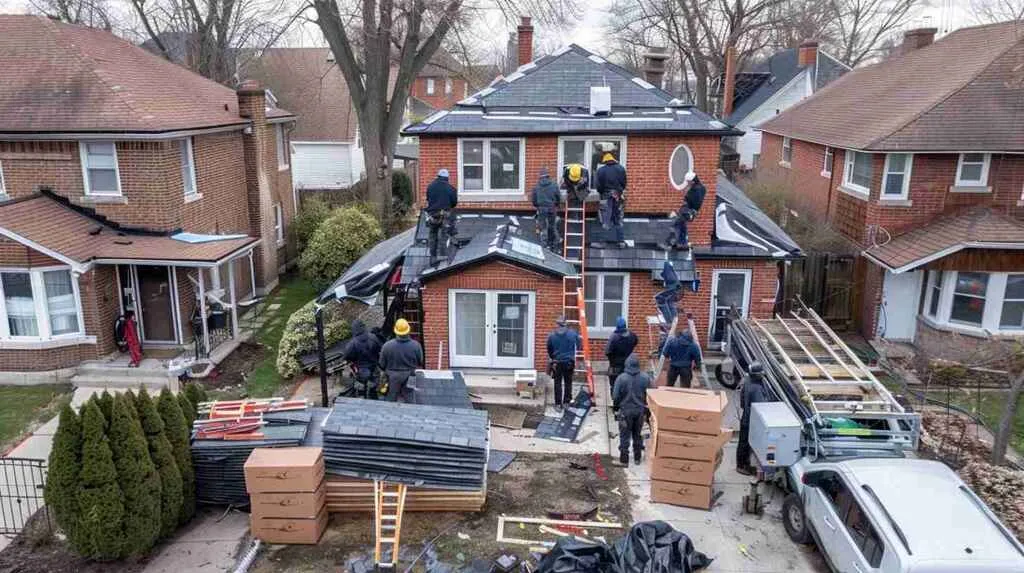
Wood Shingle Roof Cost Queens NY – Worth the Investment? | Free Estimates
Blueprint or invoice? That’s really what this decision comes down to. A wood shingle roof in Queens runs $12 to $20 per square foot installed, including tear-off, underlayment, and the shingles themselves-not just the pretty cedar strips everyone sees from the street. Two houses sitting next to each other on a Bayside block can end up tens of thousands of dollars apart because of roof size, how steep it is, and whether you’re doing real wood across every slope or mixing materials where nobody looks.
What Wood Shingle Roofs Really Cost in Queens, NY
Let me be blunt about wood shingle pricing: if anyone’s giving you a number that doesn’t include removal of your old roof, proper underlayment, and the actual installation labor, they’re kidding you or kidding themselves. The real range in Queens sits between $12 and $20 per square foot for full tear-off and install, and that spread isn’t random-it reflects material grade, roof complexity, and how many trips up and down a ladder your crew has to make. I think of cost decisions the way I used to mark up blueprints back in Bogotá: change one line-like bumping from economy cedar to premium-and suddenly every other number on the page shifts. You’re not just buying shingles; you’re buying a system that sits on top of your house for the next 30 years.
On a typical 1,600-square-foot roof in Queens, you’re looking at somewhere between $19,200 on the low end and $32,000 on the high end, assuming you go full wood coverage on every slope. That’s a big window, and it exists because two homes on the same Astoria street can have totally different realities: one’s a simple gable with clean access, the other’s got three dormers, two valleys, and a pitch that makes your knees hurt just looking at it. Then there’s material grade-cheapest cedar versus premium clear-grain makes about a $4 to $6 per square foot difference-and whether you decide to do wood only on the front-facing slopes and architectural asphalt on the back, which is a smart move in neighborhoods like Forest Hills or Kew Gardens where curb appeal matters but budgets don’t stretch forever.
Queens Wood Shingle Roof Cost Scenarios
Note: Prices are ballpark estimates for Queens and can shift with roof steepness, access challenges, and exact wood grade selected. All scenarios assume full tear-off and proper underlayment.
Fast Cost Facts for Wood Shingles in Queens
Why Two Similar Queens Homes Get Very Different Wood Roof Quotes
I still remember a Friday in Kew Gardens when a homeowner asked me this exact question-his neighbor three doors down got a quote that was $11,000 less for what looked like the same job. Turns out the neighbor went with the absolute cheapest cedar the supplier would sell, the kind that barely passed inspection. This was late August in Bayside, maybe 88 degrees and humid as hell, and I could see those budget boards starting to curl before we even finished the first slope. I stopped the crew, pulled the homeowner outside, and lined up three sample shingles on his porch rail-cheap, mid-grade, and premium-then poured a cup of water over each one. The cheap stuff soaked through and started to warp right there. The premium barely budged. He upgraded on the spot, and when that thunderstorm rolled in from the Sound an hour later, those better shingles laid flat and tight instead of buckling under the rain. Queens weather doesn’t forgive shortcuts: humid summers, sudden downpours, freeze-thaw cycles all winter. Cheap cedar might save you $4,000 today, but when it curls, splits, or fails in five years instead of 25, you’re not saving anything.
Think of your roof the way an architect thinks of a drawing-layers, scale, and lifespan all on one sheet of paper. When you change one line on that blueprint, everything else shifts. Here’s what actually moves the needle on wood shingle quotes in Queens: roof pitch and access (a steep Victorian with tight side-yard access costs way more per hour than a shallow ranch with a clean driveway), wood grade (economy versus premium cedar is a $4 to $6 per square foot swing right there), roof complexity (simple gables are straightforward, but multiple hips, valleys, and dormers mean more cuts, more waste, more labor), existing roof condition (one layer of old shingles on solid decking is one thing; two layers plus rotted plywood is a whole different job and invoice), and coverage strategy (full wood on all slopes versus premium cedar only on the street-facing side with architectural asphalt hidden in back). Each one of those decisions is like red-penciling a different part of the plan until the money, the look, and the lifespan finally line up.
Ways to Red-Pencil Your Wood Roof Plan Without Ruining the Look
Here’s the uncomfortable truth most people discover halfway through planning a wood roof: their budget can’t handle a no-compromise, full premium cedar install on every slope. But that doesn’t mean giving up or settling for architectural asphalt and pretending you’re fine with it. One February morning in Forest Hills, around 7:30 a.m., I was standing on a frozen driveway with a couple who’d just bought a 1920s Tudor and wanted wood shingles but were terrified of the price-my pen barely worked in the cold while I drew them a side-view of their roof on a yellow pad. I showed how we could cut about $9,000 by doing the street-facing slopes in premium cedar and using architectural asphalt on the back where nobody sees it from the curb or the sidewalk. We ended up doing exactly that, and three years later they called to tell me their appraiser specifically mentioned the “period-correct” wood when bumping their value. So here are the red-pencil moves that actually work: limit premium wood to visible slopes (front and sides if you’re on a corner lot, front-only if you’re mid-block), choose mid-grade cedar smartly on lower-traffic areas like garage roofs or back extensions, and simplify some details-fewer custom cuts around dormers or decorative trim if those aren’t critical to the historic character of your house.
If you were standing next to me with your water bill in one hand and this quote in the other, I’d ask you this: how long are you planning to stay in this house, and what matters more to you-lowest upfront cost or total cost of ownership? A few years back I quoted a retired teacher in Astoria for a full wood shingle roof, and she nearly fell off her stoop when she saw the total. She told me about growing up in a house with wood shingles that leaked constantly, so she already hated the idea but loved the look. I went into draftsman mode and drew two timelines on paper: one for a cheap asphalt roof replaced twice in 40 years, and one for a quality cedar roof with one major restoration around year 25. It was a weird afternoon-rain spitting, the N train rumbling by, us hunched over my sketch on her kitchen table-but we calculated that the “expensive” option was only about $85 more per year over the life of the house. She ended up doing the full wood roof, and last I heard it still looked great 12 years later. That drawing made the decision clear.
Full Wood Coverage vs Front-Only Wood in Queens
Full Wood Shingle Roof (All Slopes)
- Premium curb appeal from every angle-side yards, back patios, neighbor views all show consistent wood character
- Maximizes historic authenticity on period homes like Tudors, Victorians, and Arts & Crafts cottages throughout Queens
- Total investment typically $19,000-$36,000 depending on size and grade
- Best for homeowners planning to stay 15+ years and who value period-correct appearance above initial cost savings
Front-Facing Wood + Asphalt on Back
- Preserves street view and appraisal appeal-what buyers and assessors see from the curb is still high-quality wood
- Reduced cost: often $8,000-$15,000 less on a 1,600 sq ft roof compared to full wood coverage
- Makes most sense on mid-block homes, tight-budget renovations, or when back slopes face only fenced yards or alleys
- Allows you to invest in premium cedar where it counts and use quality architectural asphalt where visibility is low
Will the street view or the invoice matter more to you five years from now?
Should You Go Full Wood or Hybrid in Queens?
Maintenance, Lifespan, and When a Wood Roof Pays You Back in Queens
Let’s zoom out and talk lifespan without the fluff. Good cedar in Queens-assuming it’s installed right, ventilated properly, and you don’t ignore it for 20 years-will give you somewhere between 25 and 35+ years of solid service. Architectural asphalt might last 18 to 25 years depending on sun exposure, ventilation, and how many ice dams you get. Wood is not maintenance-free, and anyone telling you otherwise is lying or hasn’t seen what happens when shingles get buried under leaves and moss for five years straight. But with scheduled care, the cost per year can actually be competitive, sometimes even better than cheaper materials that need full replacement twice in the same time span. Queens conditions matter here: if you’re near the water in Howard Beach or Bayside, you’re dealing with saltier air and higher humidity. If you’re in a tree-heavy neighborhood like Douglaston or Jamaica Estates, you’ve got shade that keeps shingles damp and invites algae and moss. Both situations need slightly more attention than a bare, sunny roof in a newer subdivision.
Keep it practical: you should budget for a visual inspection and gutter cleaning every year, a professional inspection and selective repairs every 3 to 5 years, and around year 20 to 25, start planning for a deeper assessment or partial restoration depending on how things look. It’s not complicated, but it’s also not optional if you want that roof to make it to 30 years. And here’s the thing-when I drew those timelines for that retired teacher in Astoria, the 40-year window showed two cheap asphalt roofs versus one quality cedar roof plus one mid-life restoration, and the yearly cost difference was modest, maybe $85 a year. The “expensive” wood roof turned out to be surprisingly reasonable when you stop thinking in upfront dollars and start thinking in decades.
Wood Shingle Roof Care Schedule in Queens
| Interval | Recommended Task for Queens Wood Roofs |
|---|---|
| Every Year | Visual inspection from the ground looking for loose, curled, or missing shingles. Clean gutters and downspouts to prevent water backup that can soak the bottom courses of wood. |
| Every 3-5 Years | Professional inspection including close-up examination of shingles, flashings, and underlayment condition. Replace any damaged or worn shingles before small problems become leaks. |
| Every 7-10 Years | Deeper assessment of fasteners, valley flashings, and chimney/vent penetrations. Clean off moss or mildew buildup in shaded areas using gentle methods that won’t damage wood grain. Check attic ventilation to confirm it’s working properly. |
| Year 20-25+ | Planning phase for major restoration or selective replacement depending on overall condition. Evaluate if targeted repairs can extend life another 10 years or if full re-roof makes more financial sense. Factor in curb appeal, sale timing, and total cost of ownership. |
What to Do Before You Call for a Wood Shingle Estimate in Queens
A few minutes of prep helps turn a vague quote into a precise plan, and honestly it saves both of us time when I show up. Know your approximate roof size-you don’t need blueprints, but “around 1,500 square feet” or “it’s a 1,200 square-foot ranch” gives me a ballpark to work from. Think ahead about whether you’d consider hybrid solutions if full wood comes in above your budget; it’s way easier to sketch those options in your driveway than to backtrack a week later. Gather any old roof paperwork you have-warranties, past invoices, anything that tells me what’s under those shingles and when it was done. Take a few ground-level photos of the front, back, and sides if you can, and definitely note how long you’re planning to stay in the house. That last one sounds personal, but it changes everything about which cost/lifespan trade-offs make sense. And here’s my insider tip: even if you don’t know exact square footage, snapping clear photos and knowing roughly how long you’ll stay helps me sketch a much more accurate price range on the first visit instead of giving you a giant, useless window that doesn’t actually help you decide anything.
Get Ready for a Wood Shingle Roof Quote in Queens
Confirm your address and Queens neighborhood
Gather any past roof paperwork or warranties
Note current roof age and leak history
Decide if you’re open to hybrid options
Take photos from the ground
Think about how long you’ll stay
Set a realistic budget range
Common Queens Wood Shingle Cost Questions
Can I put wood shingles over my existing roof?
New York City code and most manufacturers require full tear-off before installing wood shingles. Going over old layers traps moisture, voids warranties, hides structural problems, and prevents proper ventilation. Full removal also lets us inspect and repair any rotten decking before the new roof goes on-skipping that step is asking for expensive problems down the line.
How much more does wood cost than architectural asphalt in Queens?
Wood shingle roofs typically run 60-100% more upfront than architectural asphalt. For a 1,600 sq ft roof, asphalt might cost $9,000-$14,000 installed, while wood comes in at $19,000-$32,000 depending on grade and complexity. But over 30-40 years, the gap narrows significantly when you factor in asphalt replacement cycles, disposal costs, and inflation on future labor.
Do you offer free estimates for wood shingle roofs in Queens?
Yes. Shingle Masters provides free, no-obligation estimates throughout Queens-including Forest Hills, Astoria, Bayside, Kew Gardens, Douglaston, and beyond. The visit includes roof measurements, material options, detailed line-by-line cost breakdown, and discussion of hybrid approaches if budget is a concern. No pressure, no generic ranges-just real numbers based on your actual roof.
Can I mix wood with other materials to save money?
Absolutely, and it’s one of the smartest ways to control cost without sacrificing curb appeal. Doing premium cedar on front-facing slopes and architectural asphalt on the back or sides can cut total cost by 20-30% while keeping the period-correct wood look where it matters for appraisal and street presence. Works best on mid-block homes where rear slopes aren’t visible from the street or neighboring yards.
Why Queens Homeowners Call Shingle Masters for Wood Roofs
A clear wood shingle roof plan is like a clean drawing: every line matters, every material choice shifts the whole picture, and the numbers have to add up before anyone picks up a hammer. If you’re ready for a free, line-by-line wood shingle estimate in Queens-whether you’re considering full premium cedar or a front-only hybrid that fits your budget-call Shingle Masters and let’s sketch out what makes sense for your house, your timeline, and your wallet.