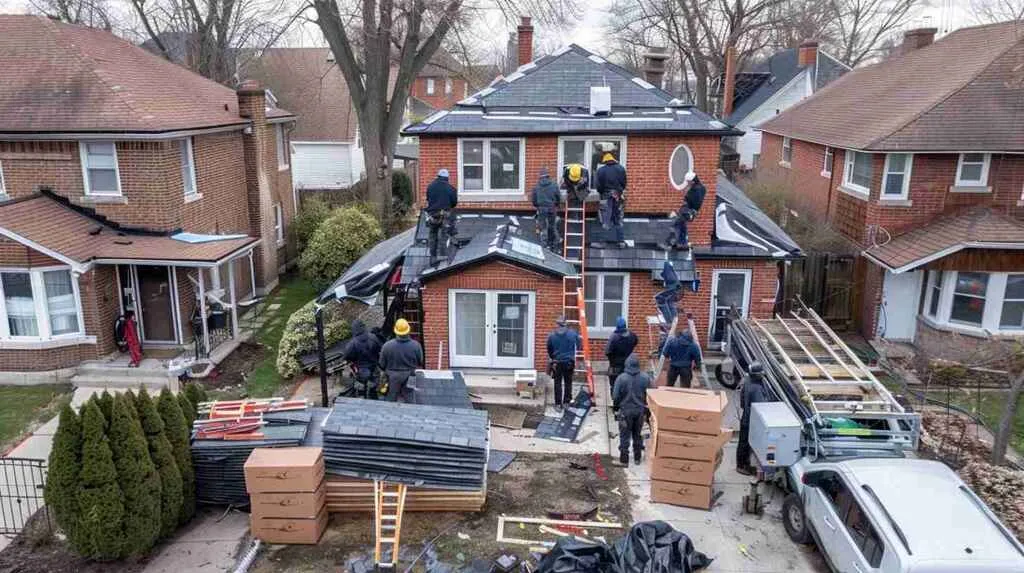
Rubber Shingles Cost Queens NY – Are They Worth It for You? | Free Quotes
Numbers first: rubber shingles in Queens run between $8.50 and $13.00 per square foot installed, and on a typical 1,400-square-foot roof that translates to roughly $12,000 to $18,000 all-in. Compare that to architectural asphalt at $5.50 to $8.00 per square foot-or $7,700 to $11,200 for the same roof-and you’re looking at a premium of four to seven thousand dollars, which sounds like a lot until you think about it in 20-year math instead of today money.
When I sit at a kitchen table in Queens and someone asks, “Luis, what’s this really going to cost me over 20 years?” I pull out a pen, not a sales brochure. The upfront gap shrinks when you factor in fewer repairs, better wind performance, and maybe one less re-roof cycle if you’re keeping the house long enough-but if you’re planning to sell in five years, rubber shingles usually don’t pencil out.
What Rubber Shingles Really Cost in Queens, NY (Per Sq Ft and Per Roof)
On a typical 1,400-square-foot roof in Queens-let’s say a Cape Cod in Bayside or a row house in Jackson Heights-you’re looking at installed rubber shingle costs between $8.50 and $13.00 per square foot, which means your total project lands somewhere around $12,000 to $18,000 depending on complexity, access, and how much rotted decking we find once we peel back the old layers. My personal opinion: rubber shingles are a premium choice and I only recommend them when the 20-year math works, not just because they look high-end or came in a glossy brochure. For comparison, a good architectural asphalt roof on that same 1,400 square feet runs about $7,700 to $11,200, so you’re paying roughly 50 to 60 percent more up front for rubber-but you’re also buying an extra decade of lifespan and better resistance to Queens winters, coastal winds, and summer heat.
Queens Rubber Shingle vs Asphalt Cost Scenarios
| Queens Example Home | Roof Size (sq ft) | Material | Installed Cost ($/sq ft) | Est. Total Price | Typical Lifespan |
|---|---|---|---|---|---|
| Bayside Cape Cod | 1,400 | Rubber Shingles | $9.50-$12.00 | $13,300-$16,800 | 40-50 years |
| Bayside Cape Cod | 1,400 | Architectural Asphalt | $6.00-$7.50 | $8,400-$10,500 | 20-25 years |
| Astoria Row House | 1,800 | Rubber Shingles | $8.50-$11.00 | $15,300-$19,800 | 40-50 years |
| Forest Hills Colonial | 2,200 | Hybrid (Rubber on windward, Asphalt elsewhere) | $7.25-$9.50 | $15,950-$20,900 | 30-40 years |
Here’s the unglamorous truth about roofing costs: most of your money is in labor and prep, not in the shingles themselves. On any roof in Queens, whether rubber or asphalt, you’re paying for tear-off and disposal of the old layers, new underlayment and ice-and-water shield, flashing around chimneys and vents, replacement of any rotted decking we uncover, and the skilled hands that tie it all together so it actually lasts. One August afternoon in Forest Hills it was 96°F and the shingles were so hot my tape measure felt soft, and I had a homeowner asking if rubber shingles were “just expensive plastic.” I took one of the sample tiles, laid it right next to their old asphalt, and we poured water from a garden hose over both; the rubber cooled and dried slower, and I used that little experiment to explain heat retention and why their summer AC bills might actually drop-the material cost difference was only about $1,800 on that job, but the labor, ventilation upgrades, and better underlayment added up to way more.
Where Your Money Goes on a Rubber Shingle Roof in Queens
| Cost Component | Approx. % of Total | Sample Cost on 1,400 sq ft Roof ($12,000 Total) |
|---|---|---|
| Labor (tear-off, install, cleanup) | 40-45% | $4,800-$5,400 |
| Rubber Shingle Material | 25-30% | $3,000-$3,600 |
| Underlayment, Ice-and-Water Shield, Flashing | 15-18% | $1,800-$2,160 |
| Decking Repair (if needed) | 8-12% | $960-$1,440 |
| Vents, Ridge Caps, Accessories | 5-8% | $600-$960 |
When Rubber Shingles Are (and Aren’t) Worth the Extra Money
Before you fall in love with any material, ask yourself how many Queens winters you actually plan to be under this roof.
I’ll be honest, if you’re planning to sell in five years, rubber shingles usually don’t pencil out. You’re paying a premium today for durability and energy savings that the next owner enjoys, and most buyers in Queens aren’t going to add four thousand dollars to their offer just because you’ve got synthetic shingles instead of good architectural asphalt. A winter job in Bayside sticks in my mind: it was a Saturday at 7 a.m., light snow drifting, and we were tearing off a leaky three-layer mess on a Cape Cod house. The owners had been burned by a low-bid roofer five years earlier, so they were suspicious of every line item, especially the higher cost of rubber shingles. Midway through, I found rotted decking around their chimney, and I stopped the crew, took photos, and invited the couple out (carefully) to the scaffolding so they could see it in person before I talked about change orders and why a more resilient shingle made sense there-that combination of bad framing and wind exposure became my go-to example of when rubber shingles are absolutely worth the extra money, because they were keeping the house at least twenty years and that windward slope had chewed through cheaper materials twice already. Bayside, Whitestone, and the Rockaways all get coastal winds that lift shingles and drive rain sideways, and older Cape Cods with past patch jobs are especially vulnerable, so the 20-year math starts to look pretty different when you’re comparing one rubber roof to two or even three asphalt re-roofs over the same span.
Rubber Shingles vs Architectural Asphalt for Queens Homeowners
| Option | Pros in Queens, NY | Cons in Queens, NY |
|---|---|---|
| Rubber Shingles |
• 40-50 year lifespan, often outlasting two asphalt cycles • Superior wind resistance (Class 4 impact rating typical) • Better freeze-thaw performance in Queens winters • Quieter in rain and hail (matters on mixed-use buildings) • Can reduce summer cooling costs by 8-12% |
• 50-60% higher upfront cost ($4,000-$7,000 more on typical roof) • Payback takes 15-20 years for most homeowners • Limited color selection compared to asphalt • Harder to find experienced installers locally • Not worth it if you’re selling in under 10 years |
| Architectural Asphalt |
• Lower upfront cost, easier to budget • Wide variety of colors and styles • Proven track record in all Queens neighborhoods • Easy to find qualified installers • Good value if you’re keeping the home 10-15 years |
• 20-25 year lifespan, meaning at least one re-roof over 40 years • More vulnerable to wind lift near water or tall buildings • Granule loss and algae staining more common • Less energy efficient in Queens summer heat • Higher long-term cost if you stay in the home 30+ years |
Think of your roof like a pair of work boots versus sneakers in a New York winter. Sneakers cost less and they’re fine if you’re just running errands for a season, but if you’re walking the same icy sidewalks every day for twenty years, boots pay for themselves in comfort, fewer replacements, and dry feet. For long-term owners in Queens-especially in wind-exposed spots near the water, high-rise corridors, or with a history of repeated leak repairs-rubber shingles can save you thousands in avoided patch jobs, emergency tarps, and that second or third re-roof you’d otherwise face with asphalt. I constantly frame decisions as “20-year math” versus “today money,” and here’s a specific example: on a 1,400 square foot roof, you might pay $13,500 for rubber versus $9,000 for good asphalt today, but if that asphalt needs replacing at year 22 and costs you another $11,000 (prices go up), you’re at $20,000 total over 40 years, while the rubber still has a decade left and you’re only at $13,500-so the break-even point is around 18 to 20 years if you avoid one full re-roof cycle.
Should You Choose Rubber Shingles for Your Queens Roof?
↓ YES → Continue
↓ NO → Architectural asphalt is usually enough
↓ YES → Continue
↓ NO → Consider a mix of rubber + asphalt
↓ YES → Continue
↓ NO → Consider a mix of rubber + asphalt
Real Queens Examples: Where Rubber Shingles Paid Off (and Almost Didn’t)
I still remember a roof over on 35th Avenue where the wind just chewed through cheap shingles every other winter-the homeowner had patched and re-patched until he finally said enough and went with rubber, and five years later he told me it was the quietest, most boring roof he’d ever owned, which is exactly what you want. One job that almost went sideways was in Astoria on a mixed-use building with a restaurant downstairs and apartments above. The landlord wanted rubber shingles strictly because he saw a glossy brochure, but after I ran the numbers, the cost difference versus architectural asphalt didn’t really make sense unless he planned to hold the building at least 20 years. Mid-estimate, the chef came out back to smoke, started complaining about grease odor getting into the apartments, and that’s when I realized their main issue wasn’t just leaks but ventilation. I reworked the proposal on the spot: upgraded venting, rubber shingles only on the wind-beaten south slope, standard shingles elsewhere-and explained how that hybrid approach trimmed the budget while still giving rubber where it actually paid off, because the south slope caught the hardest weather and the north slope was sheltered by a taller building next door.
Situations in Queens Where Rubber Shingles Make the Most Sense
-
✅
Wind-exposed ridges and upper stories near the water (Bayside, Whitestone, Rockaways) where shingles regularly lift or blow off -
✅
Close to saltwater where corrosion, freeze-thaw, and wind conspire to age roofs faster than inland neighborhoods -
✅
Roofs with complex valleys, multiple chimneys, or dormers that have leaked repeatedly and need a tougher, more flexible material -
✅
Homeowners planning to stay 20+ years who want to avoid a second re-roof and the inflation that comes with it -
⚠️
Mixed-use buildings needing quieter roofs where tenants complain about rain noise-rubber dampens sound better than asphalt (borderline case, depends on budget) -
⚠️
Rental properties with chronic leak history where frequent service calls eat into cash flow-worth it only if you’re holding long-term (borderline case)
What happened in year one on that Astoria job was better leak control, improved ventilation that the chef noticed immediately, and a quieter second floor when it rained, but what that looks like at year ten or twenty is really where rubber shingles earn their keep: no surprise re-roof invoice, no emergency patch visits, and no regret about whether you should’ve spent more back when the price was lower. In some Queens blocks it’s smarter to spend budget on better ventilation, flashing, and partial rubber on windward slopes than to do full-rubber everywhere-I’ve seen homeowners save three thousand dollars by hybrid-roofing a Colonial and still get most of the durability benefit where it actually matters, like the south and west faces that take the brunt of summer sun and winter wind.
Common Myths About Rubber Shingles in Queens, NY
| Myth | Fact |
|---|---|
| “Rubber shingles are just plastic and they’ll crack in the cold.” | Modern synthetic rubber shingles are engineered polymer composites designed for freeze-thaw cycles; they actually flex better than asphalt in Queens winters and rarely crack from cold alone. |
| “They always look fake and everyone can tell it’s not real slate.” | Early rubber shingles had a shiny, uniform look, but newer products have varied thickness, texture, and color that most neighbors can’t distinguish from natural materials unless they climb a ladder-not gonna lie, some still look obviously synthetic, so ask to see installed examples before you buy. |
| “Rubber shingles are only for flat roofs or commercial buildings.” | You’re thinking of EPDM rubber membrane; rubber shingles are individual pieces designed for pitched residential roofs and work perfectly on Queens Cape Cods, Colonials, and row houses. |
| “Rubber shingles automatically make your home more energy efficient.” | They can reduce attic heat buildup by 8-12% compared to dark asphalt, but real energy savings in Queens come from proper attic ventilation, insulation, and air sealing-the shingle is just one piece of the puzzle, not a magic bullet. |
How We Estimate Your Rubber Shingle Roof in Queens (Step by Step)
When I sit at a kitchen table in Queens and someone asks, “Luis, what’s this really going to cost me over 20 years?” I pull out a pen, not a sales brochure. We start with an honest conversation about how long you’re keeping the house, what’s driven you nuts about your current roof, and whether rubber shingles actually make financial sense for your situation-then I measure, photograph, check your decking and ventilation, run the numbers for both rubber and architectural asphalt side by side, and walk you through the five-year scenario versus the twenty-year scenario right there at your table so you can see exactly where the math tips in favor of one material or the other.
Our Rubber Shingle Estimate Process in Queens
We talk about how long you plan to keep the home, what’s bothering you about your current roof, and whether you’re open to hybrid solutions to control cost.
I measure your roof, take photos of problem areas, and note complexity like chimneys, valleys, and access challenges that affect price.
From the attic or by lifting a few shingles, I assess whether you need new plywood, better ventilation, or improved flashing-these drive real costs, not just the shingles.
I price out both options so you can compare apples to apples-same quality underlayment, same labor, just different shingle material and lifespan.
Right at your kitchen table, I sketch out what each choice costs you today and what it’ll likely cost over one or two roof lifespans, inflation included.
You get a clear breakdown-labor, materials, tear-off, extras-with photos attached, so you know exactly what you’re paying for and can compare it fairly against other quotes.
Why Queens Homeowners Trust Shingle Masters for Rubber Shingles
- Licensed and insured in NYC with all paperwork current and available on request
- 19+ years hands-on roofing experience across every Queens neighborhood and housing type
- Familiar with Queens housing types-row houses, Cape Cods, Colonials, multi-families, and mixed-use buildings
- Detailed written estimates with photos so you see exactly what needs work and what’s optional
- Local references available in Jackson Heights, Astoria, Bayside, Forest Hills, and beyond
Quick Answers About Rubber Shingles Cost in Queens, NY
Most people reading this are comparing quotes and just need clear yes/no style guidance on cost, lifespan, and payback in Queens. Here’s what you actually want to know.
Rubber Shingles Cost & Value FAQs for Queens Homeowners
What’s the typical cost per square foot for rubber shingles in Queens?
Installed rubber shingles in Queens run $8.50 to $13.00 per square foot depending on roof complexity, access, and how much prep work (decking, ventilation, flashing) you need. The material itself is only part of that; labor and good underlayment make up the bulk of your invoice.
How much more do rubber shingles cost than architectural asphalt on a 1,400 sq ft roof?
You’re looking at roughly $4,000 to $7,000 more for rubber on a typical 1,400 square foot Queens roof-rubber runs about $12,000-$18,000 installed versus $7,700-$11,200 for good architectural asphalt. That gap narrows over time if you avoid a second re-roof.
How long do rubber shingles usually last here compared to asphalt?
Rubber shingles typically last 40-50 years in Queens, while architectural asphalt gives you 20-25 years. That means rubber can outlast two asphalt roofs, which is where the long-term savings show up-one install instead of two or three over your ownership.
Will rubber shingles noticeably lower my summer electric bill in Queens?
Rubber shingles can reduce attic heat by 8-12% compared to dark asphalt, which translates to maybe $8-$15 per month in savings during peak summer if your AC works hard. Not a huge number on its own, but over 20 years it adds a couple thousand dollars to the payback equation.
Can I mix rubber shingles on one slope and asphalt on others to control cost?
Absolutely-I’ve done hybrid roofs in Queens where we use rubber on the windward south and west faces that take the most abuse, and architectural asphalt on the sheltered north slope. Saves you two to four thousand dollars while still protecting the areas that actually need the extra durability.
⚠️ Watch Out for Bargain Rubber Shingle Quotes That Are Too Low
If you get a rubber shingle quote in Queens that’s closer to asphalt pricing-say, under $8 per square foot installed-dig into what’s actually included. Quotes far below the ranges I’ve given usually mean shortcuts on underlayment, flashing, ventilation, or manufacturer-approved install methods. You’ll end up with a voided warranty, premature granule loss, wind damage, and leaks that cost way more to fix than you saved up front, especially in Queens wind and freeze-thaw conditions. A good rubber shingle job isn’t cheap, but a cheap rubber shingle job definitely isn’t good.
The choice between rubber shingles and architectural asphalt should be based on 20-year math, not brochures, and the break-even point for most Queens homeowners is somewhere around 15 to 20 years of ownership. If you’re keeping the house, facing wind or coastal exposure, or tired of patch jobs every few years, rubber shingles start to make real financial sense-but if you’re planning to sell soon or your roof is sheltered and in good shape, you’re probably better off putting that extra four to seven thousand dollars toward better ventilation, insulation, or just keeping it in your pocket. Call Shingle Masters at (your number) for a free, line-by-line rubber versus asphalt estimate tailored to your Queens roof, your timeline, and your actual weather exposure-we’ll walk you through the costs, the savings, and the 20-year math right at your kitchen table, no sales pitch required.