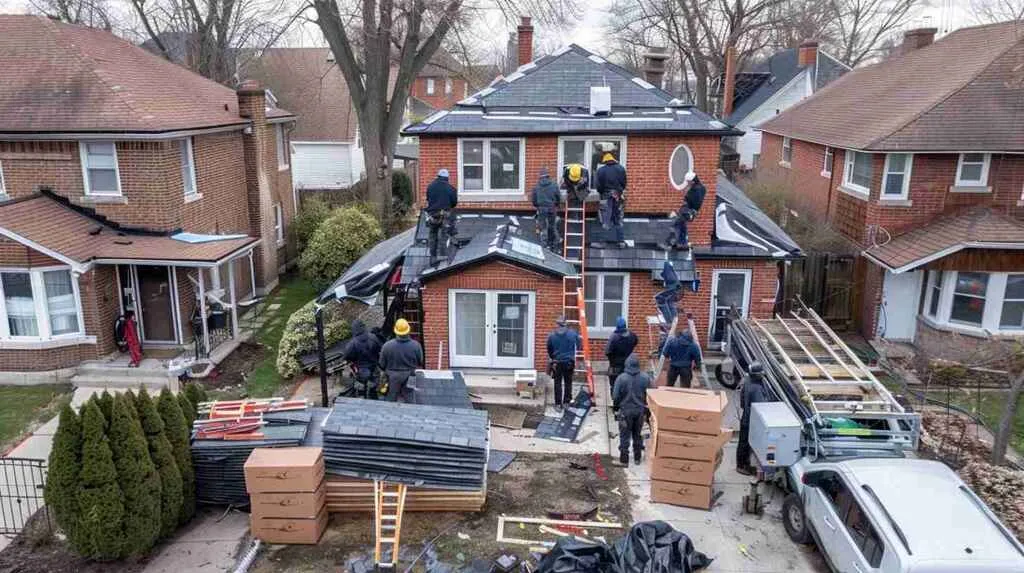
Replace Roof Decking and Shingles Queens NY – Full Cost Guide | Free Quotes
Sticker shock is real when you hear this number: in Queens right now, most homeowners end up between $11,000 and $24,000 to replace both shingles and any bad roof decking on an average-sized house. That wide range depends mainly on hidden decking conditions and whether you’re sitting on a 1950s cape or a modern two-story-and honestly, you won’t know which end of that range you’re on until someone opens the roof.
Sticker Shock: Real Queens Prices to Replace Shingles and Decking
On 43rd Avenue last fall, I walked up to what looked like a straightforward shingle job-owner wanted basic architectural shingles, no steep slopes, no chimneys giving us trouble. We quoted him $9,200 for the tear-off and new roof. By lunch on day one, we’d pulled back the first section and found that someone years ago had patched half the front slope with random scrap plywood from shipping crates-different thicknesses, gaps big enough to see the attic insulation, even a banana company logo stamped on one board. I had to stop everything, take photos, and bring the homeowner outside for the driveway conversation nobody wants: “Your ‘simple roof’ just became a decking rebuild on this entire slope, and here’s what that costs.” If this was my mother’s roof, I’d tell her the same thing I told him: you can’t put $8,000 worth of shingles on top of $2 worth of fruit-crate plywood and expect it to hold.
Here’s the blunt truth nobody likes to hear about decking costs: the line item that scares people more than the shingles is the per-sheet replacement charge when we find rot. In Queens, every rotten 4×8 sheet of plywood or OSB we pull and replace runs you about $85 to $140 installed, depending on thickness and how hard it is to get materials up to your roof. On older houses in Bayside, Forest Hills, and Jackson Heights-where you’ve got plank decking instead of sheets-that number jumps because we’re cutting, fitting, and sistering boards by hand. That’s why I always quote decking as a range: “If we find 10 bad sheets, add $1,200; if we find 40, you’re looking at closer to $4,800.” Nobody likes hearing “it depends,” but that’s the only honest answer before we peel back your shingles and see what twenty years of nor’easters and ice dams did to the wood underneath.
Typical Queens Roof + Decking Replacement Scenarios
| Scenario | Roof & Decking Description | Approx Roof Size (sq ft) | Shingle Type | Estimated Total Cost Range |
|---|---|---|---|---|
| Small Cape, Solid Deck | 1950s cape, OSB decking mostly solid, 3-5 bad sheets near valleys | 1,200 sq ft | Standard 3-tab asphalt | $8,500 – $11,000 |
| Typical Two-Story, Moderate Rot | 1970s colonial, one layer shingles, 15-20 sheets rotted from old ice dams | 1,800 sq ft | Architectural shingles (25-year) | $13,500 – $17,200 |
| Large House, Heavy Damage | 2,400 sq ft colonial, two shingle layers, widespread rot, mixed plank/OSB deck | 2,400 sq ft | Premium architectural (30-year) | $19,000 – $24,000 |
| Jackson Heights Walk-Up | Flat-to-low-slope multi-family, old plank decking with patchwork repairs, 30% needs replacement | 1,600 sq ft | Modified bitumen or low-slope shingles | $14,500 – $18,800 |
| Forest Hills Tudor, Full Rebuild | 1930s Tudor with original plank decking, needs complete tear-down to joists and rebuild | 2,000 sq ft | High-end architectural or designer shingles | $21,000 – $28,500 |
Queens Roof Replacement Cost Fast Facts
Think of Your Roof Deck Like Bones Under Your Skin
Think of your roof deck like the bones under your skin: shingles are just the visible layer, but the decking underneath is what actually holds everything up and keeps your house from flexing like a trampoline every time someone walks on the roof. In Queens, where we get hammered by nor’easters, wind-driven rain, and ice dams that sit on your eaves for weeks, hidden moisture is what turns a $12,000 roof into a $19,000 project. I see it constantly in Bayside, Forest Hills, and Jackson Heights-neighborhoods with beautiful old wood-frame houses built in the ’30s through the ’60s where original plank decking has been hiding slow rot for a decade. You pull back one section of shingles and find black, spongy boards that crumble when you push on them, and suddenly the homeowner realizes that “little leak by the chimney” wasn’t so little after all.
One cold, windy November morning in Bayside, we started a tear-off on a cape where the owner swore the decking was “fine, just had a little leak by the chimney.” By 10 a.m., my guy had stepped through a soft spot, and when I pulled the shingles back, I found black, spongy roof boards from the ridge halfway down the slope-years and years of slow ice dam damage that nobody caught because it was all hidden under two layers of shingles. I remember standing there with my coffee going cold, calling the homeowner out into the driveway and showing him my tape measure sinking into the wood like it was a wet sponge, so he knew I wasn’t making this up or padding the bill. That job went late into the night with work lights, and we ended up replacing about 60% of that slope’s decking. I still use those photos when I’m explaining to new clients how long-term hidden moisture-the kind that starts with one winter of ice dams and multiplies over five or ten years-can absolutely explode your decking costs once we finally open the roof and see what’s really going on under there.
Cost Impact of Different Decking Conditions in Queens
| Decking Condition | Typical Issues Found | Extra Labor (crew hours) | Extra Material (sheets/board feet) | Added Cost Range |
|---|---|---|---|---|
| Mostly Solid | 3-8 sheets soft near valleys, eaves, or old flashing areas; rest is firm and dry | +4 to +8 hours | 5-10 sheets of 1/2″ or 5/8″ plywood | +$800 – $1,400 |
| Moderate Rot | 20-35% of deck is spongy or delaminated; widespread moisture damage from years of leaks or poor ventilation | +12 to +20 hours | 20-35 sheets, sometimes mixed with board-foot plank replacement | +$2,800 – $5,200 |
| Severe Rot / Patchwork | 50%+ of deck is compromised; multiple generations of bad patch jobs, mixed materials, structural concerns at joists | +24 to +40 hours | Full deck rebuild: 40-70+ sheets or equivalent board feet, plus joist sistering in some areas | +$6,000 – $11,000 |
Hidden Decking Damage from Long-Term Leaks and Ice Dams
Don’t walk on a roof that feels soft or spongy-you’re not standing on solid wood anymore, you’re standing on rot. And don’t trust an old patch job just because you had “a guy fix it” five years ago; if he didn’t replace the decking underneath, he just buried the problem under new shingles. In Queens, after a bad winter or a nor’easter that sits on your house for two days, a “small leak” that drips into your attic once isn’t small-it’s the visible tip of moisture that’s been soaking into your deck for months or years. Ice dams are the worst culprits: they force water back up under your shingles and into the wood, and by the time you see a stain on your ceiling, you’ve often got 10 or 20 square feet of spongy decking already rotting away up there.
The most expensive part of your roof is the rot you don’t find until the shingles are already in the dumpster.
If We Were Standing in Your Driveway, I’d Draw You This on a Pizza Box
If we were standing in your driveway right now, I’d grab a pizza box or a takeout menu and sketch you a fast side-view of your roof-just a simple triangle with layers. At the top, you’ve got your shingles (the part everyone sees and obsesses over), then right under that is your underlayment and ice-and-water shield (the waterproof barrier that actually stops leaks), then your roof decking (the plywood or planks nailed to your rafters), and finally the framing itself-the 2×6 or 2×8 rafters that hold the whole thing up. When I first step into your attic, the three things I’m hunting for with my flashlight are: dark stains or watermarks on the underside of the decking (that’s old leaks), any soft or sagging areas when I push up on the boards (that’s active rot), and daylight peeking through cracks or knotholes (that’s your decking failing or gapping). Those three clues tell me before we ever tear off a single shingle whether your “roof job” is going to stay on budget or blow past it, and that’s why I always bring my flashlight and take photos in the attic before I even give you a final number-I’m not guessing, I’m showing you exactly what we’re dealing with down to the board.
Step-by-Step: How a Queens Shingle + Decking Replacement Actually Happens
✅ What’s Included in a Proper Shingles + Decking Replacement
Complete tear-off of all existing shingles, felt, and flashing down to bare decking
Rotten decking replacement with new plywood or plank to match your existing thickness and framing
Ice & water shield installed at eaves, valleys, and all roof penetrations per code
Synthetic underlayment covering the entire roof deck for superior waterproofing
All new flashings-drip edge, step flashing, valley metal, and pipe boots replaced
Ventilation check and adjustments to ridge vents, soffit vents, or gable vents for proper attic airflow
Full haul-away and cleanup-dumpster, magnet sweep, gutter blow-out, zero mess left behind
The Number That Really Scares People Isn’t the Shingles-It’s This One
The number that really scares people isn’t the shingles-it’s this one: $85 to $140 per sheet of rotten decking, and on a typical Queens roof with moderate rot, you might be looking at 20 to 35 sheets that need replacing. That’s an extra $2,800 to $5,200 on top of your shingle price, and it stacks up fast-especially on multi-layer tear-offs where someone just kept roofing over problems for decades. One Saturday at 6 a.m., right after a big nor’easter, I got called to a leaking top-floor unit in a rent-stabilized building in Elmhurst. When we opened the roof, we found three layers of shingles and two different generations of plank decking patched over with OSB, all soaked through; every time someone “saved money” by skipping the right decking repair, they just buried the problem deeper and made the next guy’s job-my job-twice as expensive. I sat in the stairwell with the landlord and broke down the numbers on my phone: what it would cost to spot-patch the worst boards again and limp along for another five years, versus strip everything down to the joists and rebuild the deck properly with new plywood and proper flashing. He was sweating the cost, but I told him the same thing I’d tell anyone: you can’t keep putting band-aids on rot and expect it to hold up through another ten Queens winters. He chose the full rebuild, and a year later he told me it was the first winter in a decade he didn’t get a single roof complaint from his tenants.
Here’s my personal rule of thumb, and it’s what I’d tell my own mother if she called me tomorrow about her roof: if more than 30% of your decking is soft, spongy, or shows black staining when we open it up, you’re better off doing a full deck replacement right now instead of patching and praying. The math is simple-spot-patching 15 or 20 sheets might save you $1,500 today, but if the rest of your deck is the same age and has been sitting under the same leaky roof for the same 20 years, you’re just buying yourself three to five more years before the next section fails and you’re tearing the roof open again. At that point, you’ve paid for two tear-offs, two dumpsters, two permit fees, and two rounds of labor, and you’re still left with a patchwork deck instead of a solid rebuild. When I opened that Elmhurst roof and saw three generations of “fixes,” I knew the landlord had already spent more over the years doing it cheap than he would’ve spent doing it right the first time-and that’s the conversation I have in every driveway when someone’s staring at a big decking bill and wondering if they can cut corners.
Spot-Patching Bad Decking vs Full Deck Replacement
| Option | Pros | Cons | Best For |
|---|---|---|---|
| Spot-Patch Only Visible Bad Sections |
• Lower upfront cost • Faster project (fewer labor hours) • Gets you a new roof now without major sticker shock |
• Leaves aging deck in place that may fail in 3-7 years • You’ll pay for another tear-off sooner • Patchwork deck = patchwork warranty confidence |
Homes where less than 25% of decking shows rot, roof is newer (under 15 years), and homeowner plans to sell within 5-7 years |
| Full Deck Replacement |
• Brand-new solid base-no hidden rot left behind • One tear-off, one project, done right for 25+ years • Better warranty coverage and resale value • Peace of mind through Queens winters |
• Higher upfront cost (can add $4k-$9k depending on size) • Adds 1-2 days to project timeline • Requires bigger financial decision now |
Homes with 30%+ rot or widespread moisture damage, older decking (20+ years), frequent leak history, or homeowners planning to stay 10+ years |
Should You Patch Your Deck or Replace It Completely?
30% or more: Full deck rebuild recommended ✅
20+ years old: Full deck rebuild recommended ✅
Yes, chronic leaks or damage: Full deck rebuild recommended ✅
Staying 10+ years: Full deck rebuild for long-term peace of mind ✅
Before You Call for a Quote in Queens
Before you call for a quote in Queens, grab your phone and take some pictures-inside your attic if you can get up there safely, any water stains on your ceilings, and the outside of your roof from the street so we can see the condition and how many layers you might have. Have a rough idea of when your current roof was installed, whether you’ve had any leaks (and where), and if you’ve noticed soft spots when you’ve walked on it. When you call Shingle Masters, I’ll ask you those questions in our driveway-conversation style, and I’ll give you a ballpark range over the phone before I even schedule the site visit-because I’m not interested in wasting your time or mine if we’re not in the same universe on budget.
What to Check and Gather Before Calling Shingle Masters
Queens Decking and Shingle Replacement Questions Luis Hears All the Time
How much extra will I pay per sheet of bad decking you find?
Can your crew work around tenants if I have a multi-family building?
How does weather affect your schedule for decking and shingle jobs?
Do I need a permit to replace my roof and decking in Queens?
What happens if you open my roof and find way more rot than expected?
Why Queens Homeowners Call Shingle Masters for Decking-Heavy Roofs
When you’re ready to get a real number on what it’ll cost to replace your shingles and fix the decking underneath, call Shingle Masters and ask for a Queens-specific inspection and written estimate that spells out decking costs as ranges-not surprises. Luis will walk you through photos and options like he would if it were his own mother’s roof, and you’ll know exactly what you’re paying for before anyone climbs your ladder.