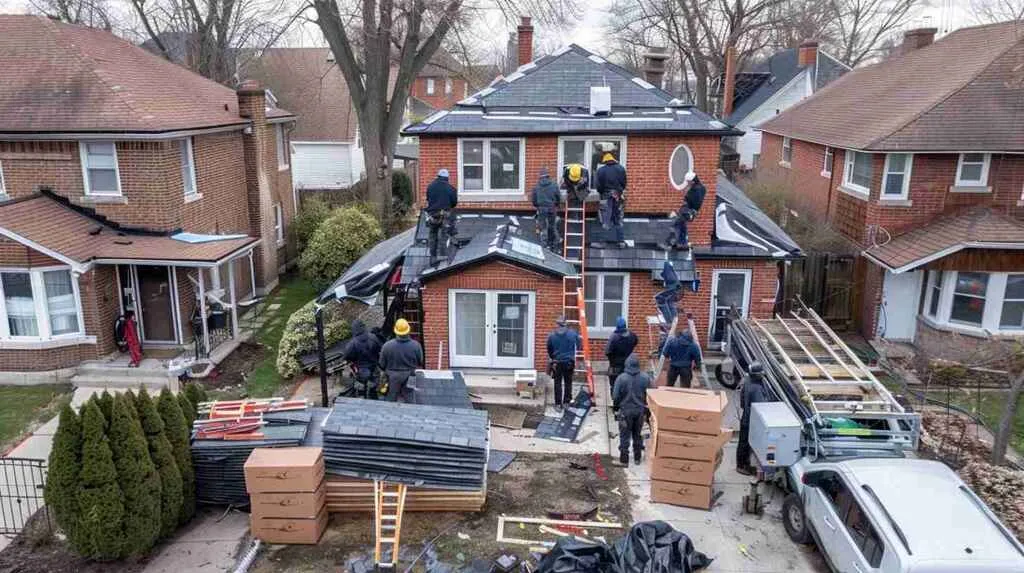
Split Pipe Boot Shingle Roof Queens NY – When and How Used | Free Estimates
Sideways rain is what usually gets your attention. A proper split pipe boot install on a shingle roof in Queens runs between $350 and $750, depending on how high your roof is, how steep the pitch is, whether your pipe’s one inch or three inches wide, and whether the old boot’s just cracked or sitting in a puddle of rotted shingles underneath.
What a Split Pipe Boot Costs on a Shingle Roof in Queens (and Why)
On a typical Queens two-family with a standard asphalt shingle roof, the first thing I look at is the pipe sticking through your shingles-height, diameter, and how ugly the existing boot looks. A straightforward replacement on a one-story ranch in a neighborhood like Glendale might land around $350 if I can park the truck next to the house, the pitch isn’t terrifying, and there’s no storm bearing down. But the same job on a three-family in Jackson Heights with tight side yards, a steep pitch, and shingles from the Clinton administration? That’s pushing toward $600 or $750 because setup takes longer, I’ll probably have to set up ladders on both sides, and I’m replacing more material once I peel back the old work. Think of your pipe boot like a rubber gasket on a car’s windshield-if that seal fails, it doesn’t matter how strong the glass is, water’s coming in around it. One February morning, around 7:30 a.m., I was on a two-story in Middle Village with the wind cutting through three layers of clothing, trying to fix a leak over a baby’s room. The homeowner swore it was the window, but once I got up there, I found a brittle rubber pipe boot split right along the backside where nobody could see from the ground. I couldn’t slide a traditional boot over it without tearing half the shingles, so I used a split pipe boot, opened it like a clam shell, wrapped it around the existing pipe, and sealed it. The dad texted me that night saying for the first time in weeks they didn’t have a bucket in the crib.
What you’re really paying for isn’t just a hunk of rubber. You’re paying for safe access, proper lifting of shingles so they don’t crack when it’s 35 degrees outside, flashing that gets tucked under the uphill shingles not over them, a boot that’s actually sized for your pipe diameter, and sealant applied in the right spots-not just globbed everywhere like frosting. I inspect from the attic first if I can, looking for daylight around the pipe or stains on the rafters, then I go topside to see if the boot’s cracked, hardened, or stretched thin. If the shingles are otherwise solid and the issue is isolated to the boot, a split pipe boot makes sense. If I see rot or a big area of curling shingles, we’re into a larger patch job, and that’s when the estimate climbs into the $900-$1,200 range because I’m not just swapping rubber-I’m rebuilding the deck underneath it.
Queens is tough on roofs. Wind off the East River can drive rain horizontal, freeze-thaw cycles in winter crack brittle boots, summer UV bakes them into chips, and most of the housing stock in neighborhoods like Corona or Forest Hills was built with boots that are now 20, 25, even 30 years old. The average boot lasts around 15 to 20 years, but if yours sits on the south-facing slope in full sun, you’re lucky to hit 12 before it starts curling. That’s local knowledge I wish more handymen understood before they caulk over a problem and call it fixed.
Typical Split Pipe Boot Pricing Scenarios – Queens, NY
All estimates assume standard asphalt shingle roofs in typical residential conditions. Emergency or same-day pricing may add 15-25%.
| Scenario | Roof / Pipe Details | What’s Included | Estimated Range |
|---|---|---|---|
| Standard One-Story | 1.5″ PVC vent, easy access, flat to moderate pitch | Remove old boot, install split boot, seal, re-weave shingles | $350-$450 |
| Two-Story with Tight Access | 2″ cast iron pipe, steep pitch, narrow side yard | Ladder setup front & back, boot replacement, shingle repair | $500-$650 |
| Three-Family / Multi-Story | 3″ vent stack, high roof, old shingles around pipe | Staging, split boot, replace several damaged shingles nearby | $600-$750 |
| Emergency Same-Day Call | Any pipe, active leak, storm forecast next day | Fast response, split boot install, temporary sealing if needed | $450-$850 |
| Boot + Deck Rot Repair | Pipe boot failed years ago, plywood deck rotted around base | Cut out rotted deck, replace plywood, new boot, reflash & shingle | $850-$1,250 |
Quick Facts – Split Pipe Boot Service in Queens
| Typical Price Range | $350-$750 for most Queens single- and two-family homes |
| Average On-Site Time | 1.5-3 hours including setup, install, and cleanup |
| Service Area Focus | All Queens neighborhoods-Jackson Heights, Forest Hills, Corona, Middle Village, Glendale, and more |
| Warranty on Repair | 2-year labor warranty, manufacturer warranty on boot material |
When You Actually Need a Split Pipe Boot Instead of Tearing Up Shingles
Here’s my honest opinion: if your pipe boot is more than 12-15 years old and you’re seeing stains on the ceiling below, you’re gambling every time it rains. The obvious signs are brown ceiling stains directly under a bathroom or kitchen vent, feeling a draft around the pipe when you’re in the attic, seeing daylight or sky around the base from below, or noticing the rubber boot itself is cracked, curled, or has thick rings of dried caulk that somebody patched over and over like bad frosting. One July afternoon in Corona, it was about 92 degrees and the shingles were practically melting under my knees when I got called by a landlord who said his third-floor tenant had “mystery water” in the bathroom ceiling. Turned out, another contractor had installed a new PVC vent pipe but never updated the old, undersized boot-they just cut the rubber and stretched it. The cut kept widening. I ended up cutting back a few shingles, removing that hacked-up boot, and installing a split pipe boot rated for the larger pipe size, then re-weaving the shingles around it. That one job convinced me how often split boots save you from re-roofing an entire section just to fix one penetration.
Now, let’s zoom out a second and talk about why a split pipe boot even exists. Standard one-piece boots only work if you can slide them down over the top of the pipe-which means if the pipe’s tall, has a cap bolted on, or got upgraded to a bigger diameter years after the roof was done, you’re stuck. You either tear off a ton of shingles to get clearance, or you use a split boot that opens along one side like a hinge, wraps around the pipe from the side, and locks back together. It’s like changing a gasket around a plumbing pipe without cutting the whole line. In Queens, especially in taller three-family buildings where side yards are six feet wide and the pipes stick up three feet above the roof deck, a split boot is often the only practical answer. Tight access makes shingle removal risky and slow, so the split design lets me work smaller, safer, and faster without compromising the seal.
Decision Tree: Should You Use a Split Pipe Boot?
START: Do you see ceiling stains directly below a roof vent or pipe penetration?
→ YES: Is the pipe boot more than 12-15 years old, or do you see visible cracks in the rubber?
→ YES: Can you slide a standard one-piece boot over the top of the pipe easily (no cap, short pipe, no obstructions)?
✓ NO obstructions? Standard boot or split boot will both work-split boot is faster if shingles are brittle.
⚠ YES obstructions (tall pipe, cap, satellite mount)? Split pipe boot is likely the right fix.
→ NO (boot looks okay): Are the shingles around the pipe lifted, damaged, or badly deteriorated?
✗ YES damaged shingles? Full boot + shingle work needed. Call for an estimate.
✓ NO damage? Boot is probably fine-check attic ventilation and flashings elsewhere.
→ NO stains yet: But the boot looks cracked or very old?
⚠ Get a professional inspection soon. Catching it early = cheaper fix, no interior damage.
⚠ Call Shingle Masters ASAP
- • Water is actively dripping from the ceiling or light fixture
- • You see sagging or bubbling drywall around the stain
- • Heavy rain or snow forecast in the next 24-48 hours
- • You can see daylight around the pipe from inside the attic
✓ Schedule Within a Week
- • Small, old brown stain that hasn’t grown in weeks
- • Slight dampness in attic after a big storm, but no drip
- • Boot looks cracked or curled but hasn’t leaked yet
- • You’re planning other roof work and want to bundle repairs
$2,000 later, that’s what most people end up paying to fix water-damaged ceilings, reframe studs, and repaint after ignoring a $450 split pipe boot replacement for two years. You’ll save ten times the repair cost if you fix the boot the week you see the first stain instead of waiting until the drywall caves in.
How I Install a Split Pipe Boot on a Queens Shingle Roof
I still remember the first time I used a split pipe boot; the old-school guy I worked for told me it was “cheating” until he saw we saved the whole slope from being torn apart. The strangest one was a Sunday evening call in Forest Hills during a rainstorm, from an elderly lady who said it “only leaked when the Mets were losing.” I laughed, but when I checked, the timing was basically whenever we got heavy, wind-driven rain from the west. Up on her roof, I found a galvanized vent pipe somebody had painted shut, with an ancient rubber boot cracked on the uphill side. Because of a satellite dish and some tight clearances, there was no way to slide a standard boot over the top. I cut in a split pipe boot, flashed it under the shingles, and sealed it to the pipe without touching the dish mount. She called me a few weeks later to brag that the Mets blew another game and her ceiling stayed dry. That’s the whole reason split boots exist-obstacles like painted caps, satellite mounts, short clearances, or pipes that got upsized after the roof was built make standard boots impossible without tearing up half a slope.
Here’s what actually happens when I do the install right. I carefully lift the shingles around and above the pipe-usually three or four rows uphill-without cracking them, especially if it’s cold or they’re older. I pull out the old boot, which is usually a brittle, cracked mess held together by prayer and caulk. Then I open the split boot like a clamp, slide it around the pipe from the side, and close it back up so the seam locks tight. The base flange goes under the uphill shingles and over the downhill ones, just like water flows-uphill stuff always tucks under, downhill stuff always lays on top. I fasten it with roofing nails through the flange, never through the rubber collar, and I seal the split seam and the pipe joint with high-grade roofing sealant, not the tube you buy at a hardware store. Finally, I re-weave the shingles back into place, making sure each one overlaps correctly and nothing’s lifting or gapped. It’s like swapping a rubber gasket around a pipe fitting-you’re not replacing the whole assembly, just the seal. Here’s my insider tip: if you see thick beads of caulk globbed around a pipe boot like cake frosting, it’s usually hiding a failing boot, and you should plan for a proper split boot or full replacement instead of another round of caulk.
Step-by-Step: How a Split Pipe Boot Gets Installed
-
1
Setup & Safety: Position ladders, set up roof jacks if the pitch is steep, and lay out tools and materials where I can reach them without walking all over the shingles. -
2
Lift Shingles Carefully: Use a flat bar to gently lift the shingles above and around the pipe-typically three to four rows uphill-without cracking brittle tabs, especially in cold weather. -
3
Remove Old Boot: Pull out the old, cracked boot and inspect the pipe and deck underneath for rust, rot, or other damage that needs fixing before the new boot goes on. -
4
Fit the Split Boot: Open the split boot along its hinge, wrap it around the pipe from the side, and close it so the seam locks together-no need to slide anything over the top. -
5
Fasten & Seal: Nail through the base flange (not the rubber collar), tuck the uphill edge under the lifted shingles, seal the split seam and pipe joint with roofing-grade sealant, and check for gaps. -
6
Re-Weave Shingles & Inspect: Lay the shingles back down in proper overlap order, press them flat, and do a final walk-around to make sure everything’s sealed, flat, and ready for the next storm.
⚠ DIY Risks Around Roof Pipes & Boots
- Breaking Brittle Shingles: Older asphalt shingles crack like potato chips when you try to lift them in cold weather or if they’re sun-baked-one wrong move and you’re buying a dozen replacement tabs.
- Creating Uphill Gaps: If you don’t tuck the boot flange under the uphill shingles, water flows straight into the gap and down into your attic-it’s the single most common mistake I see from DIY jobs.
- Relying on Surface Caulk: Globbing caulk around the pipe base might stop a drip for six months, but it’s not a real seal-UV breaks it down fast, and you’ll be back up there in a year with a worse leak and rotted deck underneath.
Extra caution: Steep or high roofs on Queens two- and three-family homes are especially dangerous without proper staging and fall protection-this isn’t a “weekend warrior” project if your roof’s over 25 feet up or steeper than 6/12 pitch.
How Long Split Pipe Boots Last on Queens Roofs (and Simple Maintenance)
The blunt truth is most leaks around pipes aren’t dramatic failures; they’re slow, sneaky drips from a boot that’s been cracked for years. A quality split pipe boot in Queens should give you 15 to 20 years if it’s installed right and your roof isn’t baking in full southern sun every day. Think of your pipe boot like the rubber gasket on a car’s windshield-if that seal fails, it doesn’t matter how strong the glass is, water’s coming in around it-and shingles are your roof’s tires protecting everything underneath. But UV from the sun hardens rubber over time, winter freeze-thaw cycles crack it, and wind-driven rain from storms off the East River tests every seal. In older Queens neighborhoods like Jackson Heights, Middle Village, and Corona, I see homes with 20-, 25-, even 30-year-old boots still sitting on the roof, long past their expiration date, just waiting for one big storm to turn a small crack into a ceiling disaster.
Maintenance is mostly about catching problems early, not constant tinkering. Once a year-ideally in the fall before winter hits-grab a pair of binoculars and look at your roof from the ground, checking each pipe boot for visible cracks, curling edges, or thick caulk rings that scream “someone patched this three times already.” After any major storm, especially wind-driven rain, pop into your attic with a flashlight and look for new water stains on the rafters or fresh dampness around the pipe penetrations. Now, let’s zoom out a second and understand that you’re not fixing anything during these checks-you’re just watching for the signs that tell you it’s time to call before a $450 boot job becomes a $2,000 ceiling repair. If your boot’s hitting the 12- to 15-year mark and you see even minor cracking, schedule a replacement. Don’t wait for the leak.
Maintenance Timeline for Pipe Boots on Queens Shingle Roofs
| When | What to Do | Why It Matters |
|---|---|---|
| Every Year | Check boots from ground with binoculars in fall; look for cracks, curling, or thick caulk patches | Catches visible problems before they turn into leaks; best done before winter |
| Every 5-7 Years | Have a roofer inspect boots up close during any scheduled roof work or gutter cleaning | Confirms condition before minor cracks become major leaks; easy add-on to other service |
| At 12-15 Years | Plan to replace boots even if they look okay-rubber degrades from UV and weather over time | Proactive replacement costs less than emergency leak repair plus interior ceiling damage |
| Immediately | Call for inspection if you see new ceiling stains, attic dampness, or visible boot damage from ground | Active leaks spread fast-every day you wait adds to interior damage and mold risk |
Myth vs. Fact: Pipe Boot & Roof Leak Misconceptions
| ❌ Myth | ✓ Fact |
|---|---|
| Caulk alone can stop a pipe leak for years if you use enough of it. | Caulk is a temporary band-aid that UV and weather break down in 6-18 months; a proper boot with correct flashing is the only real fix. |
| If it only leaks during big storms or wind-driven rain, the problem is probably the window, not the roof. | Wind pushes water uphill under shingles and through tiny boot cracks that gravity alone wouldn’t find-that’s textbook pipe boot failure, not a window issue. |
| Pipe boots last as long as the shingles around them, so if your roof is 10 years old, the boot is fine. | Rubber degrades faster than asphalt-boots typically fail at 12-15 years even if shingles are rated for 25-30, especially on south-facing sun-baked slopes. |
| Any handyman who can patch drywall can fix a leaking pipe boot-it’s just rubber and caulk. | Proper boot work requires knowing shingle weaving, flashing order (uphill under, downhill over), and using the right sealants-bad installs cause bigger leaks within a year. |
What to Check Before You Call and Common Questions
Before you pick up the phone, take five minutes to look at a few things-it doesn’t require a ladder or climbing on the roof, and it helps me figure out exactly what’s going on so I can bring the right materials and give you an accurate price over the phone instead of guessing. Grab a flashlight, walk into your attic if you can, and look for water stains on the rafters or fresh dampness around where the pipe goes through. Then step outside, look up at your roof from the driveway or street, and try to spot the pipe-note if you see obvious cracks, heavy caulk buildup, or curled rubber edges. If you’ve got a rough idea when the roof was done or the boot was last replaced, that’s gold.
Quick Checklist: Before You Call Shingle Masters
-
✓
Where’s the stain? Directly below a bathroom vent, kitchen exhaust, or general roof vent? Note the room and ceiling location. -
✓
How big is it? Dime-sized spot, dinner-plate circle, or spreading across multiple ceiling tiles? Size tells me urgency. -
✓
Old stain or fresh water? Brown and dry means it’s been leaking a while; wet or dripping means it’s active now. -
✓
Does it leak every storm? Or only when it’s windy, raining sideways, or from a certain direction? Wind-driven = classic pipe boot symptom. -
✓
Rough age of roof or boot? Even a ballpark “the roof’s about 15 years old” or “we had it done in 2008” helps me know what I’m walking into. -
✓
Photos from the ground? If you can safely snap a pic of the pipe and boot from your driveway, text it-I can often tell you what’s wrong before I even visit.
Common Questions from Queens Homeowners
Can you fix this without replacing my whole roof?
Absolutely. A split pipe boot repair is a localized fix-I lift a few rows of shingles around the pipe, swap the boot, seal it, and re-weave everything back. If your shingles are otherwise in decent shape and the deck isn’t rotted, the rest of the roof stays untouched. That’s the whole point of a split boot: surgical repair without tearing up the entire slope.
How fast can you get to my house in Queens?
For active leaks or urgent situations, I aim for same-day or next-day visits anywhere in Queens-Jackson Heights, Corona, Forest Hills, Middle Village, Glendale, you name it. For non-emergency inspections, I typically schedule within three to five business days. If a big storm’s coming and you’re already seeing drips, call me right away and I’ll prioritize it.
Will a split boot look obvious or different from the street?
Nope. Once it’s installed and the shingles are back in place, a split pipe boot looks identical to a standard one-piece boot from ground level-same black rubber collar around the pipe, same low profile. The “split” seam faces away from view most of the time, and after a few months of weather, you can’t tell which type was used unless you’re standing right on top of it with a flashlight.
What if the pipe itself is rusted or loose?
Good question. If the pipe’s rusted through or wobbling, a new boot won’t solve the problem-you’ll need a plumber to replace or stabilize the pipe first, then I come in and do the boot and flashing work around it. I’ll tell you honestly during the inspection if the pipe’s the issue, and I can coordinate timing with your plumber so you’re not paying for two separate roof visits.
Do you work on weekends or after storms?
Yes, especially for emergency leak calls. I know most people work Monday through Friday and can’t sit around waiting for a roofer, so I block out Saturday mornings for urgent jobs and inspections. After major storms, I prioritize active leaks over routine maintenance, so if your ceiling’s dripping, you’ll get bumped to the front of the line even if it’s a Sunday evening.
Why Queens Homeowners Trust Shingle Masters
| Licensed & Insured | Fully licensed NYC roofing contractor with liability and workers’ comp coverage protecting your property and our crew on every job. |
| 19+ Years Experience | Been fixing split pipe boots, flashings, and penetration leaks across Queens since 2006-from single-family homes to three-family walk-ups. |
| Fast Response in Queens | Same-day or next-day service for emergency leaks anywhere in Queens; non-urgent visits typically scheduled within 3-5 business days. |
| Written Warranty | 2-year labor warranty on all split pipe boot installations, plus manufacturer warranty on materials-everything spelled out in writing before we start. |
When I come to your house in Queens, the first question I’ll ask is, “Where do you see the water-exactly?” because that tells me which penetration to suspect. Then I’ll walk you through what I find, sketch it out on the back of my estimate sheet so you can see what’s happening on your roof, and give you a clear, written price before I lift a single shingle. Call Shingle Masters for a free, no-pressure estimate on split pipe boot work or any leak inspection anywhere in Queens-Forest Hills, Jackson Heights, Corona, Middle Village, Glendale, wherever you are, I’ll get there fast and fix it right.